
Outline
- Why Documentation Matters When Buying Polixetonium Chloride
- Certificate of Analysis (COA)
- Safety Data Sheet (SDS/MSDS)
- Technical Data Sheet (TDS)
- Product Specification Sheet
- Third-Party Testing Reports
- Certificate of Origin (COO)
- Packing List and Commercial Invoice
- Transport and Dangerous Goods Documentation
- How Buyers Can Verify Supplier Documents
- Common Documentation Mistakes Buyers Should Watch For
- Final Thoughts
- FAQs
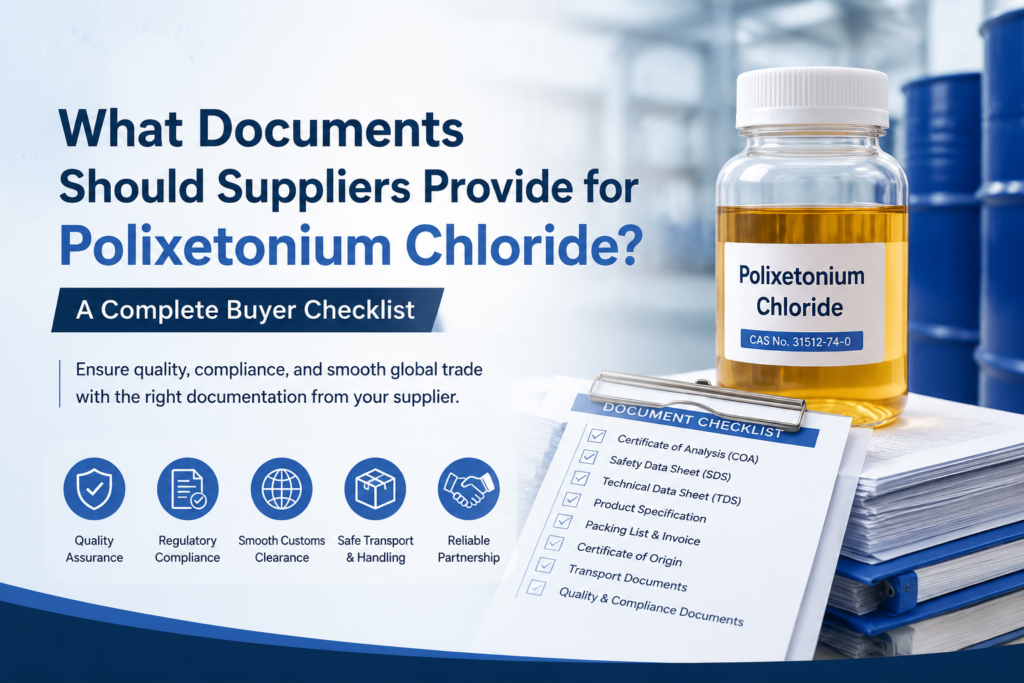
What Documents Should Suppliers Provide for Polixetonium Chloride?
Buying Polixetonium Chloride isn’t simply about comparing prices or checking active content. Experienced buyers know that reliable documentation is just as important as the product itself.
Imagine receiving a shipment that clears customs smoothly, passes incoming inspection, and goes straight into production. Now imagine the opposite—a missing Safety Data Sheet delays customs clearance, or a Certificate of Analysis doesn’t match the product label. Suddenly, what looked like a good deal becomes an expensive headache.
That’s why professional suppliers prepare far more than just the chemical itself.
In this guide, we’ll walk through the essential documents that reputable Polixetonium Chloride suppliers should be able to provide, explain why each one matters, and share a few practical tips to help you verify them before placing an order.
Why Documentation Matters When Buying Polixetonium Chloride ?
Documentation serves several important purposes throughout the purchasing process.
It helps buyers:
- Confirm product quality
- Verify product identity
- Meet import requirements
- Support internal quality management systems
- Ensure safe transportation and storage
- Trace production batches if any issues arise
For manufacturers using Polixetonium Chloride in water treatment formulations, cooling water systems, metalworking fluids, or industrial biocide applications, proper documentation also simplifies supplier qualification and annual audits.
In other words, paperwork isn’t just paperwork—it reflects how seriously a supplier manages quality.
Certificate of Analysis (COA)
The Certificate of Analysis (COA) is probably the first document most buyers request, and for good reason.
A COA confirms that the shipped batch has been tested and complies with the agreed specification.
A typical COA for Polixetonium Chloride may include:
- Product name
- CAS No. 31512-74-0
- Batch number
- Manufacturing date
- Expiration or recommended retest date
- Appearance
- Active content
- Total solids (if applicable)
- pH value
- Density
- Viscosity
- Test methods (optional)
- Quality control approval
Every shipment should have its own batch-specific COA rather than a generic template.
If a supplier sends exactly the same COA every time, it’s worth asking additional questions.
For a closer look at quality specifications, you may also enjoy reading Quality Standards for Polixetonium Chloride.
Safety Data Sheet (SDS/MSDS)
The Safety Data Sheet (SDS)—previously called the MSDS—provides information about safe handling, storage, transportation, and emergency measures.
A complete SDS generally includes:
- Product identification
- Hazard identification
- Composition information
- First-aid measures
- Fire-fighting measures
- Accidental release procedures
- Handling and storage recommendations
- Exposure controls
- Physical and chemical properties
- Stability and reactivity
- Toxicological information
- Ecological information
- Disposal considerations
- Transport information
- Regulatory information
Many countries require an SDS before chemicals can be imported or used in industrial facilities.
Even if customs doesn’t request it, your warehouse or safety department probably will.
Technical Data Sheet (TDS)
While the SDS focuses on safety, the Technical Data Sheet (TDS) explains product performance.
Think of it as the product’s technical introduction.
A TDS typically contains:
- Product description
- Typical properties
- Recommended applications
- Typical dosage ranges
- Compatibility information
- Storage recommendations
- Shelf life
- Packaging options
Unlike the COA, the TDS describes the standard product rather than an individual production batch.
Many purchasing engineers compare TDS documents from several suppliers before requesting samples.
Product Specification Sheet
Some buyers also request a formal Product Specification Sheet.
Although it may look similar to a TDS, its purpose is slightly different.
The specification sheet defines the acceptance limits agreed between buyer and supplier.
For example:
| Property | Typical Specification |
|---|---|
| Appearance | Amber transparent viscous liquid |
| Active Content | 58–61% |
| pH (10% solution) | 6.0–8.0 |
| Density | 1.148–1.153 g/cm³ |
| Viscosity | 150–400 mPa·s |
This document often becomes part of the purchasing contract.
Third-Party Testing Reports
Professional suppliers sometimes provide independent laboratory reports upon request.
These reports may include additional testing beyond routine quality control, such as:
- Molecular weight characterization
- Toxicological studies
- Stability evaluation
- Performance testing
- Compatibility studies
Third-party reports aren’t always required, but they can provide extra confidence when qualifying a new supplier or entering a regulated market.
Some suppliers also conduct periodic verification testing through accredited independent laboratories to confirm the accuracy of their routine quality control results.
For more information about quality verification, see Laboratory Testing Methods for Polixetonium Chloride.
Certificate of Origin (COO)
A Certificate of Origin confirms where the product was manufactured.
Many countries require this document for customs clearance or preferential tariff treatment.
Depending on the destination market, the COO may be issued by:
- Local Chamber of Commerce
- Customs authorities
- Authorized trade organizations
It’s usually prepared only after an order has been confirmed.
Packing List and Commercial Invoice
These two shipping documents accompany nearly every international shipment.
Packing List
The packing list typically includes:
- Number of packages
- Net weight
- Gross weight
- Package dimensions
- Packaging type
- Batch numbers
- Container information
Commercial Invoice
The commercial invoice generally contains:
- Buyer information
- Seller information
- Product description
- Quantity
- Unit price
- Total value
- HS Code
- Country of origin
- Incoterms
- Payment terms
Although these documents are prepared primarily for logistics and customs, they should match the shipment exactly.
Transport and Dangerous Goods Documentation
Transport requirements vary depending on the product, packaging, concentration, and destination.
For Polixetonium Chloride, suppliers should provide any transportation documents required by the shipping route or local regulations.
These may include:
- Transport declarations
- Freight documentation
- Container packing certificates (when applicable)
- Additional carrier-specific paperwork
Because transportation regulations can differ between countries and shipping methods, it’s always a good idea to confirm documentation requirements before production begins.
How Buyers Can Verify Supplier Documents
Receiving documents is one thing.
Knowing whether they’re genuine is another.
Here are a few practical checks:
- Make sure the product name and CAS number are consistent across all documents.
- Confirm that the batch number on the COA matches the product label.
- Check whether manufacturing dates are reasonable.
- Look for authorized signatures or quality approval.
- Verify that specification values remain consistent from batch to batch.
- Review document revision dates to ensure SDS and TDS versions are current.
- Ask questions if any values appear unusually different from previous shipments.
Reliable suppliers are generally willing to explain their documentation and provide clarification when needed.
If you’re still evaluating potential manufacturers, Choosing the Best Polixetonium Chloride Supplier offers additional guidance on assessing supplier capabilities.
Common Documentation Mistakes Buyers Should Watch For
Not every missing document is a red flag, but some issues deserve attention.
Common examples include:
- Generic COAs with no batch number
- Outdated SDS versions
- Missing manufacturing dates
- Inconsistent product names
- Different specifications across documents
- Unclear company information
- Documents containing obvious formatting or calculation errors
These issues don’t always indicate poor product quality, but they may suggest weaknesses in document management or quality control.
Final Thoughts
A dependable supplier provides more than high-quality Polixetonium Chloride—they also provide the documentation that allows buyers to purchase with confidence.
From the COA and SDS to shipping documents and quality certificates, every document plays a role in supporting product quality, regulatory compliance, and smooth international trade.
Before placing your next order, take a few extra minutes to review the supplier’s documentation package. That small step can help prevent delays, reduce risk, and build a stronger long-term partnership.
For a broader overview of sourcing considerations, don’t miss our Complete Buyer’s Guide to Polixetonium Chloride and How to Source Polixetonium Chloride from China.
Frequently Asked Questions
1. Which document is the most important when purchasing Polixetonium Chloride?
The Certificate of Analysis (COA) is usually the most important because it confirms that the specific production batch meets the agreed quality specifications.
2. Is an SDS required for every shipment?
In most international transactions, an SDS is strongly recommended and may be required by customs authorities, freight forwarders, or the buyer’s internal safety procedures.
3. What’s the difference between a COA and a TDS?
A COA contains the actual test results for an individual production batch, while a TDS describes the typical properties, applications, and technical characteristics of the standard product.
4. Should suppliers provide third-party testing reports?
Routine shipments generally rely on the supplier’s own quality control testing. However, reputable suppliers can often provide third-party testing reports or arrange additional testing upon request for specific projects or qualification purposes.
5. Can documentation help evaluate a supplier’s reliability?
Absolutely. Well-prepared, consistent, and traceable documentation is often a good indicator of a supplier’s quality management system and their commitment to long-term customer support.