
GET IN TOUCH
Ask For Sample?
Quality Standards for Polixetonium Chloride
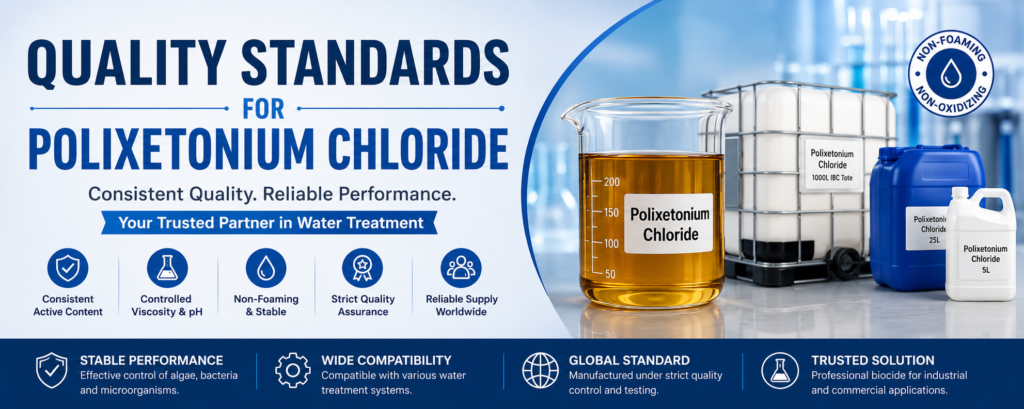
Have you ever noticed that two products labeled Polixetonium Chloride 60% can perform very differently in the same water treatment system?
One controls algae for weeks. Another requires higher dosages and still delivers inconsistent results. At first glance, both products appear identical. They may even share the same CAS number and similar specifications.
So what’s the difference?
The answer usually comes down to quality standards.
For distributors, formulators, and industrial water treatment professionals, understanding quality standards is just as important as understanding the chemistry itself. A product that consistently meets stringent quality requirements not only performs better but also reduces operational costs, minimizes customer complaints, and ensures long-term reliability.
In this article, we’ll explain what quality standards really mean for Polixetonium Chloride, which parameters deserve the most attention, and how buyers can identify products that truly deliver consistent performance.
Why Quality Standards Matter More Than You Think
Polixetonium Chloride is widely used as a non-foaming polymeric biocide in industrial water treatment systems. Because it works by disrupting microorganisms through its cationic polymer structure, consistent product quality is essential.
Unlike simple commodity chemicals, polymeric quaternary ammonium compounds are highly dependent on manufacturing control. Small variations during polymerization can influence molecular weight, viscosity, stability, and ultimately biological performance.
Poor-quality material may result in:
- Reduced algae control efficiency
- Higher chemical consumption
- Shorter treatment cycles
- Batch-to-batch inconsistency
- Customer complaints
- Increased operating costs
On the other hand, products manufactured under strict quality control provide predictable performance throughout their service life.
That’s exactly what professional buyers are looking for.
What Defines the Quality of Polixetonium Chloride?
Quality isn’t determined by a single number.
Instead, it reflects how well the manufacturer controls the entire production process—from raw material selection to polymerization, quality inspection, packaging, and storage.
A high-quality Polixetonium Chloride product should offer:
- Stable active content
- Consistent viscosity
- Controlled pH
- Uniform density
- Excellent clarity
- Low impurity levels
- Long-term storage stability
- Reliable batch consistency
Think of it this way.
A cake recipe doesn’t succeed simply because it uses the right ingredients. The mixing time, baking temperature, and quality checks all matter. Polymer production works much the same way.
The Most Important Quality Parameters
Although individual specifications may vary slightly between manufacturers, several quality indicators are universally recognized.
Appearance
A quality product should normally appear as an amber-colored, clear, viscous liquid.
The solution should remain transparent without:
- Sediment
- Suspended particles
- Layer separation
- Visible contamination
Changes in appearance during storage may indicate contamination or improper handling.
Active Content
Active content determines the amount of effective polymer available in the product.
Typical commercial products contain approximately 60% active ingredient, although individual product grades may differ.
Consistent active content helps ensure:
- Accurate dosing
- Predictable performance
- Stable formulation quality
Large fluctuations between production batches may lead to inconsistent treatment results.
Viscosity
Many buyers pay little attention to viscosity.
Actually, viscosity tells an important story.
For polymeric products like Polixetonium Chloride, viscosity often reflects the relative molecular weight of the polymer. While viscosity alone does not define quality, consistent viscosity generally indicates stable manufacturing and reproducible polymer characteristics.
Unexpected viscosity changes may suggest variations in polymerization conditions or production consistency.
pH
Commercial Polixetonium Chloride is generally supplied within a controlled pH range.
Maintaining proper pH helps ensure:
- Chemical stability
- Storage reliability
- Good compatibility with water treatment formulations
Extremely high or low pH values may affect long-term stability.
Density
Density is another useful indicator for production consistency.
Although density differences are usually small, stable density confirms uniform formulation and manufacturing control.
Why Active Content Is Not the Whole Story
This is one of the biggest misconceptions in the marketplace.
Many buyers compare products using only the active content shown on the Certificate of Analysis.
But that’s only part of the picture.
For example, some suppliers describe their product as 60% Active Content, while others may refer to 60% Solid Content. These two values are not necessarily the same.
Depending on the analytical method and product formulation, a product labeled with 60% active content may actually contain a higher proportion of effective polymer than another product labeled simply as 60% solids.
That is why experienced buyers often review:
- Product specifications
- COA
- Testing methodology
- Manufacturing consistency
rather than relying on a single percentage.
If you’re comparing products from different manufacturers, it’s worth confirming exactly how the reported value is defined. Doing so can prevent misleading comparisons and help ensure you’re evaluating equivalent products.
Common Industry Standards and Testing Methods
Professional manufacturers typically perform routine quality control on every production batch before shipment.
Common laboratory evaluations include:
- Appearance inspection
- Active content determination
- pH measurement
- Density testing
- Viscosity measurement
Active content is commonly determined using the colloid titration method, a well-established analytical technique for cationic polymers. Rather than measuring the polymer directly, this method evaluates the effective cationic charge by reacting it with an oppositely charged standard polymer under controlled conditions.
The result provides a reliable indication of the product’s effective active polymer content without requiring complex instrumental analysis.
Beyond routine laboratory testing, reputable manufacturers also maintain documented quality management procedures to ensure batch-to-batch consistency throughout production.
How Production Consistency Affects Performance
Quality isn’t created in the laboratory.
It’s created on the production line.
Consistent manufacturing requires careful control of:
- Raw material quality
- Reaction conditions
- Temperature
- Polymerization time
- Mixing efficiency
- Process monitoring
When these variables are tightly controlled, the finished product maintains stable physical and chemical properties from one batch to the next.
For customers, this means:
- More predictable algae control
- Easier dosage adjustment
- Consistent formulation behavior
- Fewer unexpected quality issues
In long-term supply partnerships, production consistency is often even more valuable than chasing the lowest price.
Packaging, Storage, and Transportation Requirements
Even the highest-quality product can lose performance if it is stored improperly.
Most manufacturers recommend:
- Keeping containers tightly sealed
- Protecting the product from direct sunlight
- Storing in a cool, dry, and well-ventilated area
- Preventing freezing
- Avoiding prolonged exposure to excessive heat
Typical commercial packaging includes:
- 25 L drums
- 200 L plastic drums
- 1000 L IBC totes
Proper packaging helps preserve product stability throughout transportation and long-term storage.
How to Evaluate a Reliable Supplier
Choosing a supplier involves much more than comparing prices.
Consider asking the following questions:
Do they provide complete technical documentation?
Reliable suppliers should readily provide:
- Technical Data Sheet (TDS)
- Certificate of Analysis (COA)
- Safety Data Sheet (SDS/MSDS)
Is their quality consistent?
Ask whether:
- Every batch is tested before shipment
- Batch records are retained
- Quality management procedures are documented
Can they support technical discussions?
Experienced manufacturers should be able to explain:
- Product specifications
- Testing principles
- Application recommendations
- Storage guidance
A supplier willing to discuss technical details usually demonstrates greater confidence in product quality.
Do they offer stable long-term supply?
Consistency over years is often more valuable than occasional low pricing.
Reliable production capacity and dependable delivery schedules are essential, especially for distributors and private-label brands.
Final Thoughts
Quality standards for Polixetonium Chloride extend far beyond a specification sheet.
Appearance, active content, viscosity, pH, density, manufacturing consistency, and quality control all contribute to how the product performs in real-world applications.
The most successful buyers don’t focus on a single number. They evaluate the complete quality system behind the product.
When manufacturers maintain strict production control and transparent quality documentation, customers gain more than a chemical—they gain confidence in every shipment.
For businesses that depend on consistent water treatment performance, that confidence is often the most valuable standard of all.
Frequently Asked Questions
1. What is the most important quality parameter for Polixetonium Chloride?
Active content is important, but it should always be evaluated together with viscosity, appearance, pH, density, and batch-to-batch consistency for a complete assessment of product quality.
2. Why can two 60% Polixetonium Chloride products perform differently?
Differences in polymerization control, molecular characteristics, impurity levels, manufacturing consistency, and the way active content is defined can all influence product performance, even when the labeled concentration appears identical.
3. How is the active content of Polixetonium Chloride typically tested?
The effective active content is commonly determined by colloid titration, a standard analytical method used for cationic polymers that measures the polymer’s effective cationic charge.
4. Does viscosity indicate product quality?
Viscosity often reflects the relative molecular weight of the polymer and the consistency of the manufacturing process. While it is not a direct measure of performance on its own, stable viscosity is generally a good indicator of production consistency.
5. What documents should a reliable Polixetonium Chloride supplier provide?
A reputable supplier should normally provide a Technical Data Sheet (TDS), Certificate of Analysis (COA), Safety Data Sheet (SDS/MSDS), and be able to explain their quality control procedures and testing methods.
If you have additional questions about Polixetonium Chloride quality standards, testing methods, or product selection, feel free to contact us. Our technical team is always happy to discuss your application and help you identify the most suitable solution for your water treatment needs.