GET IN TOUCH
Ask For Sample?
How to Source Polixetonium Chloride from China ?
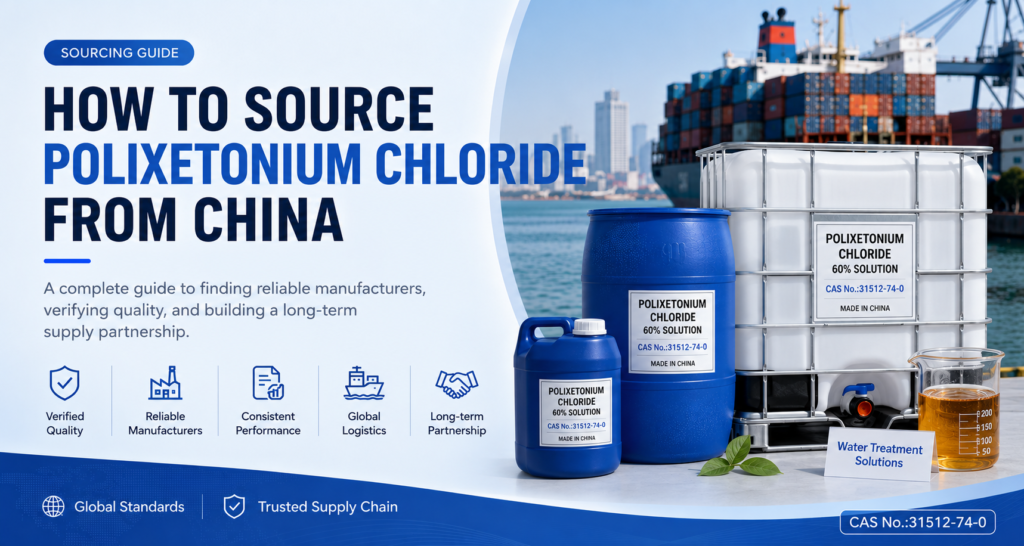
If you’ve started looking for Polixetonium Chloride suppliers, you’ve probably noticed something pretty quickly—China offers dozens of manufacturers, trading companies, and distributors. Prices vary widely. Product specifications don’t always match. Even the names can be confusing.
So how do you know which supplier is actually worth working with?
The good news is that sourcing Polixetonium Chloride from China doesn’t have to be complicated. With the right evaluation process, you can find a dependable supplier that delivers consistent quality, stable production, and responsive technical support.
This guide walks through the complete sourcing process—from defining your requirements to placing your first order—with practical advice that helps reduce risk and build a reliable supply chain.
Why More Global Buyers Source Polixetonium Chloride from China ?
China has become one of the world’s largest production bases for specialty water treatment chemicals, including Polixetonium Chloride.
There are several reasons why international buyers continue sourcing from Chinese suppliers:
- Competitive manufacturing costs
- Mature chemical production infrastructure
- Large production capacity
- Flexible packaging options
- Experience serving OEM and private-label customers
- Growing investment in quality management and laboratory testing
Of course, not every supplier offers the same level of quality. That’s exactly why supplier evaluation matters.
The lowest quotation isn’t always the lowest total cost.
Understand Exactly What You Need Before Contacting Suppliers
One of the biggest sourcing mistakes happens before the first email is even sent.
Many buyers simply ask:
“Please quote Polixetonium Chloride.”
That’s rarely enough.
Instead, prepare a specification sheet covering the following:
Product Specification
Include details such as:
- Active content
- Appearance
- Viscosity range
- Density
- pH
- Required certifications
- Intended application
For example, a swimming pool algaecide producer may prioritize long-term biological performance, while an industrial water treatment company may focus more on compatibility with existing treatment programs.
Knowing your application helps suppliers recommend the most suitable product.
How to Identify Reliable Chinese Manufacturers ?
A reliable supplier should clearly explain:
- Whether they manufacture the product themselves
- Production capacity
- Factory location
- Quality control procedures
- Export experience
- Technical support capability
A professional supplier should also be comfortable sharing:
- COA
- SDS
- Typical specification sheet
- Packaging photos
- Product testing information
If these basic documents cannot be provided promptly, consider it an early warning sign.
Questions Every Buyer Should Ask Before Ordering
Before placing your first purchase order, ask more than just the price.
Useful questions include:
What is the actual active content?
This question deserves extra attention.
Some suppliers describe products as 60% Active Content, while others may refer to total solids or content. These terms are not always interchangeable.
Understanding exactly how the product specification is defined helps avoid misunderstandings when comparing quotations.
How is product consistency controlled?
Ask about:
- Batch-to-batch testing
- Laboratory equipment
- Retained samples
- Production records
- Third-party verification
Consistency is often more valuable than obtaining the absolute lowest price.
What packaging options are available?
Common export packaging includes:
- 1 L bottles
- 5 L jerrycans
- 25 L stacktable jerrycans
- 200 L plastic drums
- 1000 L IBC totes
If you’re planning private labeling, discuss label design, carton printing, and pallet configuration early in the process.
How to Verify Product Quality ?
A professional supplier should have a documented quality control process.
Besides routine factory testing, many reputable exporters also work with independent third-party laboratories for periodic verification.
When evaluating quality, ask for:
- Certificate of Analysis (COA)
- Safety Data Sheet (SDS)
- Typical product specification
- Batch traceability
- Third-party testing reports, if available
Some suppliers also perform additional testing—such as molecular weight analysis or toxicological studies—to provide customers with a deeper understanding of product performance.
These reports aren’t mandatory, but they demonstrate a stronger commitment to quality and transparency.
Packaging, Logistics, and Export Considerations
Good sourcing doesn’t stop at manufacturing.
Reliable logistics are just as important.
Discuss topics such as:
- Minimum order quantity
- Lead time
- Export documentation
- Dangerous goods classification
- Container loading plan
- Pallet standards
- Shipping marks
Experienced exporters can also help optimize container utilization, reducing freight costs without compromising packaging safety.
Don’t forget to confirm whether samples can be shipped before bulk production.
Testing a product in your own formulation remains one of the smartest investments you can make.
Common Mistakes When Sourcing from China
After years of international chemical sourcing, several patterns appear again and again.
Choosing only by price
An unusually low quotation may indicate:
- Lower active content
- Less consistent production
- Limited technical support
- Weaker quality control
Ignoring communication quality
Fast, accurate communication often reflects how future orders will be handled.
If emails routinely take several days to answer during the quotation stage, imagine the response speed when an urgent shipment issue occurs.
Not requesting samples
Even if two suppliers claim identical specifications, real-world performance can differ.
Always perform your own evaluation whenever practical.
Overlooking long-term supply stability
Finding one good shipment is relatively easy.
Finding a supplier capable of delivering the same quality year after year is much more valuable.
Building a Long-Term Supply Partnership
The strongest supplier relationships aren’t based solely on price negotiations.
They’re built on trust, transparency, and continuous improvement.
Good suppliers appreciate customers who communicate clearly, provide technical feedback, and share future demand forecasts.
Likewise, buyers benefit from suppliers who:
- Respond quickly
- Maintain stable quality
- Offer technical assistance
- Keep production schedules predictable
- Continue improving products over time
A long-term partnership usually creates more value than switching suppliers every few months for a slightly lower price.
Final Thoughts
China offers excellent opportunities for sourcing Polixetonium Chloride, but successful procurement requires more than comparing quotations.
Take time to understand product specifications, verify quality systems, evaluate communication, and confirm manufacturing capability before placing an order.
A reliable supplier should be more than a manufacturer. They should become a technical partner who helps you maintain product quality, reduce sourcing risk, and support your business as it grows.
Investing a little more effort during supplier selection can save significant time, cost, and frustration later.
FAQs
1. Why do many buyers source Polixetonium Chloride from China?
China offers competitive pricing, mature manufacturing capabilities, flexible packaging options, and extensive export experience, making it one of the leading global sources for specialty water treatment chemicals.
2. What documents should a supplier provide?
A professional supplier should provide a Certificate of Analysis (COA), Safety Data Sheet (SDS), product specifications, and, when available, third-party testing reports.
3. Is the lowest price always the best option?
Not necessarily. Product consistency, technical support, quality control, and reliable delivery often have a greater impact on long-term purchasing costs than the initial unit price.
4. Should I request samples before placing a bulk order?
Yes. Testing samples under your own operating conditions is the best way to confirm compatibility and performance before committing to a larger purchase.
5. What should I look for in a long-term Polixetonium Chloride supplier?
Look for consistent product quality, responsive communication, documented quality control, export experience, transparent technical support, and the ability to provide stable supply over time.