
GET IN TOUCH
Ask For Sample?
Choosing the Best Polixetonium Chloride Supplier
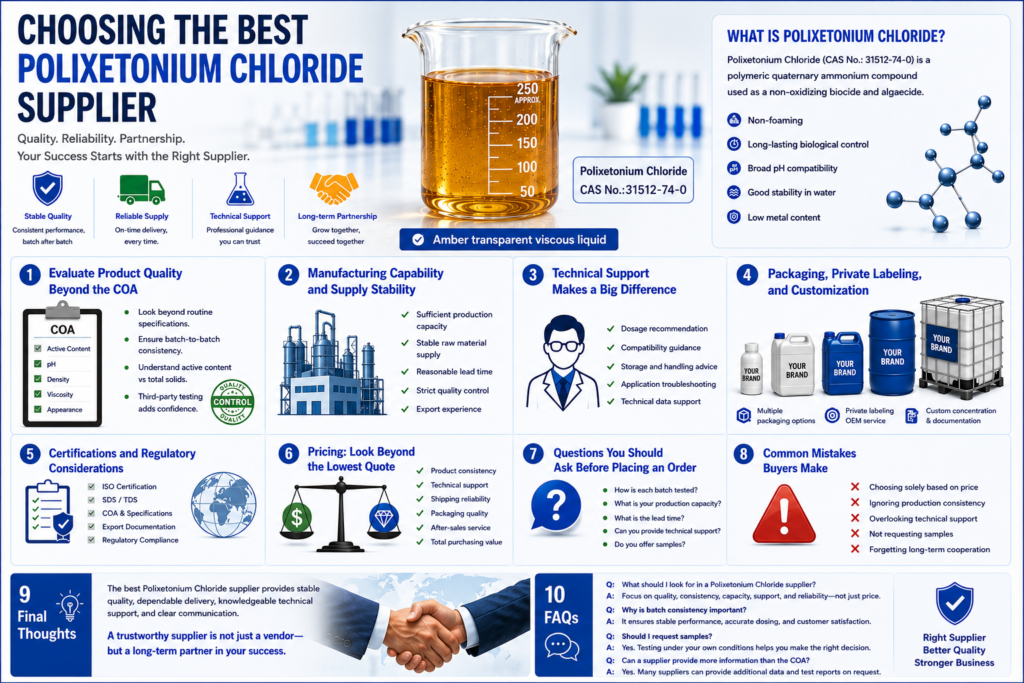
Selecting the right Polixetonium Chloride supplier isn’t simply about finding the lowest price. The supplier you choose directly affects your product quality, delivery reliability, technical support, and ultimately your reputation with your own customers.
Whether you’re sourcing Polixetonium Chloride for industrial water treatment, cooling water systems, metalworking fluids, or commercial pool products, the difference between a reliable supplier and an unreliable one can mean fewer customer complaints—or a long list of unexpected problems.
So, how do experienced buyers evaluate suppliers before making a long-term commitment?
Let’s walk through the key factors that truly matter.
Why Your Supplier Choice Matters More Than You Think ?
Many buyers assume Polixetonium Chloride is a standardized chemical and that products from different suppliers perform almost the same.
In reality, that’s often not the case.
While many products may carry similar specifications on paper, differences in polymerization control, raw material quality, purification, molecular weight distribution, and production consistency can significantly influence actual performance.
These differences may affect:
- Algae control efficiency
- Long-term stability
- Product appearance
- Viscosity consistency
- Customer complaints
- Shelf life
- Batch-to-batch repeatability
A supplier who consistently delivers stable quality often saves far more money than one offering the cheapest price.
Understand What Polixetonium Chloride Really Is
Before comparing suppliers, it’s helpful to understand what you’re actually buying.
Polixetonium Chloride (CAS No. 31512-74-0) is a polymeric quaternary ammonium compound widely used as a non-oxidizing biocide and algaecide.
Its advantages include:
- Non-foaming performance
- Long-lasting biological control
- Broad pH compatibility
- Good stability in water
- Compatibility with many water treatment programs
- Low metal content compared with copper-based algaecides
Because it’s a polymer rather than a small-molecule biocide, manufacturing quality has a greater impact on performance than many buyers initially realize.
That’s exactly why supplier selection deserves careful attention.
Evaluate Product Quality Beyond the COA
Many buyers begin by requesting a Certificate of Analysis (COA).
That’s a good start—but it shouldn’t be the finish line.
A COA usually confirms routine specifications such as:
- Active content
- pH
- Density
- Viscosity
- Appearance
These values verify that the product meets agreed specifications, but they don’t tell the whole story.
Ask About Batch Consistency
A supplier should be able to maintain consistent production over months or years—not just for one shipment.
Ask questions like:
- How stable is viscosity between batches?
- How often do production parameters fluctuate?
- Can historical COAs be provided?
- Is every production batch tested?
Consistency is often more valuable than achieving one exceptionally good batch.
Understand Active Content vs Total Solids
Here’s a point that many buyers overlook.
Some manufacturers advertise a product as having 60% active content, while others refer to 60% total solids.
These are not necessarily the same thing.
Depending on the analytical method and product formulation, two products labeled “60%” may actually contain different amounts of effective polymer.
This can directly affect dosage recommendations, cost per treatment, and overall performance.
A knowledgeable supplier should clearly explain the difference rather than relying on marketing language.
If you’re interested in understanding how active content is determined, it’s worth discussing the testing method with your supplier.
Third-Party Testing Adds Confidence
Reliable suppliers often do more than internal quality control.
Some also work with independent laboratories to verify product quality and periodically perform additional testing beyond routine COA items.
Examples may include:
- Molecular weight evaluation
- Stability testing
- Specialized analytical characterization
- Toxicological studies when applicable
Not every customer needs these reports, but the ability to provide additional technical data often reflects a supplier’s commitment to product quality.
Manufacturing Capability and Supply Stability
Imagine qualifying a supplier, completing product testing, launching your product, and then learning that the supplier cannot keep up with demand.
Unfortunately, it happens.
Before establishing long-term cooperation, consider asking about:
- Annual production capacity
- Normal lead time
- Inventory management
- Raw material sourcing
- Emergency production capability
- Export experience
A mature manufacturer usually has documented production procedures and can maintain stable deliveries even during periods of strong demand.
Reliable supply becomes especially important if you’re building your own branded products.
Technical Support Makes a Big Difference
A supplier shouldn’t disappear after sending the quotation.
The best suppliers act more like technical partners.
They should be able to answer questions such as:
- Which dosage is recommended?
- Is the product compatible with my formulation?
- How should it be stored?
- What packaging is most suitable?
- What testing data can be provided?
- What common application problems should I avoid?
Sometimes one useful technical suggestion saves weeks of troubleshooting.
That’s difficult to put a price on.
Packaging, Private Labeling, and Customization
Different markets have different packaging requirements.
A flexible supplier should offer multiple packaging options, such as:
- 1 L bottles
- 5 L jerrycans
- 25 L stackable jerrycans
- 200 L plastic drums
- 1,000 L IBC totes
Beyond packaging, many buyers also appreciate suppliers that can provide:
- Private labeling
- OEM manufacturing
- Custom concentration
- Customized documentation
- Export packaging
These services simplify purchasing and help distributors build their own brands.
Certifications and Regulatory Considerations
Depending on your market, you may need information regarding:
- Safety Data Sheets (SDS)
- Technical Data Sheets (TDS)
- Certificates of Analysis
- Product specifications
- Export documentation
- Country-specific regulatory requirements
Different countries have different compliance expectations, so discussing these requirements early helps avoid delays later.
Pricing: Look Beyond the Lowest Quote
It’s tempting to compare suppliers using only price per kilogram.
But that’s rarely the smartest approach.
Instead, think about total purchasing value.
Consider factors such as:
- Product consistency
- Technical support
- Shipping reliability
- Packaging quality
- Documentation
- Communication efficiency
- After-sales service
A product that’s slightly more expensive but consistently performs well often costs less over the long run.
Lower complaint rates, fewer production interruptions, and stronger customer satisfaction usually outweigh a small price difference.
Questions You Should Ask Before Placing an Order
Before selecting a supplier, consider asking these practical questions:
Product Quality
- How is every production batch tested?
- Can you provide multiple historical COAs?
- Is third-party testing available?
Manufacturing
- What is your monthly production capacity?
- What is your normal lead time?
- How do you ensure batch consistency?
Technical Support
- Can you recommend application dosages?
- Do you offer formulation support?
- Can additional technical data be provided upon request?
Commercial Support
- What packaging options are available?
- Do you support OEM or private label projects?
- Can samples be supplied before bulk orders?
The quality of these answers often tells you as much about the supplier as the product itself.
Common Mistakes Buyers Make
Even experienced purchasing managers sometimes overlook important details.
Here are a few common mistakes:
Choosing solely based on price
The lowest quotation isn’t always the lowest total cost.
Ignoring production consistency
One successful sample doesn’t guarantee long-term quality.
Overlooking technical support
Good communication can prevent expensive mistakes later.
Not requesting samples
Always evaluate product performance under your own operating conditions before purchasing in bulk.
Forgetting long-term cooperation
A supplier should be someone you can work with for years—not just for one shipment.
Final Thoughts
Finding the best Polixetonium Chloride supplier is about much more than comparing prices.
The right supplier provides stable quality, dependable delivery, knowledgeable technical support, flexible packaging options, and clear communication throughout the entire purchasing process.
A trustworthy supplier becomes a long-term business partner rather than simply a vendor.
Taking a little extra time to evaluate suppliers carefully today can help you avoid quality issues, supply disruptions, and unnecessary costs tomorrow.
After all, successful sourcing isn’t about finding the cheapest product—it’s about finding the supplier you can continue to trust as your business grows.
Frequently Asked Questions
1. What should I look for in a Polixetonium Chloride supplier?
Focus on product consistency, manufacturing capability, technical support, quality control, packaging flexibility, and export experience rather than price alone.
2. Why is batch consistency so important?
Variations between production batches can affect application performance, dosage requirements, and customer satisfaction. Consistent manufacturing helps ensure predictable results over time.
3. Should I request samples before placing a bulk order?
Absolutely. Testing samples under your own operating conditions is one of the most effective ways to verify product suitability before making a larger investment.
4. Can a supplier provide more information than what’s listed on the COA?
Yes. Many experienced suppliers can also provide additional technical information, third-party test reports, molecular weight characterization, or other supporting data upon request. If you have specific testing requirements, it’s always worth discussing them directly with the supplier.