
GET IN TOUCH
Ask For Sample?
Laboratory Testing Methods for Polixetonium Chloride
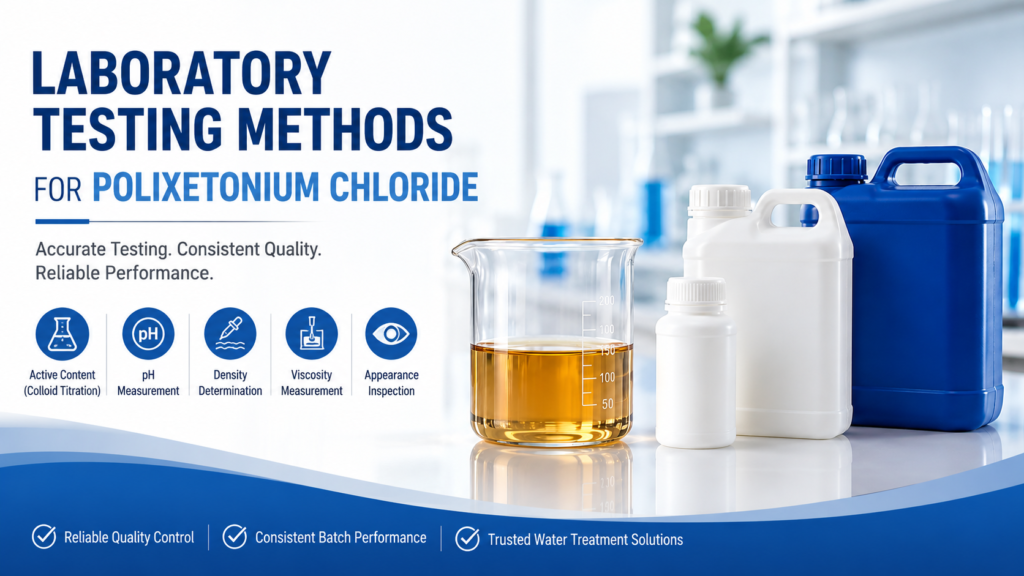
When purchasing Polixetonium Chloride, most buyers focus on the specification sheet. They compare active content, pH, viscosity, packaging, and price before making a decision. But have you ever wondered how those numbers are actually verified?
Behind every Certificate of Analysis (COA) is a series of laboratory tests designed to confirm that each production batch meets established quality standards. These tests are not simply routine paperwork—they are an essential part of manufacturing consistent, reliable water treatment chemicals.
For manufacturers, laboratory testing helps maintain stable production quality and identify potential issues before products leave the factory. For distributors and end users, it provides confidence that every shipment will perform consistently in practical applications.
This article introduces the most common laboratory testing methods used for Polixetonium Chloride. Rather than focusing on detailed laboratory procedures, we’ll explain what each test measures, why it matters, and how it contributes to overall product quality.
Why Laboratory Testing Is Essential for Polixetonium Chloride
Polixetonium Chloride is a polymeric quaternary ammonium compound widely used as a non-oxidizing biocide in industrial water treatment systems. Because it is a polymer rather than a simple inorganic chemical, its quality cannot be evaluated by appearance alone.
Even products with similar specifications may perform differently if their production processes, raw materials, or quality control standards vary.
Laboratory testing helps manufacturers verify that every batch maintains the intended physical and chemical properties before shipment.
Routine testing provides several important benefits:
- Confirms compliance with product specifications
- Ensures batch-to-batch consistency
- Detects production deviations early
- Supports long-term product reliability
- Provides objective quality documentation for customers
Simply put, laboratory testing helps turn production consistency into customer confidence.
Key Quality Parameters Every Batch Should Meet
A complete quality evaluation generally includes several laboratory measurements rather than relying on a single test result.
The most commonly monitored parameters include:
- Appearance
- Active content
- pH
- Density
- Viscosity
Each parameter reflects a different aspect of product quality, and together they provide a comprehensive picture of manufacturing consistency.
Appearance Inspection
Appearance inspection is usually the first step in laboratory quality control.
A typical Polixetonium Chloride product should be an amber, transparent, viscous liquid with no visible suspended particles, precipitation, or phase separation.
Although appearance is one of the simplest tests, it can quickly reveal abnormalities that deserve further investigation. Unexpected color changes, cloudiness, or sediment may indicate contamination, improper storage conditions, or manufacturing inconsistencies.
Appearance alone cannot determine whether a product meets specification, but it serves as an important first indication of overall product quality.
Active Content Analysis Using Colloid Titration
Among all quality control parameters, active content is often considered the most important.
After all, the effectiveness of Polixetonium Chloride depends on the amount of active cationic polymer available to perform its intended function. Accurate determination of active content therefore plays a critical role in product quality evaluation.
Professional laboratories generally determine active content using colloid titration, a testing method that has become widely accepted throughout the water treatment industry for cationic polymers.
Rather than measuring total solids, colloid titration evaluates the effective cationic activity of the polymer.
The principle is relatively straightforward.
Polixetonium Chloride contains a large number of positively charged functional groups distributed along its polymer chains. During colloid titration, these positive charges are gradually neutralized through a controlled chemical reaction. Once all active cationic sites have reacted, a clearly identifiable endpoint is reached, allowing the concentration of active polymer to be determined accurately.
Because this analytical technique directly evaluates the polymer’s cationic activity, it provides a much more meaningful assessment of product quality than simply measuring solid content.
This distinction is particularly important.
In the marketplace, products are sometimes described using either active content or solid content, yet these two values are not necessarily equivalent. Two products labeled with similar percentages may contain different amounts of effective polymer depending on the analytical definition being used.
For this reason, professional buyers should understand not only the reported specification, but also the testing methodology behind it.
Colloid titration has become the preferred analytical approach because it offers several advantages:
- Excellent repeatability
- Reliable batch comparison
- High sensitivity to active polymer concentration
- Broad acceptance within the water treatment industry
It remains one of the most valuable tools for ensuring that every production batch delivers consistent performance.
pH Measurement
The pH value is another routine laboratory measurement.
Maintaining pH within the specified range helps verify production consistency and supports long-term storage stability.
Small variations are generally expected during manufacturing. However, significant deviations may suggest formulation changes, raw material differences, or contamination that requires additional investigation.
Routine pH testing allows manufacturers to monitor process stability and maintain product quality throughout production.
Density Determination
Density provides another useful indicator of manufacturing consistency.
Because density is closely related to formulation composition, consistent density values help confirm that each production batch has been manufactured according to specification.
Unexpected density variations may indicate dilution errors, raw material inconsistencies, or production deviations.
Although density alone cannot evaluate product performance, it serves as an important supporting parameter during routine quality control.
Viscosity Measurement
Viscosity is an important physical property for polymer products.
Unlike many low-molecular-weight chemicals, the viscosity of Polixetonium Chloride often reflects characteristics of the polymer itself.
Generally speaking, products with higher molecular weight tend to exhibit higher viscosity, while lower molecular weight products usually have lower viscosity.
For this reason, viscosity is frequently monitored as an indirect indicator of manufacturing consistency.
It should be noted, however, that viscosity should never be interpreted in isolation. Instead, it should be evaluated together with active content, density, pH, and other laboratory results to obtain a complete understanding of product quality.
When all quality parameters remain stable from batch to batch, manufacturers can deliver products with more predictable performance in practical applications.
Why Consistent Laboratory Testing Benefits Customers
Laboratory testing is often viewed as an internal manufacturing activity, but its value extends well beyond the production floor.
For customers, standardized laboratory testing provides greater confidence in the products they purchase.
Reliable quality control helps ensure:
- Consistent product performance
- Stable manufacturing quality
- Reduced batch-to-batch variation
- Improved purchasing confidence
- Better long-term supplier reliability
When comparing suppliers, price is naturally an important consideration. However, a well-established quality control system often delivers greater value over time by reducing quality risks and ensuring consistent product performance.
Professional manufacturers typically implement standardized testing procedures for every production batch before shipment. Combined with comprehensive production records and continuous process monitoring, these laboratory practices help maintain consistent quality throughout the manufacturing process.
Conclusion
Laboratory testing is much more than a routine quality control procedure—it is the foundation of consistent product quality.
By evaluating appearance, active content, pH, density, and viscosity, manufacturers can verify that every batch of Polixetonium Chloride meets established quality standards before it reaches customers.
Among these tests, colloid titration has become the industry-standard method for determining active content because it measures the effective cationic activity of the polymer rather than simply its total solids. Combined with other routine laboratory measurements, it provides a reliable and comprehensive assessment of product quality.
For buyers, understanding these laboratory testing methods makes it easier to evaluate suppliers, compare product specifications, and make informed purchasing decisions. More importantly, it highlights the value of working with manufacturers that maintain rigorous quality control systems and consistent analytical standards.
Frequently Asked Questions
1. Why is laboratory testing important for Polixetonium Chloride?
Laboratory testing verifies that every production batch meets established quality specifications, ensuring consistent product performance and manufacturing reliability.
2. What is the most important laboratory test for Polixetonium Chloride?
Active content analysis is generally considered the most critical test because it measures the amount of effective cationic polymer available for water treatment applications.
3. Why is colloid titration commonly used for active content analysis?
Colloid titration evaluates the effective cationic activity of the polymer rather than simply measuring total solids, making it a more representative method for assessing product quality.
4. Besides active content, what other quality parameters are routinely tested?
Manufacturers typically monitor appearance, pH, density, and viscosity as part of routine quality control to ensure consistent product quality and batch-to-batch stability.
5. How can buyers evaluate a supplier’s quality control capability?
In addition to reviewing product specifications, buyers should consider whether the manufacturer follows standardized laboratory testing procedures, maintains consistent quality records, and provides reliable documentation such as Certificates of Analysis (COAs).