
GET IN TOUCH
Ask For Sample?
Complete Buyer’s Guide to Polixetonium Chloride
If you’re planning to source Polixetonium Chloride, chances are you’ve already realized something: not every supplier offers the same product, even when the specification sheet looks almost identical.
Some products perform consistently for months. Others lose activity sooner than expected. Some dissolve smoothly into your formulation, while others create unexpected compatibility issues. And sometimes the biggest difference isn’t obvious until your customer starts using it.
That’s exactly why this buyer’s guide exists.
Whether you’re purchasing for industrial water treatment, metalworking fluids, swimming pool chemicals, or specialty formulations, understanding the material before placing an order can save both money and frustration.
Let’s walk through everything you should know.
What Is Polixetonium Chloride?
Polixetonium Chloride is a polymeric quaternary ammonium compound widely recognized as a non-oxidizing biocide and algaecide.
Unlike traditional oxidizing biocides, it controls microorganisms through its positively charged polymer chains. These polymer molecules interact with negatively charged microbial cell membranes, disrupting their structure and ultimately preventing microbial growth.
Typical characteristics include:
- Non-foaming
- Broad pH compatibility
- Long-lasting antimicrobial activity
- Excellent compatibility with many water treatment formulations
- Low metal content
- Good storage stability
Commercial products are most commonly supplied as approximately 60% active aqueous solutions, making handling safer while maintaining excellent performance.
Why Is Polixetonium Chloride Widely Used?
One reason is versatility.
Instead of being limited to a single industry, Polixetonium Chloride performs well across many different water-based systems.
It is commonly selected because it offers:
- Effective algae control
- Broad-spectrum microbial control
- Low corrosion tendency compared with many oxidizing products
- Excellent stability during storage
- Minimal impact on system foaming
- Easy formulation with many existing products
Another important advantage?
Its polymeric structure helps provide longer-lasting control compared with many fast-consuming oxidizing treatments.
For applications where continuous protection matters, that can make a noticeable difference.
Key Technical Properties Buyers Should Understand
Not every specification matters equally.
Experienced buyers usually focus on several critical parameters.
Active Content
This determines how much effective polymer is actually present.
Typical commercial specification:
58–61% Active Content
Consistency here directly affects dosing calculations and product performance.
pH
Most products fall within:
pH (10% solution): 6.0–8.0
A stable pH generally indicates good manufacturing control.
Viscosity
Many buyers overlook viscosity.
They shouldn’t.
Viscosity often reflects the polymer’s molecular weight, which can influence overall application performance.
Typical range:
150–400 mPa·s
Very large deviations may indicate production inconsistencies or formulation differences.
Density
Typical density:
1.148–1.153 g/cm³
Density helps verify production consistency and assists with accurate dosing calculations.
Appearance
High-quality Polixetonium Chloride typically appears as:
Amber transparent viscous liquid
Appearance alone doesn’t determine quality, but sudden changes in color or clarity may deserve further investigation.
Common Applications Across Industries
One interesting thing about Polixetonium Chloride is that buyers from completely different industries often purchase essentially the same chemistry.
Swimming Pool Chemicals
This is probably the best-known application.
It is widely formulated into premium polymeric algaecides because it:
- Controls common algae
- Produces virtually no foam
- Works alongside chlorine programs
- Helps maintain water clarity
- Can also provide coagulant-aid benefits in many pool systems
Industrial Cooling Water
Industrial systems often require long-term microbial control without excessive corrosion.
Polixetonium Chloride fits well because it:
- Controls algae
- Suppresses slime formation
- Remains effective over a broad pH range
- Integrates easily into many treatment programs
Metalworking Fluids
Microbial contamination shortens coolant life.
Many formulators use Polixetonium Chloride to help:
- Reduce bacterial growth
- Improve coolant stability
- Extend service life
- Lower maintenance frequency
Other Water-Based Formulations
Depending on formulation requirements, it may also be incorporated into various specialty industrial water treatment products where durable antimicrobial performance is desired.
How to Evaluate Product Quality
Price matters.
Performance matters more.
When comparing suppliers, consider these factors.
Manufacturing Consistency
Ask whether every production batch follows standardized quality procedures.
Consistency often matters more than achieving the absolute highest specification.
Third-Party Testing
Reliable suppliers frequently perform independent testing in addition to routine internal quality control.
Besides standard COA parameters, some suppliers also conduct additional evaluations such as molecular weight characterization or toxicological testing to provide customers with a deeper understanding of product performance.
Technical Support
A supplier should be able to discuss:
- Application recommendations
- Compatibility questions
- Storage conditions
- Typical dosage ranges
- Regulatory documentation
If technical questions receive only sales answers, that’s usually not a good sign.
Documentation
Professional suppliers typically provide:
- COA
- SDS
- TDS
- Product specification
- Packing information
Some customers may also request additional supporting documents depending on their market requirements.
Understanding Active Content vs. Total Solids
This is one of the most misunderstood specifications in the industry.
Many commercial products are advertised as:
60% Active Content
Others are labeled as:
60% Total Solids
These are not necessarily the same thing.
Active content refers to the amount of effective polymer, while total solids include all non-volatile components in the product.
As a result, two products carrying a “60%” label may not actually contain the same amount of active ingredient.
For buyers comparing quotations from multiple suppliers, understanding this distinction is essential. It allows a more meaningful comparison based on actual performance rather than relying only on the headline concentration.
If you’re interested in how active content is determined or how it differs from total solids in laboratory testing, discussing the analytical methods with your supplier can provide valuable insight.
Choosing the Right Supplier
A good supplier offers more than competitive pricing.
Consider evaluating:
- Manufacturing experience
- Production consistency
- Quality management system
- Technical communication
- Third-party testing capability
- Supply stability
- Packaging flexibility
- Export experience
- After-sales support
Long-term cooperation often creates more value than simply selecting the lowest quotation.
Packaging, Storage, and Transportation
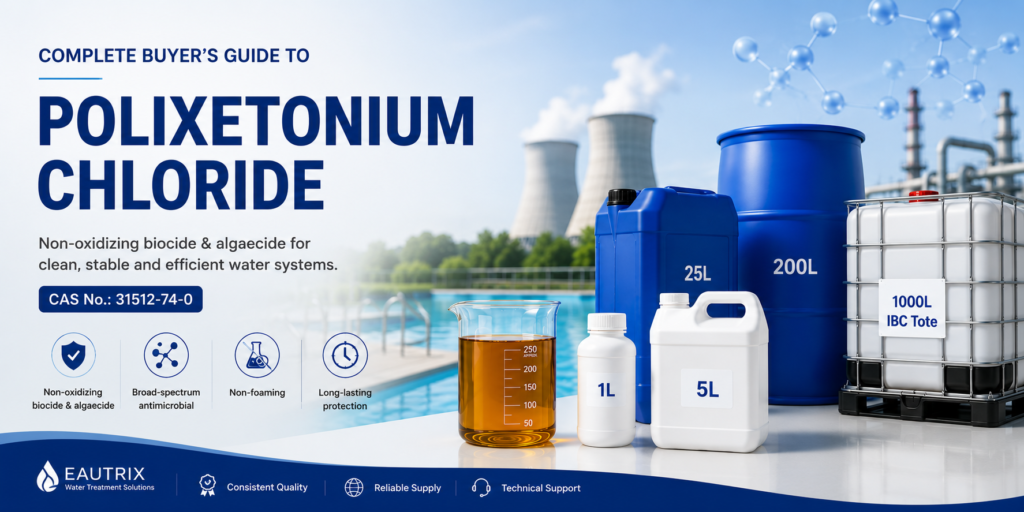
Polixetonium Chloride is commonly supplied in:
- 1 L bottles
- 5 L jerry cans
- 25 L stackable plastic jerry cans
- 200 L plastic drums
- 1000 L IBC totes
For storage:
- Keep containers tightly sealed.
- Protect from freezing.
- Store in a cool, dry, and well-ventilated area.
- Avoid prolonged exposure to direct sunlight.
Under appropriate storage conditions, the product generally maintains excellent stability.
Final Thoughts
Buying Polixetonium Chloride isn’t simply about finding the lowest price. It’s about selecting a product that delivers consistent performance, reliable quality, and dependable supply over the long term.
By understanding the technical specifications, recognizing the difference between active content and total solids, evaluating manufacturing consistency, and working with a supplier that offers strong technical support, you’ll be in a much better position to make an informed purchasing decision.
For buyers seeking long-term partnerships, the best supplier is often the one that combines stable product quality with responsive service, transparent documentation, and a willingness to support your application as your business grows.
Frequently Asked Questions
Is a higher concentration always better?
Not necessarily. Most commercial products are supplied around 60% because this concentration provides an excellent balance of performance, handling, stability, and viscosity.
Can I compare suppliers using price alone?
No. Active content, manufacturing consistency, technical support, testing capability, and product stability should all be considered alongside price.
Does appearance indicate quality?
Appearance can provide useful clues, but laboratory testing remains the most reliable way to evaluate product quality.
Can Polixetonium Chloride be customized?
Many suppliers can provide customized packaging, private labeling, and, in some cases, formulation support depending on the order quantity and application.
What documents should I request before purchasing?
At a minimum, request the COA, SDS, TDS, and product specification. Depending on your application or destination market, you may also wish to ask about third-party test reports, molecular weight characterization, or other supporting documentation.