
GET IN TOUCH
Ask For Sample?
How to Request Samples of Polixetonium Chloride ?
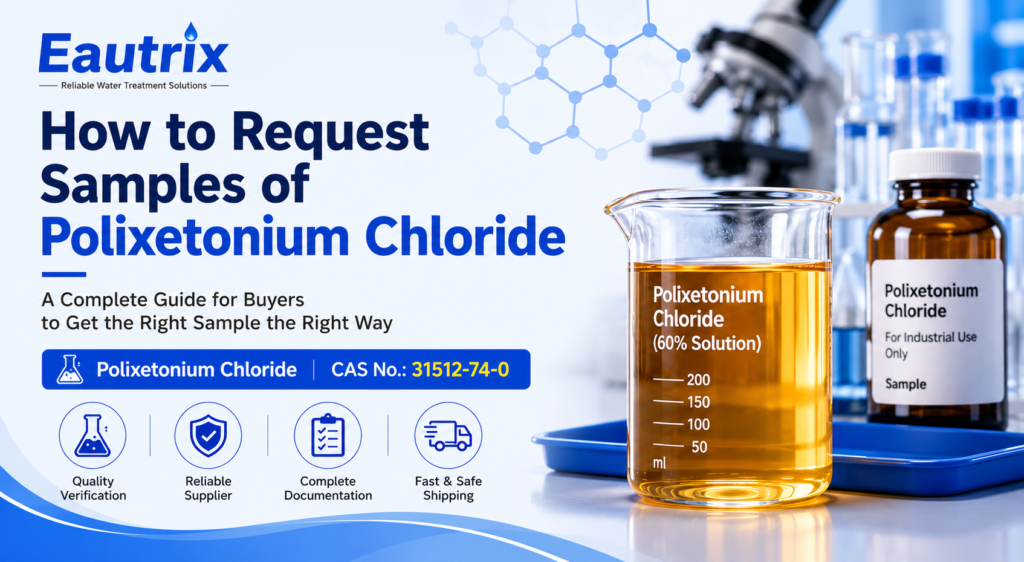
Before purchasing any specialty chemical in bulk, requesting a sample is one of the smartest steps you can take. It reduces risk, confirms product quality, and helps ensure the material performs as expected in your specific application.
This is especially true for Polixetonium Chloride (CAS No. 31512-74-0). While many suppliers claim to offer a “60% product,” the actual quality, molecular characteristics, manufacturing consistency, and technical support can vary significantly.
A sample is much more than a small bottle of liquid—it’s your first opportunity to evaluate whether a supplier deserves your long-term business.
In this guide, we’ll explain how to request Polixetonium Chloride samples professionally, what information suppliers need, what documents you should expect, and how to evaluate the sample before placing a commercial order.
Why Requesting a Sample Matters Before Bulk Purchasing ?
Imagine ordering an entire container based only on a specification sheet. Everything looks perfect on paper, but once the material reaches your factory, it behaves differently than expected.
Unfortunately, this happens more often than many buyers realize.
A properly evaluated sample helps you verify:
- Product appearance
- Active content consistency
- Performance in your formulation
- Compatibility with existing chemicals
- Packaging quality
- Supplier responsiveness
- Documentation accuracy
Perhaps even more importantly, the sampling process tells you a lot about the supplier.
Do they answer technical questions quickly?
Can they provide complete documentation?
Do they understand your application?
These small details often predict what future cooperation will look like.
When You Should Ask for a Sample ?
Not every purchase requires sampling, but in most cases, it is highly recommended.
You should request a sample when:
- You’re evaluating a new supplier.
- You’re developing a new formulation.
- You’re replacing your current raw material.
- You’re comparing multiple manufacturers.
- You’re expanding into a new market.
- Your customer requires qualification testing.
Even if you’ve used Polixetonium Chloride before, different manufacturers may produce materials with different molecular characteristics that affect real-world performance.
Testing first can save both time and money later.
What Type of Sample Should You Request?
Many buyers simply ask for “a sample.”
A better approach is to specify exactly what you need.
Common sample quantities include:
| Purpose | Recommended Quantity |
|---|---|
| Initial laboratory evaluation | 100–250 mL |
| Small formulation trials | 500 mL–1 L |
| Pilot production | 5–25 L |
| Customer qualification | 25 L or more |
For most laboratory evaluations, 100–500 mL is sufficient.
If you’re conducting multiple formulation trials, requesting a 1 L sample can reduce delays caused by repeated shipments.
Information to Prepare Before Contacting a Supplier
The more information you provide, the more useful the supplier’s recommendations will be.
Helpful information includes:
Your application
Examples include:
- Swimming pool algaecide
- Cooling water treatment
- Metalworking fluid preservative
- Oilfield water treatment
- Industrial water treatment
- Specialty chemical formulation
Suppliers can often recommend the most suitable grade based on your application.
Desired concentration
Most commercial Polixetonium Chloride is supplied as approximately 60% solution, but always confirm the actual specification.
Remember that active content and total solids content are not exactly the same thing. Some products advertised as “60%” may actually refer to different testing methods.
Clarifying this early helps avoid misunderstandings later.
Estimated annual demand
Suppliers don’t necessarily need an exact figure.
An estimate such as:
- 500 kg/year
- 5 tons/year
- 20 tons/year
helps them recommend suitable packaging and logistics.
Country of destination
Shipping regulations vary by country.
Providing your destination allows the supplier to recommend the most appropriate shipping method.
Questions to Ask When Requesting a Sample
A sample request is also an opportunity to evaluate the supplier’s technical knowledge.
Consider asking questions like:
- What is the typical active content?
- What is the viscosity range?
- What molecular weight characteristics can you share?
- Is the product suitable for my application?
- What packaging options are available?
- What is the recommended storage period?
- Can private labeling be provided later?
- Is technical support available during formulation?
Good suppliers welcome technical discussions instead of simply sending a quotation.
What Documents Should Accompany the Sample?
Professional suppliers should normally provide supporting documentation together with the sample.
Typical documents include:
- Certificate of Analysis (COA)
- Safety Data Sheet (SDS/MSDS)
- Technical Data Sheet (TDS)
- Product specification
- Recommended storage conditions
- Packaging information
Some suppliers may also provide:
- Third-party testing reports
- Typical application guides
- Compatibility information
- Performance comparison data
The more transparent a supplier is, the easier your qualification process becomes.
How to Evaluate the Sample After Receiving It ?
Receiving the sample is only the beginning.
A systematic evaluation typically includes several steps.
Visual inspection
Check whether the product matches the supplier’s description.
Polixetonium Chloride is typically an amber, transparent, viscous liquid.
Observe:
- Color consistency
- Clarity
- Presence of sediment
- Foreign particles
- Packaging integrity
Laboratory testing
Depending on your capabilities, you may verify:
- Active content
- pH
- Density
- Viscosity
These values should be reasonably consistent with the supplier’s specification.
Application testing
This is the most important step.
Evaluate performance under actual operating conditions.
For example:
Swimming pool applications:
- Algae prevention
- Water clarity
- Compatibility with chlorine
- Foam behavior
Cooling water:
- Biological control
- Compatibility with treatment program
Metalworking fluids:
- Bacterial control
- Emulsion stability
- Odor prevention
Laboratory numbers alone cannot replace practical testing.
Common Mistakes Buyers Make When Requesting Samples
Several mistakes appear repeatedly.
Asking only for the lowest price
Price matters—but performance matters more.
A slightly higher-priced product with better consistency may reduce your overall operating cost.
Providing almost no application information
If the supplier doesn’t know how you’ll use the product, they cannot make meaningful recommendations.
Skipping laboratory evaluation
Some buyers move directly from receiving a sample to placing a bulk order.
Even if the supplier has a good reputation, testing remains essential.
Comparing only specifications
Products with similar specification sheets can perform differently in real applications.
Performance testing should always have the final say.
Tips for Getting Faster Sample Approval
Suppliers are generally more responsive when they see that a request is serious and well prepared.
To speed up the process:
- Introduce your company briefly.
- Explain your application.
- Mention your estimated annual demand.
- State your testing schedule.
- Specify the sample quantity required.
- Confirm your shipping address clearly.
Clear communication benefits both sides.
Why the Cheapest Sample Isn’t Always the Best Choice ?
Many buyers focus heavily on sample cost.
Ironically, the sample itself is usually one of the smallest expenses in the entire purchasing process.
What really matters is whether the supplier can deliver consistent quality over the long term.
A reliable supplier offers more than just a competitive price.
They provide:
- Stable production quality
- Consistent batch-to-batch performance
- Responsive technical support
- Complete documentation
- Flexible packaging options
- Reliable delivery schedules
- Long-term supply stability
Choosing a supplier based solely on the lowest sample price may lead to much higher costs after commercial production begins.
Conclusion
Requesting a Polixetonium Chloride sample is more than checking whether a product meets a specification sheet. It’s the first step in evaluating a supplier’s quality, technical expertise, and long-term reliability.
By clearly explaining your application, asking the right technical questions, reviewing the accompanying documentation, and conducting thorough laboratory and performance testing, you can make purchasing decisions with much greater confidence.
Remember that the best supplier isn’t always the one offering the cheapest sample—it’s the one that consistently delivers dependable quality, transparent communication, and professional technical support. A careful sampling process today can prevent costly production issues tomorrow and lay the foundation for a successful long-term partnership.
FAQs
1. What sample size is usually recommended for Polixetonium Chloride?
For most laboratory evaluations, 100–500 mL is sufficient. If pilot production or customer qualification is planned, larger quantities such as 1–25 L may be more appropriate.
2. Is the sample usually free?
Many suppliers provide free samples, while the buyer typically covers courier charges. Policies vary depending on the supplier and the requested quantity.
3. What documents should I request together with the sample?
At a minimum, ask for a Certificate of Analysis (COA), Safety Data Sheet (SDS/MSDS), and Technical Data Sheet (TDS). If available, third-party test reports and application guidance can provide additional confidence.
4. How long does it usually take to receive a sample?
If the product is in stock, samples are often dispatched within 1–3 business days. International courier delivery generally takes 3–7 days, depending on the destination and customs clearance.
5. Can I request customized samples for OEM or private-label projects?
Yes. Many professional manufacturers support customized concentrations, packaging sizes, and private-label development once the project requirements and expected purchase volume are discussed.