GET IN TOUCH
Ask For Sample?
Why OEM Brands Prefer Polixetonium Chloride ?
If you’re building your own water treatment brand, finding the right active ingredient is only part of the equation. The supplier behind that ingredient matters just as much.
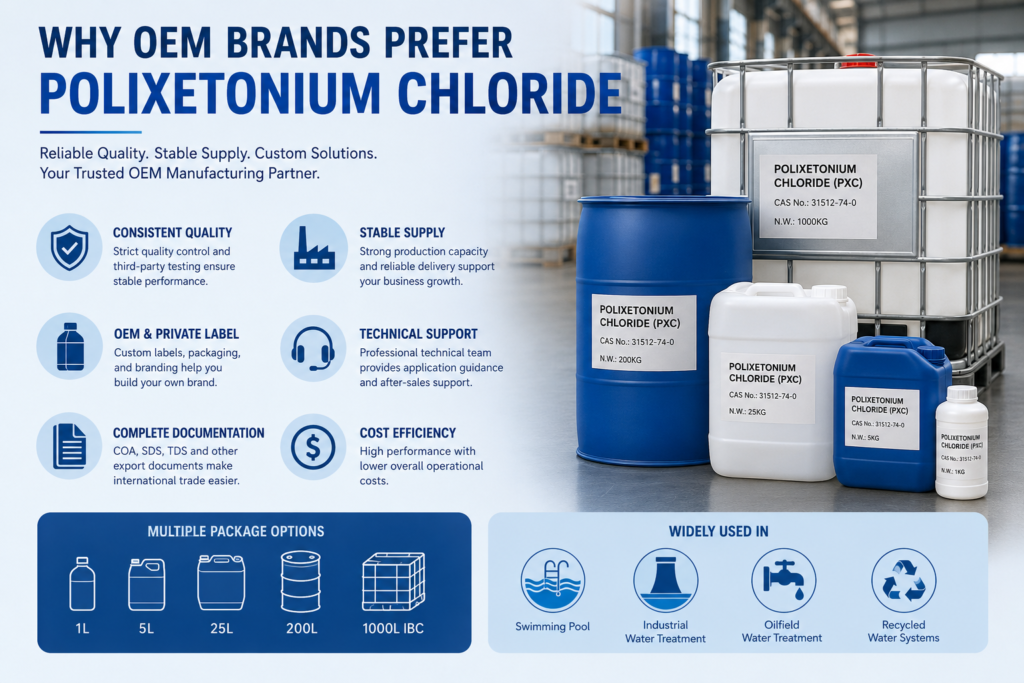
That’s one reason more OEM brands are turning to Polixetonium Chloride (CAS No. 31512-74-0). It isn’t simply because the product controls algae effectively. It’s because the right manufacturer can provide stable quality, dependable supply, technical support, and customized packaging—all of which help an OEM business grow with confidence.
Whether you’re launching a new pool chemical line or expanding an existing industrial water treatment portfolio, choosing the right OEM partner can save time, reduce costs, and strengthen your reputation in the market.
Let’s take a closer look at why so many private-label brands continue to choose Polixetonium Chloride.
Why More OEM Brands Are Choosing Polixetonium Chloride ?
Competition in the water treatment industry has become more intense over the past few years. Buyers are no longer looking for the cheapest raw material. They’re looking for a supplier that helps them build a reliable business.
Polixetonium Chloride fits this need well because it offers several advantages:
- Long-lasting non-oxidizing algae control
- Non-foaming performance
- Broad compatibility with many water treatment programs
- Stable storage characteristics
- Suitable for industrial and commercial applications
For OEM companies, these benefits translate into fewer customer complaints, better product consistency, and stronger brand loyalty.
After all, when customers buy your label, they expect the same quality every single time.
What OEM Customers Really Expect from a Supplier ?
Price is important.
But experienced buyers usually evaluate much more than price alone.
A professional OEM manufacturer should provide:
- Consistent manufacturing processes
- Reliable delivery schedules
- Complete technical documentation
- Fast communication
- Flexible packaging options
- Long-term production stability
Think about it this way.
A delayed shipment can interrupt your production line. An unstable product can damage your reputation. Missing documentation may delay customs clearance.
The right supplier helps prevent these problems before they happen.
Consistent Quality Builds Long-Term Brand Trust
Nothing is more valuable to an OEM brand than consistency.
When every batch performs the same way, your customers develop confidence in your products.
This starts with manufacturing control.
Reliable suppliers typically maintain strict quality management throughout production, including:
- Raw material inspection
- In-process quality control
- Finished product testing
- Batch traceability
- Retained samples for future verification
Many manufacturers also work with independent third-party laboratories to periodically verify important product characteristics. This additional testing provides another level of confidence beyond routine factory quality control.
For Polixetonium Chloride, consistency is especially important because variations in molecular characteristics may influence product performance in different applications.
If you’re interested in understanding quality in more detail, you may also enjoy What Makes High-Quality Polixetonium Chloride and Quality Standards for Polixetonium Chloride.
Flexible Formulation Options for Different Markets
Not every market requires exactly the same product.
Some customers prefer concentrated formulations.
Others focus on transportation efficiency.
Certain markets may require different packaging sizes or customized labeling.
An experienced OEM manufacturer understands these differences and works closely with customers to develop suitable solutions whenever technically feasible.
Depending on project requirements, OEM services may include:
- Customized product labels
- Private brand packaging
- Multiple package sizes
- Language-specific labels
- Pallet configuration adjustments
- Shipping mark customization
These details may seem small, but they make importing and selling much easier.
Private Label and Custom Packaging Make Branding Easier
For many distributors, building a recognizable brand is far more valuable than simply reselling generic chemicals.
Private labeling allows companies to establish their own identity without investing in manufacturing facilities.
Typical packaging options include:
- 1L plastic bottles
- 5L plastic jerrycans
- 25L stackable jerrycans
- 200L plastic drums
- 1000L IBC totes
OEM suppliers can often assist with:
- Label printing
- Carton design
- Pallet labeling
- Barcode printing
- Batch coding
- Production date marking
These services help create a professional appearance that reflects your brand image.
A Stable Supply Chain Supports Business Growth
Imagine winning several large customers…
…only to discover your supplier cannot deliver on time.
That’s every distributor’s nightmare.
Reliable supply is one of the biggest reasons OEM brands stay with the same manufacturer for years.
A dependable supplier should offer:
- Stable production capacity
- Reasonable lead times
- Inventory planning
- Flexible shipping arrangements
- Consistent export experience
When your supplier becomes predictable, your own planning becomes much easier.
Technical Support Doesn’t End After Delivery
A shipment arriving at your warehouse isn’t the end of the relationship.
In many cases, it’s just the beginning.
Professional OEM manufacturers often support customers with:
- Product recommendations
- Application guidance
- COA interpretation
- SDS and TDS preparation
- Storage recommendations
- Technical troubleshooting
Sometimes customers even request additional testing beyond standard specifications.
Depending on available resources, suppliers may also assist with third-party analysis such as molecular weight characterization or toxicological studies to provide deeper product understanding.
This kind of cooperation creates long-term partnerships instead of one-time transactions.
Documentation Makes International Purchasing Much Easier
International buyers usually require much more than a commercial invoice.
Common documentation includes:
- Certificate of Analysis (COA)
- Safety Data Sheet (SDS)
- Technical Data Sheet (TDS)
- Packing List
- Commercial Invoice
- Certificate of Origin (when required)
Clear documentation reduces delays during customs clearance and simplifies customer qualification procedures.
For many OEM brands, fast documentation can be just as valuable as fast production.
Cost Efficiency Is About More Than Product Price
It’s tempting to compare suppliers based only on the price per kilogram.
But experienced buyers know that total ownership cost tells the real story.
For example:
A supplier with slightly higher pricing may actually reduce your overall costs through:
- Better batch consistency
- Fewer customer complaints
- Lower product returns
- Faster technical support
- Reliable delivery
- Reduced inventory risk
In other words, lower operating costs often come from better reliability—not simply lower purchase prices.
This is discussed further in How Polixetonium Chloride Reduces Operating Costs and ROI Benefits of Polixetonium Chloride.
Long-Term OEM Partnerships Create More Value
The strongest OEM relationships are built over years, not months.
As cooperation grows, manufacturers gain a deeper understanding of your business.
They learn:
- Your packaging preferences
- Seasonal demand patterns
- Shipping requirements
- Market expectations
- Product positioning
That knowledge helps improve efficiency for both sides.
Over time, supplier and customer begin working less like separate companies and more like partners pursuing the same goal.
How to Choose the Right Polixetonium Chloride OEM Manufacturer ?
Not every manufacturer offers the same level of service.
When evaluating potential suppliers, consider the following questions:
- Is product quality consistent from batch to batch?
- Can they provide complete technical documentation?
- Do they support private labeling?
- Can they customize packaging?
- Do they have export experience?
- Is communication fast and professional?
- Can they provide third-party testing when needed?
- Are they willing to support long-term cooperation rather than short-term sales?
If you answer “yes” to most of these questions, you’ve likely found a supplier worth building a relationship with.
For a more detailed evaluation checklist, be sure to read How to Choose Polixetonium Chloride and Choosing the Best Polixetonium Chloride Supplier.
Final Thoughts
Polixetonium Chloride has become a preferred choice for many OEM brands because it offers far more than effective algae control.
Behind every successful private-label product is a dependable manufacturing partner who delivers consistent quality, reliable supply, responsive technical support, and flexible OEM services.
When those elements come together, distributors can focus on growing their business instead of solving supply problems.
If you’re planning to launch or expand your own water treatment brand, selecting the right Polixetonium Chloride manufacturer may be one of the most important decisions you’ll make.
A good supplier delivers products.
A great supplier helps build your brand.
FAQs
1. Why do OEM brands choose Polixetonium Chloride?
OEM brands value Polixetonium Chloride for its consistent performance, non-foaming characteristics, reliable algae control, and the availability of private-label manufacturing, custom packaging, and technical support.
2. Can Polixetonium Chloride be supplied under a private label?
Yes. Many manufacturers provide OEM and private-label services, including custom labels, packaging, carton printing, pallet markings, and branding to support distributors and chemical companies.
3. What documents should an OEM supplier provide?
A professional supplier should typically provide a COA, SDS, TDS, packing list, commercial invoice, and other export documents required for international shipments.
4. How can I evaluate a Polixetonium Chloride OEM manufacturer?
Look beyond price. Evaluate manufacturing consistency, quality control, export experience, documentation, communication speed, customization capabilities, and long-term technical support.
5. Can Polixetonium Chloride packaging be customized?
Yes. Depending on the manufacturer’s capabilities, packaging can usually be supplied in various sizes, such as 1L bottles, 5L jerrycans, 25L stackable containers, 200L drums, and 1000L IBC totes, with customized labels and branding to match your market requirements.