
GET IN TOUCH
Ask For Sample?
What Makes High-Quality Polixetonium Chloride?
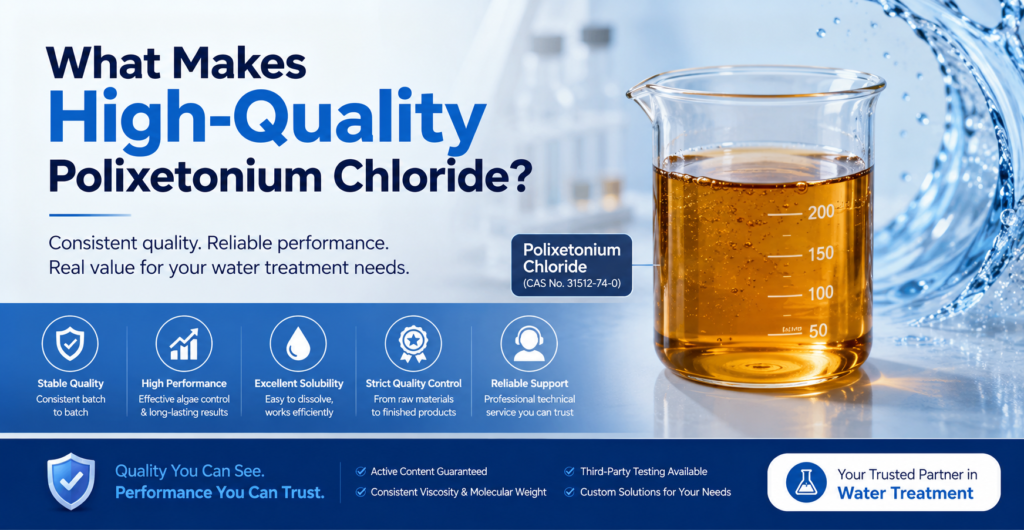
When purchasing Polixetonium Chloride (CAS No. 31512-74-0), many buyers naturally focus on price. After all, products with similar specifications often appear nearly identical on paper. The certificate of analysis (COA) may show comparable active content, pH, density, and viscosity, making every supplier seem equally qualified.
But here’s the reality: not all Polixetonium Chloride performs the same in real applications.
Whether it is used in industrial cooling water, swimming pool algaecides, or other water treatment systems, product quality directly affects algae control efficiency, dosage requirements, operating costs, and even customer satisfaction.
A lower purchase price can easily become a higher operating cost if the product requires more frequent dosing or delivers inconsistent performance.
So, what actually separates premium-quality Polixetonium Chloride from an average product?
Let’s break it down.
Why Product Quality Matters More Than Price
Polixetonium Chloride is a polymeric quaternary ammonium compound. Unlike many commodity chemicals, its performance depends on far more than simply meeting a minimum specification.
Two products labeled as 60% Polixetonium Chloride may behave quite differently because of differences in:
- Polymer molecular weight
- Polymer distribution
- Manufacturing process
- Raw material purity
- Process control
- Long-term production consistency
These differences are not always obvious from a standard COA.
That is why experienced buyers often evaluate suppliers—not just products.
What Defines High-Quality Polixetonium Chloride?
High-quality Polixetonium Chloride typically combines several characteristics rather than excelling in only one.
These include:
- Stable active content
- Consistent molecular weight
- Controlled viscosity
- Excellent water solubility
- Non-foaming performance
- Reliable algae control
- Batch-to-batch consistency
- Long-term storage stability
When all of these factors remain stable over multiple production batches, customers can confidently use the same dosage without constantly adjusting their treatment program.
Consistency is often more valuable than chasing the highest specification.
Active Content vs. Total Solids: An Important Difference
One area that often causes confusion is active content.
Many suppliers advertise their products simply as 60%.
However, buyers should ask an important question:
Does that 60% refer to active content or total solids?
These are not necessarily the same.
Active content represents the effective polymer responsible for algae control.
Total solids include all non-volatile materials present in the product.
In practical terms, a product labeled as 60% active content generally contains more effective polymer than a product labeled as 60% solids.
The difference may seem small, but over thousands of kilograms, it can significantly affect dosage efficiency and overall operating costs.
Understanding exactly how the supplier defines “60%” helps buyers make a fair comparison.
Molecular Weight and Viscosity: What They Tell You
Viscosity is more than just a physical property.
For polymer products like Polixetonium Chloride, viscosity often provides valuable insight into molecular weight.
Generally speaking:
- Higher molecular weight often produces higher viscosity.
- Lower molecular weight usually results in lower viscosity.
Although higher viscosity does not automatically guarantee better performance, it frequently reflects stronger polymer chains that contribute to longer-lasting biological control.
The key is consistency.
Large fluctuations in viscosity from one batch to another may indicate inconsistent polymerization during manufacturing.
Reliable manufacturers carefully monitor viscosity because stable molecular weight helps maintain predictable field performance.
Appearance and Color Consistency
At first glance, appearance may seem unimportant.
Actually, it provides useful information about production quality.
High-quality Polixetonium Chloride is typically supplied as an amber, transparent, viscous liquid.
Minor color variations can occur naturally, but the product should remain:
- Clear
- Free from suspended particles
- Free from precipitation
- Uniform in appearance
Unexpected cloudiness, excessive darkening, or visible impurities may indicate contamination, degradation, or manufacturing inconsistencies.
Appearance alone cannot determine quality—but it can certainly raise important questions.
Performance Testing Beyond the COA
A COA confirms whether the product meets routine specifications.
It does not necessarily demonstrate how the product performs in actual applications.
Leading manufacturers often conduct additional evaluations beyond routine quality control.
Examples may include:
- Molecular weight analysis
- Long-term stability studies
- Compatibility evaluations
- Performance validation under representative application conditions
- Third-party laboratory verification for selected properties
Want to know how manufacturers verify product quality? Explore the laboratory testing methods for Polixetonium Chloride to better understand routine quality control and testing principles.
Some manufacturers also periodically send production samples to independent laboratories to verify internal testing accuracy.
These additional evaluations provide buyers with greater confidence in long-term product reliability.
If you have specific performance requirements, it is always worth discussing them with your supplier. In many cases, additional testing data may already be available or can be obtained through existing laboratory resources.
Manufacturing Process and Quality Control
Consistent product quality begins long before the final packaging stage.
Reliable manufacturers generally invest heavily in:
- Qualified raw materials
- Controlled reaction conditions
- Process monitoring
- Standardized production procedures
- Batch traceability
- Routine equipment calibration
Quality control is not simply the final inspection.
It starts with raw materials and continues throughout every production step.
This systematic approach helps minimize batch variation and provides stable product performance over time.
Understanding the quality standards for Polixetonium Chloride can help buyers compare suppliers more effectively and identify products with consistent manufacturing quality.
Packaging, Storage, and Supply Stability
Even an excellent product can lose quality if handled improperly.
Professional suppliers pay close attention to:
- Suitable packaging materials
- Proper sealing
- Warehouse temperature control
- Inventory management
- Transportation protection
High-quality Polixetonium Chloride should remain stable under recommended storage conditions without significant changes in appearance or routine quality indicators during its intended shelf life.
Reliable supply is equally important.
Customers running continuous production cannot afford interruptions caused by inconsistent manufacturing schedules.
Questions Every Buyer Should Ask Before Purchasing
Rather than comparing price alone, consider asking suppliers questions like these:
- Is the stated 60% based on active content or total solids?
- How is active content verified?
- Is third-party testing available?
- Is molecular weight data available?
- How is batch consistency controlled?
- Can typical production data be shared?
- What quality management procedures are followed?
- How are customer complaints investigated and resolved?
Suppliers who can answer these questions clearly usually demonstrate a stronger commitment to product quality.
Final Thoughts
High-quality Polixetonium Chloride is not defined by a single specification.
Instead, it reflects the combination of consistent manufacturing, accurate quality control, stable polymer characteristics, reliable performance, and dependable technical support.
While pricing will always remain an important consideration, experienced buyers know that long-term value comes from consistent quality rather than the lowest initial cost.
Choosing a supplier who understands both the chemistry and the application can reduce operating costs, improve treatment performance, and build greater confidence over the lifetime of the product.
Before requesting quotations, read our guide on how to choose the right Polixetonium Chloride supplier to avoid common purchasing mistakes and make a more informed decision.
Frequently Asked Questions
1. What should Polixetonium Chloride look like?
High-quality Polixetonium Chloride is typically an amber, transparent, viscous liquid without suspended particles or visible precipitation.
2. Why is active content more important than total solids?
Active content represents the effective polymer responsible for performance, while total solids include all non-volatile components. Two products labeled “60%” may not contain the same amount of active polymer.
3. Does higher viscosity always mean better quality?
Not necessarily. Viscosity often reflects molecular weight, but consistent viscosity from batch to batch is generally more important than simply having a higher value.
4. Can a COA fully guarantee product performance?
No. A COA confirms routine quality specifications, but additional evaluations—such as molecular weight analysis, stability testing, and application performance studies—provide a more complete picture of product quality.
5. What is the most important factor when selecting a Polixetonium Chloride supplier?
Look beyond price. Consider manufacturing consistency, quality control systems, technical support, third-party verification, and the supplier’s ability to provide stable performance over multiple production batches.