GET IN TOUCH
Ask For Sample?
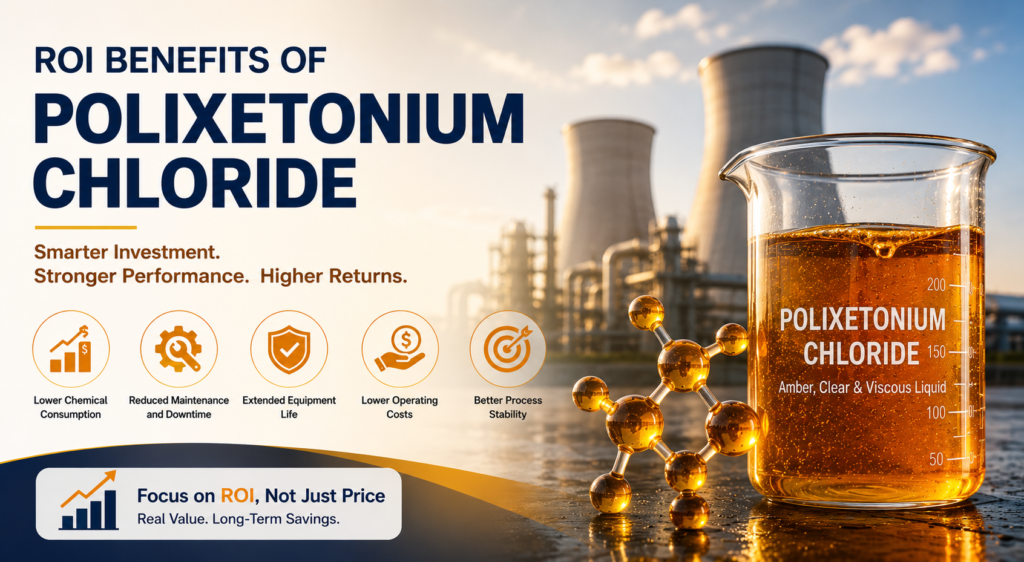
ROI Benefits of Polixetonium Chloride: Why Smart Buyers Focus on Total Value Instead of Price
When purchasing industrial water treatment chemicals, it’s tempting to compare products based solely on price per kilogram or price per drum. After all, that’s the number everyone sees first.
But is the lowest-priced chemical really the least expensive option?
Not always.
Experienced buyers know that the real cost of a biocide goes far beyond its purchase price. Chemical consumption, maintenance frequency, equipment reliability, production interruptions, labor costs, and product quality all contribute to the overall operating expense.
That’s exactly why more companies are evaluating Return on Investment (ROI) rather than simply comparing quotations.
Polixetonium Chloride has earned a strong reputation in industrial water treatment because it delivers consistent biological control while helping reduce many hidden operating costs. Although the initial purchase price may be higher than some conventional products, many users find that the overall economics become much more favorable over time.
Let’s take a closer look at where these savings come from.
Why ROI Matters When Choosing a Water Treatment Biocide
Every chemical added to a water system should create measurable value.
The real question isn’t:
“How much does this product cost?”
Instead, ask:
“How much money does this product save me?”
For industrial cooling water, process water, and similar systems, poor microbial control can lead to:
- Biofilm formation
- Reduced heat-transfer efficiency
- Increased energy consumption
- More frequent cleaning
- Equipment fouling
- Unexpected shutdowns
- Higher maintenance costs
- Shorter equipment life
Even a relatively inexpensive biocide can become very costly if these issues continue to occur.
That’s why ROI has become one of the most important purchasing indicators.
What Makes Polixetonium Chloride a Cost-Effective Solution
Polixetonium Chloride is a polymeric quaternary ammonium compound widely used for controlling algae and microorganisms in industrial water systems.
Its value comes from several characteristics:
- Non-foaming performance
- Broad compatibility with many water treatment programs
- Good stability across a wide pH range
- Long service life in circulating water systems
- Reliable algae control
- Reduced risk of repeated contamination
Instead of solving today’s algae problem only to face another outbreak next week, many facilities prefer products that provide more stable long-term control.
That consistency directly affects operating costs.
Lower Chemical Consumption, Better Long-Term Value
One of the easiest ROI improvements comes from reducing overall chemical usage.
A product with stronger persistence often requires:
- Less frequent dosing
- Lower replenishment rates
- Fewer emergency shock treatments
- Better maintenance of biological control
Imagine two products.
Product A costs less per drum but requires weekly heavy dosing.
Product B costs slightly more yet maintains performance for a longer period.
After several months, Product B may actually consume fewer total kilograms.
In many facilities, total annual chemical expenditure matters far more than unit price.
That’s where Polixetonium Chloride frequently delivers better value.
Reduced Equipment Downtime and Maintenance Costs
Microbial contamination doesn’t simply make water look dirty.
It affects the entire operating system.
Algae and biofilm can reduce heat-transfer efficiency, restrict flow, and increase maintenance frequency.
Every maintenance shutdown has hidden costs:
- Lost production time
- Additional labor
- Cleaning chemicals
- Replacement parts
- Restart procedures
Keeping biological growth under control helps reduce these interruptions.
For manufacturers operating around the clock, even one avoided shutdown may offset the cost difference between competing biocides.
That’s a significant ROI factor that often doesn’t appear on a quotation sheet.
Extended Service Life of Water Systems
Water systems represent major capital investments.
Cooling towers, heat exchangers, circulation pumps, pipelines, and storage tanks are expensive assets designed for years of operation.
Excessive biological fouling can accelerate wear by:
- Restricting water flow
- Increasing mechanical load
- Promoting localized corrosion under deposits
- Increasing cleaning frequency
While no biocide can eliminate every maintenance requirement, effective biological control helps maintain cleaner operating conditions.
Over time, that may contribute to longer equipment life and fewer unexpected repairs.
Lower Labor and Operational Expenses
Have you noticed how much staff time routine maintenance can consume?
Operators may need to:
- Inspect algae growth
- Adjust dosing
- Clean strainers
- Flush pipelines
- Remove deposits
- Respond to customer complaints
When microbial control becomes more stable, these routine tasks often require less intervention.
The result isn’t just chemical savings.
It’s improved labor efficiency.
And labor is becoming one of the fastest-growing operating costs in many countries.
Proper dosing and system management can further increase savings. Read our guide on Optimizing Performance with Polixetonium Chloride for practical recommendations.
Improved Product Quality and Process Stability
In many manufacturing processes, water quality directly influences production quality.
Biological contamination can lead to:
- Process instability
- Reduced cooling efficiency
- Unplanned production interruptions
- Inconsistent operating conditions
Stable microbial control helps maintain more predictable process performance.
For manufacturers producing high-value products, consistency itself has measurable financial value.
Less variation often means:
- Higher production efficiency
- Lower rejection rates
- Better customer satisfaction
These benefits can be difficult to quantify individually, yet together they often make a meaningful contribution to overall ROI.
Comparing Total Cost of Ownership Instead of Purchase Price
Professional purchasing teams increasingly evaluate chemicals using Total Cost of Ownership (TCO) rather than purchase price alone.
Instead of asking:
“Which product is cheaper?”
They ask:
“Which product costs less to operate?”
A complete evaluation should include:
| Cost Factor | Purchase Price Only | Total Cost of Ownership |
|---|---|---|
| Product price | ✓ | ✓ |
| Chemical consumption | ✗ | ✓ |
| Dosing frequency | ✗ | ✓ |
| Equipment maintenance | ✗ | ✓ |
| Downtime risk | ✗ | ✓ |
| Labor requirements | ✗ | ✓ |
| Equipment lifespan | ✗ | ✓ |
| Production efficiency | ✗ | ✓ |
This broader perspective often changes purchasing decisions.
The lowest quotation isn’t always the lowest operating cost.
Before comparing suppliers, it’s helpful to learn how to evaluate Polixetonium Chloride performance using practical quality and application indicators.
How to Calculate the ROI of Polixetonium Chloride
Every facility is different, but a practical ROI evaluation can follow a simple framework.
Step 1: Record Current Operating Costs
Include:
- Annual biocide purchases
- Cleaning expenses
- Maintenance labor
- Downtime costs
- Equipment repair costs
Step 2: Estimate Performance Improvements
Consider expected reductions in:
- Chemical usage
- Cleaning frequency
- Maintenance hours
- Emergency shutdowns
- Equipment fouling
Even modest improvements across several categories can add up over a year.
Step 3: Compare Annual Savings with Additional Investment
A simplified formula is:
ROI (%) = (Annual Savings − Additional Chemical Cost) ÷ Additional Chemical Cost × 100
For example:
- Additional chemical investment: US$5,000
- Annual operating savings: US$18,000
ROI:
(18,000 − 5,000) ÷ 5,000 × 100 = 260%
While actual results vary by system design, operating conditions, and treatment program, this example illustrates why many buyers evaluate total financial impact rather than purchase price alone.
Choosing a Reliable Supplier to Maximize ROI
Even the best chemistry cannot deliver strong ROI without consistent product quality.
When selecting a supplier, consider more than pricing.
Look for:
- Consistent active content
- Stable batch-to-batch quality
- Reliable production capacity
- Third-party quality verification
- Technical support
- Responsive after-sales service
- Flexible packaging options
A dependable supplier helps reduce supply risks while ensuring that product performance remains consistent over the long term.
Consistent product quality is essential for achieving long-term ROI. Learn more about the Quality Standards for Polixetonium Chloride that professional buyers should review before purchasing.
Conclusion
The true value of Polixetonium Chloride isn’t measured by its price per kilogram.
It’s measured by the operating savings it helps generate.
Lower chemical consumption, fewer maintenance interventions, reduced downtime, longer equipment life, and more stable production can all contribute to a stronger financial return.
For companies focused on long-term efficiency rather than short-term purchasing costs, evaluating ROI instead of unit price provides a much clearer picture of overall value.
When viewed through the lens of total operating cost, Polixetonium Chloride often proves to be an investment rather than simply another expense.
FAQs
1. Why is ROI more important than purchase price when selecting Polixetonium Chloride?
Purchase price reflects only the initial cost. ROI considers the total financial impact, including chemical consumption, maintenance, downtime, labor, and equipment performance, giving a more complete picture of long-term value.
2. Can Polixetonium Chloride help reduce operating costs?
Yes. By providing reliable biological control, it can help reduce cleaning frequency, maintenance requirements, emergency treatments, and production interruptions, depending on the specific application and operating conditions.
3. How do I calculate the ROI of Polixetonium Chloride?
Compare your current annual operating costs with the projected costs after adopting Polixetonium Chloride. Include savings from reduced chemical usage, lower maintenance expenses, fewer shutdowns, and improved operational efficiency.
4. Which industries benefit most from the ROI of Polixetonium Chloride?
Industries operating recirculating water systems—such as power generation, HVAC, manufacturing, paper mills, metal processing, and commercial water treatment—may realize meaningful cost savings through improved microbial control.
5. How can I maximize the return on my investment in Polixetonium Chloride?
Choose a supplier that offers consistent product quality, dependable technical support, comprehensive quality documentation, and reliable global supply. Proper dosing, routine monitoring, and integration into a well-designed water treatment program will also help achieve the best long-term results.