GET IN TOUCH
Ask For Sample?
How Polixetonium Chloride Reduces Operating Costs ?
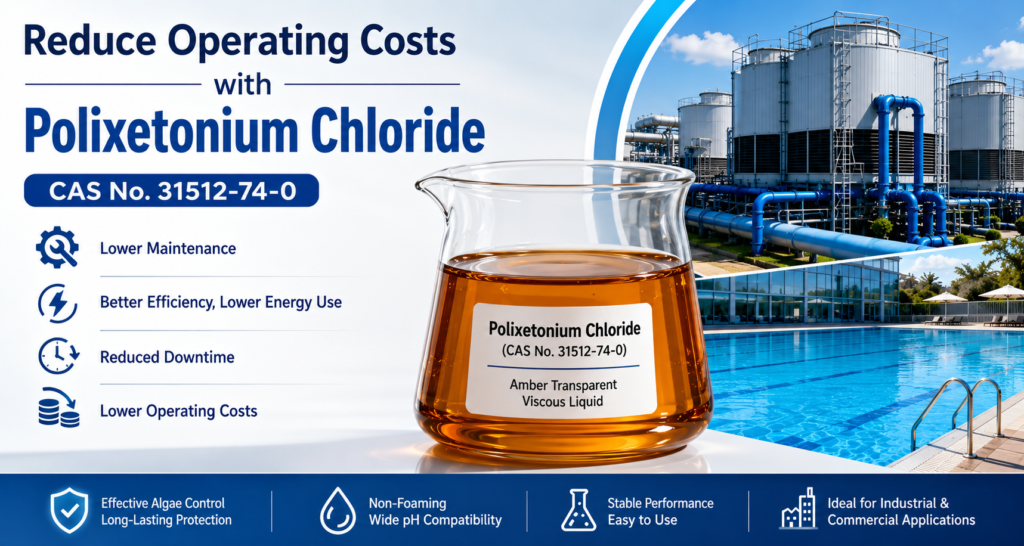
Every water treatment system has one thing in common: operating costs never stay still.
Chemical prices fluctuate. Labor becomes more expensive. Equipment maintenance adds up. Even a small increase in water consumption or cleaning frequency can significantly affect annual operating expenses.
That’s exactly why many industrial facilities, commercial water treatment companies, and swimming pool chemical manufacturers are shifting their attention from simply buying the cheapest chemical to choosing products that lower the total cost of operation.
One product that often delivers this advantage is Polixetonium Chloride (CAS No. 31512-74-0).
At first glance, it may appear more expensive than some conventional biocides or algae-control chemicals. But when you look beyond the purchase price, the overall economics become much more attractive.
Let’s explain why.
What Is Polixetonium Chloride?
Polixetonium Chloride is a polymeric quaternary ammonium compound widely used as a non-oxidizing biocide and algaecide in industrial water treatment and swimming pool applications.
Unlike oxidizing biocides that work through rapid oxidation, Polixetonium Chloride acts through a cationic polymer mechanism. Positively charged polymer chains interact with negatively charged microorganisms, disrupting their cell membranes and preventing further growth.
Because of this mechanism, it offers several practical advantages:
- Non-foaming
- Broad pH compatibility
- Good stability during storage
- Compatible with many common water treatment programs
- Long-lasting biological control
These characteristics contribute directly to lower operating expenses.
If you’re new to this chemistry, our guide Everything You Need to Know About Polixetonium Chloride explains its properties, applications, and key advantages in greater detail.
Where Operating Costs Come From in Water Treatment
When people think about treatment costs, they usually focus on chemical prices.
But chemicals often represent only part of the total operating budget.
A typical system also includes costs such as:
- Equipment cleaning
- Biofilm removal
- Downtime
- Labor
- Water replacement
- Energy consumption
- Maintenance
- Product inventory
- Waste disposal
Interestingly, many of these hidden expenses are connected to biological contamination.
If algae, slime, or microorganisms are not effectively controlled, almost every other operating cost begins to increase.
That’s where Polixetonium Chloride can make a noticeable difference.
How Polixetonium Chloride Helps Reduce Total Operating Costs
Longer Residual Activity Means Fewer Chemical Additions
One major advantage of polymeric biocides is their ability to provide relatively long-lasting control.
Instead of requiring frequent dosing to maintain protection, properly managed systems can often extend treatment intervals compared with products that lose activity rapidly.
This can help reduce:
- Chemical handling
- Operator workload
- Inventory turnover
- Dosing frequency
For facilities managing multiple systems, even a small reduction in maintenance visits can translate into meaningful annual savings.
Less Biofilm Means Better Equipment Efficiency
Biofilm isn’t just unpleasant.
It acts like insulation.
Heat exchangers, cooling systems, and circulation equipment become less efficient when coated with biological deposits.
As biofilm builds up:
- Heat transfer efficiency decreases.
- Pumps work harder.
- Energy consumption increases.
- Cleaning becomes more frequent.
By helping control microorganisms before extensive biofilm develops, Polixetonium Chloride supports more consistent system performance and can reduce maintenance requirements.
Reduced Cleaning Frequency
Manual cleaning is expensive.
It involves labor, downtime, chemicals, and sometimes temporary shutdowns.
Facilities that maintain better biological control often experience:
- Less slime accumulation
- Cleaner system surfaces
- Reduced maintenance intervals
- Lower cleaning chemical consumption
Even one avoided shutdown each year can offset a significant portion of the chemical cost.
Lower Risk of Equipment Downtime
Unexpected downtime is usually far more expensive than planned maintenance.
Blocked pipelines, clogged filters, biological fouling, or algae growth can interrupt normal production and require emergency service.
A stable preventative treatment program helps reduce these risks.
Although no chemical can eliminate every operational issue, maintaining effective microbial control decreases the likelihood of biologically related interruptions.
Improved Water Quality Supports Overall Process Stability
Consistent water quality often results in more stable operation.
Whether it’s a cooling tower or a commercial swimming pool, fewer biological fluctuations generally mean:
- More predictable water chemistry
- Easier routine maintenance
- Reduced corrective chemical additions
- Better overall operating efficiency
Small improvements repeated throughout the year can produce significant cumulative savings.
Lower operating costs often begin with higher system efficiency. Learn more in How Polixetonium Chloride Improves Process Efficiency.
Real-World Industries That Benefit Most
Polixetonium Chloride is used across a wide range of industries where biological growth directly affects operating costs.
Industrial Cooling Water Systems
Cooling towers continuously circulate warm water—an ideal environment for algae and microbial growth.
Effective biological control helps reduce fouling, maintain heat transfer efficiency, and minimize maintenance.
Commercial Swimming Pools
For pool operators, algae outbreaks are expensive.
They often require:
- Pool closure
- Shock treatment
- Extra labor
- Additional cleaning
- Increased chemical consumption
As a non-foaming polymeric algaecide, Polixetonium Chloride helps maintain cleaner water and reduce the likelihood of costly corrective treatments.
Decorative Fountains and Water Features
Public fountains are expected to remain visually attractive.
Preventing algae growth helps reduce manual cleaning and water replacement while improving appearance throughout the season.
Industrial Process Water
Manufacturing systems that rely on circulating water benefit from improved microbial control, helping reduce operational interruptions caused by biological contamination.
For additional application examples across different industries, see Industry-Specific Uses of Polixetonium Chloride.
Cost Savings Beyond Chemical Consumption
Here’s something many buyers overlook.
The cheapest product isn’t always the least expensive solution.
Imagine two chemicals:
Product A
- Lower purchase price
- Requires weekly dosing
- More cleaning
- More labor
- Higher downtime risk
Product B (Polixetonium Chloride)
- Higher unit price
- Longer service intervals
- Lower maintenance
- Less cleaning
- Better operational consistency
Over twelve months, Product B may produce a lower total cost of ownership despite its higher initial purchase price.
That is why experienced purchasing managers often evaluate overall operating economics instead of focusing solely on the invoice price.
How to Maximize Cost Efficiency with Polixetonium Chloride
Using the right product is only part of the equation.
To achieve the best return on investment:
- Select the appropriate concentration for your application.
- Follow recommended dosing guidelines.
- Monitor water quality regularly.
- Maintain proper circulation.
- Avoid unnecessary overdosing.
- Store the product under recommended conditions.
- Work with a supplier that provides consistent product quality and technical support.
Consistent product quality also helps reduce batch-to-batch variation, making treatment programs more predictable.
Product quality and correct dosing both influence operating costs. Our article Optimizing Performance with Polixetonium Chloride shares practical recommendations.
Common Mistakes That Increase Costs
Even high-quality products cannot compensate for poor application practices.
Some common mistakes include:
Using Price as the Only Purchasing Criterion
A lower purchase price may result in higher operating expenses if performance is inconsistent.
Ignoring Preventive Treatment
Waiting until algae or biofilm becomes visible usually requires more chemicals and more labor than maintaining routine prevention.
Incorrect Dosing
Too little product may reduce treatment effectiveness.
Too much product increases chemical costs without necessarily improving results.
Following supplier recommendations and monitoring system performance is the most cost-effective approach.
Choosing Inconsistent Suppliers
Variation in active content, molecular characteristics, or manufacturing quality can affect treatment consistency.
Reliable suppliers help maintain stable long-term operating costs.
Is Polixetonium Chloride Worth the Investment?
For many industrial users, the answer is yes.
Instead of evaluating only the purchase price, consider the broader financial picture:
- Lower maintenance costs
- Reduced cleaning frequency
- Improved equipment efficiency
- Less downtime
- Lower labor requirements
- More stable water quality
- Better long-term operating economics
When these factors are combined, Polixetonium Chloride often provides value that extends well beyond the cost of the chemical itself.
Conclusion
Reducing operating costs isn’t about finding the lowest-priced chemical. It’s about selecting a treatment solution that improves the efficiency of your entire system.
Polixetonium Chloride helps achieve this by supporting effective biological control, reducing maintenance demands, minimizing downtime, and contributing to more stable operation over time.
Whether you manage industrial cooling water, commercial swimming pools, decorative fountains, or other water systems, evaluating the total cost of ownership can reveal benefits that aren’t immediately obvious from the purchase price alone.
A well-designed treatment program built around consistent product quality and proper application can deliver measurable savings year after year.
If you’re evaluating suppliers or comparing specifications, don’t miss How to Choose Polixetonium Chloride, which explains the key quality indicators buyers should review before making a purchasing decision.
Frequently Asked Questions
1. How does Polixetonium Chloride reduce operating costs?
It helps reduce expenses by controlling biological growth, lowering cleaning frequency, reducing maintenance, minimizing downtime, and supporting more efficient system operation.
2. Is Polixetonium Chloride more cost-effective than cheaper biocides?
While its purchase price may be higher than some alternatives, many users find that reduced labor, maintenance, and operational interruptions lead to a lower total cost of ownership.
3. Which industries benefit most from using Polixetonium Chloride?
Industrial cooling water systems, commercial swimming pools, decorative fountains, and other circulating water systems commonly benefit from improved biological control and lower maintenance requirements.
4. Does using more Polixetonium Chloride always improve performance?
No. Excessive dosing increases chemical costs and may not provide additional benefits. Following supplier recommendations and monitoring system performance is generally the most economical approach.
5. What should buyers look for when choosing a Polixetonium Chloride supplier?
Look for consistent active content, reliable manufacturing quality, stable product performance, technical support, third-party testing capabilities, and dependable supply. These factors help ensure predictable operating costs over the long term.