
GET IN TOUCH
Ask For Sample?
How to Improve Performance with Polixetonium Chloride ?
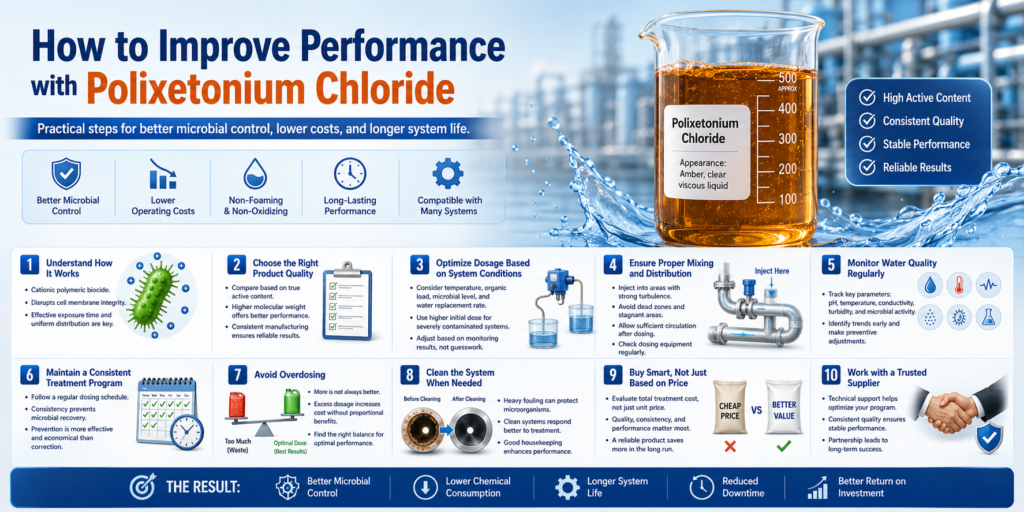
When a water treatment program doesn’t deliver the expected results, many people assume the chemical itself is the problem. Surprisingly, that’s often not the case.
In many cooling water systems, industrial process water applications, and swimming pool formulations, Polixetonium Chloride, CAS No. 31512-74-0, performs exactly as designed—but only when it’s used under the right conditions. Factors such as dosage, water quality, system cleanliness, and product quality all influence the final performance.
The good news? Most performance issues can be corrected without changing products.
In this guide, we’ll explain the practical steps that help maximize the effectiveness of Polixetonium Chloride, reduce operating costs, and achieve more stable long-term results.
Why Performance Optimization Matters
Polixetonium Chloride is valued because it provides long-lasting microbiological control while remaining:
- Non-foaming
- Non-oxidizing
- Stable across a wide pH range
- Compatible with many industrial water systems
- Easy to handle compared with many traditional biocides
However, even an excellent product cannot compensate for poor application practices.
Improving performance means:
- Better algae control
- More consistent microbial suppression
- Lower chemical consumption
- Longer service intervals
- Improved system cleanliness
- Better return on investment
Small adjustments often produce noticeable improvements.
Understand How Polixetonium Chloride Works
Before discussing optimization, it’s important to understand its working mechanism.
Unlike oxidizing biocides that destroy microorganisms through rapid oxidation, Polixetonium Chloride is a cationic polymeric biocide.
Its positively charged polymer chains interact with negatively charged microbial cell surfaces, disrupting cell membrane integrity and eventually causing cell death.
Because of this mechanism:
- Good contact time matters.
- Uniform distribution throughout the system is important.
- Adequate concentration must be maintained.
Performance depends on maintaining effective exposure rather than producing an immediate “shock” effect.
Choose the Right Product Quality
Not every Polixetonium Chloride product on the market performs the same.
Several quality factors directly influence field performance.
Active Content
One of the first specifications buyers compare is concentration.
However, it’s important to understand that active content and total solids content are not always identical.
Some suppliers advertise products based on solids content, while others specify true active content. Two products both labeled “60%” may not actually contain the same amount of effective polymer.
For this reason, always compare products using active content whenever possible.
If you are interested in understanding how active content is measured, feel free to discuss the testing methods with your supplier.
Molecular Weight
Although molecular weight is not always listed on a COA, it strongly influences product performance.
Higher molecular weight generally provides:
- Better adsorption onto microorganisms
- Longer residual activity
- Improved treatment efficiency in many systems
Consistency between production batches is equally important.
Manufacturing Consistency
Reliable manufacturers maintain tight control over:
- Viscosity
- Polymerization process
- Raw material quality
- Batch-to-batch consistency
Stable manufacturing usually leads to more predictable field performance.
Optimize Dosage Based on System Conditions
Using either too little or too much product reduces treatment efficiency.
Several operating factors affect the ideal dosage:
- Water temperature
- Organic contamination
- System turnover
- Existing microbial population
- Water replacement rate
Systems with heavy biological contamination generally require higher initial treatment levels before switching to maintenance dosing.
Starting with an insufficient dosage often allows microorganisms to recover quickly.
On the other hand, excessive dosing usually increases operating costs without delivering proportional benefits.
Whenever possible, base dosage adjustments on actual system monitoring rather than fixed schedules.
Ensure Proper Mixing and Distribution
Even a premium product cannot work effectively if it never reaches every part of the system.
Poor circulation creates untreated areas where microorganisms continue growing.
For best performance:
- Inject into areas with strong turbulence.
- Avoid stagnant sections whenever possible.
- Allow sufficient circulation after dosing.
- Verify that dosing equipment operates correctly.
Uniform distribution usually improves treatment efficiency more than simply increasing dosage.
Monitor Water Quality Regularly
Performance optimization isn’t a one-time adjustment.
Water quality changes continuously.
Important parameters to monitor include:
- pH
- Temperature
- Conductivity
- Turbidity
- Microbial activity
- Organic loading
Routine monitoring allows operators to identify trends before biological problems become serious.
Instead of reacting to algae outbreaks, operators can make small preventive adjustments that keep systems stable.
Maintain a Consistent Treatment Program
One of the most common mistakes is inconsistent dosing.
Skipping scheduled additions often allows microorganisms to recover, making later treatment much more difficult.
A consistent treatment program offers several advantages:
- Stable microbial control
- Reduced algae growth
- Lower overall chemical consumption
- More predictable operating costs
- Better long-term system cleanliness
Think of Polixetonium Chloride as preventive maintenance rather than emergency treatment.
Consistency almost always outperforms occasional heavy dosing.
Avoid Common Performance Mistakes
Several avoidable mistakes reduce treatment efficiency.
Assuming More Product Always Works Better
Increasing dosage beyond the recommended range rarely doubles performance.
Instead, it usually increases operating costs.
Always optimize before increasing consumption.
Ignoring Existing Fouling
Heavy slime or deposits may physically shield microorganisms from the treatment chemical.
Cleaning heavily fouled systems before beginning a treatment program often produces much better results.
Purchasing Only on Price
The lowest-priced product isn’t always the most economical.
Differences in active content, molecular weight, manufacturing consistency, and quality control can significantly affect real-world performance.
Evaluating total treatment cost usually provides a better purchasing decision than comparing unit price alone.
Neglecting Routine Monitoring
Without regular testing, operators may not notice gradual changes until visible biological growth appears.
Preventive monitoring saves both time and treatment costs.
Conclusion
Improving the performance of Polixetonium Chloride is rarely about finding a different product. More often, it’s about using the product correctly.
Selecting consistent product quality, verifying active content, optimizing dosage, maintaining good circulation, monitoring water conditions, and following a regular treatment program all contribute to better long-term results.
When these factors work together, users typically achieve more reliable microbial control, lower operating costs, and longer-lasting system cleanliness.
For industrial users and water treatment professionals, performance optimization is an ongoing process—not a one-time adjustment. Small improvements in application practices can lead to significant gains in efficiency over time.
Frequently Asked Questions
1. Does using more Polixetonium Chloride always improve performance?
No. Excessive dosing generally increases chemical costs without providing proportional performance improvements. The optimal dosage depends on water quality, contamination level, and system operating conditions.
2. Why do two products labeled “60%” sometimes perform differently?
The label may refer to different specifications, such as active content or total solids content. Differences in molecular weight, manufacturing quality, and batch consistency can also affect real-world performance.
3. How often should system conditions be monitored?
Routine monitoring schedules vary by application, but regularly checking parameters such as pH, temperature, microbial activity, and organic loading helps maintain stable treatment performance.
4. Can poor circulation reduce treatment efficiency?
Yes. Areas with inadequate circulation may receive insufficient chemical exposure, allowing microorganisms to survive and continue growing. Proper mixing is essential for uniform treatment.
5. What is the most effective way to maximize Polixetonium Chloride performance?
Use a high-quality product with consistent active content, apply the correct dosage, ensure thorough distribution, monitor water quality regularly, and maintain a consistent preventive treatment program rather than relying on occasional corrective dosing.