
GET IN TOUCH
Ask For Sample?
Everything You Need to Know About Polixetonium Chloride
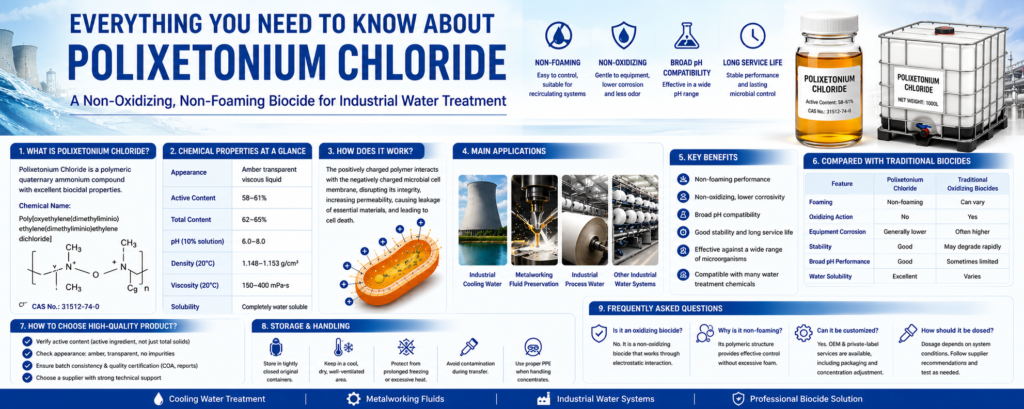
Whether you’re treating industrial cooling water, preserving metalworking fluids, or looking for a reliable non-oxidizing biocide, you’ve probably come across Polixetonium Chloride.
But what exactly is it? Why has it remained a trusted solution for decades while many other water treatment chemicals come and go? And perhaps more importantly, how can you tell whether you’re buying a high-quality product?
This guide answers those questions in plain English. Whether you’re new to the product or already sourcing it for commercial use, you’ll gain a practical understanding of its chemistry, performance, applications, and purchasing considerations.
What Is Polixetonium Chloride?
Polixetonium Chloride is a polymeric quaternary ammonium compound (often called a polymeric quaternary ammonium biocide). Unlike traditional oxidizing biocides such as chlorine or bromine, it controls microorganisms without relying on oxidation.
Its chemical name is:
Poly[oxyethylene(dimethyliminio)ethylene(dimethyliminio)ethylene dichloride]
Common product information includes:
| Property | Value |
|---|---|
| Chemical Name | Poly[oxyethylene(dimethyliminio)ethylene(dimethyliminio)ethylene dichloride] |
| CAS No. | 31512-74-0 |
| EINECS No. | 608-627-7 |
| Appearance | Amber transparent viscous liquid |
| Typical Active Content | 58–61% |
| pH (10% solution) | 6.0–8.0 |
| Solubility | Completely water soluble |
Because it is a polymer rather than a small-molecule biocide, it behaves differently in water systems. It provides effective microbial control while producing very little foam, making it suitable for systems where excessive foaming would interfere with operation.
Why Is Polixetonium Chloride So Widely Used?
Not every water treatment chemical survives decades of commercial use.
Polixetonium Chloride has remained popular because it solves several practical problems at the same time.
It offers:
- Non-foaming performance
- Broad pH compatibility
- Good stability during storage
- Lower corrosivity than many oxidizing biocides
- Long service life in many recirculating systems
- Good compatibility with many common water treatment formulations
For plant operators, these advantages translate into fewer operational headaches.
Imagine constantly fighting foam in a cooling tower or watching metal equipment suffer from aggressive oxidizers. A polymeric biocide avoids many of those issues while still helping control microbial growth.
That’s one reason it continues to be specified by many industrial water treatment formulators.
Chemical Properties at a Glance
One interesting feature of Polixetonium Chloride is its polymeric structure.
Instead of being a small reactive molecule, it consists of repeating quaternary ammonium units carrying positive charges along the polymer chain.
These positive charges allow the polymer to interact efficiently with negatively charged microbial cell surfaces.
Typical specifications include:
| Test Item | Typical Specification |
|---|---|
| Appearance | Amber transparent viscous liquid |
| Active Ingredient | 58–61% |
| Total Content | 62–65% |
| Density | 1.148–1.153 g/cm³ |
| Viscosity | 150–400 mPa·s |
An important point worth mentioning is viscosity.
Many buyers focus only on active content. That’s understandable—but viscosity often tells another part of the story.
For polymeric products like Polixetonium Chloride, viscosity generally reflects molecular weight. Within a properly controlled manufacturing process, molecular weight can influence product performance. While higher isn’t always better for every application, consistent viscosity usually indicates stable production quality from batch to batch.
How Does Polixetonium Chloride Work?
The working mechanism is surprisingly elegant.
Microbial cell membranes typically carry negative electrical charges.
Polixetonium Chloride carries multiple positive charges along its polymer backbone.
When the polymer approaches microorganisms, electrostatic attraction brings the molecules into close contact with the cell surface.
The interaction can:
- Disrupt membrane integrity
- Increase membrane permeability
- Cause leakage of essential intracellular materials
- Eventually lead to microbial death
Unlike oxidizing biocides, this process does not rely on releasing chlorine, bromine, or oxygen radicals.
As a result, it is generally less aggressive toward equipment while still providing effective microbial control.
Because the polymer remains dissolved in water rather than acting as a rapidly consumed oxidant, it can provide sustained antimicrobial activity under appropriate operating conditions. The duration of effectiveness still depends on factors such as contamination level, system turnover, organic load, and dosage.
Main Applications of Polixetonium Chloride
One of the biggest strengths of Polixetonium Chloride is its versatility.
Industrial Cooling Water Treatment
Cooling towers provide an ideal environment for microorganisms.
Warm temperatures, nutrients, and continuous water circulation encourage biological growth.
Polixetonium Chloride helps control algae and microbial slime while minimizing foaming, making it suitable for many industrial recirculating cooling water programs.
Metalworking Fluid Preservation
Water-based cutting fluids are highly susceptible to bacterial contamination.
Without adequate preservation, they may develop:
- Unpleasant odors
- Reduced lubrication performance
- Shortened fluid life
- Increased maintenance costs
Polixetonium Chloride has been used for preserving many water-based synthetic and semi-synthetic metalworking fluids. Recommended treatment levels vary depending on system conditions and formulation, so users should always follow supplier guidance and conduct compatibility testing where appropriate.
Industrial Process Water
Many industrial water systems require ongoing microbial control to maintain operational efficiency.
Typical examples include:
- Paper manufacturing
- Textile processing
- Industrial cleaning systems
- Closed-loop water systems
The product can be incorporated into broader water treatment programs alongside scale inhibitors, corrosion inhibitors, and dispersants, provided compatibility has been verified.
Specialty Water Treatment Formulations
Because it is compatible with many formulation components, Polixetonium Chloride is also used by manufacturers developing private-label or customized industrial water treatment products.
Its stability and ease of handling make it a practical choice for formulation work.
Key Benefits Compared with Traditional Biocides
Every biocide has strengths and limitations.
Here’s where Polixetonium Chloride often stands out.
| Feature | Polixetonium Chloride | Many Oxidizing Biocides |
|---|---|---|
| Foaming | Non-foaming | Can vary |
| Oxidizing Action | No | Yes |
| Equipment Corrosion | Generally lower | Often higher |
| Stability | Good | May degrade rapidly |
| Broad pH Performance | Good | Sometimes limited |
| Water Solubility | Excellent | Varies |
Of course, no single product is perfect for every application.
System design, water chemistry, contamination level, temperature, and local regulations all influence biocide selection. That’s why experienced water treatment professionals often evaluate several factors before choosing the most suitable chemistry.
How to Choose High-Quality Polixetonium Chloride
Not all products on the market are manufactured to the same standard.
Here are several points worth checking before making a purchasing decision.
Verify the Active Content
Many suppliers advertise products as “60%.”
However, active content and total solids content are not necessarily the same measurement.
Two products labeled “60%” may contain different amounts of active polymer depending on how the specification is defined and measured.
For that reason, always ask suppliers whether the reported value refers to active ingredient or solid content, and request the corresponding test method if clarification is needed.
Look at Appearance
A high-quality product is typically:
- Amber transparent
- Uniform
- Free from visible impurities
- Stable during storage
Cloudiness or unexpected sediment may indicate quality issues or improper storage.
Check Batch Consistency
Reliable manufacturers maintain tight quality control from batch to batch.
Ask for:
- Certificate of Analysis (COA)
- Quality inspection records
- Production traceability
- Third-party testing reports, if available
Consistency often matters more than chasing the lowest price.
Evaluate Technical Support
A good supplier provides more than just a drum of chemicals.
Technical support may include:
- Dosage recommendations
- Compatibility advice
- Application guidance
- Storage recommendations
- Regulatory documentation such as SDS and TDS
That support can save considerable time during product qualification and routine use.
Storage, Handling, and Compatibility
Polixetonium Chloride is generally straightforward to handle, but following good chemical management practices helps preserve product quality and safety.
Recommended practices include:
- Store in tightly closed original containers.
- Keep in a cool, dry, and well-ventilated area.
- Protect from prolonged freezing or excessive heat.
- Avoid contamination during transfer.
- Use appropriate personal protective equipment when handling concentrates.
Before mixing Polixetonium Chloride with other treatment chemicals, compatibility should always be confirmed through laboratory or field testing. This is especially important when working with strongly anionic materials, which may interact with cationic polymers and reduce performance.
Final Thoughts
Polixetonium Chloride has earned its reputation through decades of reliable performance in industrial water treatment.
Its polymeric structure, non-foaming characteristics, broad application range, and compatibility with many treatment programs make it a valuable option for controlling microorganisms in cooling water, metalworking fluids, and other industrial systems.
At the same time, successful application depends on more than choosing the right product. Consistent manufacturing quality, verified active content, technical support, and proper dosing all play important roles in achieving dependable results.
If you’re evaluating suppliers, don’t stop at the price tag. Ask about active ingredient testing, production consistency, quality documentation, and application support. Those details often make the biggest difference over the long run.
Frequently Asked Questions
1. What is Polixetonium Chloride mainly used for?
Polixetonium Chloride is primarily used as a non-oxidizing polymeric biocide in industrial cooling water systems, metalworking fluid preservation, and other industrial water treatment applications where microbial control is required.
2. Is Polixetonium Chloride an oxidizing biocide?
No. It is a non-oxidizing biocide that works through electrostatic interaction with microbial cell membranes rather than by oxidation.
3. Why is Polixetonium Chloride considered non-foaming?
Its polymeric structure allows it to provide effective microbial control without generating the excessive foam commonly associated with some surfactant-based chemistries, making it suitable for recirculating water systems.
4. What should I check before purchasing Polixetonium Chloride?
Pay attention to the active ingredient content, product appearance, viscosity consistency, quality certifications, batch-to-batch consistency, and the supplier’s ability to provide technical documentation such as COA, TDS, and SDS.
5. Can Polixetonium Chloride be customized for private-label products?
Yes. Many manufacturers offer OEM and private-label services, including customized packaging, labeling, concentration adjustment, and technical support for industrial water treatment formulations.