
GET IN TOUCH
Ask For Sample?
How Polixetonium Chloride Improves Process Efficiency
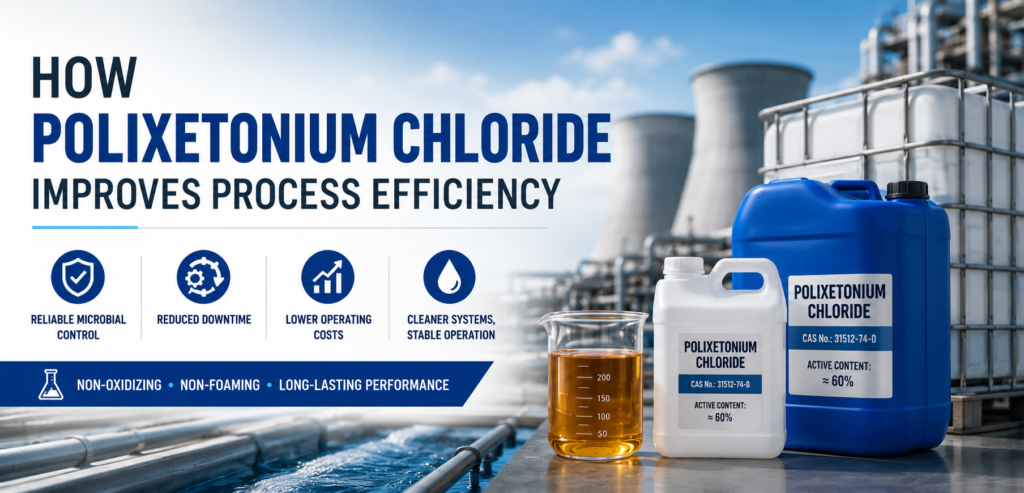
Every industrial water system has the same goal: keep production running smoothly while minimizing downtime, maintenance, and operating costs.
That sounds simple. In reality, microorganisms, algae, slime, and biofilm constantly work against that goal. Once biofilm begins to develop, heat transfer becomes less efficient, flow resistance increases, and maintenance intervals become shorter. Before long, productivity starts to suffer.
This is where Polixetonium Chloride has earned its reputation.
Unlike many conventional biocides that require frequent shock dosing or create unwanted foam, Polixetonium Chloride offers long-lasting microbial control with excellent operational compatibility. For many cooling water systems, process water circuits, and industrial applications, that translates directly into higher process efficiency.
Let’s look at how it works.
What Is Polixetonium Chloride?
Polixetonium Chloride (CAS No. 31512-74-0) is a polymeric quaternary ammonium compound widely used as a non-oxidizing, non-foaming biocide for industrial water treatment.
It is commonly supplied as an approximately 60% active solution, appearing as an amber-colored, clear, viscous liquid.
Compared with traditional oxidizing biocides, polymeric quaternary compounds offer several operational advantages:
- Non-foaming
- Broad pH compatibility
- Good material compatibility
- Long-lasting antimicrobial activity
- Easy liquid dosing
- Suitable for continuous treatment programs
These characteristics make it especially attractive for systems where stable operation is just as important as microbial control.
How Polixetonium Chloride Improves Process Efficiency
Process efficiency isn’t determined by a single factor.
Instead, it results from many small improvements working together.
Polixetonium Chloride contributes by helping operators maintain cleaner systems with fewer interruptions.
Its main benefits include:
- Better control of algae and slime
- Reduced biofilm accumulation
- More stable water circulation
- Less unexpected maintenance
- Improved equipment availability
- Lower overall operating costs
None of these improvements may seem dramatic on their own.
Together, however, they can make a noticeable difference over months of continuous operation.
Reduced Equipment Downtime
Few things are more expensive than unexpected shutdowns.
When slime or algae accumulate inside cooling towers, pipelines, or heat exchangers, equipment performance gradually declines. Operators eventually have to stop production for cleaning or maintenance.
Polixetonium Chloride helps interrupt this cycle.
By controlling microbial growth before thick deposits develop, systems often remain cleaner for longer periods.
The practical results may include:
- Longer cleaning intervals
- Fewer emergency shutdowns
- Reduced maintenance labor
- Better production continuity
For facilities operating around the clock, even a small reduction in downtime can have significant economic value.
Lower Chemical Consumption
Many facilities rely on multiple chemicals to maintain water quality.
These may include:
- Oxidizing biocides
- Scale inhibitors
- Corrosion inhibitors
- Dispersants
- Defoamers
Excessive biological growth can increase the demand for several of these products.
When microbial populations remain under better control, overall chemical programs often become easier to manage.
Although every system is different, many operators find they can maintain stable water quality with fewer corrective treatments.
That means:
- Less chemical waste
- Simpler inventory management
- More predictable operating costs
Improved Water Quality and System Stability
Clean water flows more efficiently.
Biofilm doesn’t just contain microorganisms—it also traps suspended solids, organic matter, and corrosion products.
These deposits reduce flow efficiency and interfere with heat transfer.
By helping limit microbial attachment and slime formation, Polixetonium Chloride supports:
- Better circulation
- More stable operating conditions
- Cleaner heat exchange surfaces
- Reduced pressure drop across equipment
Over time, these improvements contribute to more consistent production performance.
Non-Foaming Performance for Continuous Operation
Foam may seem like a small issue.
In many industrial systems, it isn’t.
Foaming can interfere with pumps, overflow tanks, circulation, filtration, and process monitoring.
Some quaternary ammonium compounds generate significant foam under agitation.
Polixetonium Chloride is specifically valued for its non-foaming performance, making it suitable for systems with:
- High circulation rates
- Mechanical agitation
- Cooling towers
- Continuous processing equipment
The result is smoother operation without introducing another operational problem.
Broad Compatibility with Industrial Water Treatment Programs
Industrial water treatment rarely depends on a single product.
Instead, facilities build complete treatment programs containing several specialty chemicals.
Polixetonium Chloride is generally compatible with many commonly used treatment chemicals when properly formulated into a complete program.
This flexibility makes it easier to integrate into existing operations without major equipment modifications.
One important exception deserves attention.
Strong anionic chemicals can reduce the effectiveness of cationic polymeric quaternary compounds. For that reason, compatibility testing is recommended whenever new treatment chemicals are introduced into a system.
A well-balanced treatment program helps maximize both microbial control and process efficiency.
Typical Applications Where Efficiency Gains Are Most Noticeable
Polixetonium Chloride is used across a wide range of industrial water systems.
Some common examples include:
Industrial Cooling Water Systems
Cleaner heat exchangers help maintain cooling performance while reducing maintenance frequency.
Process Water Circulation Systems
Continuous microbial control helps minimize slime accumulation and supports stable operation.
Metalworking Fluid Preservation
Proper microbial control can help extend fluid service life and reduce bacterial contamination in compatible water-based metalworking fluids.
Industrial Water Storage Systems
Long-term microbial management helps maintain water quality during storage and circulation.
Although every facility has unique operating conditions, these applications often experience measurable improvements in operational stability.
How to Maximize Process Efficiency with Polixetonium Chloride
Simply selecting the right biocide is only part of the solution.
Getting the most from Polixetonium Chloride also depends on proper system management.
Consider the following recommendations:
- Monitor microbial activity regularly.
- Follow the recommended dosing program.
- Maintain good system cleanliness.
- Avoid mixing directly with strong anionic chemicals.
- Review water quality data routinely.
- Adjust treatment based on operating conditions rather than fixed schedules.
A balanced maintenance program almost always performs better than waiting until contamination becomes obvious.
Final Thoughts
Process efficiency isn’t just about running equipment faster.
It’s about keeping systems reliable, minimizing interruptions, and reducing unnecessary operating costs.
Polixetonium Chloride contributes to these goals by providing dependable microbial control while avoiding many of the operational drawbacks associated with foaming products or aggressive oxidizing biocides.
For facilities looking to improve cooling system reliability, maintain cleaner process water, and reduce maintenance frequency, it remains a practical and proven option.
Small improvements made consistently often produce the biggest gains over time—and that’s exactly where Polixetonium Chloride delivers value.
Frequently Asked Questions
1. How does Polixetonium Chloride improve industrial process efficiency?
It helps control algae, bacteria, and slime that can reduce heat transfer efficiency, restrict water flow, and increase maintenance frequency. Cleaner systems generally operate more consistently with fewer interruptions.
2. Is Polixetonium Chloride suitable for continuous dosing?
Yes. Because it is a non-oxidizing, non-foaming polymeric biocide, it is commonly used in continuous or routine treatment programs, depending on the system design and operating conditions.
3. Does Polixetonium Chloride reduce equipment maintenance?
It can help extend cleaning intervals by limiting microbial growth and slime formation. Actual maintenance schedules depend on water quality, system design, and the overall treatment program.
4. Can Polixetonium Chloride be used with other water treatment chemicals?
In many cases, yes. However, strong anionic chemicals may reduce its effectiveness because of interactions with the cationic polymer. Compatibility testing is recommended before combining treatment chemicals.
5. Which industries benefit most from using Polixetonium Chloride?
Industries with recirculating water systems—such as cooling water, process water treatment, compatible water-based metalworking fluids, and certain industrial water storage systems—often benefit from improved operational stability, cleaner equipment, and reduced downtime.