
GET IN TOUCH
Ask For Sample?
Industry-Specific Uses of Polixetonium Chloride
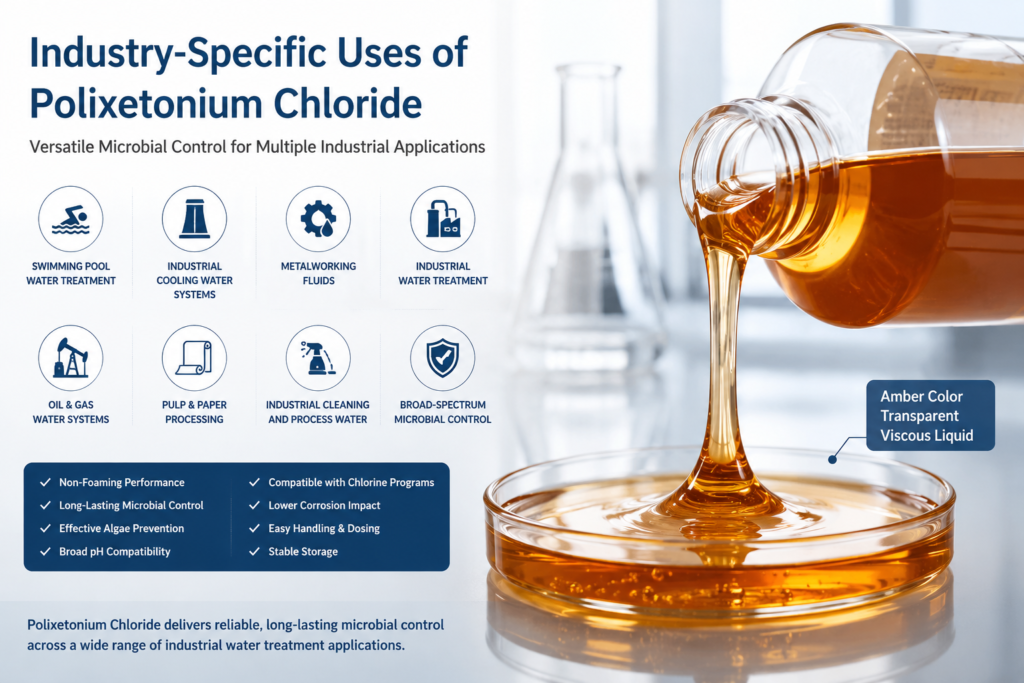
Water systems rarely fail for just one reason. Algae, bacteria, slime, suspended solids, and changing water chemistry often work together, creating problems that reduce efficiency and increase maintenance costs.
That’s exactly why Polixetonium Chloride has attracted attention across multiple industries. Rather than acting as a traditional oxidizing biocide, it provides long-lasting microbial control with excellent compatibility in many water treatment programs. It is particularly valued for its non-foaming performance, broad operating range, and relatively low impact on equipment compared with many conventional oxidizing treatments.
From swimming pools to industrial cooling systems, this polymeric quaternary ammonium compound has found a place in applications where stable water quality is essential.
Let’s take a closer look at where it is used—and why.
What Makes Polixetonium Chloride Suitable for Multiple Industries?
Before discussing individual industries, it helps to understand what gives this chemistry such broad appeal.
Unlike many fast-acting oxidizing biocides, Polixetonium Chloride works by interacting with negatively charged microbial cell membranes. Its polymeric structure allows it to remain active in water for longer periods while maintaining excellent distribution throughout circulating systems.
Some of its most appreciated characteristics include:
- Non-foaming performance
- Long-lasting microbial control
- Effective algae prevention
- Broad pH compatibility
- Good compatibility with chlorine treatment programs
- Reduced equipment corrosion compared with oxidizing chemicals
- Easy liquid handling and dosing
- Stable storage characteristics
These features make it adaptable to several industries where water quality directly affects productivity.
Swimming Pool Water Treatment
Swimming pools remain one of the best-known applications.
Whether for residential pools, commercial facilities, hotels, or water parks, algae prevention is an ongoing challenge. While chlorine disinfects pool water, it is not always sufficient to prevent algae growth under heavy sunlight, warm temperatures, or high bather loads.
Polixetonium Chloride is widely formulated into polymeric algaecides because it offers several practical advantages:
- Prevents green algae growth
- Controls black algae development
- Helps maintain clear water
- Produces virtually no foam
- Compatible with chlorine and bromine systems
- Does not introduce copper that may contribute to staining
Industrial Cooling Water Systems
Cooling towers create an ideal environment for microbial growth.
Warm temperatures, nutrients, continuous circulation, and sunlight all encourage algae and bacterial contamination.
Unchecked biological growth can cause:
- Biofilm formation
- Reduced heat transfer efficiency
- Increased energy consumption
- Blocked heat exchangers
- Higher maintenance costs
Polixetonium Chloride is frequently incorporated into industrial cooling water treatment programs because it provides continuous microbial control without introducing foam into recirculating systems.
It is commonly used in:
- HVAC cooling towers
- Manufacturing plants
- Chemical processing facilities
- Petrochemical cooling systems
- Utility cooling circuits
Its compatibility with many common water treatment chemicals makes it suitable for integrated treatment programs.
Metalworking Fluids
Water-based metalworking fluids are especially vulnerable to bacterial contamination.
As microorganisms multiply, operators often notice:
- Unpleasant odors
- Reduced coolant performance
- Lower lubrication efficiency
- Shortened fluid life
- Increased maintenance
Polixetonium Chloride has been used as a preservative for certain water-based metalworking fluids, particularly systems that do not contain strong anionic surfactants.
Typical applications include:
- Synthetic cutting fluids
- Semi-synthetic coolants
- Water-based machining lubricants
- Grinding fluids
By suppressing microbial growth, manufacturers can often extend coolant service life while maintaining more stable operating conditions.
Because metalworking formulations vary significantly, compatibility testing is always recommended before large-scale implementation.
Industrial Water Treatment
Many industrial processes depend on consistent water quality.
Even when algae is not the primary concern, microbial contamination can gradually reduce system efficiency.
Industries using Polixetonium Chloride include:
- General manufacturing
- Food processing utility water (non-product contact systems)
- Textile facilities
- Chemical production
- Utility water circulation systems
In these environments, the product helps maintain cleaner circulation systems while reducing biological fouling that may interfere with normal operation.
Oil & Gas Water Systems
Water plays an important role throughout oil and gas production.
Produced water, storage systems, and certain process water circuits can all experience microbial contamination.
When biological growth is left untreated, operators may encounter:
- Slime deposits
- Reduced flow efficiency
- Equipment fouling
- Increased maintenance frequency
Depending on the specific treatment program and local regulations, Polixetonium Chloride may be incorporated into water management strategies where non-foaming performance is particularly desirable.
Actual application protocols should always follow field testing and local regulatory requirements.
Pulp & Paper Processing
Paper manufacturing uses large volumes of recirculating water.
Microbial growth may contribute to:
- Slime accumulation
- Machine downtime
- Sheet defects
- Odor problems
- Reduced production efficiency
Polixetonium Chloride can help suppress biological growth in selected process water systems, contributing to cleaner equipment and more stable operation.
Since every paper mill operates under different process conditions, treatment programs are typically optimized through site-specific evaluations.
Industrial Cleaning and Process Water
Many industrial cleaning systems continuously recycle water.
Without proper microbial control, these systems may gradually develop:
- Biofilm
- Odor
- Cloudy water
- Reduced cleaning efficiency
Applications may include:
- Equipment washing systems
- Process rinse water
- Closed-loop cleaning systems
- Industrial recycling water
Maintaining cleaner water often translates into longer operating cycles and reduced cleaning downtime.
How to Choose the Right Grade for Your Industry
Not every application requires the same product specification.
Several factors should be considered before selecting a grade:
Active Content
Different manufacturers may specify active content differently from total solids content. These values are not always interchangeable, so reviewing technical specifications carefully is important when comparing products.
Viscosity
Viscosity often reflects the molecular weight of the polymer. While higher viscosity does not automatically mean better performance for every application, it is an important quality indicator and should remain consistent between production batches.
Evaluate compatibility with:
Compatibility
- Existing treatment chemicals
- Water chemistry
- System materials
- Process additives
Laboratory or field trials are strongly recommended before commercial implementation.
Supplier Support
Reliable suppliers typically provide:
- Technical consultation
- Product recommendations
- COA documentation
- SDS documentation
- Application guidance
- Sample evaluation
Good technical support can significantly shorten product qualification time.
You many find more information here to select right grade of Polixetonium Chloride 31512-74-0.
Final Thoughts
One of the reasons Polixetonium Chloride continues to gain attention is its versatility.
Instead of serving only one niche application, it provides practical value across swimming pools, cooling towers, industrial water treatment, metalworking fluids, pulp and paper processing, and several other water-based systems.
Its combination of non-foaming performance, effective algae control, long-lasting activity, and broad compatibility makes it a dependable option for many industrial users seeking stable water treatment performance.
As with any specialty chemical, the most successful results come from selecting the appropriate grade, verifying compatibility, and applying the product according to the specific requirements of each system.
Frequently Asked Questions
1. Which industry uses Polixetonium Chloride the most?
Swimming pool water treatment is one of the largest application areas, where it is widely used as a polymeric algaecide. It is also commonly used in industrial cooling water systems and selected metalworking fluid formulations.
2. Is Polixetonium Chloride only used for algae control?
No. Although algae control is one of its primary applications, it is also used to suppress microbial growth in various industrial water systems.
3. Can Polixetonium Chloride be used with chlorine?
Yes. It is generally compatible with properly maintained chlorine treatment programs, which is one reason it is popular in swimming pool applications.
4. Is Polixetonium Chloride suitable for metalworking fluids?
Yes, it has been used in certain water-based synthetic and semi-synthetic metalworking fluids to help control microbial contamination. However, compatibility should always be verified, particularly in formulations containing strong anionic surfactants.
5. How do I select the right Polixetonium Chloride grade?
Consider the active content, viscosity, product consistency, compatibility with your system chemistry, and the supplier’s technical support. Requesting samples and conducting laboratory or field evaluations before full-scale use is the most reliable approach.