
GET IN TOUCH
Ask For Sample?
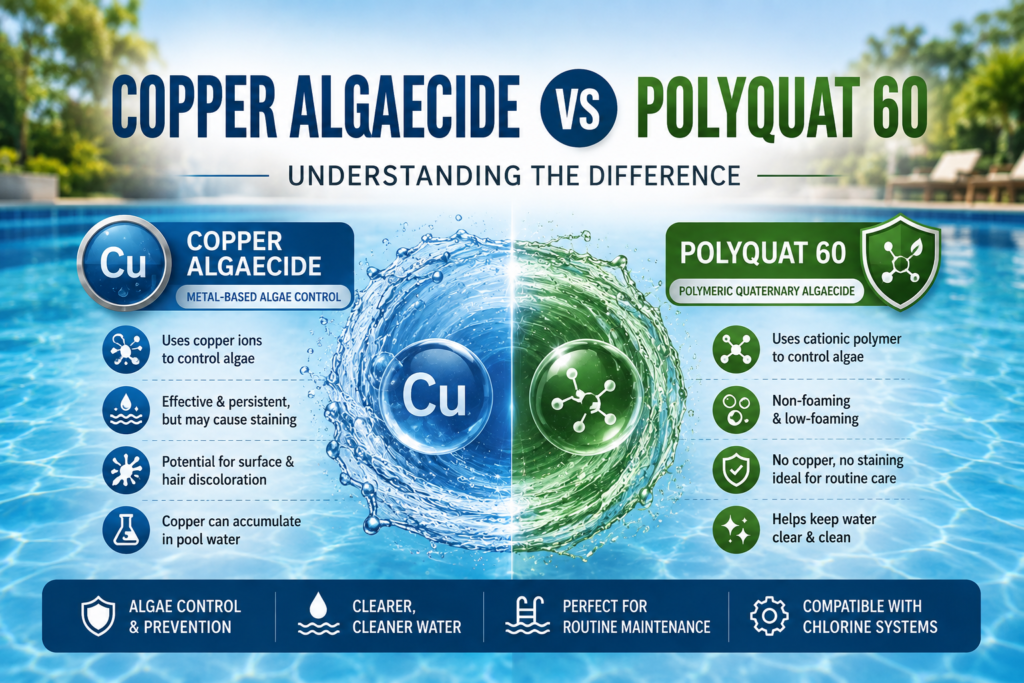
Copper Algaecide vs Polyquat 60: Understanding the Difference
A swimming pool can look perfectly balanced on Monday and develop a faint green tint by Friday. That’s the frustrating thing about algae—it doesn’t always wait for an obvious maintenance mistake.
Chlorine remains the main sanitizer in most pools, but many pool care programs also use an algaecide as an extra layer of protection. Two common choices are copper-based algaecides and Polyquat 60.
Both are used to control algae. Beyond that, though, they behave quite differently.
Copper algaecides rely on dissolved copper ions to interfere with algae. Polyquat 60 is a polymeric quaternary ammonium compound that acts through a positively charged polymer structure. That difference affects everything from staining and water appearance to foaming, compatibility, and routine maintenance.
So, which one makes more sense?
There isn’t a universal winner. The better choice depends on what you’re trying to accomplish—and what side effects you’re willing to manage.
First Things First: What Is a Copper Algaecide?
Copper has been used to control algae for a long time, and for good reason.
Copper ions can interfere with important biological processes inside algal cells. When a copper-containing algaecide is added to pool water, soluble copper becomes part of the algae-control mechanism.
Various copper compounds and complexes may be used in commercial formulations. The exact behavior of a product therefore depends on its formulation rather than simply whether the label says “copper.”
One major attraction is straightforward: copper can provide persistent algae-control activity in pool water.
That persistence, however, is also where some of the complications begin.
Copper is a metal. It doesn’t simply vanish after doing its job. Its behavior can change with water chemistry, concentration, oxidation conditions, surfaces, and other treatment chemicals.
If conditions aren’t well controlled, copper may contribute to staining or discoloration.
That beautiful blue pool suddenly showing greenish hair or marks on a pale surface? Nobody planned for that.
So, What Exactly Is Polyquat 60?
Polyquat 60 belongs to a very different chemical family.
The name commonly refers to a concentrated polymeric quaternary ammonium algaecide. Rather than depending on metal ions, it uses a cationic—or positively charged—polymer to interact with algae.
If you’re new to this chemistry, it helps to start with the basics. Our What Is Polyquat 60 Algaecide? A Complete Beginner’s Guide explains what Polyquat 60 is, why the “60” matters, and how this polymer-based algaecide fits into everyday swimming pool care.
The “60” generally refers to the approximate concentration of active polymer in the concentrated raw material or commercial formulation, although buyers should always verify the actual specification of the product they are purchasing.
Polyquat 60 is especially valued because properly formulated products can provide algae control without introducing copper into the pool.
It is also widely associated with non-foaming or low-foaming performance, which separates it from many conventional low-molecular-weight quaternary ammonium algaecides.
That distinction matters more than it may sound.
In pools with strong circulation, waterfalls, spas, return jets, or other aeration, a foaming algaecide can turn routine maintenance into a bubbly headache.
Polyquat 60 was designed around a different chemistry.
Copper vs Polyquat 60: The Basic Difference
Here is the simplest way to think about the two.
| Property | Copper Algaecide | Polyquat 60 |
|---|---|---|
| Main active mechanism | Copper ions | Cationic polymer |
| Chemistry type | Metal-based | Polymeric quaternary ammonium |
| Primary role | Algae control | Algae control and prevention |
| Adds metal to pool | Yes | No copper |
| Staining concern | Possible if copper chemistry isn’t controlled | No copper staining |
| Hair discoloration concern | Possible under certain conditions | No copper-related hair discoloration |
| Foaming | Depends on formulation | Typically non-foaming/low-foaming |
| Persistence | Can be relatively persistent | Residual activity, but polymer can be consumed or removed over time |
| Routine maintenance suitability | Depends strongly on water conditions | Commonly suited to preventive programs |
| Water chemistry management | Copper concentration needs attention | Correct dosage and sanitizer balance still matter |
The biggest difference isn’t simply that one is “metal” and the other is “polymer.”
It’s what happens after you put them into the pool.
How Does Copper Actually Control Algae?
Copper ions are biologically active.
When algae are exposed to sufficient available copper, the metal can interfere with proteins, enzymes, cellular membranes, and other processes required for normal growth.
Think of it as throwing several tiny wrenches into the biological machinery of an algal cell.
That makes copper useful against several forms of algae and explains its long history in water treatment.
But copper concentration isn’t the whole story.
The chemical form of copper matters too.
Pool pH, alkalinity, other dissolved substances, oxidizing conditions, and treatment products can affect whether copper remains dissolved or contributes to deposits and discoloration.
This is why simply adding “more copper” isn’t necessarily better.
Too little may not give the desired algae-control effect. Too much—or poorly managed water chemistry—can increase unwanted consequences.
Polyquat 60 Takes a Different Route
Polyquat 60 doesn’t need metal ions to attack algae.
Its polymer chains carry positive charges. Algal cell surfaces generally carry negatively charged sites, so electrostatic attraction helps bring the polymer into contact with the cells.
That interaction can disrupt normal membrane function and interfere with the organism’s ability to survive and reproduce.
That positive-charge interaction is central to the way this chemistry works. If you’d like to understand the process beyond the simple “it kills algae” explanation, see How Does Polyquat 60 Algaecide Work in Swimming Pools?, where we explain the polymer–algae interaction and its role in ongoing algae control.
There’s another interesting feature here.
Because Polyquat 60 is a polymer, it can also influence suspended particles through charge interactions and bridging behavior. This is one reason users sometimes notice improved water clarity alongside algae-control treatment.
That doesn’t mean Polyquat 60 should automatically be treated as a replacement for a dedicated pool clarifier. Formulation, dosage, particle type, and pool conditions still matter.
But the polymeric behavior helps explain why Polyquat 60 feels quite different in use from a simple metal-ion treatment.
The Staining Question Is Hard to Ignore
This is probably the most important practical distinction for many pool owners.
Copper can stain. Polyquat 60 doesn’t introduce copper.
Copper-containing water does not automatically mean a stained pool. Plenty of pools use copper products without obvious problems.
Trouble tends to appear when copper concentration and water chemistry move into an unfavorable combination.
Copper may deposit on:
- plaster and other pool surfaces;
- fittings and equipment;
- ladders or decorative features;
- hair and, in some circumstances, fabrics.
The famous “chlorine turned my hair green” story is also a little misleading.
Chlorine can participate indirectly by affecting chemistry, but copper is commonly responsible for the actual green discoloration.
For commercial pools, resorts, spas, or pools with expensive light-colored finishes, avoiding unnecessary metal accumulation can therefore be a meaningful advantage.
Polyquat 60 sidesteps that particular issue because its algae-control mechanism isn’t based on copper.
But Doesn’t Polyquat 60 Foam?
This is where different types of quaternary ammonium chemistry often get lumped together.
Traditional quaternary ammonium algaecides can foam, particularly when water is heavily agitated.
Polyquat 60 is different.
Its polymeric structure generally gives it much lower foaming characteristics, which is one reason it became popular for swimming-pool algae control.
This makes the chemistry useful where circulation or aeration would make conventional foaming quats troublesome.
Still, don’t interpret “non-foaming” as permission to pour in half the bottle because the pool looks a little suspicious.
Dosage matters.
More algaecide isn’t automatically more effective pool care.
What About Chlorine Compatibility?
Neither copper algaecide nor Polyquat 60 should be viewed as a substitute for proper sanitization.
That’s worth emphasizing.
Algaecide controls algae. Sanitizer manages the broader microbiological load and provides the primary disinfection barrier.
A pool can contain algaecide and still have poor sanitation.
Polyquat 60 is commonly incorporated into chlorine-based maintenance programs because it can provide supplemental algae protection without adding copper.
There is a catch, though.
Strong oxidizing conditions can gradually degrade polymeric algaecides. So Polyquat 60 isn’t permanently sitting in the water waiting for algae forever. Treatment frequency should follow the product label and actual pool conditions.
Copper behaves differently because the metal itself isn’t destroyed in the same way an organic polymer can be.
That’s one reason copper can persist—but again, persistence cuts both ways.
Which One Is Better for Preventive Maintenance?
For many routine maintenance programs, Polyquat 60 has a particularly attractive profile.
Why?
Because prevention isn’t only about killing algae. It’s also about avoiding new maintenance problems while doing so.
Imagine you’re responsible for dozens of pools.
You want predictable treatment. You don’t want foaming. You don’t want to keep increasing the pool’s metal content. And you certainly don’t want phone calls about stained plaster or someone’s blond hair developing a green cast.
In that setting, a non-copper, polymer-based algaecide can be appealing.
Polyquat 60 can therefore fit well into:
- regular preventive algae-control programs;
- seasonal pool maintenance;
- winterization programs;
- pools where copper accumulation is undesirable;
- pools with decorative or light-colored surfaces;
- systems where foaming should be minimized.
It still needs to be used correctly. Water balance, circulation, filtration, chlorine concentration, and physical cleaning remain part of the equation.
There is no magic bottle that replaces good pool maintenance.
This combination of non-foaming performance, metal-free algae control, and suitability for preventive treatment also explains why the chemistry has become attractive to professional pool operators. For a closer look at that decision, read Why Pool Professionals Choose Polyquat 60 Instead of Copper Algaecides.
Does That Mean Copper Algaecides Are Bad?
No.
That’s too simplistic.
Copper has genuine algaecidal activity, and copper-containing formulations can work effectively when used according to their labels and under suitable water conditions.
In some treatment strategies, persistence is precisely what makes copper attractive.
The concern is really about control.
If you’re using a copper algaecide, you need to understand that you’re adding a metal to a dynamic water system. The existing copper concentration and overall water chemistry therefore matter.
Polyquat 60 offers another path: algae control without adding copper.
For many operators, that’s the deciding factor.
What About a Pool That’s Already Green?
Here’s where expectations need to stay realistic.
A badly neglected green pool isn’t necessarily solved by choosing one algaecide over another.
First ask why algae gained control.
Is free chlorine too low?
Has stabilizer become excessive relative to the sanitizer program?
Is circulation poor?
Is the filter struggling?
Are there dead zones behind ladders or around steps?
Has brushing been neglected?
Treating the symptom while ignoring the cause is a bit like repeatedly mopping the kitchen floor while the sink is still overflowing.
For an established algae bloom, the appropriate response may involve correcting water balance, restoring effective sanitizer levels, brushing surfaces, improving circulation, filtering out debris, and then using an appropriate algaecide according to its approved label.
Polyquat 60 is particularly useful as part of a prevention and maintenance strategy, rather than as an excuse to neglect the rest of the pool.
Copper Algaecide vs Polyquat 60 for Winterization
Winterization is another area where Polyquat 60 gets considerable attention.
A pool may remain closed for months. Sanitizer levels can decline, circulation may stop, and spring temperatures eventually create more favorable conditions for algae.
Nobody enjoys pulling back the cover in spring and discovering something resembling pea soup.
A polymeric, non-foaming algaecide can provide supplemental protection during the closed period without deliberately increasing copper levels.
Again, persistence isn’t infinite. Climate, closing procedure, water temperature, initial water quality, cover condition, and treatment dosage all influence spring results.
The algaecide is one piece of the winterization program—not the entire program.
For Pool Chemical Formulators, the Difference Gets Even More Important
The copper-versus-polyquat question isn’t limited to homeowners.
For formulators, private-label pool chemical companies, distributors, and professional service businesses, the choice affects product positioning.
A copper formulation may be marketed around metal-based algae control and persistent activity.
A Polyquat 60 formulation can be positioned differently: polymeric, non-copper, low-foaming algae protection suitable for preventive maintenance programs.
Raw-material quality becomes important here.
Polyquat 60 is a concentrated polymer solution, so formulators should pay attention to parameters such as:
- active content;
- appearance;
- pH;
- viscosity;
- density;
- batch consistency;
- storage stability.
Don’t judge a raw material by concentration alone.
Two materials carrying a similar generic description may still behave differently if their actual specifications or manufacturing consistency differ.
So, Which Should You Choose?
Ask what problem you’re actually trying to solve.
If your treatment strategy specifically calls for copper-based algae control and the pool’s metal concentration can be properly managed, a copper algaecide may be suitable.
If your priority is preventive algae control without adding copper, Polyquat 60 often makes more sense.
For pools where staining, hair discoloration, or metal buildup is a particular concern, the case for a non-copper algaecide becomes stronger.
And if foaming is a concern, Polyquat 60 has another practical advantage over many traditional quat-based alternatives.
Still, neither chemistry fixes poor pool management.
Keep the sanitizer where it belongs. Maintain pH and water balance. Brush the pool. Run the circulation system correctly. Keep the filter working.
Then let the algaecide do the job it was actually designed to do.
The Bottom Line
Copper algaecides and Polyquat 60 can both control algae, but they do it through fundamentally different chemistry.
Copper products rely on biologically active copper ions. They can provide effective and persistent algae control, but copper accumulation introduces considerations around staining, discoloration, and water chemistry.
Polyquat 60 relies on a positively charged polymer. It provides algae-control activity without adding copper and is valued for its low-foaming characteristics and suitability for preventive pool maintenance.
So the question isn’t really:
“Which algaecide is stronger?”
A better question is:
“Which chemistry fits the pool and maintenance program with the fewest unwanted consequences?”
For many routine and preventive applications, that’s exactly where Polyquat 60 earns its place.
Frequently Asked Questions
1. Is Polyquat 60 better than copper algaecide for swimming pools?
Polyquat 60 is often preferred when pool owners want preventive algae control without adding copper. Copper algaecides can also be effective, but copper concentration needs to be managed because excessive or poorly controlled copper can contribute to staining and discoloration.
2. Can Polyquat 60 cause green hair?
Polyquat 60 doesn’t introduce copper, so it isn’t associated with copper-related green hair discoloration. Green hair in swimming pools is commonly linked to copper depositing on hair rather than chlorine literally turning the hair green.
3. Does Polyquat 60 make swimming pool water foam?
Polyquat 60 is generally considered a non-foaming or low-foaming polymeric algaecide. This is an important difference between Polyquat 60 and many conventional quaternary ammonium algaecides, which can create noticeable foam under strong water agitation.
4. Can I use Polyquat 60 with chlorine?
Polyquat 60 is commonly used as supplemental algae protection in chlorine-maintained swimming pools. It doesn’t replace chlorine or another approved primary sanitizer. Always follow the algaecide label and maintain appropriate sanitizer and water-balance conditions.
5. Is Polyquat 60 suitable for winter pool algae prevention?
Yes, Polyquat 60 is commonly used in pool-closing and winter maintenance programs because it provides supplemental algae protection without adding copper and has low-foaming characteristics. Results still depend on correct dosage, water balance, pool cleanliness, temperature, and the overall winterization procedure.