
GET IN TOUCH
Ask For Sample?
Why Traditional Pool Algaecides May Cause Foam Problems?
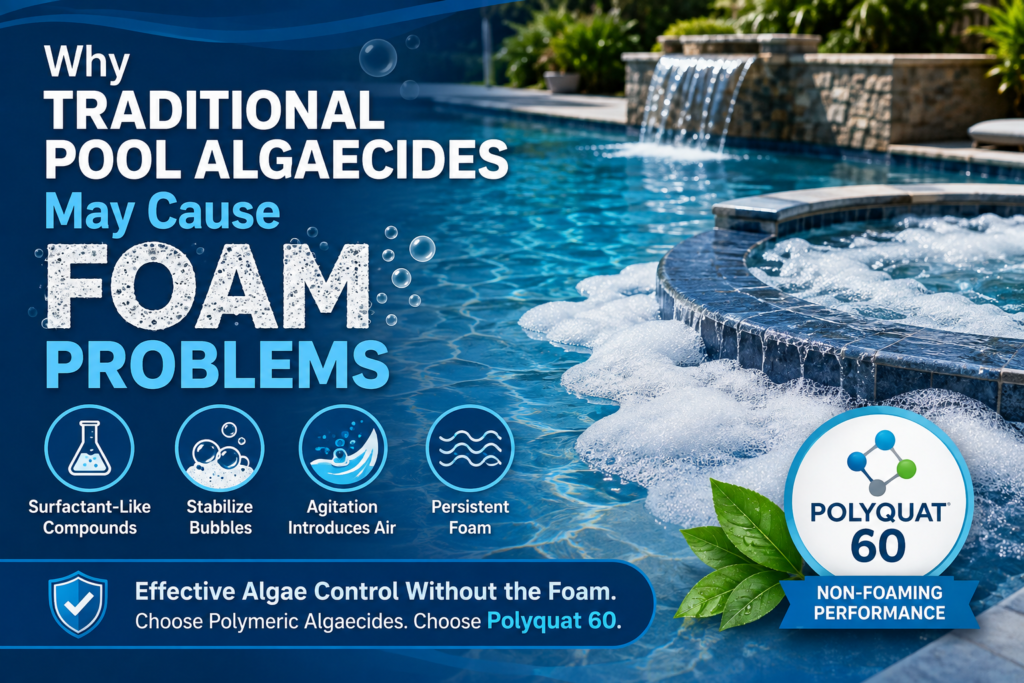
A swimming pool can look perfectly clean and still have one rather annoying problem: foam.
Turn on the circulation system, start a spa jet, or let swimmers splash around, and suddenly a layer of white bubbles begins collecting along the waterline. Sometimes the foam disappears quickly. Sometimes it hangs around long enough to make otherwise clear pool water look as if someone poured soap into it.
And, oddly enough, the product added to prevent algae may be part of the reason.
Some traditional pool algaecides contain surfactant-like compounds that can stabilize bubbles when the water is agitated. This doesn’t necessarily mean the algaecide is poor quality. It is often a consequence of the chemistry used in the formulation.
Understanding that difference matters when choosing an algaecide—especially for spas, fountains, pools with water features, and other systems where water is constantly moving.
First Things First: Where Does Pool Foam Come From?
Pure water doesn’t hold foam very well.
You can splash it, pump it, spray it through a fountain, or send it through spa jets. Bubbles appear, of course, but they usually collapse almost immediately.
Persistent foam requires something else.
Certain dissolved organic materials and surface-active substances can reduce the surface tension of water and help stabilize the thin liquid films surrounding air bubbles. Instead of bursting quickly, the bubbles survive and collect at the surface.
Think about washing dishes.
Water alone produces very little lasting foam. Add detergent, however, and a small amount of agitation creates a sink full of bubbles. Pool water operates under the same basic physical principle, although the chemistry and concentrations are quite different.
Possible contributors to pool foam include:
- Residues from personal-care products
- Body oils and cosmetics
- Certain cleaning products
- High levels of dissolved organic material
- Some algaecide formulations
- Excessive algaecide dosage
That last point deserves a closer look.
Why Can Traditional Pool Algaecides Produce Foam?
Many conventional algaecides have historically relied on quaternary ammonium compounds, often called quats.
Quats are cationic compounds, meaning they carry a positive electrical charge. This property helps them interact with negatively charged microbial surfaces and plays an important role in their biological activity.
But some lower-molecular-weight quaternary ammonium compounds also behave somewhat like surfactants.
A surfactant molecule has an unusual personality. One part interacts readily with water, while another part has an affinity for less polar materials. Because of this structure, surfactants tend to accumulate at interfaces—including the boundary between water and air.
That’s where the foam story begins.
When air enters treated pool water through splashing, pumps, return jets, waterfalls, or spa systems, surface-active molecules can gather around the newly formed bubbles.
Those bubbles may then survive longer than they would in untreated water.
One bubble isn’t a problem.
Thousands of stabilized bubbles? Now you’ve got visible foam.
The Chemistry Isn’t “Bad”—It’s Just Doing More Than One Thing
It’s tempting to conclude that a foaming algaecide must be inferior. That’s too simple.
Traditional quaternary ammonium algaecides became widely used for good reasons. They can provide useful algae control, and their cationic chemistry allows them to interact effectively with biological surfaces.
The drawback is that some of the same molecular characteristics associated with their performance can contribute to surface activity.
So the problem isn’t necessarily that the chemistry doesn’t work.
It’s that the chemistry may bring an unwanted side effect.
For a quiet residential pool with limited agitation, slight foaming potential might barely be noticeable. Put the same chemistry into a heavily aerated spa or a pool with several waterfalls and vigorous return jets, and the result can look very different.
Context matters.
Agitation Is the Missing Half of the Foam Equation
Here’s an easy detail to overlook: an algaecide doesn’t create air.
The pool equipment does.
Foaming becomes visible when air is incorporated into water containing substances capable of stabilizing bubbles.
Consider a pool with:
- Powerful return jets
- Waterfalls
- Deck jets
- Fountains
- Swim jets
- Air-injection systems
- Attached spas
- High swimmer activity
All of these introduce or mix air into the water.
If surface-active compounds are present, every little air bubble has a better chance of surviving.
This explains why one pool may show almost no visible foam after an algaecide treatment while another develops obvious froth using a similar product.
The chemistry may be similar. The hydraulic conditions aren’t.
Spas and Water Features Can Make the Problem Much More Obvious
A conventional swimming pool provides plenty of water movement, but a spa takes agitation to another level.
Air and water are deliberately mixed at high speed. That’s part of what makes the spa experience enjoyable.
Unfortunately, it’s also a remarkably effective foam test.
A formulation with even moderate foaming potential can become much more noticeable under those conditions. The same applies to decorative fountains and pools containing waterfalls or strong aeration systems.
Imagine shaking a bottle.
A liquid that looks completely calm while sitting on a table can suddenly reveal its foaming tendency once vigorously mixed.
Pools aren’t bottles, obviously, but the principle is similar.
For this reason, foaming behavior deserves more attention when an algaecide will be used in highly agitated water systems.
Dose Matters More Than People Sometimes Realize
There’s another common cause of algaecide-related foam: adding too much product.
More algaecide doesn’t automatically mean better algae control.
When a surfactant-like active ingredient is introduced above the recommended treatment concentration, more surface-active material remains in the water. Under sufficient agitation, the tendency toward persistent bubbles can increase.
This is particularly easy to encounter when pool owners respond aggressively to an algae problem.
The pool turns green.
They add chlorine.
Then more chlorine.
Then algaecide.
Then, just to be safe, a little more algaecide.
Sound familiar?
Chemical treatment isn’t like turning up the volume on a speaker. Doubling the amount of a product doesn’t necessarily double the desired result. It may simply increase unwanted side effects.
Following the manufacturer’s recommended dosage remains important regardless of the type of algaecide being used.
Not All Quaternary Algaecides Behave the Same Way
This distinction is important.
The term quaternary ammonium compound covers a broad family of materials. Their molecular structures, molecular weights, charge densities, and physical behavior can differ considerably.
Traditional monomeric or lower-molecular-weight quats should therefore not be treated as chemically identical to polymeric quaternary ammonium compounds.
That’s where products commonly described as polyquat algaecides enter the picture.
Polymeric quaternary compounds contain repeating charged units incorporated into a larger molecular structure. That structural difference can substantially change how the material behaves in water.
So while both product categories involve cationic chemistry, their practical properties aren’t necessarily the same.
It’s a bit like comparing individual train cars with an entire connected train. The components may share similarities, but the larger structure moves and behaves differently.
This structural difference is also why Polyquat 60 is often discussed separately from conventional quat algaecides. If you’re new to this chemistry, our What Is Polyquat 60 Algaecide? A Complete Beginner’s Guide explains what Polyquat 60 is, how it differs from traditional algaecides, and where it fits into a modern pool maintenance program.
Why Polymeric Algaecides Can Reduce Foam Problems
One reason products such as Polyquat 60 became useful in swimming pool treatment is their low-foaming or non-foaming behavior compared with many traditional quat-based formulations.
Polyquat 60 is a polymer-based cationic algaecide. Rather than behaving like a conventional small-molecule surfactant, its polymeric structure changes how the active material interacts with water, biological surfaces, and air-water interfaces.
As a result, properly formulated Polyquat 60 products are generally selected where effective algae control is wanted without the troublesome foam associated with some conventional quat algaecides.
This distinction becomes particularly useful in:
- Residential swimming pools
- Commercial pools
- Spas and hot tubs, where permitted by the specific product label
- Pools with fountains
- Pools with waterfalls
- Systems with vigorous circulation
- Maintenance programs where water appearance is important
After all, killing algae isn’t much of a cosmetic victory if the pool ends up looking like a bubble bath.
Traditional Quats vs. Polymeric Algaecides: What’s Actually Different?
The easiest way to understand the difference is to focus on practical behavior rather than getting lost in chemical terminology.
| Property | Traditional Quat Algaecides | Polymeric Algaecides Such as Polyquat 60 |
|---|---|---|
| Chemical character | Often lower-molecular-weight cationic compounds | Cationic polymer |
| Surface activity | Can be relatively significant | Generally lower foaming tendency |
| Foam potential | Can become noticeable with agitation | Typically low or non-foaming |
| Effect of overdosing | May increase visible foam | Foam problems generally less pronounced |
| Highly aerated pools | May require greater attention | Often better suited |
| Algae-control role | Preventive/control treatment depending on formulation | Preventive/control treatment depending on formulation |
This doesn’t mean every product marketed under either category behaves identically. Concentration, formulation, dosage, water chemistry, and other ingredients all matter.
Always evaluate the actual formulation rather than relying only on a broad chemical category.
Foam Can Also Tell You Something About the Pool
Here’s an interesting twist.
Foam isn’t always just a nuisance. Sometimes it’s a clue.
If a pool suddenly begins foaming after chemical treatment, ask what changed.
Was an algaecide recently added?
Was the dosage unusually high?
Has swimmer load increased?
Are cosmetics, sunscreen, body oils, or cleaning residues accumulating?
Has the pool received several chemical products within a short period?
A little detective work can save a lot of unnecessary treatment.
Adding another chemical every time something looks wrong can quickly turn pool maintenance into chemical whack-a-mole: fix one symptom, create another, then add something else to fix that.
A better approach is to identify the source.
Does Foam Mean the Algaecide Is Dangerous?
Not by itself.
Visible foam is primarily a physical indication that bubbles are being stabilized in the water. Its presence alone doesn’t tell you whether a particular treatment concentration is safe or unsafe.
Those questions depend on the actual product formulation, concentration, intended application, regulatory status, and label directions.
Pool operators should therefore follow the instructions and restrictions supplied with the specific finished product.
This distinction is particularly important for commercial buyers.
An active raw material and a finished retail pool algaecide aren’t necessarily the same thing. Finished formulations may contain different active concentrations, stabilizers, water, processing aids, or other ingredients.
The product label and technical documentation should always take priority over assumptions based solely on the active ingredient name.
What About Chlorine?
Another misconception occasionally pops up here: if chlorine controls algae, why use an algaecide at all?
Because the two can play different roles in a pool-maintenance program.
Chlorine is primarily used as a sanitizer and oxidizer. Maintaining an appropriate sanitizer residual remains fundamental to pool hygiene.
An algaecide may be used as an additional algae-control tool, depending on the pool, environmental conditions, treatment program, and product instructions.
For example, algae pressure can increase because of warm temperatures, strong sunlight, heavy swimmer loads, poor circulation, or inconsistent sanitizer levels.
An algaecide shouldn’t be treated as a replacement for proper sanitation.
Think of it more like an additional layer of algae management.
And when that additional layer is needed, choosing a formulation that doesn’t create another maintenance headache becomes rather attractive.
When Does a Non-Foaming Algaecide Make Particular Sense?
Foam resistance isn’t equally important in every swimming pool.
A lightly used backyard pool without water features may never expose the weakness of a moderately foaming formulation.
Other environments are less forgiving.
A low-foaming or non-foaming algaecide becomes especially useful when the pool contains strong jets, waterfalls, fountains, attached spas, or other equipment that continuously mixes air into the water.
Commercial facilities may have another reason to care: appearance.
Guests don’t know the molecular chemistry of pool water. They simply see bubbles and wonder whether something is wrong.
Even harmless-looking foam can undermine confidence in an otherwise well-maintained pool.
That’s a practical issue, not just a chemistry issue.
Choosing an Algaecide Is About More Than Killing Algae
When evaluating pool algaecides, it’s easy to focus on one question:
Does it control algae?
That’s obviously important—but it’s not the only question worth asking.
A more useful evaluation considers several factors together:
- What types of algae is the formulation intended to control?
- Is it designed primarily for prevention, treatment, or both?
- Does it cause foam under normal circulation?
- What happens under strong aeration?
- Is it compatible with the existing pool-treatment program?
- Does it contain metals that could contribute to staining concerns?
- What concentration of active material is supplied?
- What dosage does the finished formulation require?
- Is the product suitable for the intended market and application?
For formulators and professional buyers, physical properties matter as well. Active concentration, viscosity, density, pH, appearance, storage stability, and formulation compatibility can all affect how an algaecide performs as a commercial product.
In other words, the active ingredient is only part of the story.
Why Foam Control Matters More Than It Seems
Foam may sound like a minor cosmetic complaint. Sometimes it is.
But persistent foam can affect the user’s perception of water quality, particularly in commercial swimming pools, resorts, spas, and decorative aquatic environments.
Clear, calm water communicates cleanliness.
A thick layer of bubbles communicates something else—even when the water itself is properly treated.
This is one reason formulation chemistry has gradually moved toward solutions that provide biological control while reducing undesirable secondary effects.
Polymeric algaecides fit naturally into that approach.
They don’t make good pool maintenance automatic. Sanitizer control, filtration, circulation, brushing, pH management, and routine monitoring still matter.
What they can do is remove one potential source of frustration from the treatment program.
And sometimes that’s exactly what good chemistry should accomplish: solve the original problem without introducing a new one.
The Bottom Line
Traditional pool algaecides may cause foam because some conventional quaternary ammonium compounds possess significant surface-active properties.
When those compounds are present in pool water, agitation from pumps, jets, waterfalls, fountains, swimmers, or spa equipment can introduce air. Surface-active molecules help stabilize those bubbles, allowing visible foam to accumulate.
Higher-than-recommended dosages can make the effect more noticeable.
Polymeric quaternary algaecides such as Polyquat 60 behave differently because their larger polymer structure changes their physical interaction with the water. Properly formulated products in this category are known for low-foaming or non-foaming performance, making them particularly useful where vigorous circulation or aeration is present.
The lesson is simple: don’t judge an algaecide solely by whether it controls algae.
Look at how it behaves in the whole pool system.
Because a pool treatment should leave you with clear water—not a surprise bubble bath.
Frequently Asked Questions
1. Why does my pool foam after adding algaecide?
Some traditional algaecides contain surface-active quaternary ammonium compounds that can stabilize air bubbles. Foam becomes more noticeable when pumps, jets, waterfalls, or swimmers strongly agitate the water. Excessive dosage may also increase foaming.
2. What type of pool algaecide does not cause foam?
Polymeric algaecides such as Polyquat 60 are generally known for low-foaming or non-foaming performance. Actual behavior still depends on the finished formulation and recommended dosage.
3. Does adding too much algaecide cause pool foam?
It can. If an algaecide contains surface-active ingredients, using more than the recommended amount can increase their concentration in the water and make persistent foam more likely during agitation.
4. Why is Polyquat 60 considered a non-foaming pool algaecide?
Polyquat 60 uses polymeric cationic chemistry rather than behaving like a conventional lower-molecular-weight quat surfactant. Its molecular structure gives it different interfacial behavior, which helps reduce the persistent foaming associated with some traditional quat algaecides.
5. Is a non-foaming algaecide better for pools with waterfalls and spa jets?
It can be particularly useful in highly agitated systems because waterfalls, fountains, return jets, and spa equipment continuously introduce air into the water. Choosing a low-foaming or non-foaming algaecide can therefore help maintain a cleaner water surface while supporting the pool’s algae-control program.