
GET IN TOUCH
Ask For Sample?
What Is Polyquat 60 Algaecide? A Complete Beginner’s Guide
If you have ever opened your swimming pool after a hot summer week and found green water, slippery walls, or stubborn algae spots hiding in corners, you already know one thing: algae can turn a beautiful pool into a frustrating maintenance problem very quickly.
But here is the interesting part — not every algaecide works in the same way.
Some products rely on metals. Some depend on strong oxidizing chemistry. Others are designed to provide longer-lasting protection while staying gentle on pool surfaces and equipment.
This is where Polyquat 60 Algaecide comes into the picture.
So, what exactly is Polyquat 60? Why do so many pool professionals use it? Is it really better than traditional algaecides? And why do manufacturers around the world produce it as a concentrated 60% solution?
Let’s take a closer look.
1. What Is Polyquat 60 Algaecide?
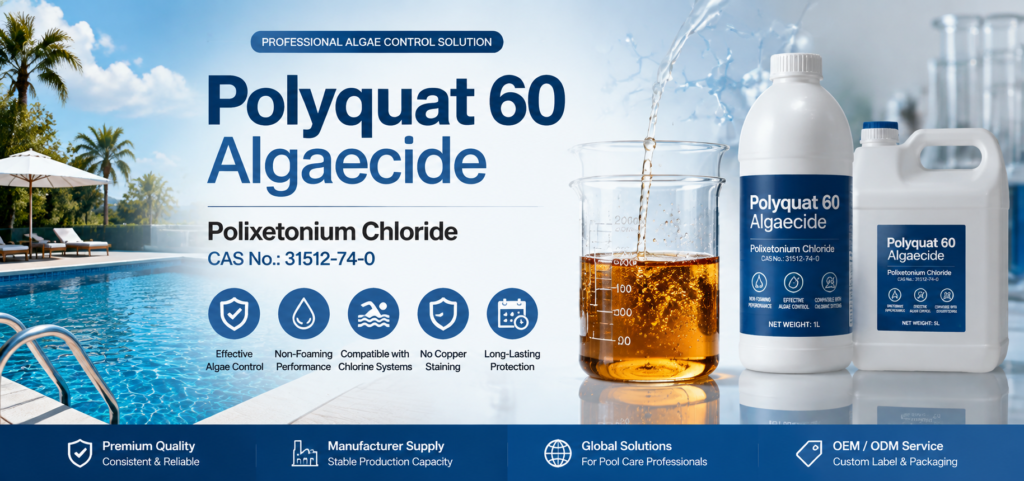
Polyquat 60 Algaecide is a non-oxidizing polymeric quaternary ammonium compound widely used for swimming pool algae control.
The active ingredient behind many Polyquat 60 products is:
Polixetonium Chloride
also known as:
- Polyquaternium-42
- Polyquat
- WSCP
- Polymeric quaternary ammonium compound
with the chemical identification:
CAS No.: 31512-74-0
Unlike chlorine-based oxidizers, Polyquat 60 does not kill algae through oxidation. Instead, it works through a different mechanism related to its positively charged polymer structure.
Simply put, Polyquat 60 attaches to algae cells, damages their protective membranes, and prevents algae from continuing to grow.
Think of algae as tiny unwanted plants trying to build a community inside your pool.
Polyquat 60 works like a security system that stops them before they take over.
That is why many pool professionals use it not only for treating algae problems but also for prevention.
Why Is Polyquat 60 Popular in Pool Maintenance?
The popularity of Polyquat 60 comes from several practical advantages:
- Non-foaming performance
- Compatible with chlorine and bromine systems
- No copper staining problems
- Effective across a wide pH range
- Suitable for regular maintenance programs
- Lower risk of damaging pool surfaces
For many pool owners, the biggest advantage is simple:
It controls algae without creating new headaches.
After all, nobody wants to remove algae today and spend the next week dealing with cloudy water or stained surfaces.
2. Why Is It Called “Polyquat 60”?
The name “Polyquat 60” sounds technical, but the meaning is actually easier than it looks.
Let’s break it down.
“Poly”
The word “Poly” refers to the polymer structure.
Unlike traditional quaternary ammonium compounds with smaller molecules, Polyquat products contain long-chain polymer molecules.
These longer chains provide different performance characteristics, including better surface interaction and longer-lasting activity.
“Quat”
“Quat” is short for quaternary ammonium compound.
Quaternary ammonium compounds are a family of chemicals commonly used in:
- Disinfectants
- Sanitizers
- Preservatives
- Water treatment products
- Algae control formulations
Their positive electrical charge allows them to interact with negatively charged biological surfaces.
“60”
The number “60” usually refers to the approximate active ingredient concentration.
Commercial Polyquat 60 Algaecide products are commonly supplied as:
60% Polyquaternium-42 solution
The remaining portion is mainly water and formulation components.
You may wonder:
“Why not sell it at 100% concentration?”
Good question.
Polymeric quaternary ammonium compounds are highly viscous materials. A 100% active product would be difficult to pump, measure, transport, and formulate.
The 60% concentration provides a practical balance between:
- Active content
- Handling convenience
- Storage stability
- Application accuracy
This is why most commercial Polyquat 60 products are supplied as liquid concentrates.
3. The Chemistry Behind Polyquat 60 Algaecide
To understand why Polyquat 60 works, we need to look briefly at its chemistry.
The active material belongs to the family of cationic polymers.
“Cationic” simply means positively charged.
Many biological surfaces, including algae cell membranes, carry negative charges.
When Polyquat molecules enter the water, their positively charged polymer chains are attracted to these negatively charged surfaces.
It is similar to how a magnet attracts metal objects.
The polymer attaches to algae cells and interferes with their normal functions.
How Does the Polymer Structure Matter?
This is where Polyquat 60 differs from many traditional algaecides.
A small molecule may act quickly but disappear relatively fast.
A polymer molecule contains repeating units connected together in a chain.
That structure can provide:
- Stronger interaction with algae cells
- Longer residence time in water systems
- Different performance behavior compared with simple quaternary ammonium compounds
Of course, actual performance depends on many factors, including:
- Water chemistry
- Algae species
- Temperature
- Organic contamination
- Product dosage
Chemistry is never magic — but the right chemistry can make maintenance much easier.
4. How Does Polyquat 60 Control Algae in Swimming Pools?
Many beginners think algaecide simply “kills green color.”
The reality is more interesting.
Algae growth usually follows several steps:
- Algae spores enter the pool
- They attach to surfaces
- They multiply
- They create visible green or cloudy water problems
Polyquat 60 mainly helps by interrupting this growth cycle.
Step 1: Contact With Algae Cells
Because Polyquat 60 is a cationic polymer, it interacts with algae cell surfaces.
This contact is the first step in its activity.
Step 2: Disruption of Cell Function
The polymer affects the algae membrane structure.
When algae cells cannot maintain normal biological functions, growth slows and eventually stops.
Step 3: Prevention of New Growth
One reason Polyquat 60 is widely used as a maintenance algaecide is that it helps reduce the chance of algae returning.
This makes it especially useful for:
- Vacation pool care
- Winter closing
- High-temperature seasons
- Commercial pools with heavy use
Is Polyquat 60 a Replacement for Chlorine?
No.
This is an important point.
Polyquat 60 is an algaecide, not a complete sanitizer.
Chlorine remains responsible for controlling many microorganisms and maintaining sanitary water conditions.
A good pool maintenance program usually combines:
- Proper chlorine levels
- Balanced pH
- Filtration
- Circulation
- Algae prevention
Polyquat 60 is a supporting tool — a very useful one — but it is not a substitute for complete pool care.
5. Why Do Pool Professionals Prefer Polyquat 60?
When pool professionals choose an algaecide, they are usually looking for more than just “something that kills algae.”
A good product needs to work well while fitting into a complete pool maintenance system.
After all, maintaining a pool is not only about removing algae. It is about keeping water clear, equipment protected, and customers satisfied.
This is why Polyquat 60 has become a popular choice among many professional pool operators.
5.1 Non-Foaming Performance Matters
One common problem with some algaecides is excessive foaming.
For a small backyard pool, a little foam may not seem like a big issue.
But imagine a:
- Hotel swimming pool
- Public recreation center
- Apartment complex pool
- Commercial spa
Foam immediately affects the user experience.
Nobody wants to walk into a luxury swimming pool and see a layer of bubbles floating on the surface.
Polyquat 60 is known as a non-foaming algaecide, which makes it suitable for applications where appearance matters.
This is one reason many professional formulators prefer polymeric quaternary ammonium compounds over traditional high-foaming quats.
5.2 Better Compatibility With Pool Chemistry
Swimming pool water is a carefully balanced environment.
The chemistry includes:
- Free chlorine
- pH regulators
- Alkalinity control agents
- Calcium hardness adjusters
- Oxidizers
- Water clarifiers
A good algaecide should work together with these components instead of creating new problems.
Polyquat 60 is widely recognized for its compatibility with chlorine-based pool systems.
This makes it suitable for routine algae prevention programs.
5.3 No Copper Staining Concerns
Copper-based algaecides have been used for decades.
They can be effective, especially against certain algae types.
However, copper introduces another consideration:
metal staining.
Under certain conditions, copper can accumulate and create:
- Greenish hair discoloration
- Surface stains
- Equipment deposits
This does not mean copper algaecides are always unsuitable.
They still have their applications.
However, for many premium pool maintenance products, avoiding metal-related problems is a major advantage.
That is where Polyquat 60 becomes attractive.
5.4 Suitable for Preventive Pool Care
Many pool owners make the same mistake:
They wait until algae becomes visible.
By the time the water turns green, the problem may already be well established.
A better approach is prevention.
Polyquat 60 is commonly used during:
- Pool opening season
- Hot weather periods
- Heavy rainfall periods
- Before vacations
- Winter closing procedures
The idea is simple:
Preventing algae growth is usually easier than fighting a serious algae outbreak.
6. Polyquat 60 vs Copper-Based Algaecides: What Is the Difference?
This is one of the most common questions from pool professionals.
“Should I use Polyquat 60 or copper algaecide?”
The answer depends on the application.
Let’s compare them.
| Feature | Polyquat 60 | Copper Algaecide |
|---|---|---|
| Chemical type | Polymeric quaternary ammonium compound | Metal-based compound |
| Active mechanism | Cationic polymer interaction | Copper ion activity |
| Foaming | Non-foaming | Depends on formulation |
| Metal staining risk | Very low | Possible under certain conditions |
| Chlorine compatibility | Generally good | Requires careful management |
| Best use | Preventive maintenance, premium pool care |
Why Some Premium Brands Prefer Polyquat 60
The swimming pool industry has become more focused on user experience.
Customers care about:
- Clear water
- Clean surfaces
- Easy maintenance
- Less chemical trouble
A product that creates another maintenance issue is not ideal.
That is why many premium formulations use Polyquat 60 as a core active ingredient.
7. Polyquat 60 vs Other Non-Oxidizing Algaecides
Polyquat 60 belongs to the non-oxidizing algaecide family.
But it is not the only option.
Other non-oxidizing algaecides include:
- Simple quaternary ammonium compounds
- Polymeric quaternary ammonium compounds
- Specialty organic biocides
So what makes Polyquat 60 different?
Polyquat 60 vs Traditional Quats
Traditional quaternary ammonium compounds usually have smaller molecular structures.
They can be effective, but some formulations may create more foam.
Polymeric quats use larger molecular chains.
These differences can influence:
- Surface interaction
- Foaming behavior
- Application characteristics
This is why Polyquat 60 is often positioned as a premium alternative.
For readers interested in the chemistry behind this material, you can learn more here:
What Is Polixetonium Chloride? A Complete Beginner’s Guide
This article explains the chemical identity, CAS number, and industrial applications of the active ingredient behind Polyquat 60.
8. How to Use Polyquat 60 Algaecide Correctly
Even the best product will not perform well if it is used incorrectly.
Pool chemistry is a balancing act.
The correct dosage depends on:
- Pool size
- Algae condition
- Product concentration
- Water quality
- Manufacturer recommendations
Typical Uses of Polyquat 60
1. Preventive Maintenance
For pools with no visible algae:
Polyquat 60 is added periodically to reduce algae growth risk.
This is common during:
- Summer months
- High sunlight exposure
- Heavy pool usage
2. Pool Opening Treatment
After winter, pools often face:
- Organic buildup
- Poor circulation
- Early algae growth
Adding Polyquat 60 during opening procedures can help prepare the water for normal sanitizing.
3. Winter Closing
Many pool professionals add Polyquat 60 before closing a pool.
Why?
Because stagnant water creates an ideal environment for algae growth.
A properly maintained closed pool is much easier to reopen.
Important Note About Dosage
Different Polyquat 60 formulations may have different active concentrations and instructions.
Always follow:
- Product label directions
- Local regulations
- Manufacturer recommendations
More chemical does not always mean better results.
In pool chemistry, balance wins.
9. What Should Buyers Know When Sourcing Polyquat 60?
For distributors, importers, and private label brands, buying Polyquat 60 is very different from purchasing a simple commodity chemical.
The product quality can directly affect customer satisfaction.
So what should buyers check?
9.1 Confirm the Active Ingredient
The first question:
“What is the actual active ingredient?”
For genuine Polyquat 60 products, buyers should confirm whether the product is based on:
Polixetonium Chloride (CAS No. 31512-74-0)
or another quaternary ammonium compound.
Different chemistries can have different performance profiles.
9.2 Review Technical Specifications
A reliable supplier should provide technical information such as:
- Active content
- Appearance
- pH value
- Density
- Viscosity
- Storage conditions
- Shelf life
For Polyquat 60, customers often expect a concentrated liquid with consistent physical properties.
9.3 Check Packaging Options
Different markets require different packaging.
Common options include:
- 1L plastic bottles
- 5L plastic jerrycans
- 25L stacktable plastic jerrycans
- 200L drums
- 1000L IBC totes
Private label customers may also require:
- Custom labels
- Custom packaging
- Brand support
9.4 Consider Regulatory Requirements
Different countries have different rules for pool chemicals and algaecides.
Before importing Polyquat 60, buyers should check:
- Local chemical regulations
- Label requirements
- Registration requirements
- Transportation classification
A professional supplier should help customers prepare the necessary documents.
10. Choosing a Reliable Polyquat 60 Algaecide Manufacturer
Finding a supplier is easy.
Finding the right supplier is harder.
A good manufacturer should provide more than a product price.
They should provide confidence.
Look for These Supplier Qualities:
1. Stable Production Capability
Chemical customers need consistency.
A product that performs differently from batch to batch creates problems for distributors.
2. Technical Support
A good supplier should understand:
- Pool applications
- Formulation requirements
- Concentration adjustment
- Packaging solutions
Sometimes buyers do not need a lower price.
They need someone who can solve problems.
3. Private Label Experience
Many pool chemical brands do not manufacture everything themselves.
They work with specialized chemical producers.
A supplier with OEM/private label experience can support:
- Brand development
- Label design
- Packaging selection
- Market-specific requirements
4. Quality Documentation
Professional buyers usually request:
- COA (Certificate of Analysis)
- SDS/MSDS
- Technical Data Sheet
- Shipping documents
Reliable documentation is part of reliable supply.
Frequently Asked Questions About Polyquat 60 Algaecide
1. What is Polyquat 60 Algaecide made of?
Polyquat 60 Algaecide is mainly based on a polymeric quaternary ammonium compound called Polixetonium Chloride (CAS No. 31512-74-0). It is a non-oxidizing polymer algaecide commonly used for swimming pool algae control, especially in maintenance and prevention programs.
2. Is Polyquat 60 better than copper algaecide?
Polyquat 60 and copper algaecides work through different chemical mechanisms. Polyquat 60 is often preferred for premium pool applications because it is non-metal based, non-foaming, and does not create copper staining concerns. However, the best choice depends on pool conditions, algae type, and maintenance requirements.
3. Can Polyquat 60 Algaecide be used with chlorine?
Yes. Polyquat 60 is commonly used together with chlorine-based pool sanitation systems. It acts as an algae control agent while chlorine continues to perform its main sanitizing role. Proper water balance and dosage control are still important.
4. Why is Polyquat 60 usually supplied as a 60% solution?
Polyquat 60 is supplied as a concentrated liquid because the active polymer is highly viscous. A 60% concentration provides a practical balance between active content, handling convenience, transportation, and formulation flexibility.
5. Where can I buy bulk Polyquat 60 Algaecide for private label production?
Bulk Polyquat 60 is usually purchased from specialized chemical manufacturers that provide concentrated Polyquaternium-42 solutions, technical documents, and OEM/private label services. Buyers should evaluate active content, production capability, quality documentation, and application support before selecting a supplier.