
GET IN TOUCH
Ask For Sample?
Why More Pool Brands Are Switching to Non-Metal Algaecides?
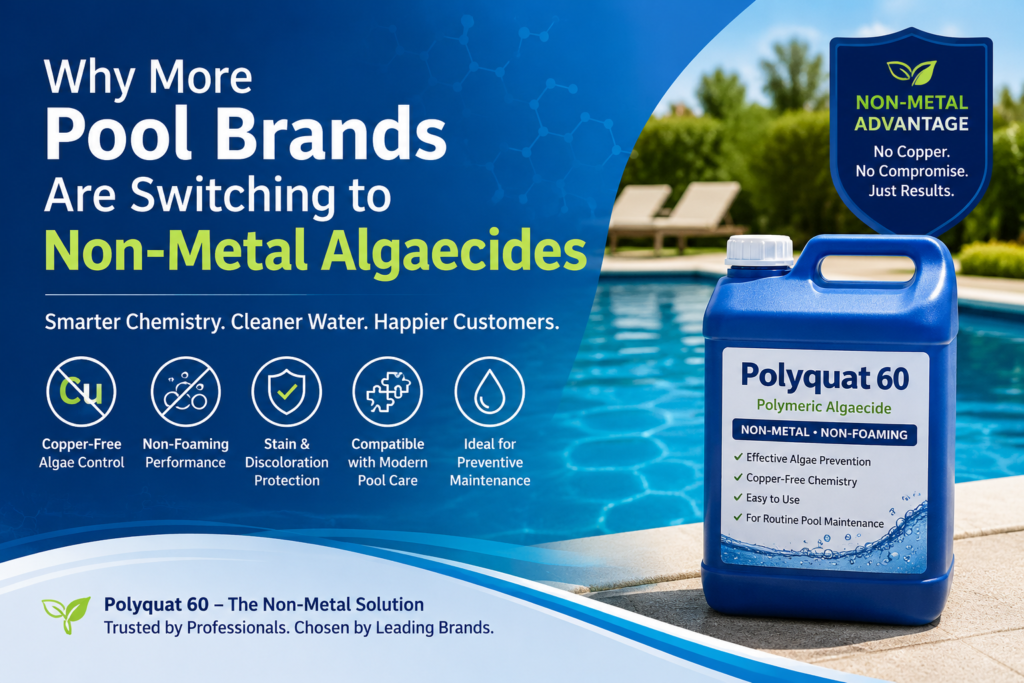
For years, metal-based algaecides have been a familiar part of swimming pool care. Copper compounds, in particular, have earned a place on store shelves because they can suppress many common types of algae and are relatively easy to formulate into consumer pool products.
But the pool chemical market is changing.
More formulators, private-label brands, distributors, and professional pool service companies are paying closer attention to non-metal algaecides. Polymeric products such as Polyquat 60 are receiving particular interest because they can help control algae without adding copper or other metals to pool water.
Why the shift?
It isn’t simply a case of one chemistry suddenly becoming “better” than another. Pool brands have become more sensitive to staining, water discoloration, foaming, compatibility with other treatment chemicals, and the overall experience of the pool owner. The algaecide now has to do more than control algae. It has to fit comfortably into a complete water-care program.
And that’s where non-metal chemistry becomes interesting.
Metal Algaecides Worked for a Reason
Before discussing why brands are moving toward non-metal alternatives, it’s worth giving copper chemistry some credit.
Copper ions have well-known algicidal properties. They interfere with biological processes inside algae cells and can help prevent or suppress algae growth when maintained at suitable concentrations.
That makes copper-based products attractive for a fairly obvious reason: they work.
They can also provide residual activity in pool water. Unlike chlorine, which is consumed as it reacts with contaminants and sunlight, dissolved copper can remain present for a longer period.
So why would anyone want to move away from it?
Because killing algae is only one part of pool maintenance.
A modern pool product has to live alongside chlorine or other sanitizers, pH adjusters, clarifiers, scale-control chemicals, filtration systems, heaters, decorative surfaces, and — perhaps most importantly — swimmers.
Once you look at the whole system rather than algae alone, the picture gets more complicated.
The Trouble With Metals: They Don’t Simply Disappear
When a pool owner pours a metal-based algaecide into the water, the active metal doesn’t vanish after doing its job.
It remains part of the pool’s water chemistry.
Under suitable conditions, dissolved metals can contribute to staining or water discoloration. Copper is particularly familiar to experienced pool professionals because its behavior changes with water chemistry.
High pH, elevated metal concentrations, oxidation conditions, and interactions with other substances in the water can increase the chance of visible problems.
That creates an awkward situation.
A pool may have fewer algae problems but suddenly develop another issue — stains on surfaces or unwanted color in the water.
For a homeowner standing beside a freshly finished white plaster pool, that’s hardly a satisfying trade.
Staining Is More Than a Chemistry Problem
From a pool brand’s perspective, staining carries another cost: customer dissatisfaction.
Imagine the situation.
A consumer buys an algaecide because the front label promises cleaner, clearer pool water. A few weeks later, marks appear on the pool surface. The cause may involve several factors, including pH, water balance, existing metals, dosage, and oxidation chemistry.
But who gets blamed?
Usually the bottle that was recently added.
This is one reason product formulators increasingly think beyond raw algicidal performance. A chemistry that reduces certain secondary risks can make the overall maintenance program easier for both professionals and homeowners.
Non-metal algaecides offer a straightforward advantage here:
They do not intentionally introduce copper as the algicidal active ingredient.
That doesn’t mean a non-metal algaecide magically prevents every stain. Pools can contain metals from source water, corroding equipment, previous treatments, or other chemicals.
Still, avoiding another intentional source of metal can simplify water management.
So, What Exactly Is a Non-Metal Algaecide?
“Non-metal algaecide” is a broad description rather than one single chemical family.
It generally refers to algae-control products whose active ingredients do not rely on metals such as copper for their primary effect.
One important category is polymeric quaternary ammonium compounds, often shortened to polymeric quats or polyquats.
Among pool professionals, one of the best-known examples is Polyquat 60.
Polyquat 60 is commonly associated with a polymeric cationic active ingredient. Instead of introducing copper ions, the positively charged polymer interacts with negatively charged biological surfaces.
Among pool professionals, one of the best-known examples is Polyquat 60. If you’re new to this chemistry and want to understand what the product actually is before comparing it with metal-based alternatives, our What Is Polyquat 60 Algaecide? A Complete Beginner’s Guide explains its chemistry, typical role in pool care, and why it has become a familiar option for algae prevention.
Think of it less like dropping tiny metal particles into a pool and more like sending long, positively charged molecular chains through the water.
That difference in chemistry changes how the product behaves.
Why Polyquat 60 Keeps Coming Up
Ask experienced pool formulators about non-metal algaecides and Polyquat 60 is likely to enter the conversation sooner or later.
There’s a practical reason.
A properly formulated Polyquat 60 product can combine several characteristics that are attractive for routine pool care:
- No copper-based algicidal active ingredient
- Low-foaming or non-foaming performance compared with many conventional quaternary ammonium algaecides
- Compatibility with common pool maintenance programs when used as directed
- Useful preventive algae-control performance
- Suitability for maintenance and seasonal treatment concepts
That combination matters.
A pool brand isn’t necessarily looking for the most aggressive chemical it can put in a bottle. It often wants a product that consumers can use repeatedly without creating unnecessary side effects.
Routine maintenance is a different game from emergency algae treatment.
The Foam Problem Changed the Conversation
There’s an important distinction here.
Not every non-metal algaecide behaves the same way.
Traditional quaternary ammonium compounds — often simply called “quats” — can be effective against algae, but some may produce noticeable foam, particularly when circulation, return jets, spas, fountains, or other forms of water agitation are involved.
Anyone who has seen a pool suddenly looking suspiciously like a giant bathtub knows why this matters.
Foam may not always indicate a serious water-quality problem, but consumers don’t like it. It looks wrong.
Polymeric quaternary ammonium chemistry was developed differently. Products commonly sold as Polyquat 60 are valued partly because of their non-foaming characteristics.
This gives pool brands a useful middle ground: metal-free algae control without the foaming behavior associated with some conventional quat formulations.
For brands selling premium maintenance products, that’s a meaningful distinction.
Foaming is more than a cosmetic nuisance. It can become especially noticeable around return jets, waterfalls, spas, and other areas with strong water movement. If you’re comparing different algaecide chemistries, see Why Traditional Pool Algaecides May Cause Foam Problems for a closer look at why certain formulations foam and why polymeric alternatives behave differently.
Modern Pool Care Is Becoming More About Compatibility
Years ago, pool maintenance could sometimes feel like a simple sequence:
Add chlorine. Adjust pH. Add algaecide. Done.
Real pools aren’t quite that cooperative.
Today’s pool owners may use automated chlorination, saltwater chlorine generators, variable-speed pumps, cartridge filters, clarifiers, enzymes, phosphate-management products, specialty surface treatments, and several other chemicals throughout the season.
Every additional ingredient makes compatibility more important.
An algaecide therefore shouldn’t be judged in isolation.
The better question is:
How does this algaecide behave as part of the complete pool treatment program?
This systems-based approach favors products that don’t unnecessarily complicate the chemistry.
Non-metal polymeric algaecides can be appealing because they avoid adding another metal variable that must later be managed.
Clear Water Isn’t Enough — It Has to Look Right
Pool chemistry has an unusual challenge: customers can see the product’s performance.
Nobody stands beside an industrial cooling tower expecting the water to sparkle like a holiday brochure.
Swimming pools are different.
The customer wants blue water, clean walls, no visible algae, no strange foam, and no mysterious stains near the steps.
Appearance is part of performance.
That changes formulation priorities.
A technically effective product that creates undesirable visual side effects can still produce a poor customer experience. Conversely, an algaecide designed for steady preventive use can become valuable precisely because nothing dramatic happens.
No green walls.
No foam party.
No unexpected metal-related color.
Sometimes boring chemistry is very good chemistry.
Non-Metal Algaecides Fit Preventive Maintenance Particularly Well
Another reason for the shift is the growing emphasis on prevention rather than rescue treatment.
Once a pool has a severe algae bloom, the treatment program may require brushing, filtration, sanitizer adjustment, oxidation, and other corrective measures. An algaecide alone shouldn’t be expected to solve every heavily contaminated pool.
Preventive maintenance is different.
The goal is to make conditions less favorable for algae before visible growth takes over.
Polymeric algaecides fit naturally into this approach. Depending on the formulation and label directions, they can be incorporated into regular maintenance programs alongside proper sanitizer levels, filtration, circulation, and water balance.
That’s important because an algaecide should support good pool care — not replace it.
Chlorine remains the primary sanitizer in many swimming pools. Polyquat-type algaecides generally play a supporting algae-control role.
That distinction is worth making clear, especially when designing consumer labels and marketing materials.
Why Private-Label Pool Brands Are Paying Attention
There is also a commercial side to the story.
Private-label pool chemical brands don’t merely buy chemistry. They sell an experience.
A consumer may never know the chemical name of the polymer inside the bottle. What they notice is whether the product is easy to dose, whether the pool foams afterward, whether the water remains attractive, and whether the treatment fits comfortably into their normal maintenance routine.
For private-label formulators, non-metal algaecides can therefore support several product positions.
A brand might build a product around concepts such as:
- Non-metal algae control
- Copper-free maintenance
- Non-foaming algae prevention
- Routine weekly or periodic algae control
- Seasonal pool maintenance
- Winterizing support
The exact claims, of course, must match the formulation, applicable regulations, testing, and approved labeling in the target market.
That’s especially important with biocidal products. Marketing language can’t simply run ahead of regulatory reality.
Copper-Free Positioning Is Easy for Consumers to Understand
Chemical marketing often gets buried under technical vocabulary.
Cationic polymers. Active concentration. Molecular charge density. Compatibility profiles.
Useful? Absolutely.
Exciting to the average pool owner? Probably not.
“Copper-free,” however, is immediately understandable.
Consumers already encounter discussions about metals in pool water, staining, discoloration, and even greenish hair associated with copper-containing water under certain conditions.
A copper-free algaecide therefore communicates a relatively simple idea: control algae without intentionally adding copper through the algaecide itself.
For retail packaging, that simplicity has value.
The technical chemistry sits behind the claim, while the consumer sees the practical benefit.
Does This Mean Copper Algaecides Are Becoming Obsolete?
No.
And this is where the discussion needs some balance.
Copper-based algaecides remain useful products. They can provide effective algae control and may be appropriate for particular applications, treatment programs, product positions, and markets.
They also have decades of practical use behind them.
The movement toward non-metal chemistry isn’t necessarily a rejection of copper. It’s better understood as an expansion of formulation choices.
A manufacturer might even maintain both types in its product portfolio.
For example, one product line could emphasize strong copper-based algae control, while another focuses on copper-free, non-foaming preventive maintenance.
Different pools have different needs.
Different customers do too.
Copper-based products still have a legitimate place in pool care, so the decision doesn’t have to be framed as “copper is bad, Polyquat is good.” The two chemistries simply come with different strengths and trade-offs. For a side-by-side explanation, read Copper Algaecide vs Polyquat 60: Understanding the Difference, where we compare how each approach works and what pool brands should consider when choosing between them.
The Switch Is Really About Reducing Trade-Offs
Every pool chemical comes with trade-offs.
Strong oxidation can consume sanitizer.
Some quaternary ammonium compounds can foam.
Metal-based products can complicate metal management.
Highly concentrated products require careful dosing.
There’s no magic bottle.
The attraction of polymeric non-metal algaecides is that they can reduce several of the trade-offs that matter most in routine pool maintenance.
That makes them particularly interesting for brands trying to create a cleaner, simpler treatment system.
Rather than asking only, “Will this kill algae?” formulators are increasingly asking:
“Will it control algae without causing another problem that the customer then has to fix?“
That’s a much better product-development question.
What Pool Brands Should Check Before Switching
Moving from a metal-based algaecide to a polymeric product isn’t simply a matter of replacing one raw material with another at the same dosage.
The formulation needs to be evaluated as a complete system.
Pool chemical manufacturers should consider factors such as active concentration, viscosity, pH, stability, dilution behavior, compatibility with packaging, recommended treatment level, and interaction with other ingredients in the finished formula.
Raw material consistency matters too.
For concentrated polymeric algaecides, changes in active content or viscosity can affect manufacturing, filling, dilution, and final product performance.
Brands developing private-label products should therefore work from a defined raw-material specification rather than relying solely on a generic product name such as “Polyquat 60.”
Two products carrying similar commercial descriptions aren’t automatically identical in every manufacturing parameter.
Ask for the specification. Check the COA. Test the formulation.
It’s not glamorous advice, but it prevents expensive headaches later.
The Bigger Trend: Pool Chemicals Are Becoming More User-Friendly
The move toward non-metal algaecides reflects something broader happening across the pool industry.
Chemical products are increasingly being judged not just by whether they perform their primary function, but by how easily they fit into the customer’s entire maintenance routine.
Consumers want fewer surprises.
Service professionals want predictable chemistry.
Distributors want fewer complaints.
Brands want products that are easier to explain.
That combination naturally creates interest in non-metal, non-foaming polymeric algaecides.
Polyquat 60 happens to sit comfortably in that space.
It provides pool brands with another way to approach algae prevention without relying on copper as the active algicidal component — and without accepting the foaming behavior associated with some traditional quaternary ammonium products.
That’s why the shift isn’t really about chasing a fashionable ingredient.
It’s about making pool care a little less troublesome.
And, frankly, anyone who has spent a summer fighting a stubborn green pool can appreciate that.
Frequently Asked Questions
1. Why are pool brands switching from copper algaecides to non-metal algaecides?
Many brands want algae-control products that don’t intentionally add copper to pool water. Non-metal polymeric algaecides can reduce concerns related to copper accumulation, staining, and discoloration while fitting well into preventive maintenance programs.
2. Is Polyquat 60 a non-metal algaecide?
Yes. Polyquat 60 refers to a polymeric quaternary ammonium algaecide that does not rely on copper or another metal as its algicidal active ingredient. It is widely associated with non-foaming algae-control formulations for swimming pools.
3. What is the difference between Polyquat 60 and copper algaecide?
The main difference is chemistry. Copper algaecides rely on copper ions for algae control, while Polyquat 60 uses a cationic polymer. This difference affects properties such as metal introduction, staining considerations, foaming behavior, and how each product fits into a pool maintenance program.
4. Does a non-metal algaecide replace chlorine in a swimming pool?
No. An algaecide should not automatically be treated as a replacement for a registered pool sanitizer. In many maintenance programs, chlorine handles sanitation while the algaecide provides additional help with algae prevention. Always follow the approved product label and local regulations.
5. Why is non-foaming Polyquat 60 useful for private-label pool chemicals?
A non-foaming Polyquat 60 formulation can help private-label brands create copper-free algae-control products designed for routine pool maintenance without the noticeable foam associated with some traditional quat algaecides. Its concentrated liquid format can also suit different finished-product concentrations and packaging formats.