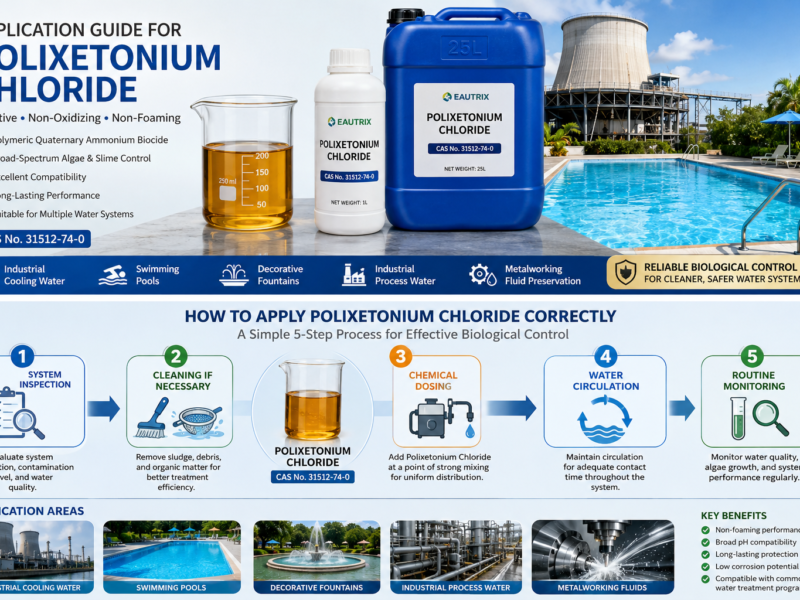
Infographic demonstrating the correct application procedure for Polixetonium Chloride, including system inspection, dosing, circulation, and monitoring for industrial cooling water and swimming pool algae control.

Application Guide for Polixetonium Chloride

GET IN TOUCH Ask For Sample? Application Guide for Polixetonium Chloride If you’ve selected Polixetonium Chloride for your water treatment program, you’re already using one of the most effective non-oxidizing polymeric biocides available. But choosing the right product is only part of the equation. The real question is this: Are...
Read More
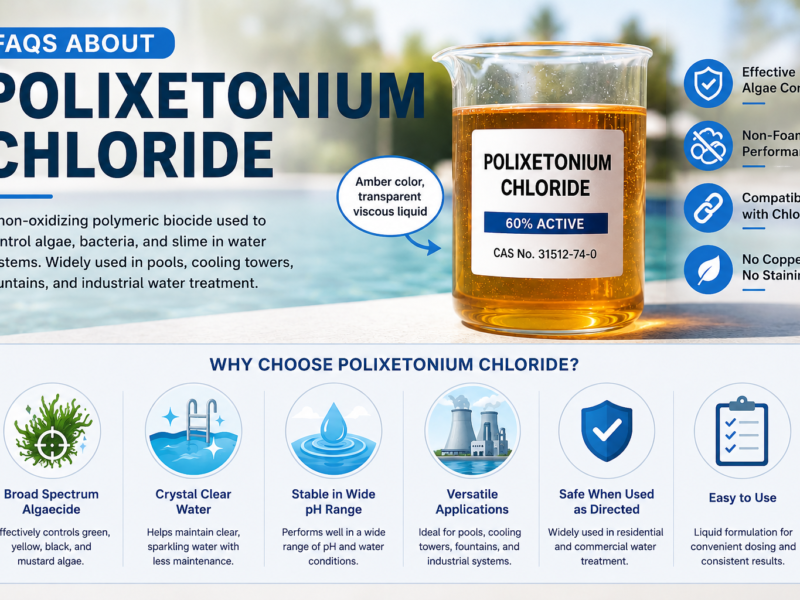
Infographic answering frequently asked questions about Polixetonium Chloride (CAS No. 31512-74-0), showing its amber transparent viscous liquid appearance, non-foaming performance, algae control, chlorine compatibility, and common water treatment applications

Frequently Asked Questions About Polixetonium Chloride

GET IN TOUCH Ask For Sample? Frequently Asked Questions About Polixetonium Chloride 1. What is Polixetonium Chloride used for? Polixetonium Chloride is a non-oxidizing polymeric biocide used to control algae, bacteria, and slime-forming microorganisms in water systems. It is widely applied in swimming pools, industrial cooling water, decorative fountains, water...
Read More
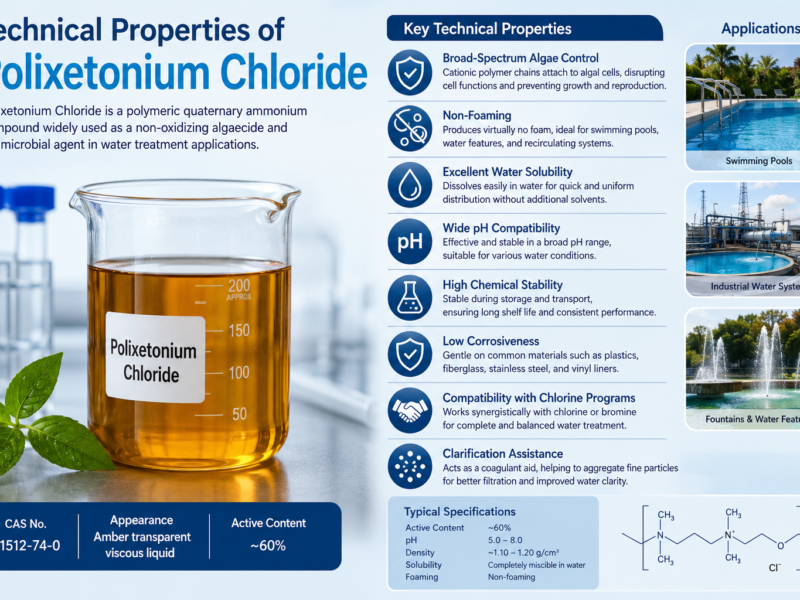
Technical infographic illustrating the key properties of Polixetonium Chloride (CAS No. 31512-74-0), showing an amber transparent viscous liquid, non-foaming performance, broad-spectrum algae control, excellent water solubility, chlorine compatibility, clarification assistance, and typical applications in swimming pools, industrial water systems, and decorative fountains

Technical Properties of Polixetonium Chloride

GET IN TOUCH Ask For Sample? Technical Properties of Polixetonium Chloride When selecting a polymeric biocide for water treatment, performance depends on much more than the product name. The technical properties determine how well the product controls algae, how long it remains effective, how easily it blends into formulations, and...
Read More
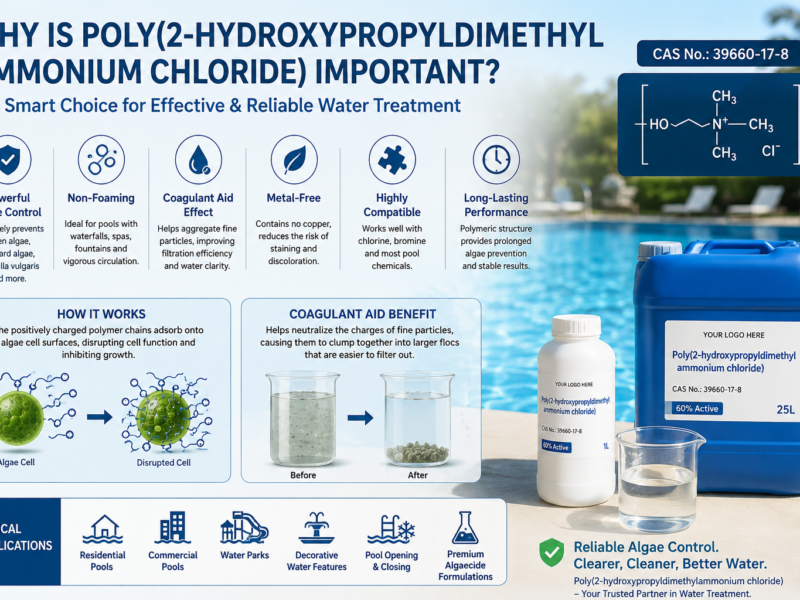
Educational infographic showing the key benefits and working mechanism of Poly(2-hydroxypropyldimethylammonium chloride), including algae cell disruption, improved water clarity through coagulant aid action, typical pool applications, and product packaging beside a clear swimming pool.

Why Is Poly(2-hydroxypropyldimethylammonium chloride) Important?

GET IN TOUCH Ask For Sample? Why Is Poly(2-hydroxypropyldimethylammonium chloride) Important? Water treatment has changed dramatically over the past few decades. Today’s systems aren’t just expected to keep water clean—they’re expected to do it efficiently, safely, and with fewer side effects. That’s exactly where Poly(2-hydroxypropyldimethylammonium chloride) comes in. Known in...
Read More
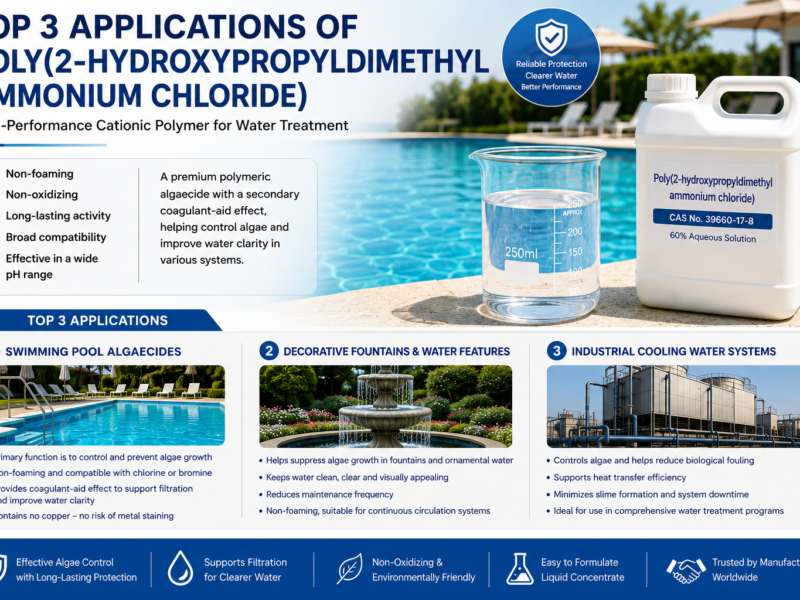
Professional infographic featuring Poly(2-hydroxypropyldimethylammonium chloride 60% aqueous solution for water treatment, illustrating its primary use as a polymeric algaecide in swimming pools, fountains, and cooling water systems, with long-lasting algae control and improved filtration support

Top 3 Applications of Poly(2-hydroxypropyldimethylammonium chloride)

GET IN TOUCH Ask For Sample? Top 3 Applications of Poly(2-hydroxypropyldimethylammonium chloride) Poly(2-hydroxypropyldimethylammonium chloride) (CAS No. 39660-17-8) is a high-performance cationic quaternary ammonium polymer widely used in industrial water treatment. Thanks to its non-foaming, non-oxidizing, and long-lasting antimicrobial performance, it has become a preferred active ingredient in many commercial formulations....
Read More
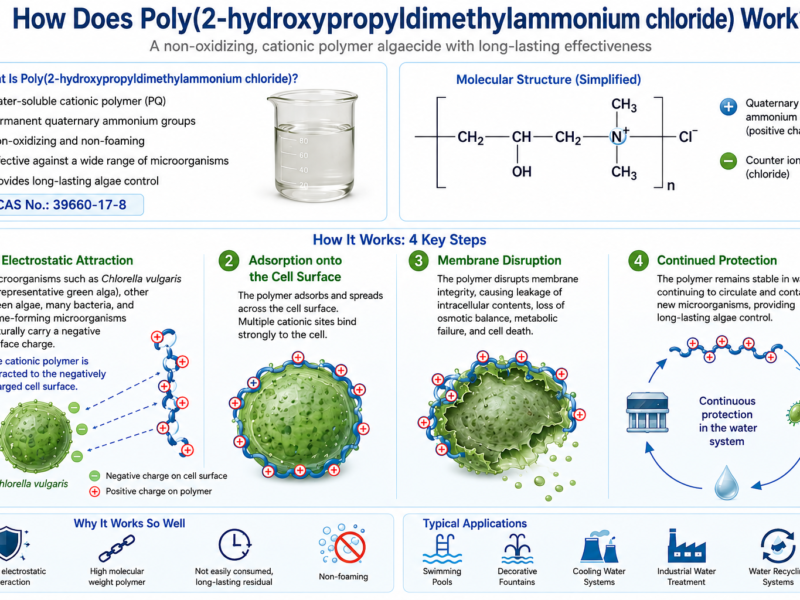
Scientific infographic illustrating the working mechanism of Poly(2-hydroxypropyldimethylammonium chloride (CAS No. 39660-17-8), showing its molecular structure, four-step antimicrobial mechanism, and applications in swimming pools, cooling water systems, decorative fountains, industrial water treatment, and water recycling systems

How Does Poly(2-hydroxypropyldimethylammonium chloride) Work?

GET IN TOUCH Ask For Sample? How Does Poly(2-hydroxypropyldimethylammonium Chloride) Work? When people first hear about Poly(2-hydroxypropyldimethylammonium chloride), one question usually comes up: How can one chemical prevent algae for weeks without behaving like chlorine or copper-based products? The answer lies in its molecular structure rather than strong oxidation or...
Read More
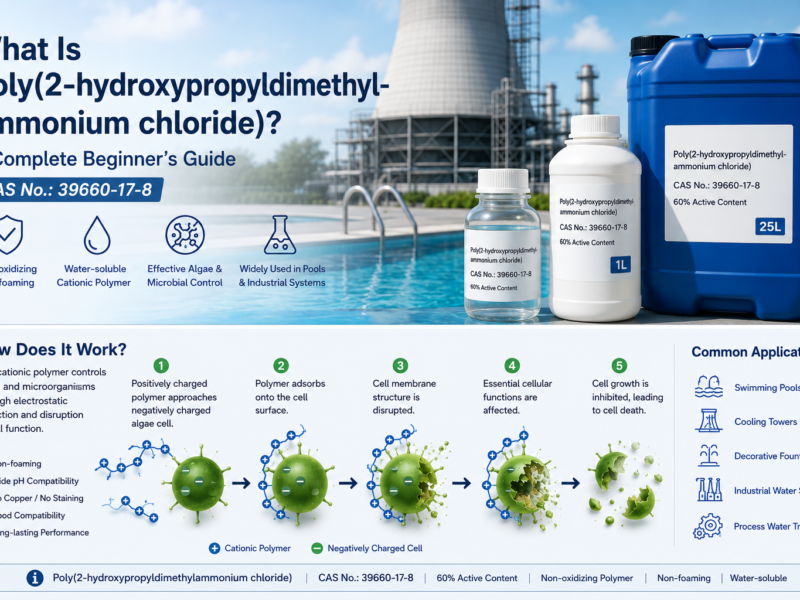
Infographic showing how Poly(2-hydroxypropyldimethylammonium chloride attaches to negatively charged algae and microbial cells through electrostatic attraction, helping control biological growth while remaining non-foaming and water-soluble

What Is Poly(2-hydroxypropyldimethylammonium Chloride)? A Complete Beginner’s Guide

GET IN TOUCH Ask For Sample? What Is Poly(2-hydroxypropyldimethylammonium Chloride)? A Complete Beginner’s Guide If you’ve been researching industrial biocides, pool algaecides, or water treatment polymers, you’ve probably come across the rather intimidating name Poly(2-hydroxypropyldimethylammonium chloride). At first glance, it sounds like something only a chemist could pronounce. But here’s...
Read More
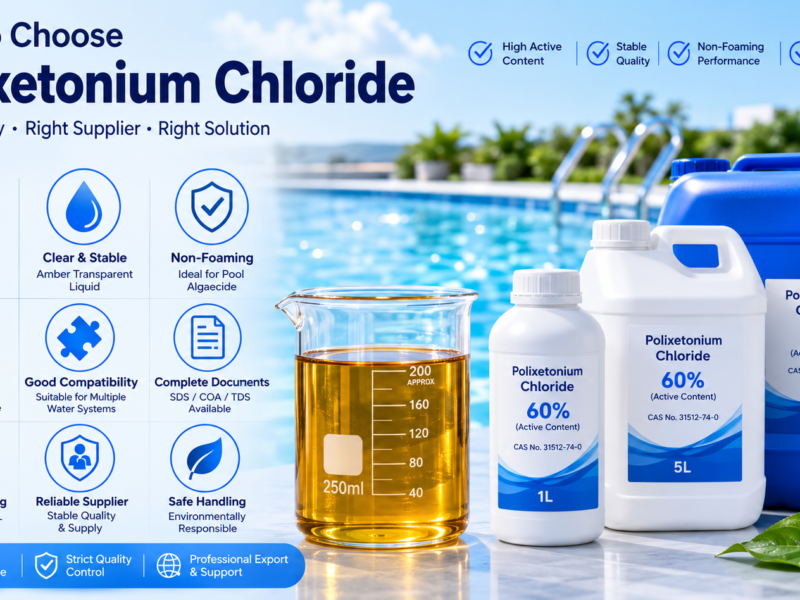
Amber transparent Polixetonium Chloride liquid with HDPE packaging options for non-foaming pool algaecide and water treatment use.

How to Choose Polixetonium Chloride?

GET IN TOUCH Ask For Sample? How to Choose Polixetonium Chloride Choosing Polixetonium Chloride sounds easy at first. You ask for CAS No. 31512-74-0, check the price, compare two or three suppliers, and place the order. Well… not quite. If you’ve ever bought water treatment chemicals, pool algaecide raw materials,...
Read More