
GET IN TOUCH
Ask For Sample?
Application Guide for Polixetonium Chloride
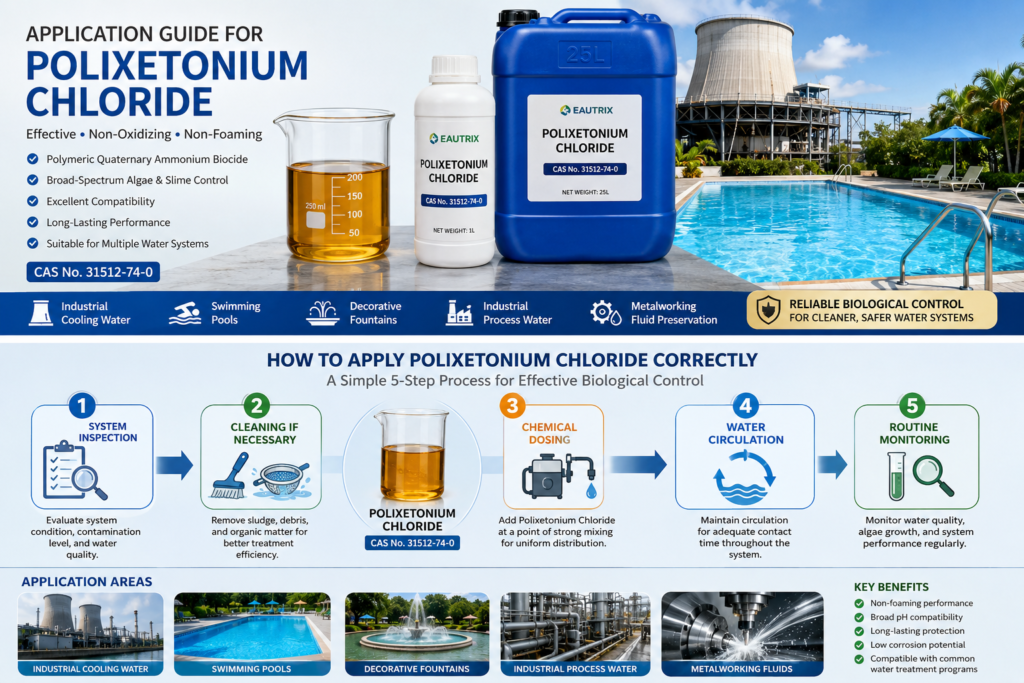
If you’ve selected Polixetonium Chloride for your water treatment program, you’re already using one of the most effective non-oxidizing polymeric biocides available. But choosing the right product is only part of the equation.
The real question is this:
Are you applying it correctly?
Even a high-quality product can deliver disappointing results if the dosage, addition point, or treatment schedule isn’t suitable for the system. On the other hand, proper application helps maximize algae control, reduce maintenance costs, and extend the service life of your water system.
This guide explains how to use Polixetonium Chloride (CAS No. 31512-74-0) in different applications, along with practical recommendations based on typical industrial and commercial water treatment practices.
What Is Polixetonium Chloride?
Polixetonium Chloride is a polymeric quaternary ammonium compound widely used as a non-oxidizing biocide for controlling algae, slime, and microbial fouling in water systems.
Unlike oxidizing biocides that react quickly and are rapidly consumed, this polymer works through electrostatic interaction with microorganisms. Positively charged polymer chains attach to negatively charged cell surfaces, disrupting normal cellular functions and eventually causing cell death.
Because of this different mode of action, Polixetonium Chloride often provides longer-lasting biological control without introducing chlorine, bromine, or heavy metals into the system.
Typical advantages include:
- Non-foaming during normal circulation
- Broad operating pH range
- Good compatibility with many water treatment programs
- Lower corrosion potential than many oxidizing treatments
- Effective algae control in both industrial and recreational water systems
How Polixetonium Chloride Works
Understanding the treatment mechanism makes it much easier to apply the product correctly.
Rather than oxidizing microorganisms chemically, Polixetonium Chloride uses its permanent positive charges to interact directly with microbial cells.
The process generally follows several stages.
Adsorption onto the Cell Surface
Most algae and bacteria carry a naturally negative surface charge.
The cationic polymer is strongly attracted to these cells, allowing it to adsorb rapidly onto their outer membrane.
Membrane Disruption
Once attached, the polymer interferes with membrane integrity.
The damaged membrane loses its ability to regulate nutrients and maintain normal cellular activity.
Cell Inactivation
As membrane damage progresses, cellular metabolism stops.
Affected microorganisms can no longer reproduce or survive.
Continued Protection
Unlike oxidizing disinfectants that disappear quickly after reacting with organic matter, polymeric biocides usually remain active longer in the water. This characteristic often allows longer intervals between treatments when system conditions are properly managed.
Main Application Areas
One reason Polixetonium Chloride remains widely used is its versatility.
Different industries may apply the product differently, but the objective is usually the same—maintaining clean water while minimizing biological contamination.
Cooling Water Systems
Industrial cooling towers provide ideal conditions for algae growth.
Warm temperatures, sunlight, and continuous nutrient supply can quickly lead to fouling.
Routine addition of Polixetonium Chloride helps:
- Prevent algae growth
- Reduce slime accumulation
- Maintain heat-transfer efficiency
- Lower cleaning frequency
- Improve overall operating stability
Preventive treatment is generally more economical than waiting until severe contamination develops.
Swimming Pools
Polixetonium Chloride is widely formulated into premium polymeric algaecides for residential and commercial swimming pools.
Compared with copper-based algaecides, it offers several practical advantages:
- Excellent preventive algae control
- Non-foaming during circulation
- Compatible with chlorine and bromine programs
- No added copper that may contribute to metal staining
- Suitable for routine maintenance programs
Many pool operators also appreciate that polymeric algaecides help maintain clearer water while supporting overall water balance.
Decorative Fountains
Outdoor fountains constantly receive dust, pollen, leaves, and sunlight.
These conditions encourage algae growth, especially during warmer months.
Regular treatment helps keep:
- Water visually clear
- Stone surfaces cleaner
- Pumps operating efficiently
- Maintenance requirements lower
Industrial Process Water
Many industrial water systems require reliable biological control to maintain production efficiency.
Depending on the process, uncontrolled biological growth may:
- Restrict flow
- Reduce heat transfer
- Increase maintenance costs
- Shorten equipment life
Routine monitoring combined with scheduled dosing helps minimize these risks.
Metalworking Fluid Preservation
Polixetonium Chloride has also been used for preserving certain water-based metalworking fluids, particularly systems based on synthetic or semi-synthetic formulations that do not contain incompatible anionic surfactants.
Its primary role is to suppress bacterial growth that can lead to:
- Fluid degradation
- Offensive odors
- Reduced machining performance
- Shortened coolant service life
Treatment schedules should always follow the recommendations established for the specific metalworking fluid formulation.
Preventive Treatment vs. Corrective Treatment
One mistake many operators make is waiting until algae become visible.
By that point, the biological population has usually grown well beyond what can be seen.
Preventive dosing generally provides several benefits:
- Lower overall chemical consumption
- Better water clarity
- More stable microbial control
- Reduced cleaning downtime
- Improved operating efficiency
Think of it like changing the oil in your car. It’s much easier—and far less expensive—to prevent problems than to repair damage after it happens.
Step-by-Step Application Instructions
Using Polixetonium Chloride correctly is about more than simply pouring it into a water system. The location, timing, and condition of the system all influence treatment efficiency. A thoughtful application plan can improve biological control while reducing unnecessary chemical consumption.
Step 1: Evaluate the System Condition
Before adding any biocide, inspect the system and collect basic operating information.
Ask yourself a few simple questions:
- Is this a preventive treatment or a corrective treatment?
- Has algae already become visible?
- Is there excessive sludge or organic debris?
- Has the system recently been cleaned?
- What is the total water volume?
Knowing the answers helps determine a more appropriate treatment strategy.
Step 2: Remove Heavy Deposits Whenever Possible
Polixetonium Chloride works best when it can contact microorganisms directly.
If thick sludge, leaves, scale, or heavy biofilm are present, part of the product may be consumed before reaching the target organisms.
For systems with severe fouling, consider:
- Removing accumulated debris
- Cleaning strainers and filters
- Flushing heavily contaminated sections
- Improving water circulation before treatment
This preparation often leads to better results than simply increasing the dosage.
Step 3: Add the Product Where Mixing Is Most Effective
Uniform distribution is important.
In most circulating systems, Polixetonium Chloride is introduced at locations where strong turbulence promotes rapid mixing, such as:
- Chemical dosing tanks
- Circulation pump suction lines
- High-flow piping
- Cooling tower basins with good circulation
Avoid adding the product into stagnant areas where mixing is poor.
Step 4: Allow Adequate Contact Time
After dosing, keep the circulation system operating whenever possible.
Continuous circulation helps the polymer contact microorganisms throughout the system instead of remaining concentrated in one location.
Depending on the application, several hours of circulation may be recommended before partial blowdown or water replacement.
Step 5: Monitor the Results
Good water treatment is an ongoing process rather than a one-time event.
Regularly monitor indicators such as:
- Water clarity
- Visible algae growth
- Slime formation
- Filter pressure
- Microbial counts (when available)
These observations help determine whether the treatment frequency or dosage should be adjusted.
Factors That Affect Performance
Even when the recommended dosage is used, treatment performance can vary from one system to another.
Several operating conditions influence how effectively Polixetonium Chloride controls biological growth.
Organic Contamination
Organic matter consumes treatment capacity.
Leaves, dirt, pollen, oils, and suspended solids can reduce the amount of active polymer available to interact with microorganisms.
Cleaner systems generally require less product.
Water Temperature
Warmer water encourages faster microbial growth.
Cooling towers during summer, for example, often require more frequent monitoring than systems operating in colder seasons.
Water Circulation
Poor circulation creates dead zones where microorganisms can continue growing.
Maintaining adequate flow throughout the system improves treatment efficiency.
Existing Biological Population
Preventing growth is easier than eliminating an established bloom.
If heavy contamination already exists, an initial corrective treatment may be necessary before switching to a maintenance program.
Compatibility with Other Water Treatment Chemicals
One reason Polixetonium Chloride remains popular is its compatibility with many commonly used water treatment chemicals.
It is frequently incorporated into programs that also include:
- Chlorine
- Bromine
- Scale inhibitors
- Corrosion inhibitors
- Dispersants
- pH adjustment chemicals
However, one important consideration should never be overlooked.
Because Polixetonium Chloride is a cationic polymer, it may become incompatible with strongly anionic products. Direct mixing with anionic surfactants or certain anionic polymers can reduce performance or lead to undesirable precipitation.
When introducing a new chemical into an existing treatment program, it is good practice to:
- Review compatibility information supplied by the manufacturer.
- Perform a small-scale jar test if compatibility is uncertain.
- Add different chemicals separately rather than mixing concentrated products together.
These simple precautions help maintain consistent treatment performance.
Common Application Mistakes to Avoid
Even experienced operators occasionally make avoidable mistakes. Recognizing these issues early can improve results and reduce operating costs.
Waiting Until Algae Become Severe
Visible algae are usually the final stage of biological growth rather than the beginning.
Routine preventive treatment is generally more effective than emergency corrective dosing.
Assuming More Chemical Always Works Better
Adding excessive amounts does not necessarily improve biological control.
Instead, it may increase operating costs without delivering proportional benefits.
Following a monitored treatment program is usually the more economical approach.
Poor Mixing
If the product is added to areas with little circulation, much of it may remain localized.
Good mixing is one of the simplest ways to improve treatment efficiency.
Ignoring Routine Monitoring
Water systems change over time.
Seasonal temperature changes, contamination levels, and operating conditions all influence treatment requirements.
Regular inspection allows adjustments before problems become serious.
Mixing with Incompatible Chemicals
Never assume that all water treatment products are compatible.
Checking compatibility before combining chemicals helps avoid unexpected performance issues.
Storage and Handling Recommendations
Proper storage helps maintain product quality throughout its shelf life.
General recommendations include:
- Store in the original tightly closed container.
- Keep the product in a cool, dry, and well-ventilated location.
- Protect from freezing and prolonged exposure to direct sunlight.
- Avoid contamination during handling.
- Follow all instructions provided in the Safety Data Sheet (SDS).
Personnel should wear appropriate personal protective equipment (PPE), including chemical-resistant gloves and eye protection, when handling the concentrated product.
For large-scale industrial applications, local safety procedures and environmental regulations should always be followed.
Final Thoughts
Polixetonium Chloride has earned its reputation as a reliable non-oxidizing polymeric biocide because it combines effective algae control with excellent operational characteristics. Its non-foaming behavior, broad compatibility, and long-lasting activity make it a valuable choice for cooling water systems, swimming pools, decorative fountains, and selected industrial water applications.
That said, no water treatment chemical performs at its best without proper application. Understanding your system, using an appropriate dosage, ensuring good circulation, and monitoring results regularly will almost always deliver better performance than relying on higher chemical consumption alone.
Every water system is different. Factors such as water quality, contamination level, operating temperature, and treatment objectives all influence the most suitable application program. When these variables are considered together, Polixetonium Chloride can provide consistent, dependable biological control while helping reduce maintenance requirements and extend equipment life.
If you are evaluating Polixetonium Chloride for a new project—or comparing different product specifications—technical support can make the selection process much easier. Choosing the right active content, viscosity range, and application strategy often has a greater impact than simply comparing prices.
Frequently Asked Questions
1. Can Polixetonium Chloride be used together with chlorine?
Yes. Polixetonium Chloride is commonly used alongside chlorine or bromine in many water treatment programs. It is generally compatible with these oxidizing disinfectants, provided they are applied according to a well-designed treatment schedule.
2. Does Polixetonium Chloride produce foam?
One of its key advantages is its non-foaming performance under normal operating conditions, making it suitable for circulating cooling water systems and swimming pool applications where foam is undesirable.
3. Is Polixetonium Chloride suitable for swimming pools?
Yes. It is widely used as the active ingredient in polymeric swimming pool algaecides. It helps prevent algae growth, works well with chlorine-based sanitation programs, and does not introduce copper ions that may contribute to surface staining.
4. How should Polixetonium Chloride be stored?
Store the product in its original sealed container in a cool, dry, and well-ventilated area. Protect it from freezing, excessive heat, and direct sunlight, and always follow the storage and handling recommendations provided in the product’s Safety Data Sheet.