
GET IN TOUCH
Ask For Sample?
Technical Properties of Polixetonium Chloride
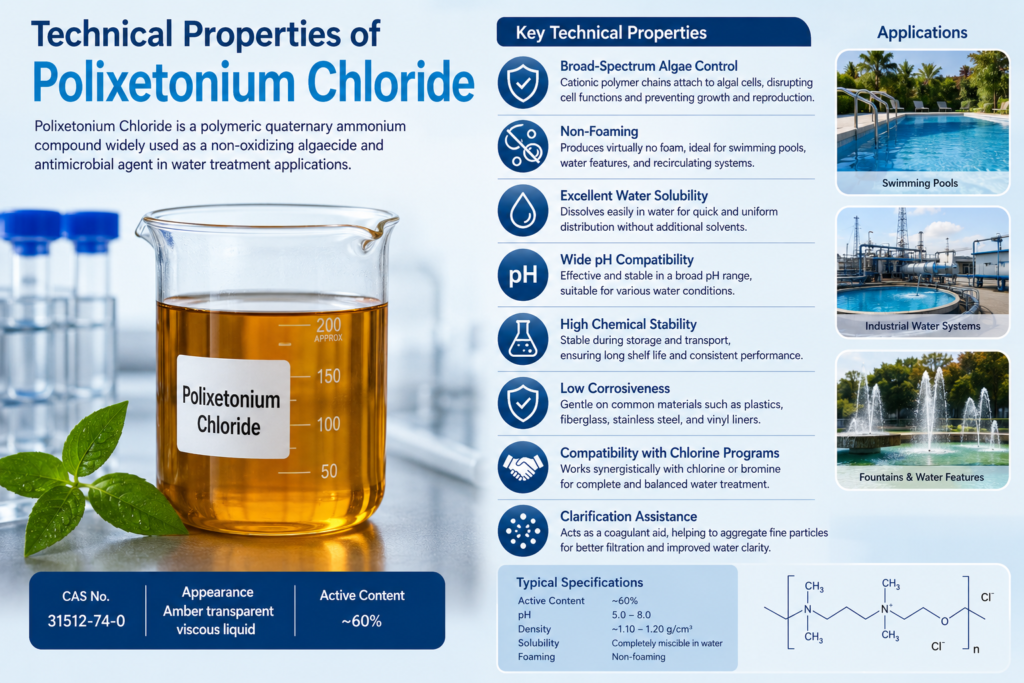
When selecting a polymeric biocide for water treatment, performance depends on much more than the product name. The technical properties determine how well the product controls algae, how long it remains effective, how easily it blends into formulations, and whether it is compatible with other treatment chemicals.
Polixetonium Chloride has earned a strong reputation because it combines broad-spectrum algae control with excellent water compatibility, non-foaming performance, and long-lasting activity. These characteristics have made it a preferred active ingredient for swimming pool chemicals, industrial water treatment, and other water-based systems.
This guide explains the most important technical properties of Polixetonium Chloride and why they matter when choosing a reliable supplier or comparing different products.
What Is Polixetonium Chloride?
Polixetonium Chloride is a polymeric quaternary ammonium compound widely used as a non-oxidizing algaecide and antimicrobial agent.
Unlike chlorine or bromine, which work through oxidation, Polixetonium Chloride acts through its positively charged polymer chains. These chains attach to negatively charged algal cell surfaces, disrupt normal cell functions, and ultimately prevent algae from surviving and reproducing.
Because of this unique mechanism, it provides effective algae prevention while remaining non-foaming and compatible with most common water treatment programs.
Typical product information includes:
- Chemical Name: Poly[oxyethylene(dimethyliminio)ethylene(dimethyliminio)ethylene dichloride]
- CAS No.: 31512-74-0
- Appearance: Amber transparent viscous liquid
- Product Form: 60% Aqueous solution
Key Technical Properties of Polixetonium Chloride
1. Polymeric Cationic Structure
The defining feature of Polixetonium Chloride is its cationic polymer backbone.
Its positively charged polymer chains are attracted to negatively charged microorganisms, particularly algae. Instead of rapidly oxidizing cells like chlorine, the polymer adsorbs onto cell surfaces, disrupting membrane integrity and inhibiting essential biological functions.
This polymeric mechanism contributes to:
- Long-lasting algae prevention
- Reduced consumption of oxidized productes to save cost
- Stable performance over a broad operating range
2. Non-Foaming Performance
One of the biggest advantages is its non-foaming behavior.
Foam formation can interfere with water circulation, filtration, and the visual appearance of swimming pools or industrial water systems. Because Polixetonium Chloride produces virtually no foam under normal operating conditions, it is suitable for:
- Swimming pools
- Decorative fountains
- Water features
- Recirculating water systems
This characteristic is one reason polymeric algaecides are often preferred over many surfactant-based alternatives.
3. Excellent Water Solubility
Polixetonium Chloride dissolves readily in water.
Good water solubility allows:
- Fast and uniform distribution
- Easy dosing
- Consistent treatment performance
- Simple formulation into liquid products
No additional solvents are typically required.
4. Broad pH Compatibility
Another important property is its ability to perform across a relatively wide pH range.
Most swimming pools operate between pH 7.2 and 7.8, while industrial systems may experience wider fluctuations.
Polixetonium Chloride maintains stable performance under typical operating conditions without requiring frequent pH adjustment.
5. High Chemical Stability
The polymer exhibits good stability during storage and transportation.
When stored properly, it maintains:
- Active ingredient stability
- Appearance
- Viscosity
- Performance consistency
Proper packaging and storage help maximize shelf life.
6. Low Corrosiveness
Unlike highly oxidizing disinfectants, Polixetonium Chloride is generally much less aggressive toward common system materials when used at recommended concentrations.
This makes it suitable for systems containing:
- Plastic piping
- Fiberglass
- Vinyl liners
- Stainless steel equipment
- Filtration systems
7. Compatibility with Chlorine Programs
Many users ask whether Polixetonium Chloride can replace chlorine.
The answer is no.
Instead, it is commonly used alongside chlorine or bromine to improve algae prevention while allowing the sanitizer to focus primarily on pathogen control.
This complementary approach helps maintain cleaner water and reduce the likelihood of algae blooms.
Why These Properties Matter in Real Applications
The technical properties directly influence practical performance.
For swimming pool owners and formulators, they mean:
- Cleaner-looking water
- Reliable algae prevention
- No troublesome foam
- Compatibility with existing sanitizer programs
- Easier routine maintenance
For chemical manufacturers, these properties allow:
- Stable formulations
- Good storage performance
- Reliable product consistency
- Straightforward private-label production
Typical Technical Specifications
Actual specifications may vary slightly by manufacturer, but a typical commercial grade is shown below.
| Property | Typical Value |
|---|---|
| Appearance | Amber transparent viscous liquid |
| CAS No. | 31512-74-0 |
| Active Content | 58.0% – 61.0% |
| pH(10% water solution) | 6.0–8.0 |
| Density | 1.148–1.153 g/cm³ |
| Viscosity(mPa·S) | 150-400 |
| Solubility | Completely miscible with water |
| Foaming | Non-foaming |
Always refer to the supplier’s Technical Data Sheet (TDS) and Certificate of Analysis (COA) for product-specific values.
How to Evaluate Product Quality
Not every product labeled as Polixetonium Chloride offers the same performance.
When comparing suppliers, pay attention to several key indicators.
Active Content
Some manufacturers specify active content, while others report solid content. These are not always the same value. Products labeled with the same percentage may contain different actual amounts of effective polymer, making this an important point to verify during supplier evaluation.
Appearance
A high-quality product should be a clean amber transparent viscous liquid without visible suspended matter or phase separation.
Viscosity
Viscosity often reflects the polymer’s molecular weight distribution. Consistent viscosity from batch to batch usually indicates stable manufacturing quality and helps maintain predictable application performance.
Batch Consistency
Reliable manufacturers maintain strict quality control to ensure each production batch delivers consistent activity, appearance, and physical properties.
Storage and Handling Considerations
For optimal product stability:
- Store in tightly closed original containers.
- Keep away from direct sunlight.
- Avoid prolonged freezing or excessive heat.
- Prevent contamination during handling.
- Follow local safety regulations and consult the Safety Data Sheet (SDS).
Under recommended storage conditions, the product generally maintains stable quality throughout its specified shelf life.
Conclusion
The technical properties of Polixetonium Chloride explain why it has become one of the most trusted polymeric algaecides for water treatment.
Its non-foaming nature, excellent water solubility, broad pH compatibility, chemical stability, and unique cationic polymer structure provide dependable algae control across a wide range of applications. In addition, its secondary coagulant aid effect can help support improved water clarity in well-managed systems.
When selecting a supplier, don’t focus solely on price. Reviewing active content, viscosity consistency, appearance, manufacturing quality, and technical documentation will help ensure reliable long-term performance.
Frequently Asked Questions
1. What is the primary function of Polixetonium Chloride?
Its primary function is to act as a non-oxidizing polymeric algaecide, preventing algae growth in swimming pools and other water systems.
2. Does Polixetonium Chloride produce foam?
No. One of its key technical advantages is its non-foaming performance, making it suitable for recirculating water systems and swimming pools.
3. Can Polixetonium Chloride replace chlorine?
No. It is designed to complement chlorine or bromine by controlling algae, while oxidizing sanitizers continue to provide primary disinfection.
4. What should buyers look for when comparing Polixetonium Chloride suppliers?
Look beyond price. Compare active content, product appearance, viscosity consistency, quality control procedures, and the availability of complete technical documentation such as the TDS, SDS, and COA.