
GET IN TOUCH
Ask For Sample?
Understanding Different Types of Pool Algaecides
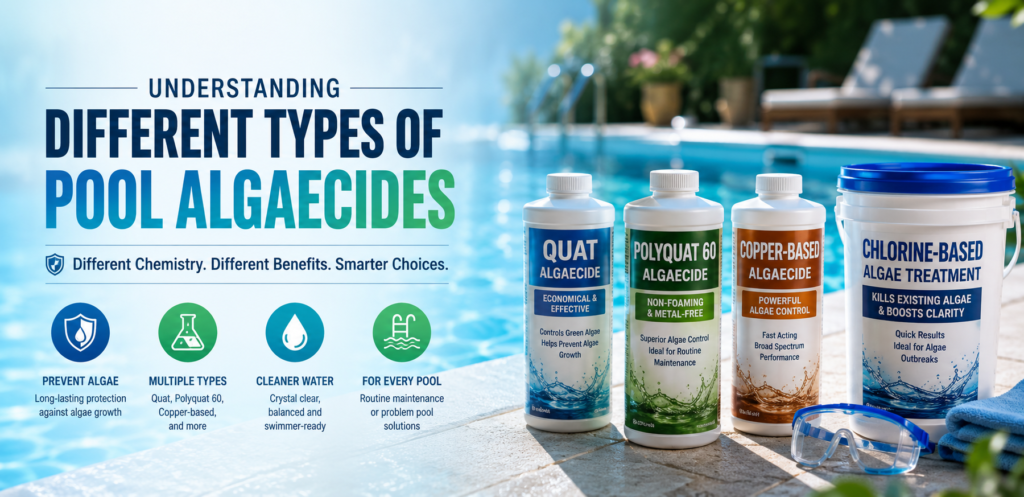
Keeping a swimming pool free from algae sounds simple: maintain chlorine, keep the water moving, and clean the surfaces regularly.
Then one warm week arrives.
The water starts looking slightly dull. A green tint appears near the steps. Maybe the walls feel a little slippery. Suddenly, the pool owner is staring at a shelf full of products labeled algaecide, algae preventer, copper algaecide, polyquat, quat, or chlorine enhancer.
Which one actually makes sense?
The answer depends on what the pool needs. Pool algaecides aren’t one single class of chemical. They use different active ingredients, attack algae in different ways, and behave very differently once added to pool water.
Some are inexpensive but may foam. Some offer strong algae control but can introduce metals into the water. Others, such as Polyquat 60, are designed around polymer chemistry and provide non-foaming, metal-free algae control.
So, rather than asking, “What’s the strongest algaecide?” a more useful question is:
What type of algaecide fits this pool and its maintenance program?
Let’s break it down.
First Things First: What Does an Algaecide Actually Do?
An algaecide is a chemical product formulated to kill algae, suppress its growth, or prevent it from becoming established in pool water.
That sounds similar to chlorine—and there is some overlap.
Chlorine is primarily the pool’s sanitizer and oxidizer. It helps control bacteria, viruses, algae, and organic contamination. A properly maintained chlorine residual remains the foundation of most conventional swimming pool sanitation programs.
Algaecides have a narrower job.
Depending on their chemistry, they may damage algae cell membranes, interfere with essential cellular processes, or create conditions that make algae growth more difficult.
This distinction matters because an algaecide normally shouldn’t be treated as a replacement for proper chlorination.
Think of chlorine as the main security system around a house. An algaecide is an extra lock on a door where trouble tends to appear.
You still need the security system.
The Main Types of Pool Algaecides
Most swimming pool algaecides can be grouped into a few broad chemical families:
- Quaternary ammonium compound algaecides
- Polymeric quaternary ammonium algaecides
- Copper-based and other metallic algaecides
- Chlorine-based algae treatments
You’ll occasionally encounter products using other chemistries or combinations of active ingredients. Still, these categories explain much of what pool owners, service companies, distributors, and private-label brands encounter commercially.
And despite similar labels, their behavior can be surprisingly different.
Quat Algaecides: Affordable, Familiar—and Sometimes Foamy
Traditional quaternary ammonium compounds, often shortened to quats, have been used in antimicrobial products for decades.
They’re cationic compounds, meaning they carry a positive electrical charge.
Why does that matter?
Algal cell surfaces generally contain negatively charged components. The positively charged quat molecules are attracted to those surfaces and can interact with cell membranes, disturbing their normal structure and function.
Once membrane integrity is compromised, the algae struggle to survive.
It’s rather like damaging the walls of thousands of microscopic water balloons. Once those walls stop doing their job, the cells can’t maintain normal internal conditions.
Why Are Quat Algaecides Popular?
Cost is one reason.
Traditional quat algaecides can be relatively economical, making them attractive for routine pool maintenance products.
They may also offer:
- Good performance against common green algae
- Straightforward formulation
- Easy incorporation into many liquid pool products
- Familiar chemistry for pool chemical manufacturers
There’s a catch, though.
The Foam Problem
Certain conventional quat algaecides can produce foam, especially when used at higher concentrations or when water is strongly agitated.
Picture spa jets, waterfalls, return jets, fountains, or swimmers churning the water. Under the wrong conditions, a surfactant-like algaecide can leave the pool looking less like a resort and more like someone accidentally poured dish soap into it.
That’s not exactly the customer experience a pool brand wants.
The tendency to foam is one reason polymeric algaecides gained so much attention.
Polymeric Algaecides: When Quat Chemistry Gets an Upgrade
Polymeric quaternary ammonium algaecides belong to the broader cationic polymer family.
Rather than behaving like smaller conventional quat molecules, these materials contain repeating positively charged units along a polymer chain.
One of the best-known examples in swimming pool treatment is Polyquat 60.
Polyquat 60 is widely associated with non-foaming algae-control formulations and is especially useful where manufacturers or pool operators want to avoid adding copper or other metals.
How Does Polyquat 60 Work?
Its positively charged polymer structure interacts with negatively charged algae surfaces.
These interactions can disrupt cell membrane function and interfere with normal cellular processes. The polymeric structure also changes how the active material behaves compared with conventional small-molecule quats.
The practical result?
Effective algae control without the heavy foaming commonly associated with some traditional quat products.
For pool owners, that’s useful.
For professional maintenance companies and private-label chemical brands, it’s even more interesting because the user experience matters almost as much as the chemistry. A product that controls algae but creates a bathtub full of bubbles has solved one problem and introduced another.
Why Polyquat 60 Has Become Such an Important Category
Polyquat 60 combines several characteristics that fit modern pool maintenance programs particularly well.
It is generally valued for being:
- Non-foaming
- Metal-free
- Suitable for routine algae prevention
- Compatible with many conventional pool maintenance programs when used according to product directions
- Useful for seasonal and winterizing formulations
- Less associated with metal staining concerns than copper-containing products
There’s another subtle advantage.
Because Polyquat 60 doesn’t depend on copper for algae control, repeated treatment doesn’t intentionally add copper ions to pool water.
That distinction becomes important when we’re talking about long-term maintenance rather than one emergency treatment.
For a deeper explanation of this chemistry, see What Is Polyquat 60 Algaecide? A Complete Beginner’s Guide.
Copper-Based Algaecides: Powerful Chemistry with a Trade-Off
Copper is toxic to algae at relatively low concentrations, which is why copper compounds have a long history in algae-control applications.
Copper-based pool algaecides may contain copper salts or formulated/complexed copper systems designed to improve stability and performance.
Copper ions interfere with essential biological processes within algae cells, including enzyme activity and photosynthetic functions.
And yes—they can work very well.
That’s why copper hasn’t simply disappeared from pool treatment.
But effective doesn’t automatically mean ideal for every situation.
The Main Concern with Copper: It Stays in the Water
Chlorine gets consumed.
Many organic treatment chemicals gradually break down.
Copper is an element.
Once copper has been introduced into pool water, it doesn’t simply disappear through normal chemical degradation. Its concentration can change through dilution, precipitation, filtration of precipitated material, water replacement, or interactions with pool surfaces and other substances.
Repeated dosing therefore deserves attention.
Under unfavorable water conditions, dissolved metals can contribute to staining or discoloration.
You’ve probably heard stories about swimmers with light-colored hair developing a greenish tint after spending time in a pool. Chlorine often gets blamed.
Copper is frequently the more relevant culprit.
That’s the awkward side of metallic algaecides: a product can control algae successfully while creating another water-quality concern if metal levels and pool chemistry aren’t managed carefully.
Copper vs. Polyquat 60: Two Very Different Strategies
Copper-based products and Polyquat 60 can both be used for algae control, but they approach the problem through different chemistry.
| Feature | Traditional Quat | Polyquat 60 | Copper-Based Algaecide |
|---|---|---|---|
| Main chemistry | Quaternary ammonium compound | Polymeric quaternary ammonium compound | Copper compounds |
| Metal-free | Yes | Yes | No |
| Foaming potential | Can be noticeable | Low/non-foaming when properly formulated | Generally low |
| Routine prevention | Yes | Well suited | Possible |
| Metal accumulation concern | No | No | Yes |
| Staining concern from active ingredient | Low | Low | Possible |
| Cost | Usually lower | Usually higher | Varies |
| Typical positioning | Economy maintenance | Premium/non-foaming maintenance | Strong metal-based algae control |
There’s no universal winner here.
Copper chemistry still has legitimate uses. Conventional quats can make economic sense in some formulations. Polyquat 60 becomes particularly attractive when low foam, metal-free treatment, and routine prevention are priorities.
For a closer comparison, read Copper Algaecide vs Polyquat 60: Understanding the Difference.
What About Chlorine-Based Algae Treatments?
Here’s where terminology gets a little messy.
Products marketed for “killing algae” aren’t always algaecides in the narrow chemical sense. Some are simply chlorine-based oxidizing treatments designed to raise the available chlorine concentration quickly.
When a pool has an established algae bloom, oxidation is often a major part of corrective treatment.
A high chlorine level can destroy algae cells and oxidize organic material. Brushing, filtration, circulation, and removal of dead material then become part of the cleanup.
That makes chlorine extremely important for treating an active algae problem.
But chlorine treatment and preventive algaecide treatment shouldn’t automatically be treated as identical jobs.
Killing Algae and Preventing Algae Aren’t Quite the Same Thing
Suppose a pool has already turned visibly green.
At that point, adding a maintenance dose of algaecide and waiting for a miracle probably isn’t the smartest plan.
The pool may require:
- Water testing and chemistry correction
- Appropriate chlorination
- Thorough brushing
- Continuous or extended filtration
- Filter cleaning or backwashing as appropriate
- Removal of accumulated debris
- Follow-up algae prevention
Now consider another pool.
It’s crystal clear. Chlorine is within the intended operating range. Circulation is good. The owner simply wants additional protection during hot weather or before leaving for vacation.
That’s a different job.
A preventive algaecide such as Polyquat 60 may make much more sense there.
One pool needs correction. The other needs prevention.
Small distinction? Not really.
So Why Isn’t Chlorine Always Enough?
Under ideal conditions, properly managed chlorine provides substantial algae control.
Pools, unfortunately, don’t live in laboratories.
They sit outside.
Sunlight affects chlorine. Rain changes water chemistry. Leaves and insects introduce organic matter. Swimmers bring sweat, sunscreen, cosmetics, and other contaminants. Hot weather can accelerate biological activity, while poor circulation creates sheltered areas where chemical distribution isn’t as effective.
And sometimes maintenance simply gets missed for a few days.
That’s life.
Algaecides can therefore provide another layer of protection within a broader maintenance program, particularly when environmental conditions make algae growth more likely.
If this sounds familiar, Why Chlorine Alone Cannot Always Prevent Algae explains the relationship between sanitizer residual, environmental pressure, circulation, and preventive algae control in more detail.
Choosing an Algaecide Starts with the Pool, Not the Label
Walking into a store and grabbing the bottle with the largest “ALGAE KILLER” text isn’t much of a selection strategy.
Start by asking what problem you’re actually trying to solve.
For Routine Preventive Maintenance
A non-foaming polymeric algaecide can be attractive, particularly where metal-free treatment is preferred.
Polyquat 60 fits naturally into this category.
For Budget-Focused Routine Programs
Traditional quat algaecides may provide economical algae control.
The potential for foam should be considered, particularly in highly aerated pools, spas, fountains, or water features.
When Metal-Based Treatment Is Acceptable
Copper-based algaecides remain an option where their algae-control properties fit the application and copper concentration can be managed appropriately.
Existing metal levels should be considered before repeated use.
For an Active Green Pool
Don’t assume that simply adding more algaecide will solve everything.
Test the water first.
Correct sanitizer and water balance, brush affected surfaces, maintain circulation and filtration, and follow the treatment directions appropriate to the pool system.
Algaecide can play a role, but severe algae problems usually need a complete corrective approach.
Don’t Forget the Type of Algae
“Algae” is a convenient umbrella term, but pool contamination doesn’t always behave the same way.
Green Algae
This is the classic pool problem.
Water may turn cloudy green, walls can become slippery, and algae may spread quickly when sanitizer levels fall.
Green algae is generally easier to control than more stubborn pool growths when caught early.
Yellow or Mustard Algae
Yellowish growth may appear on shaded walls, floors, ladders, or equipment.
It can be persistent and may return when contaminated brushes, toys, cleaning equipment, or other pool accessories reintroduce material.
Black Algae
What pool professionals commonly call black algae can be particularly difficult because colonies may become firmly established in porous surfaces and develop protective structures.
Brushing and surface treatment become especially important.
The lesson is simple: identifying what you’re dealing with matters.
More Algaecide Isn’t Better
This deserves emphasis.
When people see algae, the instinct is often: If one dose works, two doses must work twice as well.
Chemistry rarely rewards that logic.
Overdosing some traditional quat products can increase foaming. Excessive copper treatment can raise dissolved metal levels. Unnecessary chemical additions also increase treatment cost and may complicate water balance.
Follow the manufacturer’s labeled dosage and directions for the specific product.
Concentration matters too. Two bottles with similar names may contain very different active ingredient levels.
Read the label—not just the marketing on the front.
A Better Way to Think About Pool Algae Control
Instead of thinking:
Chlorine vs. algaecide
think:
Sanitation + circulation + filtration + cleaning + water balance + targeted algae prevention.
Each part supports the others.
Chlorine handles the core sanitation workload. Circulation distributes treatment chemicals. Filtration removes suspended material. Brushing disrupts growth on surfaces. Correct water chemistry helps the entire treatment program function as intended.
An algaecide adds another barrier.
And when algae pressure increases because of summer heat, storms, heavy swimmer loads, neglected circulation, or seasonal closing, that extra barrier can become surprisingly valuable.
Which Type of Pool Algaecide Makes the Most Sense?
There’s no single chemical that fits every swimming pool.
Traditional quat algaecides offer economical algae control but may create foam.
Copper-based algaecides can be effective, but introducing metals means pool operators need to consider accumulation, staining, and discoloration.
Chlorine-based treatment remains central when oxidation and corrective treatment are needed.
Polymeric quaternary ammonium products such as Polyquat 60 occupy a useful middle ground: strong preventive positioning, low foaming behavior, and no intentional addition of copper or other metals.
That’s why they’ve become an important part of many modern pool-care programs.
The chemistry is different. The strengths are different. And once those differences are understood, choosing an algaecide becomes much less confusing.
Frequently Asked Questions
1. What are the main types of swimming pool algaecides?
The major categories include traditional quaternary ammonium compound algaecides, polymeric quaternary ammonium algaecides such as Polyquat 60, copper-based algaecides, and chlorine-based algae treatments. Each uses different chemistry and has different advantages and limitations.
2. Is Polyquat 60 better than a regular quat algaecide?
Polyquat 60 is often preferred when non-foaming performance is important. Traditional quat algaecides can be more economical, but some may create noticeable foam, particularly at higher concentrations or under strong water agitation.
3. Is copper algaecide safe for swimming pools?
Copper-based algaecides can be used successfully when applied according to their approved product directions. However, repeated copper addition should be managed carefully because excessive metal levels can contribute to staining and discoloration.
4. Can I use Polyquat 60 instead of chlorine?
No. Polyquat 60 is an algaecide, not a replacement for the primary sanitizer in a conventional chlorinated pool. It is generally used alongside an appropriate sanitation, circulation, filtration, and water-balance program.
5. What is the best non-foaming algaecide for routine pool maintenance?
Polymeric quaternary ammonium algaecides such as Polyquat 60 are commonly used when a pool-care program calls for non-foaming, metal-free algae prevention. The exact product and dosage should always follow the manufacturer’s label and local regulatory requirements.