
GET IN TOUCH
Ask For Sample?
What Is a Non-Oxidizing Algaecide?
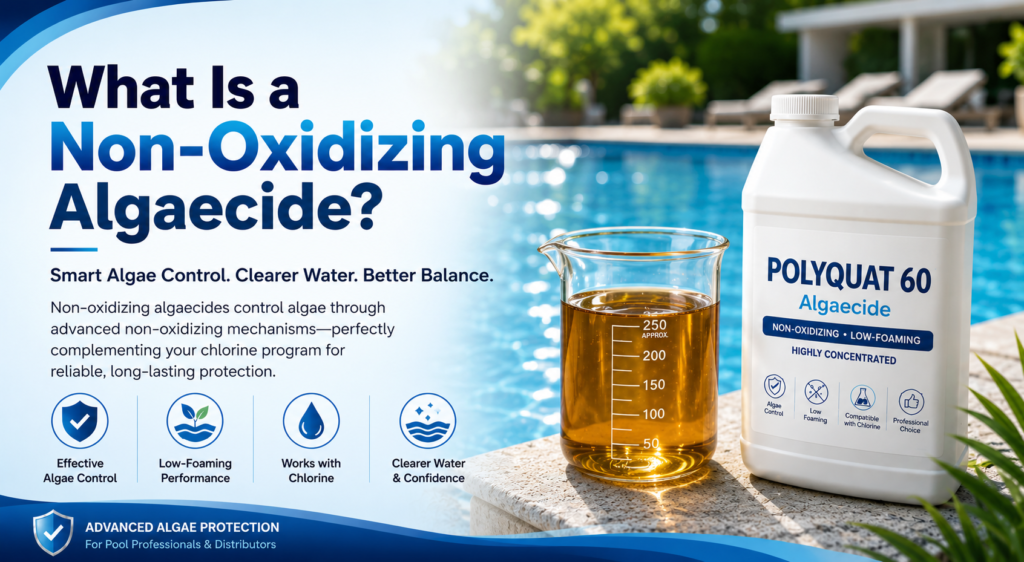
A swimming pool can look perfectly clear on Monday and start showing a faint green tint by Wednesday. Chlorine is present. The filter is running. The pH seems fine. So what happened?
Algae control is rarely as simple as adding more sanitizer.
One useful tool is a non-oxidizing algaecide. Instead of controlling algae mainly through oxidation, this type of product works through other chemical mechanisms, such as disrupting cell membranes or interacting with negatively charged biological surfaces.
That distinction sounds technical, but it matters. It affects how an algaecide behaves in pool water, how long its effect may persist, whether it causes foam, and how it fits alongside chlorine.
Here’s what pool owners, formulators, distributors, and private-label brands should know.
What Does “Non-Oxidizing” Mean?
The easiest way to understand a non-oxidizing algaecide is to compare it with chlorine.
Chlorine is an oxidizing sanitizer. In water, active chlorine species can react with microorganisms and many organic contaminants. These oxidation reactions damage essential cellular components and help keep pool water sanitary.
A non-oxidizing algaecide takes a different route.
It does not rely primarily on oxidation to control algae. Depending on its chemistry, it may interact with cell membranes, disturb membrane integrity, interfere with normal cellular functions, or create conditions that make it harder for algae to establish and spread.
Think of the difference this way.
An oxidizer attacks through highly reactive chemistry. A non-oxidizing algaecide can act more like a chemical interference system: it interacts with the organism in a more targeted way without depending on the same oxidation pathway.
That difference is why non-oxidizing algaecides can complement an existing chlorine program rather than simply acting as “more chlorine.”
So, How Does a Non-Oxidizing Algaecide Work?
There isn’t one universal mechanism because “non-oxidizing algaecide” describes a broad category rather than one specific molecule.
However, many pool algaecides in this category are cationic, meaning they carry positive electrical charges.
Algal cell surfaces generally contain negatively charged sites. That creates a useful interaction.
Opposite charges attract.
When a positively charged algaecidal molecule or polymer approaches the cell surface, electrostatic attraction can help bring the active chemistry into close contact with the organism.
From there, depending on the active ingredient, the algaecide may:
- disturb cell membrane structure;
- increase membrane permeability;
- interfere with normal transport across the membrane;
- cause leakage of cellular material;
- inhibit normal growth and reproduction.
The organism loses its ability to function normally.
This is quite different from simply oxidizing everything the chemical encounters.
And that difference has practical consequences.
Oxidizing vs. Non-Oxidizing Algaecides: What’s the Real Difference?
The terminology can get confusing because swimming pool products often perform overlapping jobs.
A simple comparison helps.
| Feature | Oxidizing Treatment | Non-Oxidizing Algaecide |
|---|---|---|
| Main mechanism | Oxidation | Membrane disruption or other non-oxidative mechanisms |
| Typical example | Chlorine-based treatment | Polymeric quat algaecide |
| Main pool role | Sanitation and oxidation | Supplemental algae control |
| Residual behavior | Depends heavily on oxidizer demand | May provide useful persistence depending on chemistry |
| Reaction with organic contamination | Often significant | Usually different and more selective |
| Use with chlorine | Forms the primary sanitizer system | Commonly used as a supporting treatment |
One point deserves emphasis: non-oxidizing does not mean chlorine-free.
A pool using a non-oxidizing algaecide will normally still need an appropriate sanitizer.
That’s an important distinction because an algaecide and a sanitizer aren’t automatically interchangeable.
Why Isn’t Chlorine Always Enough?
If chlorine kills algae, why bother adding another product?
Fair question.
Under good conditions, maintaining an appropriate sanitizer residual, circulation, filtration, and balanced water chemistry can provide strong algae protection. But real pools aren’t laboratory beakers.
Things change.
A hot weekend brings more swimmers. A thunderstorm dumps rainwater and debris into the pool. Leaves collect in a corner. Water circulation behind the ladder isn’t great. The chlorine residual drops overnight.
Warm temperatures and sunlight can add more pressure.
Suddenly, algae have an opportunity.
This is where a supplemental non-oxidizing algaecide can become useful. It can provide another algae-control mechanism within a broader maintenance program.
For pools with recurring algae pressure, that extra layer can be valuable.
Not All Non-Oxidizing Algaecides Are the Same
Here’s where product selection becomes important.
“Non-oxidizing” describes how a product works in broad terms. It doesn’t tell you everything about its performance.
Different active chemistries can behave quite differently.
Traditional quaternary ammonium compounds, often called quats, have long been used for microbial and algae control. They can be effective, but certain conventional quat formulations may produce noticeable foam under conditions of strong circulation, aeration, fountains, spas, or water features.
That’s not exactly the look a pool owner wants.
Polymeric quaternary ammonium compounds were developed with different performance characteristics.
And that brings us to one of the better-known examples in swimming pool maintenance.
Where Does Polyquat 60 Fit?
Polyquat 60 is a common name used in the pool industry for a concentrated polymeric quaternary ammonium algaecide.
Rather than being a small conventional quat molecule, the active material is polymeric and carries multiple cationic sites along its molecular structure.
That structure matters.
The positively charged polymer can interact with negatively charged biological surfaces, contributing to algae control without depending primarily on oxidation.
Polyquat-type products are especially attractive in pool formulations because they can combine algae-control performance with low-foaming or non-foaming behavior compared with many traditional quat systems.
For anyone comparing pool algaecide technologies, our Polyquat 60 Algaecide product information provides a closer look at this polymer-based approach and its use in private-label and professional pool-care formulations.
This chemistry also explains why Polyquat 60 shouldn’t simply be described as another sanitizer.
Its role is different.
Polyquat 60 and Chlorine Aren’t Rivals
It’s tempting to frame the choice as “chlorine versus algaecide.”
That’s usually the wrong question.
They perform different jobs.
Chlorine remains central to sanitation in conventional chlorinated pools. It helps control microorganisms and oxidize contaminants introduced by swimmers and the environment.
A non-oxidizing algaecide provides supplemental algae control.
Used correctly, the two approaches can work together.
Imagine maintaining a house. Your door lock provides essential security, but you might still install an alarm. The alarm doesn’t make the lock unnecessary, and the lock doesn’t make every other layer pointless.
Pool chemistry can work in much the same way.
This is also why simply increasing chlorine whenever algae pressure appears isn’t always the most elegant maintenance strategy.
Sometimes the better question is: why is algae gaining a foothold in the first place?
The Big Advantage: Another Mechanism of Algae Control
One of the most useful features of a non-oxidizing algaecide is straightforward: it adds a mechanism that is different from the primary oxidizing sanitizer.
This can be helpful when pool conditions fluctuate.
Consider what happens during a busy summer weekend.
Swimmer load rises. Sunscreen, sweat, organic debris, and other contaminants enter the water. The sanitizer faces greater demand. Meanwhile, warm water may favor faster biological growth.
A supplemental algaecide isn’t a substitute for correcting poor water chemistry, but it can strengthen the algae-control program.
That’s the key.
Supplement, not substitute.
Low-Foaming Performance Can Matter More Than You Think
Foam might sound cosmetic until you’re dealing with a pool covered in bubbles.
Traditional quat-based algaecides can have surfactant-like behavior. Under vigorous circulation or aeration, some may contribute to foaming.
In a quiet residential pool, that might be manageable.
Put the same chemistry into a system with jets, waterfalls, fountains, or aggressive circulation and things can look very different.
Polymeric quat algaecides such as Polyquat 60 are widely valued partly because of their low-foaming characteristics.
This is particularly relevant for professional formulations where appearance matters almost as much as algae control. Nobody wants to explain to a hotel manager why a freshly treated swimming pool suddenly resembles a bubble bath.
For a more detailed explanation of this behavior, see our What Makes Polyquat 60 a Non-Foaming Pool Algaecide? guide.
What About Metal-Based Algaecides?
Another major category of pool algaecides uses metals, especially copper.
Copper ions can be effective against algae, which is why copper-based products have been used for many years.
But metal-based and polymeric non-metal algaecides aren’t identical solutions.
Copper accumulation can become a concern under certain pool conditions. Metals in pool water may contribute to staining or discoloration, particularly when water chemistry isn’t carefully managed.
A polymeric quat provides a different approach without depending on copper as the active algae-control component.
That can be attractive for pool-care brands looking to formulate a non-metal algae-control program.
The choice isn’t simply about which chemistry sounds stronger. It depends on the formulation goal, pool conditions, compatibility requirements, treatment program, local regulations, and desired user experience.
Does “Non-Oxidizing” Mean Gentle?
Not necessarily.
This is worth clearing up.
People sometimes hear “non-oxidizing” and assume it means weak, harmless, or chemically mild. That’s not what the term means.
It describes the mode of action.
A non-oxidizing biocide or algaecide can still be biologically active. That’s the whole point.
Concentrated products must be formulated, transported, stored, handled, and dosed according to the applicable product documentation, regulations, and label instructions.
So “non-oxidizing” should never be confused with “inactive.”
Does a Non-Oxidizing Algaecide Last Longer?
Sometimes it can provide useful residual or persistent algae-control activity, but broad claims should be treated carefully.
Persistence depends on several factors:
- active chemistry;
- concentration;
- dosage;
- water temperature;
- pool chemistry;
- contamination level;
- filtration and circulation;
- interactions with other treatment chemicals;
- frequency of water replacement.
Polymeric cationic materials can interact with biological surfaces and other negatively charged materials in water. Their behavior is therefore quite different from that of highly reactive oxidizing sanitizers.
Still, there is no sensible universal claim such as “all non-oxidizing algaecides last X times longer than chlorine.”
Pool chemistry doesn’t work that neatly.
Preventive Treatment vs. Fighting a Green Pool
This distinction matters.
A non-oxidizing algaecide can be particularly useful as part of a preventive maintenance program designed to reduce the chance of algae becoming established.
A pool that has already turned into an opaque green mess is another story.
Heavy algae growth may require a broader corrective process involving water testing, adjustment of chemistry, appropriate sanitizer treatment, brushing, filtration, cleaning, and removal of dead algae.
Dumping more algaecide into badly maintained water isn’t a magic reset button.
Prevention is usually easier.
Anyone who has spent an afternoon brushing green walls under blazing summer sun probably doesn’t need much convincing.
When Might a Non-Oxidizing Algaecide Be Useful?
Its value becomes especially clear when algae pressure is likely to increase.
For example, pool-care programs may incorporate supplemental algaecides during periods involving:
- hot weather;
- heavy swimmer loads;
- frequent rainfall;
- seasonal opening;
- periods of difficult algae control;
- pool closing and winterization;
- reduced sanitizer stability;
- recurring algae problems.
The exact treatment program should always follow the registered product label and applicable local requirements.
For manufacturers and distributors, meanwhile, the formulation question is slightly different.
They may care about active concentration, compatibility, appearance, viscosity, packaging, dilution behavior, foam characteristics, stability, and private-label requirements.
In other words, the chemistry is only half the story. A good commercial pool product also needs to behave well in the bottle and in the customer’s pool.
Why Polymeric Algaecides Have Become Important?
Modern pool-care products aren’t judged only by whether they kill algae.
Users expect more.
They want clear water without persistent foam. They don’t want staining. They want products that fit easily into an existing maintenance routine. Distributors want stable formulations and straightforward packaging. Private-label brands need consistent raw materials.
Polymeric quaternary ammonium chemistry fits many of those needs rather well.
The long-chain polymer structure and multiple cationic sites distinguish these materials from simpler conventional quats.
If you’re interested in the chemistry behind that difference, our <u>Polyquat 60 Explained: The Science Behind Polymer-Based Algaecides</u> article looks more closely at how polymer structure relates to pool performance.
That technical background is useful because two bottles labeled “algaecide” may contain very different chemistry.
What Should Buyers Look for in a Non-Oxidizing Algaecide?
For professional buyers, choosing a product based only on price per kilogram can be misleading.
Active concentration matters.
So does consistency.
A concentrated polymeric algaecide should be evaluated using relevant specifications and documentation rather than product appearance alone. Depending on the material and intended market, buyers may need to review parameters such as active content, pH, viscosity, density, appearance, storage conditions, and regulatory status.
Documentation matters too.
COA and SDS information should correspond to the actual supplied product, and specifications should be clearly agreed before commercial orders.
Private-label buyers have another layer to consider: the concentrated raw material may eventually be diluted or incorporated into a finished consumer formulation.
That makes batch-to-batch consistency especially important.
Non-Oxidizing Algaecides Are Part of a System
This may be the most important takeaway.
A non-oxidizing algaecide isn’t supposed to fix every pool problem.
Poor circulation? Fix the circulation.
Incorrect pH? Correct it.
Dirty filter? Clean it.
Insufficient sanitizer? Address it.
Algae growing in dead spots? Brush and improve circulation where possible.
Then let the algaecide do the job it was actually designed to do.
A well-maintained swimming pool is a system. Sanitizer, filtration, circulation, water balance, physical cleaning, and supplemental algae control all interact.
Treating one bottle as a cure-all usually leads to disappointment.
The Bottom Line
A non-oxidizing algaecide is an algae-control chemical that works primarily through mechanisms other than oxidation.
In swimming pool applications, cationic and polymeric quaternary ammonium compounds are important examples. Their positive charges can promote interaction with negatively charged algal cell surfaces, disrupting normal cellular function and helping control algae.
Polyquat 60 is a widely recognized polymeric example. Its combination of non-oxidizing algae control and low-foaming characteristics makes this chemistry useful in many professional and private-label pool-care formulations.
But the most important point is surprisingly simple:
An algaecide works best as part of good pool maintenance—not as a replacement for it.
Keep the sanitizer where it belongs. Maintain circulation and filtration. Balance the water. Clean the pool.
Then use supplemental algae control where it makes sense.
That’s a much stronger strategy than waiting for the water to turn green and wondering what went wrong.
Frequently Asked Questions
1. What is the difference between an oxidizing and non-oxidizing algaecide?
An oxidizing treatment controls microorganisms through oxidation reactions, while a non-oxidizing algaecide uses other mechanisms, such as interaction with and disruption of cell membranes. Polymeric quaternary ammonium algaecides are common non-oxidizing examples in swimming pool care.
2. Can I use a non-oxidizing algaecide with chlorine?
Many non-oxidizing pool algaecides are designed for use within chlorinated pool-maintenance programs. They provide supplemental algae control rather than replacing the primary sanitizer. Always follow the finished product’s approved label directions and compatibility guidance.
3. Is Polyquat 60 a non-oxidizing algaecide?
Yes. Polyquat 60 is commonly described as a polymeric quaternary ammonium algaecide that controls algae through non-oxidizing mechanisms. It is also known for low-foaming performance compared with many conventional quat algaecides.
4. Does a non-oxidizing pool algaecide prevent foaming?
Not every non-oxidizing algaecide is non-foaming. Foam behavior depends on the active chemistry and formulation. Polymeric quat products such as Polyquat 60 are commonly selected when low-foaming algae control is desired.
5. Is a non-oxidizing algaecide better than a copper algaecide?
Neither chemistry is automatically better for every application. Copper-based products and polymeric non-metal algaecides control algae differently and have different formulation considerations. Buyers should compare factors such as metal content, staining concerns, foam characteristics, compatibility, active concentration, regulatory requirements, and the intended pool-maintenance program.