
GET IN TOUCH
Ask For Sample?
Why Chlorine Alone Cannot Always Prevent Algae?
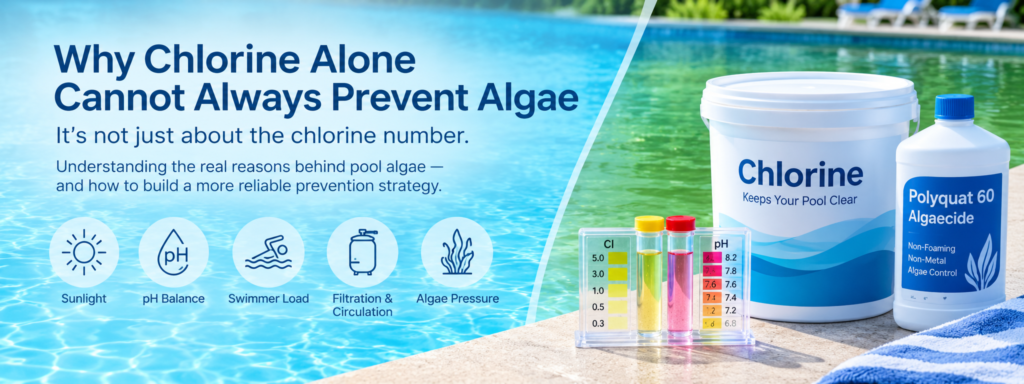
A swimming pool can look perfectly clear one afternoon and show a faint green tint the next morning. The first reaction is usually predictable: “But the chlorine level was fine. How did algae get in?”
It’s a fair question.
Chlorine is the backbone of modern swimming pool sanitation. When the water chemistry, circulation, filtration, and chlorine level are properly managed, it can provide very effective protection against algae. Yet real pools rarely operate under perfect laboratory conditions. Sunlight changes. Swimmer load jumps. Leaves fall into the water. Filters get dirty. Water hides in steps, corners, plumbing, and behind ladders.
And chlorine gets consumed along the way.
That is why algae control is better understood as a system, rather than a single chemical reading on a test strip.
This article explains why chlorine alone may sometimes fail to keep algae away, what happens inside the pool when protection weakens, and where supplemental algae-control products such as Polyquat 60 can fit into a broader maintenance program.
Chlorine Is Powerful—So Why Does Algae Still Appear?
First, chlorine deserves some credit.
It is widely used because it performs several jobs at once. Chlorine helps control microorganisms, oxidizes many contaminants introduced into pool water, and plays a central role in keeping recreational water sanitary.
Under well-controlled conditions, maintaining an appropriate free chlorine concentration can greatly reduce the chance of algae becoming established.
The problem is the phrase “well-controlled conditions.”
A swimming pool is an open and constantly changing water system.
Every swimmer adds organic material. Every windy afternoon can bring dust, pollen, leaves, and other debris. Strong sunlight affects chlorine. Rain changes water chemistry. Warm temperatures can accelerate biological activity. Meanwhile, circulation is rarely identical in every square inch of the pool.
So the chlorine concentration measured near one part of the pool does not necessarily describe what is happening everywhere else.
That distinction matters.
A Chlorine Reading Doesn’t Tell the Whole Story
Imagine checking your car’s fuel gauge and concluding that the engine must be running perfectly because there is fuel in the tank.
Obviously, there is more to it than that.
Pool chemistry works in a similar way.
A free chlorine reading tells you that measurable chlorine is present. It does not, by itself, describe the entire sanitation environment.
The effectiveness of chlorine is influenced by several factors, including:
- free chlorine concentration
- cyanuric acid (CYA) concentration
- pH
- sunlight exposure
- water temperature
- organic contamination
- swimmer load
- circulation
- filtration
- surfaces where algae may become established
This is why two pools showing apparently similar chlorine readings can behave very differently.
One remains sparkling clear.
The other starts developing algae along a shaded wall.
So, what changed?
Usually, the answer isn’t one dramatic failure. It’s several small factors working together.
Sunlight Can Consume Chlorine Faster Than You Expect
Outdoor swimming pools face a particularly persistent opponent: ultraviolet radiation.
Sunlight can accelerate the breakdown of unprotected chlorine. Without adequate stabilization, an outdoor pool may lose a meaningful portion of its chlorine during sunny conditions.
This is one reason cyanuric acid is commonly used in outdoor chlorinated pools. CYA helps protect chlorine from rapid degradation caused by sunlight.
Sounds perfect, right?
Well, there’s a catch.
Cyanuric acid protects chlorine, but it also changes chlorine chemistry. As CYA concentration increases, the amount of highly active chlorine available at a given free chlorine reading changes.
That means free chlorine and CYA should not be considered completely independent numbers.
A pool owner might look at a test and say:
“There’s chlorine in the pool, so algae shouldn’t grow.”
But the better question is:
Is the chlorine level appropriate for the pool’s actual water chemistry and operating conditions?
That is a much more useful way to think about algae prevention.
Too Much Stabilizer Can Complicate Chlorine Management
Cyanuric acid is useful. Excessive accumulation, however, can make chlorine management more challenging.
This can happen gradually.
For example, some stabilized chlorine products introduce additional CYA whenever they are added. Over time, the stabilizer concentration may rise unless water replacement or another management measure reduces it.
The pool may still show measurable free chlorine.
Yet its effective sanitation conditions may not be what the operator expects based on the chlorine number alone.
This is one reason experienced pool professionals look at relationships between water parameters, rather than chasing a single target number.
Pool chemistry is a bit like cooking. Salt may be essential, but knowing there are three grams of salt in a dish doesn’t tell you whether the dish tastes right unless you know how much food you’re seasoning.
Context changes everything.
pH Changes How Chlorine Behaves
Pool pH isn’t merely about swimmer comfort.
It also affects chlorine chemistry.
When chlorine is added to water, several chlorine species can exist in equilibrium. Hypochlorous acid is particularly important because of its strong sanitizing activity.
Changes in pH influence this equilibrium.
In practical pool operation, this is another reason chlorine concentration cannot be interpreted in isolation.
Suppose a pool has adequate chlorine on paper, but the pH has drifted outside its desired operating range. The pool may not behave the way the operator expects.
Add strong sunlight, warm water, and a busy weekend, and suddenly that comfortable safety margin becomes much smaller.
Algae doesn’t need an invitation. It needs an opportunity.
Organic Contamination Creates Chlorine Demand
Here’s another part of the story that test-strip thinking can miss.
Chlorine isn’t sitting around waiting exclusively for algae.
It has other work to do.
Swimming pools constantly receive contaminants such as:
- sweat and body residues
- cosmetics and personal-care products
- leaves and plant material
- pollen
- soil and dust
- insects
- environmental debris
- other oxidizable organic material
When chlorine reacts with contaminants, chlorine is consumed.
This creates chlorine demand.
During periods of unusually high contamination, chlorine consumption can temporarily outpace chlorine addition.
Think about a pool party.
Ten people enter a pool that normally sees two swimmers. Sunscreen, sweat, hair products, dirt, and other material suddenly enter the water. At the same time, the afternoon sun continues working against the chlorine.
The pool hasn’t necessarily been badly maintained.
The operating conditions simply changed faster than the treatment program did.
And that’s precisely when algae prevention can become less reliable.
Warm Weather Makes the Situation Even More Interesting
Warm, sunny weather is exactly when people want to use their pools most.
Unfortunately, it can also create conditions favorable to algae growth while increasing pressure on the pool’s treatment system.
Higher temperatures may support faster biological activity. More swimmers increase contamination. Longer sunny periods can increase chlorine loss in outdoor pools.
Then there is evaporation, occasional rain, windblown debris…
You get the picture.
This helps explain why a pool can behave beautifully for weeks during moderate conditions and suddenly become troublesome during a hot spell.
The chemistry didn’t decide to take the weekend off.
The load on the system changed.
Sometimes the Problem Isn’t Chlorine at All
This is where algae control becomes surprisingly mechanical.
A pool can contain sufficient sanitizer overall and still have localized trouble because the water isn’t moving evenly.
Swimming pools contain potential low-flow or dead zones.
Common examples include areas:
- behind ladders
- around steps
- near corners
- underneath removable equipment
- around fittings
- in poorly positioned return-flow areas
- inside sections of plumbing
- along rough or damaged surfaces
If fresh chlorinated water does not circulate effectively through these locations, algae may gain a foothold.
This also explains why brushing matters.
Brushing isn’t just cosmetic housekeeping. It physically disturbs deposits and growth on surfaces while exposing those areas more directly to treated water.
A little elbow grease still has a place in pool chemistry. Funny how often that happens.
Filtration and Chlorination Have Different Jobs
Chlorine and filtration support each other, but they are not interchangeable.
Chlorine provides chemical control.
The filter physically removes suspended material from circulating water.
When filtration is poor, the water may retain more suspended contamination. When circulation is poor, treated water may not reach every part of the pool efficiently.
This creates a familiar situation:
The owner keeps adding chemicals, yet the pool doesn’t improve as expected.
Sometimes the answer isn’t another scoop, tablet, or bottle.
Sometimes the filter needs attention.
Checking filter condition, circulation time, return flow, pump performance, and brushing routines can be just as important as adjusting chemical treatment.
Algae Becomes More Difficult Once It Establishes Itself
Preventing algae and removing established algae are two different challenges.
Early algae growth may begin as a thin layer on a pool surface. If conditions remain favorable, the population can expand and become increasingly difficult to remove.
Surface-associated microorganisms may also exist within organic deposits or biofilm-like layers that reduce direct exposure to treatment chemicals.
This is especially relevant in rough, porous, cracked, or poorly circulated areas.
Once substantial growth has developed, simply restoring a normal maintenance chlorine level may not produce an immediate visual recovery. The pool may require a combination of chemical correction, physical brushing, filtration, cleaning, and other treatment steps appropriate to the specific situation.
This is why prevention tends to be much easier than recovery.
A few minutes of routine maintenance can save hours of staring unhappily at green water later.
Not All Algae Problems Behave the Same Way
Pool owners commonly use the word “algae” as if it describes one problem.
It doesn’t.
Green algae is probably the most familiar because it can turn water cloudy or visibly green. Other surface growths may appear yellowish, brownish, or very dark and can behave differently depending on the organism and pool environment.
Certain persistent growths are especially troublesome in rough or porous surfaces, cracks, shaded areas, and locations with limited circulation.
That matters because treatment cannot always be reduced to:
Algae = add more chlorine.
Correct identification, water testing, physical cleaning, circulation, filtration, and chemical treatment should work together.
So, Do Pools Actually Need an Algaecide?
Not necessarily.
This distinction is important.
A properly managed chlorinated pool may be maintained successfully without routine algaecide use. Chlorine remains the primary sanitizer and should not be replaced by an algaecide.
An algaecide is better viewed as a supplemental algae-control tool.
That supplemental protection can be useful when operating conditions make algae pressure harder to manage—for example, during warm weather, periods of heavy use, seasonal opening or closing, temporary chlorine fluctuations, or recurring algae problems.
The goal isn’t to make chlorine unnecessary.
It’s to make the overall algae-control program more resilient.
Where Does Polyquat 60 Fit?
Polyquat 60 is a common name used in the pool industry for a concentrated polymeric quaternary ammonium algaecide.
Unlike chlorine, it is generally used specifically as an algae-control product rather than as the pool’s primary sanitizer.
One of the characteristics that makes polymeric quaternary products interesting for pool applications is their ability to provide algae-control activity without relying on an oxidizing mechanism like chlorine.
This gives pool formulators another tool to work with.
For readers interested in the chemistry behind this type of product, our Polyquat 60 Algaecide product information explains its typical characteristics, supply form, and use in commercial pool-care formulations.
Polyquat 60 should still be regarded as part of a broader treatment program. It does not remove the need to maintain appropriate sanitizer levels, pH, filtration, or circulation.
That’s worth repeating: supplemental does not mean substitute.
Why Non-Foaming Performance Matters
Traditional quaternary ammonium algaecides can be associated with foaming, particularly when used at higher concentrations or in pools with strong water agitation.
Foam is hardly the look anyone wants beside crystal-clear pool water.
Polymeric quaternary algaecides such as Polyquat 60 are valued partly because they are generally associated with low- or non-foaming performance when appropriately formulated and applied.
That characteristic can be useful in swimming pools, fountains, and other circulating water environments where visible foam would be undesirable.
The polymeric chemistry also distinguishes Polyquat 60 from simpler conventional quaternary ammonium compounds.
If you’re comparing algaecide chemistries for a formulation, our What Makes Polyquat 60 a Non-Foaming Pool Algaecide? article provides a closer look at why molecular structure matters.
What About Copper-Based Algaecides?
Metal-based algae-control systems represent another established approach.
Copper ions can provide effective algaecidal activity, but pool formulators also need to consider metal management. Under unsuitable water conditions, dissolved metals may contribute to staining or discoloration issues.
Non-metal polymeric algaecides offer a different route.
They do not depend on copper as their active algae-control component, which can be attractive for formulations designed around a non-metal treatment strategy.
The choice isn’t simply about asking which chemical is “stronger.” That’s too simplistic.
The better questions are:
What type of pool is being treated? What other chemicals are present? What is the maintenance program? Is foaming a concern? Are metals undesirable? Is the product intended for prevention, seasonal maintenance, or another defined application?
Chemistry works better when the question is specific.
The Better Strategy: Build Several Layers of Protection
Think of algae prevention like protecting a house from rain.
A good roof is essential. But you still want gutters, drainage, sealed windows, and proper grading around the foundation.
Chlorine is the roof.
It does most of the heavy lifting, but the whole system determines whether water gets inside.
For a swimming pool, a stronger algae-prevention program usually combines appropriate sanitizer management with balanced water chemistry, effective circulation, adequate filtration, routine brushing and cleaning, control of organic debris, and supplemental algae-control chemistry when appropriate.
No single layer needs to compensate constantly for failure somewhere else.
That is the key.
Don’t Let the Pool Become a Chemistry Yo-Yo
One of the biggest maintenance mistakes is allowing water conditions to swing repeatedly between extremes.
Chlorine gets low.
Add a lot.
pH moves.
Correct it.
Water becomes cloudy.
Add something else.
Then algae appears, and another treatment goes in.
Soon the pool has become a chemistry experiment nobody volunteered for.
Consistent maintenance is usually easier.
Regular testing helps identify changes before they become visible problems. Good circulation distributes treatment chemicals. Filtration removes material from the water. Brushing prevents neglected surfaces from becoming comfortable homes for growth.
Supplemental algaecides can then serve a defined purpose rather than acting as an emergency response to every problem.
Why This Matters for Pool Chemical Formulators
For pool-care brands and private-label manufacturers, this distinction is particularly important.
Consumers often expect one bottle to solve everything.
Chemistry rarely works that way.
A well-designed pool maintenance range can instead give each product a clear job: sanitation, pH management, oxidation, clarification, algae prevention, seasonal treatment, or another specific function.
Polyquat 60 can fit naturally into that type of product system as a concentrated polymeric algaecide ingredient.
For manufacturers developing finished formulations, factors such as active concentration, compatibility, dosage strategy, packaging, local regulatory requirements, and product positioning should all be considered before commercial production.
Our Polyquat 60 Explained: The Science Behind Polymer-Based Algaecides article discusses the chemistry in greater detail for formulators and professional buyers.
Chlorine Is Still the Foundation
After discussing all the reasons chlorine can struggle, it would be easy to walk away with the wrong conclusion.
So let’s make this clear.
Chlorine is not the problem.
Proper chlorine management remains fundamental to swimming pool sanitation and algae prevention.
What fails is often the assumption that maintaining some measurable chlorine automatically guarantees an algae-free pool regardless of everything else happening in the water.
It doesn’t.
Chlorine concentration can change. CYA affects chlorine chemistry. pH matters. Sunlight matters. Organic contamination creates demand. Circulation varies throughout the pool. Filters need maintenance. Surfaces need brushing.
And algae is rather good at exploiting neglected corners.
The more reliable approach is therefore not chlorine versus algaecide.
It is chlorine plus good pool management, with supplemental algae-control chemistry used where it provides a practical benefit.
That small change in thinking makes a big difference.
Final Thoughts
So, why can chlorine alone sometimes fail to prevent algae?
Because a swimming pool is dynamic.
Chlorine is constantly being produced, added, distributed, consumed, stabilized, and affected by the surrounding environment. The concentration measured during one test is only a snapshot of that constantly changing system.
Sunlight can increase chlorine loss. Organic contamination raises chlorine demand. Water chemistry influences chlorine performance. Poor circulation creates weak spots. Established surface growth can become harder to treat.
None of this makes chlorine ineffective.
It simply means effective algae prevention requires more than watching one chlorine number.
Maintain the appropriate sanitizer level. Keep water chemistry within the recommended operating range. Circulate and filter effectively. Brush neglected surfaces. Remove organic debris. And where additional algae protection makes sense, a non-metal, non-oxidizing algaecide such as Polyquat 60 can serve as a supplemental part of the program.
Clear water usually isn’t the result of one miracle chemical.
It’s the result of several small things being done consistently—and, yes, that’s less exciting than a miracle bottle. But it works.
Frequently Asked Questions
1. Why does my pool get algae even though the chlorine level is normal?
A normal free chlorine reading does not describe every factor affecting algae control. Cyanuric acid concentration, pH, sunlight, organic contamination, circulation, filtration, and localized low-flow areas can all influence the pool’s resistance to algae. Chlorine should therefore be interpreted within the complete water-management system.
2. Can algae grow in a chlorinated swimming pool?
Yes. Algae may develop when effective chlorine protection temporarily becomes inadequate or when poorly circulated areas receive less treated water. Heavy swimmer loads, warm weather, debris, sunlight, unsuitable water chemistry, and neglected surfaces can increase the risk.
3. Does Polyquat 60 replace chlorine in swimming pools?
No. Polyquat 60 is an algaecide, not a replacement for the pool’s primary sanitizer. It can be used as supplemental algae-control chemistry alongside appropriate chlorine levels, balanced water chemistry, circulation, filtration, and routine cleaning.
4. Why is Polyquat 60 used for swimming pool algae prevention?
Polyquat 60 is a polymeric quaternary ammonium algaecide used in pool-care formulations for algae control. It is particularly attractive where formulators want a non-metal, non-oxidizing, low-foaming or non-foaming algae-control ingredient. Actual formulation and use requirements depend on product specifications and applicable regulations.
5. Is Polyquat 60 better than adding more chlorine for algae?
They perform different roles, so it is not simply a matter of one being better. Chlorine is the primary sanitizer and an important part of algae prevention. Polyquat 60 is a supplemental algaecide. A well-managed pool should first maintain appropriate sanitizer levels and water conditions; an algaecide may provide another layer of algae control where needed.