
GET IN TOUCH
Ask For Sample?
Polyquat 60 Explained: The Science Behind Polymer-Based Algaecides
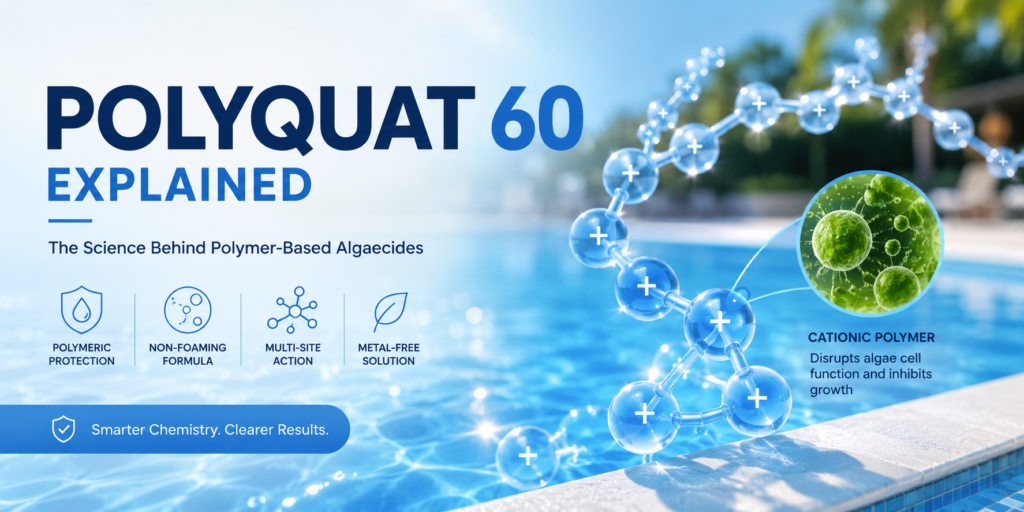
A swimming pool can look perfectly clear on Monday and show the first hint of green by Thursday. Chlorine was added. The filter is running. The water chemistry seems reasonable. So what happened?
Algae control is rarely as simple as adding more sanitizer.
This is where Polyquat 60 has earned a place in many pool maintenance programs. Unlike chlorine-based shock treatments or metal-based algaecides, Polyquat 60 relies on cationic polymer chemistry. Its long molecular chains carry positive charges that interact with negatively charged biological surfaces, helping control algae without introducing copper and without the heavy foaming associated with some conventional quaternary ammonium compounds.
That sounds straightforward. The chemistry behind it, though, explains why this material behaves differently from many familiar pool algaecides.
Here’s the short version: Polyquat 60 isn’t simply “another quat.” Its polymeric structure matters.
What Exactly Is Polyquat 60?
Polyquat 60 is the common pool-industry name for a polymeric quaternary ammonium algaecide supplied at approximately 60% active concentration.
If the chemistry is new to you, it helps to start with the product itself before getting into molecular interactions. Our What Is Polyquat 60 Algaecide? A Complete Beginner’s Guide explains what Polyquat 60 is, how it is commonly used in swimming pools, and why it differs from several other types of pool algaecides.
The word “polyquat” gives us a useful clue.
“Poly” refers to a polymer—a molecule made from repeating structural units. “Quat” refers to quaternary ammonium functionality, which carries a permanent positive charge.
Put those ideas together and you get a cationic polymer containing multiple positively charged sites along its molecular structure.
That distinction is important.
A conventional quaternary ammonium compound is generally a much smaller molecule. A polymeric quat contains many repeating units linked into a larger chain. Consequently, its interaction with algae, surfaces, dissolved materials, and other components of pool water can be quite different.
This molecular architecture is one of the reasons Polyquat 60 has become associated with non-foaming algae control.
And no, “60” doesn’t mean you should maintain 60 ppm of the product in your swimming pool. It normally refers to the concentration of the commercial algaecide concentrate.
The Chemistry Starts With Electrical Charge
To understand Polyquat 60, forget swimming pools for a moment.
Imagine two magnets.
Opposite charges attract. Similar charges repel.
Biological surfaces, including many algae cell surfaces, tend to exhibit a net negative character under typical water conditions. Polyquat 60, meanwhile, is strongly cationic, meaning its polymer chain contains positively charged groups.
That creates electrostatic attraction.
When the polymer encounters algae cells, its positively charged sites can associate with negatively charged components of the cell surface.
This interaction may disturb the normal function and integrity of the cell envelope. The result is an environment that becomes increasingly unfavorable for algae survival and growth.
The key point is that Polyquat 60 doesn’t need to behave like chlorine to be useful.
Chlorine is an oxidizing sanitizer.
Polyquat 60 is a non-oxidizing polymeric algaecide.
Those are different chemical jobs.
That difference is also why treating Polyquat 60 as simply “extra chlorine” misses much of what makes the chemistry interesting.
Why Does the Polymer Chain Matter So Much?
Here’s where things get more interesting.
Imagine touching a surface with one fingertip. Now imagine laying your entire hand across it.
The contact isn’t the same.
Something similar happens when comparing smaller quaternary ammonium molecules with larger polymeric cationic structures.
Because Polyquat 60 contains multiple charged sites distributed along a polymer chain, one molecule can potentially interact with a biological surface at multiple points.
Chemists often describe this concept in terms of multivalent interactions.
You don’t really need the jargon, though. Think of it as multiple points of contact instead of one.
This can influence:
- adsorption onto biological surfaces,
- interaction with suspended particles,
- retention within the water system,
- behavior at interfaces,
- and the overall duration of contact between the polymer and target organisms.
The polymer chain isn’t just a carrier for the active groups. It is part of the reason the material behaves the way it does.
So, How Does Polyquat 60 Affect Algae?
Algae may look simple—a green film on a wall, a cloudy tint in the water, perhaps a slippery patch near the steps—but at the cellular level, there is plenty going on.
The cell membrane helps regulate what enters and leaves the cell. Maintaining that barrier is essential for normal cellular activity.
A strongly cationic polymer can associate with negatively charged components on or near this surface.
Once sufficient interaction occurs, normal membrane behavior may be disrupted.
This electrostatic interaction is only part of the story. Polymer chain length, multiple cationic sites, and contact with algae surfaces all contribute to the way the material behaves in pool water. For a closer look at the mechanism, see How Does Polyquat 60 Algaecide Work in Swimming Pools?, where we explain the process from polymer–cell interaction to practical algae control.
That can interfere with essential cellular processes and make continued algae growth difficult.
This mechanism is fundamentally different from simply oxidizing organic matter.
It also helps explain why polymer-based algaecides are usually considered supplemental algae-control products rather than replacements for a complete sanitizing program.
Chlorine still matters.
Filtration still matters.
Circulation still matters.
Water balance still matters.
Polyquat 60 adds another layer of algae control rather than magically making those fundamentals disappear.
Why Is Polyquat 60 Non-Oxidizing?
Oxidizing chemicals work through oxidation reactions. Chlorine is the obvious pool example.
Polyquat 60 doesn’t depend primarily on oxidation.
Instead, its activity comes from the interaction of the cationic polymer with biological surfaces.
This makes it a non-oxidizing algaecide.
Why should pool operators care?
Because an oxidizer and a non-oxidizing algaecide don’t necessarily have to perform identical functions in a maintenance program.
Think of it like maintaining a house. Cleaning the floor and preventing insects aren’t the same task, even though both contribute to keeping the house pleasant.
Similarly, a sanitizer is primarily responsible for controlling microorganisms and maintaining sanitary water, while an algaecide is used specifically to help prevent or control algae.
The distinction becomes especially useful when designing preventive maintenance programs.
The Non-Foaming Advantage Isn’t an Accident
Anyone who has dealt with an excessively foaming pool knows how quickly chemistry can turn into a visual mess.
Some traditional quaternary ammonium algaecides have a surfactant-like character. Under agitation—from return jets, waterfalls, spa jets, swimmers, or circulation equipment—they may produce noticeable foam.
Polyquat 60 behaves differently.
Its polymeric molecular structure greatly reduces the tendency to create persistent foam compared with many simpler quaternary ammonium compounds.
That’s one of its most recognizable practical advantages.
In a quiet laboratory beaker, foaming may seem like a minor detail. Put the same chemistry into a swimming pool with strong circulation, though, and suddenly it matters quite a lot.
Nobody wants a backyard pool looking like an oversized bubble bath.
This is one reason polymer-based algaecides became attractive for pools where operators want supplementary algae control without significant foam formation.
Polyquat 60 vs. Traditional Quat Algaecides
Both product families may contain positively charged quaternary ammonium functionality, so it’s tempting to put them into the same basket.
Chemically, that’s too simplistic.
Traditional quaternary ammonium algaecides often contain relatively small cationic surfactant molecules. Their amphiphilic nature—the combination of water-loving and hydrophobic portions—contributes to biological activity but can also promote foaming.
Polyquat 60 uses a polymeric cationic structure instead.
That structural difference changes several practical characteristics.
| Property | Polyquat 60 | Traditional Quat Algaecides |
|---|---|---|
| Chemical structure | Cationic polymer | Smaller quat molecules |
| Primary character | Polymeric cationic algaecide | Cationic surfactant-type algaecide |
| Foaming tendency | Low/non-foaming | Can be noticeable |
| Metal content | Metal-free | Usually metal-free |
| Oxidizing action | Non-oxidizing | Non-oxidizing |
| Typical role | Preventive/maintenance algae control | Algae control |
| Interaction mechanism | Multi-site cationic polymer interaction | Cationic/surfactant interaction |
So while both belong to the broad world of quaternary ammonium chemistry, their real-world behavior shouldn’t automatically be treated as identical.
What About Copper-Based Algaecides?
Copper introduces another completely different approach.
Copper ions can be highly effective against algae, which is why copper-based algaecides have been used for decades.
But metal chemistry comes with its own considerations.
Under certain water conditions, dissolved copper may contribute to staining or discoloration. Water balance, copper concentration, surfaces, and other chemical factors all influence that risk.
Polyquat 60 doesn’t depend on copper.
That means it can provide algae control without intentionally adding a metal-based active ingredient to the water.
This distinction matters particularly in maintenance programs designed around metal-free algae prevention.
Does that make copper algaecides universally bad?
No.
Does it make Polyquat 60 universally superior?
Also no.
Chemistry rarely rewards blanket statements. The better choice depends on the pool, the problem being addressed, local product registrations, maintenance strategy, water conditions, and the formulation being used.
Polyquat 60 and Chlorine Aren’t Really Competitors
One of the most common misunderstandings about algaecides is treating them as substitutes for chlorine.
They aren’t.
Chlorine is primarily a sanitizer and oxidizer. A properly maintained chlorine residual helps control bacteria, other microorganisms, and algae while also oxidizing contaminants introduced by swimmers and the environment.
Polyquat 60 has a narrower purpose: supplemental algae control.
That makes the relationship complementary rather than competitive.
A practical maintenance program may use chlorine as the main sanitizer while incorporating a polymeric algaecide where additional algae prevention is useful.
This distinction becomes especially important during conditions that increase algae pressure, such as hot weather, heavy rain, high swimmer loads, poor circulation, or periods when maintenance becomes less consistent.
That complementary role becomes clearer when Polyquat 60 is viewed as part of a complete maintenance program rather than as a stand-alone treatment. In The Role of Algaecides in Modern Pool Maintenance Programs, we look at where preventive algaecides fit alongside sanitization, filtration, circulation, brushing, and routine water balance.
You know how pools behave after several hot, stormy days? Everything seems fine—until it isn’t.
Preventive chemistry is partly about creating a little more margin before that happens.
Why Can Algae Appear Even When Chlorine Is Present?
Seeing a chlorine reading on a test kit doesn’t automatically prove that every part of the pool has ideal algae-control conditions.
Several variables matter at the same time.
Circulation may be poor in steps, corners, ladders, or other dead zones. Filter performance may have declined. Organic contamination can increase sanitizer demand. Water balance can shift. Stabilizer levels can affect chlorine management in outdoor pools. Warm temperatures and strong sunlight can further complicate the picture.
And algae growth doesn’t politely wait for someone to finish diagnosing the problem.
This is why pool maintenance is better understood as a system rather than a single chemical measurement.
Polyquat 60 can support that system, but it cannot repair a broken pump, clean a clogged filter, correct badly unbalanced water, or compensate indefinitely for inadequate sanitizer.
That’s an important limitation—and an important sign of responsible product use.
Does Polyquat 60 Kill Existing Algae or Prevent It?
It can be used in algae-control programs, but prevention is often where polymeric algaecides make the most practical sense.
Why?
A severe algae bloom represents a much larger biological load than the tiny amount of early growth present in a properly maintained pool.
Once water becomes heavily green or cloudy, treatment often requires several actions: correcting water chemistry, restoring effective sanitizer levels, brushing surfaces, improving circulation, cleaning or backwashing filtration equipment, and physically removing dead material.
Adding more algaecide while ignoring those issues isn’t a clever shortcut.
For routine maintenance, however, supplemental algaecide can help reduce the opportunity for algae to gain a foothold.
It’s rather like pulling a few weeds regularly instead of waiting until the garden disappears beneath them.
Polymer Chemistry May Also Affect Suspended Material
There’s another interesting feature of cationic polymers.
Positive polymer charges can interact not only with biological surfaces but also with certain negatively charged suspended particles.
In water treatment chemistry, related cationic polymers are widely studied and used because electrostatic interactions can influence particle destabilization and aggregation.
This doesn’t mean every Polyquat 60 pool product should automatically be marketed as a clarifier. Formulation, molecular characteristics, dosage, and regulatory labeling matter.
Still, the underlying chemistry helps explain why polymer behavior in water is more complex than a simple “kill algae” description suggests.
A polymer chain can interact with its environment at numerous points.
That’s part of what makes polymeric water-treatment chemistry so useful—and sometimes a little tricky.
Why Is It Called “60”?
This question causes more confusion than it should.
The number normally refers to the approximate active concentration of the commercial concentrate, commonly around 60%.
It isn’t the recommended concentration in pool water.
A manufacturer may purchase a concentrated polymeric raw material and formulate it into a finished retail or professional pool product at a different concentration.
That distinction matters for distributors and private-label companies.
A 60% industrial concentrate, for example, should not automatically be treated as though it were a ready-to-use consumer pool product. Finished formulations require appropriate formulation design, dosing instructions, packaging, labeling, stability evaluation, and compliance with applicable regulations.
The chemistry may begin with the same polymer. The commercial products can be quite different.
Why Formulation Quality Matters More Than the Name on the Label?
Here’s a detail buyers sometimes overlook.
Two products described casually as “Polyquat 60” aren’t necessarily identical in every practical characteristic.
Active concentration matters, of course. But manufacturers and formulators may also evaluate parameters such as:
- appearance,
- active matter,
- pH,
- density,
- viscosity,
- residual raw materials,
- storage stability,
- batch consistency,
- and compatibility with the intended formulation.
For B2B buyers, this is why a specification sheet and certificate of analysis can tell you more than a product name alone.
“Polyquat 60” is useful commercial shorthand.
It isn’t a complete specification.
If you’re evaluating the raw material itself rather than a finished pool product, understanding the polymeric chemistry, active concentration, physical properties, and intended application becomes much more important.
What Can Affect Polyquat 60 Performance in a Real Pool?
Laboratory chemistry is neat. Swimming pools aren’t.
A real pool contains sanitizer, dissolved minerals, organic matter, sunscreen, body oils, dust, leaves, treatment chemicals, and whatever else swimmers bring with them.
That environment affects performance.
Dosage is obviously important, but so are circulation, filtration, water temperature, algae load, sanitizer residual, pH, and the presence of other treatment chemicals.
Cationic polymers can also interact with oppositely charged materials. That’s basic charge chemistry.
For that reason, chemical compatibility shouldn’t be assumed simply because two products are both sold for water treatment.
Finished pool products should always be applied according to their registered or approved label instructions and the manufacturer’s directions.
More chemical isn’t automatically more protection.
Sometimes it’s simply more chemical.
Why Pool Professionals Keep Polyquat 60 in the Toolbox
The appeal becomes easier to understand once you put the chemistry and practical behavior together.
Polyquat 60 offers a combination that is useful in many pool maintenance programs: polymeric cationic algae control, low foaming tendency, non-oxidizing action, and no dependence on copper as the active mechanism.
Those characteristics can make it particularly attractive for preventive programs.
Its role isn’t glamorous. You may never see a dramatic overnight transformation when it is used correctly.
Actually, that’s often the point.
Preventive maintenance is successful when nothing dramatic happens.
The water stays clear. Walls remain clean. Algae doesn’t establish itself. The pool simply behaves.
Sometimes boring chemistry is excellent chemistry.
The Bigger Lesson: Polyquat 60 Is About Structure, Not Just Ingredients
If there’s one idea worth remembering, it’s this:
Polyquat 60 behaves the way it does because it is a cationic polymer.
Its positive charges create attraction toward negatively charged biological surfaces. Its polymeric structure provides multiple interaction sites. That architecture also distinguishes it from smaller surfactant-like quaternary ammonium compounds and helps explain its low-foaming behavior.
This is why simply describing it as a “quat algaecide” doesn’t tell the whole story.
It’s also why polymer-based algaecides occupy an interesting middle ground in pool chemistry.
They don’t replace sanitation.
They don’t eliminate the need for circulation and filtration.
They don’t make water balance irrelevant.
Instead, they provide another chemical mechanism that can be incorporated into a broader algae-control strategy.
And that’s really the science behind Polyquat 60: not one dramatic reaction, but a carefully useful combination of charge, polymer structure, surface interaction, and formulation chemistry.
Frequently Asked Questions
1. How does Polyquat 60 algaecide work in swimming pools?
Polyquat 60 uses a positively charged polymer that interacts with negatively charged components of algae cell surfaces. These interactions can disrupt normal cell-envelope functions and help inhibit algae growth. It is a non-oxidizing mechanism and therefore differs from chlorine-based treatment.
2. Is Polyquat 60 a non-foaming pool algaecide?
Polyquat 60 is generally regarded as a low-foaming or non-foaming polymeric algaecide. Its polymer structure behaves differently from traditional small-molecule quaternary ammonium algaecides, which may produce more noticeable foam under strong water agitation.
3. Does Polyquat 60 contain copper?
Polyquat 60 itself is a polymeric quaternary ammonium algaecide and does not depend on copper for its algae-control mechanism. Buyers should still check the formulation and label of any finished commercial pool product because products may contain additional ingredients.
4. Can Polyquat 60 replace chlorine in a swimming pool?
No. Polyquat 60 should not be treated as a replacement for an approved pool sanitizer. Chlorine provides broad sanitizing and oxidizing functions, while Polyquat 60 is primarily used as supplemental algae control. Proper sanitation, filtration, circulation, and water balance remain essential.
5. What does the “60” in Polyquat 60 mean?
The “60” generally refers to an approximately 60% active commercial concentrate. It does not mean a swimming pool should contain 60% or 60 ppm Polyquat. Actual dosing depends on the finished formulation, intended use, applicable regulations, and the manufacturer’s label directions.