
GET IN TOUCH
Ask For Sample?
The Role of Algaecides in Modern Pool Maintenance Programs
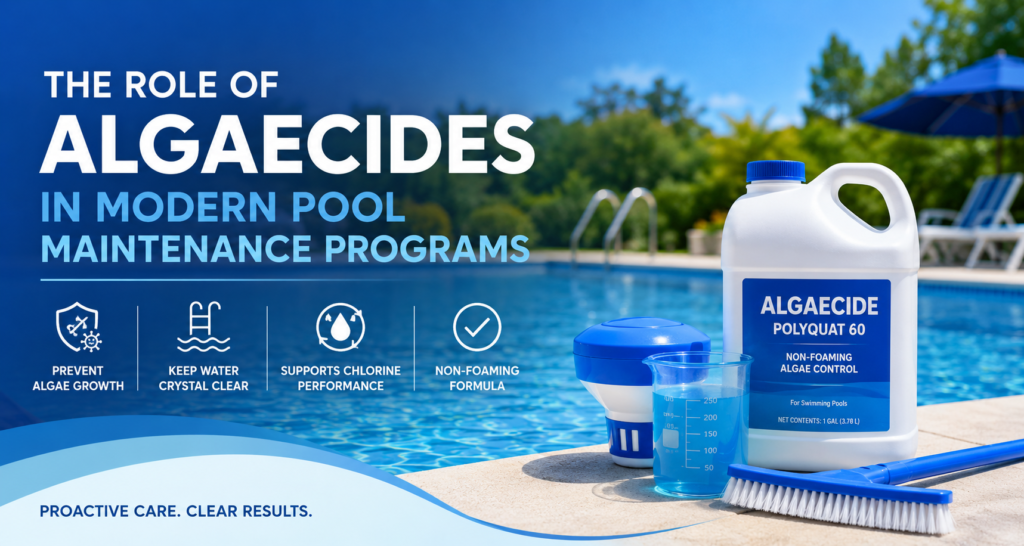
A swimming pool can look perfect on Monday and start showing a faint green tint by Friday. Anyone who has maintained a pool through a hot summer knows how quickly things can change.
Sunlight gets stronger. More swimmers jump in. Rain carries dust and organic matter into the water. Chlorine gets consumed faster than expected. Circulation may not reach every corner equally. Then algae finds a small opening.
That is why modern pool maintenance is rarely built around one chemical alone.
Chlorine remains the main sanitizer in most swimming pools, but it works as part of a larger water-care program. Filtration, circulation, pH control, brushing, oxidation, and algae prevention all contribute to keeping the water clear and pleasant.
Algaecides have a specific place within that program.
They are not simply chemicals added after a pool has turned green. In many maintenance programs, they are used as a preventive layer that helps reduce the chance of algae becoming established when pool conditions become less than ideal.
So, what exactly does an algaecide contribute? And if a pool already uses chlorine, why would it need one?
Let’s break it down.
Why Does Algae Keep Coming Back?
Algae is remarkably good at taking advantage of imperfect pool conditions.
Its spores can enter a swimming pool through wind, rain, dust, equipment, swimsuits, or surrounding vegetation. Keeping every single spore out of an outdoor pool isn’t realistic.
Fortunately, the presence of algae spores does not automatically mean that visible algae will develop.
The real problem begins when conditions allow those organisms to multiply.
Warm water, sunlight, nutrients, weak circulation, insufficient sanitizer levels, and neglected surfaces can create favorable conditions. A pool may appear perfectly clear while the early stages of algae growth are already taking place on steps, ladders, corners, walls, or areas with poor circulation.
Think of algae control a little like garden weed control. Finding a seed in the soil isn’t necessarily the problem. Giving that seed the right combination of moisture, warmth, and nutrients is what allows it to take over.
Pools behave in a surprisingly similar way.
This is also why algae problems often seem to appear overnight. In reality, the conditions that allowed the bloom probably developed over several days.
If Chlorine Kills Algae, Why Use an Algaecide?
This is probably the most important question.
Chlorine can control many microorganisms and plays the primary sanitizing role in most residential and commercial swimming pools. Under properly maintained conditions, an adequate free chlorine residual can also help prevent algae growth.
So an algaecide should not be viewed as a replacement for chlorine.
Its value is different.
An algaecide can provide another barrier against algae, particularly when the normal sanitation system comes under pressure.
Consider what happens during a busy summer weekend.
The water is warmer. Twenty people use the pool instead of five. Sunscreen, sweat, cosmetics, dirt, and other organic material enter the water. Strong sunlight contributes to chlorine loss. Meanwhile, swimmers want the pool open all day.
Suddenly, the sanitizer has considerably more work to do.
A preventive algaecide can help reduce the likelihood that algae takes advantage of that temporary weakness.
That’s the key idea:
Chlorine provides primary sanitation. Algaecides provide targeted algae-control support.
This distinction becomes especially important when a pool stays green even though chlorine is still present. Sanitizer readings alone do not tell the whole story—pH, circulation, chlorine demand, nutrients, and established algae can all affect the result. If you’ve run into this frustrating situation, our guide on Why Pool Water Turns Green Even with Chlorine explains the most common reasons and what they mean for an algae-control program.
The two jobs overlap somewhat, but they are not identical.
Modern Pool Care Is About Layers of Protection
Older approaches to pool maintenance were sometimes quite reactive.
Wait until something goes wrong. Then add chemicals.
Green pool? Shock it.
Cloudy water? Add something.
Algae on the wall? Brush it and treat it.
That approach can work, but it often creates a frustrating cycle of problems followed by heavy corrective treatments.
Modern maintenance programs increasingly emphasize keeping the pool stable.
A well-managed program normally combines several elements:
- Appropriate sanitizer residual
- Balanced pH and other key water parameters
- Effective filtration
- Adequate circulation
- Routine brushing and cleaning
- Periodic oxidation when required
- Preventive algae control where appropriate
Each part supports the others.
For example, even an excellent algaecide cannot compensate for a pump that barely moves water through the pool. Likewise, powerful filtration cannot fully correct poor sanitizer management.
There isn’t one magic bottle.
And perhaps that’s a good thing. Pool chemistry becomes much easier to understand once we stop expecting one chemical to solve every problem.
The Main Role of Algaecides: Prevention
The word “algaecide” naturally makes people think about killing algae.
Yet one of its most useful roles is preventing a visible algae problem from developing in the first place.
A maintenance dose can help suppress algae during normal pool operation, particularly when environmental conditions favor growth.
This preventive approach has several practical advantages.
When algae is prevented from establishing itself, the pool operator may avoid the heavy brushing, filtration load, downtime, and corrective chemical treatment associated with a major bloom.
There is another benefit that receives less attention: consistency.
Pool owners generally don’t want water that alternates between crystal clear and green every few weeks. They want boring water.
Clear today. Clear tomorrow. Clear next weekend.
Boring is beautiful when you’re maintaining a swimming pool.
Preventive Treatment and Corrective Treatment Are Not the Same
This distinction matters.
A preventive algaecide program is designed to help stop algae from becoming established. The product is generally used periodically according to its label directions and the needs of the particular pool.
Corrective treatment is different.
Once a swimming pool has developed a substantial algae bloom, the maintenance program may require several actions at the same time: restoring appropriate sanitizer conditions, brushing affected surfaces, improving circulation, cleaning or backwashing the filter, removing debris, and using an appropriate algae-control treatment.
Simply pouring more algaecide into severely green water may not address the underlying cause.
Why?
Because the pool may also have a filtration problem, inadequate chlorine, unsuitable pH, poor circulation, excessive debris, or some combination of these factors.
A green pool is a symptom. Good maintenance asks what caused the symptom.
How Do Algaecides Work?
Different algaecide chemistries work differently, so there isn’t one mechanism that describes every product.
Some products interfere with algae cell membranes. Others rely on metal ions that inhibit biological processes. Polymeric cationic algaecides interact with negatively charged biological surfaces and can disrupt cell integrity and normal cellular function.
“Cationic” simply means positively charged.
Many biological surfaces carry negative charges. This creates an attraction between certain positively charged polymers and the algae cells.
It’s a little like static electricity, although the chemistry is obviously more complicated.
The important point for a pool operator is that an algaecide can attack algae through a mechanism different from chlorine oxidation.
That complementary chemistry is one reason algaecides can fit naturally into broader maintenance programs.
Why Polyquat 60 Fits Preventive Maintenance So Well
Polyquat 60 has become particularly associated with routine algae prevention.
Its role becomes easier to understand once you look at what happens at the algae-cell level. Rather than acting as another oxidizing sanitizer, this polymeric quaternary chemistry interacts with algae through a different mechanism. For a closer look at the chemistry and practical implications, see How Does Polyquat 60 Algaecide Work in Swimming Pools?.
That mechanism helps explain why Polyquat 60 can serve as a complementary preventive treatment alongside a properly maintained chlorine program rather than trying to replace it.
The name generally refers to a concentrated polymeric quaternary ammonium algaecide based on polixetonium chloride chemistry.
Its appeal comes from a combination of properties rather than one dramatic feature.
First, it is non-foaming under normal use conditions. That makes it easier to incorporate into pools where visible foam would be undesirable.
Second, it does not rely on copper for algae control. Pool operators concerned about adding metals to the water may therefore consider polymeric chemistry.
Third, it can be used as part of a regular preventive program rather than waiting for a severe algae outbreak.
And fourth, its chemistry complements rather than replaces the primary sanitizing system.
That last point deserves repeating.
Polyquat 60 is not a substitute for maintaining appropriate sanitizer levels.
Its strongest role is usually as one component within a well-managed pool care program.
Algaecides Can Help During High-Risk Periods
Not every week presents the same algae risk.
July is not January. A pool used by two people isn’t under the same load as a hotel pool packed with guests.
A modern maintenance program should recognize those differences.
Hot Weather
Warm water often creates favorable conditions for biological growth while also increasing the overall demand placed on pool treatment systems.
Strong sunlight can further challenge chlorine management in outdoor pools.
Preventive algae control becomes especially useful during extended hot periods.
Heavy Bather Loads
More swimmers mean more contaminants entering the water.
Sweat, skin oils, cosmetics, sunscreen, and dirt all contribute to the chemical and filtration load.
The pool may look fine immediately after a busy day, but conditions can change quickly afterward.
Heavy Rain and Storms
A thunderstorm can dump more than water into a swimming pool.
Dust, pollen, leaves, soil particles, and other contaminants may enter at the same time. Water chemistry can also shift because of dilution.
Testing and correcting the water after severe weather is therefore important.
Vacations and Irregular Maintenance
Ever returned from a trip to find the pool looking rather less inviting than when you left?
Long periods without testing, brushing, or normal maintenance can create opportunities for algae.
A preventive treatment before periods of reduced maintenance may be useful when permitted by the product directions, but it should accompany—not replace—proper sanitizer and circulation management.
Pool Opening and Closing
Seasonal pools experience unusual conditions during opening and winterization.
Organic debris may accumulate during the closed season, while water temperatures and sanitizer levels change significantly.
For this reason, certain algaecides are commonly incorporated into opening, closing, or winter maintenance programs.
Algaecides May Reduce the Need for Emergency Corrections
Preventive maintenance usually costs less—in effort as much as chemicals—than recovering a badly neglected pool.
A serious algae bloom can require repeated brushing, filter cleaning, water testing, chemical correction, and considerable circulation time.
The pool may remain unusable or unattractive during treatment.
That creates an especially large problem for hotels, resorts, apartment complexes, community pools, and other commercial facilities.
Imagine telling hotel guests that the beautiful pool shown in the booking photos is temporarily green.
Not ideal.
For professional operators, preventive algae management is partly about reducing that operational risk.
A stable maintenance program can make water conditions more predictable.
But More Algaecide Is Not Better
Chemical treatment has an annoying habit of refusing to follow the “more is better” rule.
Algaecides are no exception.
Adding excessive amounts does not automatically provide better algae control. Depending on the chemistry, overdosing may contribute to foaming, water-quality problems, unnecessary chemical cost, or other undesirable effects.
Always follow the registered product label and supplier instructions applicable to the market where the product is used.
The maintenance dose and initial treatment dose may also differ.
This is another reason pool operators should understand the active chemistry rather than buying products purely by front-label marketing claims.
Don’t Ignore Circulation
Here’s an easy thing to overlook.
A chemical can only work effectively where it reaches.
Swimming pools contain areas where circulation is weaker: behind ladders, around steps, near corners, beneath certain fittings, and along surfaces far from return jets.
These locations often become the first places where algae appears.
If algae repeatedly develops in exactly the same corner, adding more chemicals may not be the smartest first response.
Check the circulation pattern.
Adjust return jets where possible. Brush the affected area. Inspect the filtration system. Make sure water is actually moving through the problem zone.
Chemistry and hydraulics work together.
That relationship is fundamental to modern pool maintenance.
Brushing Still Matters—Yes, Even with Good Chemicals
Nobody gets particularly excited about brushing a pool.
Yet physical cleaning remains valuable.
Algae can attach to surfaces and become more difficult to treat as growth develops. Brushing disrupts deposits, exposes affected areas to treated water, and helps move loosened material toward the filtration system.
An algaecide does not make brushing obsolete.
Nor does chlorine.
The best maintenance programs combine chemistry with physical pool care.
Sometimes the humble pool brush deserves more credit than the expensive chemical bottle sitting next to it.
Filtration Completes the Picture
Killing or suppressing algae is only part of restoring clear water.
Suspended material still has to be removed.
That’s the filter’s job.
After algae has been damaged or killed, fine particles can remain suspended and make the water appear cloudy. Proper filtration helps remove this material.
Depending on the filter type and pool conditions, cleaning or backwashing may be required more frequently during corrective treatment.
So when someone asks, “Which chemical makes green water clear?” the answer is often more complicated than expected.
The chemical treatment addresses biological growth.
The filtration system helps restore visual clarity.
Both matter.
How Algaecides Can Support Chlorine Efficiency
This point needs careful wording.
Algaecides should not be presented as a way to operate a pool with inadequate sanitizer.
However, preventing a large algae population can reduce one source of demand on the treatment system.
Once significant biological growth develops, more treatment effort is required to regain control. Preventing that growth can therefore help keep the overall maintenance program stable.
Think of it as keeping a small problem small.
That is very different from deliberately reducing chlorine below the level required for safe pool operation.
The goal isn’t “less chlorine at any cost.”
The goal is more consistent water management.
Choosing an Algaecide Should Start with Chemistry, Not Marketing
Walk through a pool chemical aisle and you’ll see plenty of confident claims.
“Maximum strength.”
“Ultimate algae destroyer.”
“Professional formula.”
Sounds impressive. But what is actually inside the bottle?
For professional buyers, private-label pool chemical companies, distributors, and experienced pool operators, the active chemistry matters considerably more than dramatic packaging.
Useful questions include:
- What is the active ingredient?
- What is its concentration?
- Is the product polymeric or a conventional quat?
- Is it non-foaming?
- Does it contain copper or other metals?
- What applications is it intended for?
- What are the recommended treatment conditions?
- Is it compatible with the existing pool maintenance program?
- What regulatory requirements apply in the target market?
These questions help distinguish the chemistry from the sales language.
Polyquat 60 and Private-Label Pool Maintenance Products
The role of algaecides extends beyond poolside maintenance.
For pool chemical brands and distributors, concentrated algaecide raw materials can serve as the foundation for several commercial formulations.
Polyquat 60, for example, may be supplied as a concentrated active material and then incorporated into finished products designed for particular markets.
These may include routine maintenance algaecides, seasonal algae-control products, winter treatment products, or formulations sold under private labels.
This is where understanding raw-material concentration becomes important.
A concentrated industrial ingredient and a retail algaecide are not necessarily the same product.
The retail formulation may contain a different active concentration and must be manufactured, labeled, registered, packaged, and used according to applicable local requirements.
For buyers sourcing algaecide ingredients, knowing the chemistry behind the finished bottle helps with formulation planning, quality control, and supplier evaluation.
A Good Maintenance Program Doesn’t Wait for Green Water
Perhaps the biggest change in modern pool maintenance is philosophical rather than chemical.
The goal is stability.
You don’t wait for pH to become wildly incorrect before testing it.
You don’t wait until the filter is completely blocked before paying attention to pressure.
And ideally, you don’t wait for a thick layer of algae to cover the walls before thinking about algae control.
Preventive maintenance looks less dramatic because nothing spectacular happens.
That’s precisely the point.
The water stays blue.
The walls stay clean.
Swimmers don’t notice anything.
For a pool maintenance professional, that’s a pretty good outcome.
Where Algaecides Fit in a Complete Pool Maintenance Program
It helps to picture pool maintenance as several overlapping defenses.
Sanitization controls microorganisms and maintains hygienic water conditions.
Water balance keeps the chemical environment within appropriate operating ranges.
Circulation distributes treated water throughout the pool.
Filtration removes suspended contaminants.
Physical cleaning removes debris and disrupts deposits on surfaces.
Algae prevention provides additional protection against one of the most persistent visual and operational problems in swimming pools.
Remove one layer and the others have to work harder.
This explains why algaecides shouldn’t be judged in isolation.
The better question isn’t:
“Can this algaecide keep my pool clean?”
It is:
“How does this algaecide fit into my complete maintenance program?”
That’s a much more useful question.
The Bottom Line: Algaecides Are Supporting Players with an Important Job
Chlorine deserves its central position in swimming pool maintenance, but maintaining consistently clear water involves much more than keeping a chlorine reading on a test strip.
Algae takes advantage of fluctuations.
Hot weather, heavy swimming, storms, weak circulation, organic contamination, neglected surfaces, and irregular maintenance can all create opportunities for growth.
Algaecides add another layer of protection.
Their most valuable contribution is often preventive: helping suppress algae before a small problem becomes a green pool requiring major corrective work.
Different chemistries bring different characteristics. Conventional quats, polymeric quaternary algaecides, copper-based products, and specialty formulations each need to be evaluated according to their chemistry and intended use.
Among these options, non-foaming polymeric algaecides such as Polyquat 60 have become useful tools for routine preventive programs because they provide targeted algae control without relying on copper and without the foaming associated with some traditional quaternary products.
Still, no algaecide can compensate for poor pool management.
Maintain the sanitizer. Keep the water balanced. Run the circulation system properly. Clean the filter. Brush the pool. Remove debris.
Then let the algaecide do the job it was actually designed to do: provide an additional defense against algae within a complete pool maintenance program.
Clear water rarely comes from one heroic chemical treatment.
More often, it comes from several ordinary things being done consistently well.
Frequently Asked Questions
1. Do I need an algaecide if my swimming pool already uses chlorine?
Not every properly maintained pool necessarily requires routine algaecide treatment, because chlorine itself helps control algae. However, a preventive swimming pool algaecide can provide additional protection during hot weather, heavy pool use, storms, seasonal maintenance, or other periods when algae risk increases. It should support rather than replace the primary sanitizer.
2. What is the role of Polyquat 60 in swimming pool maintenance?
Polyquat 60 algaecide is commonly used as a non-foaming polymeric algae-control treatment. Its main role is to help prevent and control algae while fitting into a broader program that includes chlorine, filtration, circulation, water balance, and physical cleaning.
3. Is Polyquat 60 better than a copper-based pool algaecide?
The two chemistries have different characteristics. Copper-based products can provide effective algae control, while non-copper Polyquat 60 algaecide avoids adding copper to pool water and is valued for its non-foaming properties. The better choice depends on the pool system, water conditions, treatment goals, and applicable product directions.
4. Can algaecide clear a swimming pool that has already turned green?
Algaecide may form part of a green swimming pool algae treatment program, but severe algae problems usually require more than one product. Sanitizer conditions, pH, circulation, filtration, brushing, debris removal, and filter cleaning should also be checked and corrected as needed.
5. How often should a preventive pool algaecide be added?
The correct preventive algaecide maintenance schedule depends on the active ingredient, concentration, pool conditions, local regulations, and specific product label. Initial treatment, routine maintenance, and seasonal treatment rates may differ, so pool operators should follow the directions provided for the registered finished product.