GET IN TOUCH
Ask For Sample?
Polixetonium Chloride CAS 31512-74-0 Explained: What Buyers Should Know
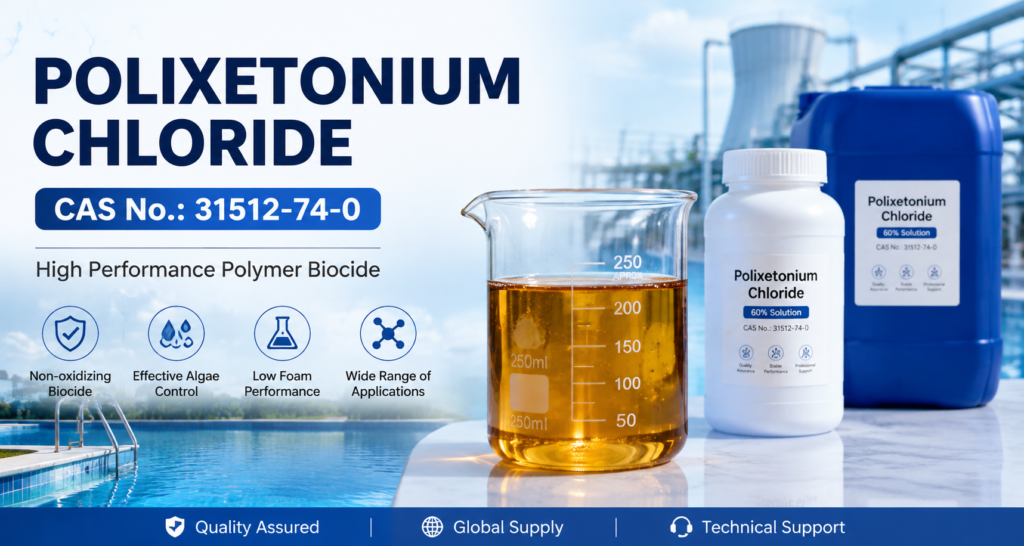
When purchasing specialty chemicals, a small number can make a surprisingly big difference.
For Polixetonium Chloride, that number is CAS 31512-74-0.
At first glance, a CAS number may look like just another technical code written on a specification sheet. But for buyers, importers, distributors, and formulators, it is much more than that. It is the chemical identity card that helps confirm whether everyone is talking about the same material.
Imagine asking for “a blue car” without mentioning the model, manufacturer, or year. You may receive many answers, but are you really comparing the same thing? Chemical purchasing works in a similar way. Product names, trade names, and regional naming habits can create confusion.
This is exactly why understanding Polixetonium Chloride CAS 31512-74-0 matters.
Whether you are sourcing a non-oxidizing algaecide, evaluating a supplier, or developing a water treatment formulation, knowing the relationship between CAS number, chemical name, concentration, and application can help you avoid costly mistakes.
So, what exactly does CAS 31512-74-0 tell buyers? Let’s take a closer look.
What Does CAS 31512-74-0 Mean for Polixetonium Chloride Buyers?
A CAS number is assigned by the Chemical Abstracts Service to identify a specific chemical substance.
For Polixetonium Chloride, the registered CAS number is:
CAS No.: 31512-74-0
This number is globally recognized and helps buyers, suppliers, laboratories, and regulatory organizations identify the same chemical regardless of language differences or commercial naming.
Why does this matter?
Because Polixetonium Chloride has several different names in the market.
You may see it described as:
- Polixetonium Chloride
- Polyquaternium-42
- Poly[oxyethylene(dimethyliminio)ethylene(dimethyliminio)ethylene dichloride]
- WSCP
- Polyquat 60
- Algaecide 60
Some of these names describe the chemical structure. Others are industry names or commercial references.
For a buyer, relying only on a product name can create confusion.
A supplier in one country may call it Polyquaternium-42, while another supplier may use Polixetonium Chloride. Are they different products?
Usually, no.
The CAS number provides the first important confirmation that both parties are referring to the same chemical substance.
The key point is simple:
Always confirm the CAS number before comparing prices, specifications, or supplier offers.
A lower price does not always mean a better deal if the material behind the quotation is different.
What Is Polixetonium Chloride?
Polixetonium Chloride is a cationic polymeric biocide belonging to the quaternary ammonium polymer family.
Unlike traditional small-molecule quaternary ammonium compounds, Polixetonium Chloride has a polymeric structure. This difference gives it several unique performance characteristics.
In simple terms, the molecule contains positively charged functional groups along a polymer chain.
These positive charges allow the polymer to interact with negatively charged surfaces commonly found in:
- algae cells
- microorganisms
- organic particles
- suspended impurities
Think about a magnet attracting metal pieces. The mechanism is not exactly the same, but the idea is similar: electrical attraction plays an important role.
Because of its polymer structure, Polixetonium Chloride is widely used where buyers need:
- long-lasting algae control
- non-oxidizing biocidal activity
- low foam performance
- compatibility with various water treatment systems
It is commonly supplied as a concentrated liquid solution, especially a 60% active solution, for industrial and commercial applications.
Compared with many traditional algaecides, Polixetonium Chloride offers a different balance between effectiveness and system compatibility.
For example, in swimming pools, some products may create unwanted foam or interact with other chemicals. In industrial water systems, excessive corrosion or unstable performance can become expensive problems.
This is why polymeric quaternary compounds continue to attract attention from formulators and water treatment professionals.
Why Is CAS Number 31512-74-0 Important in Chemical Purchasing?
For experienced chemical buyers, the CAS number is one of the first things checked during supplier evaluation.
But why?
Because chemical markets are full of similar-sounding materials.
A product name may describe:
- a chemical family
- a formulation
- a trade product
- a regional naming preference
- a supplier-specific grade
These are not always identical.
For Polixetonium Chloride, CAS 31512-74-0 helps buyers confirm:
1. Product identity
The CAS number confirms the chemical substance being discussed.
This is especially important when purchasing internationally because translation differences can easily happen.
A buyer in Europe, a supplier in China, and a distributor in the Middle East may use different names for the same material.
The CAS number becomes the common language.
2. Regulatory communication
Regulatory documents, safety data sheets (SDS), technical documents, and laboratory reports often reference CAS numbers.
When reviewing supplier documents, buyers should check whether:
- the CAS number matches
- the chemical name is consistent
- the specification describes the correct concentration
- the application information matches the intended use
A small mismatch here can create unnecessary problems later.
3. Supplier comparison
Imagine receiving three quotations:
Supplier A:
Polixetonium Chloride 60%
Supplier B:
Polyquaternium-42 60%
Supplier C:
WSCP 60%
Without checking CAS numbers, comparing these offers can become confusing.
With CAS 31512-74-0, buyers have a clearer starting point.
Of course, CAS confirmation is only the first step. Quality, active content, viscosity, documentation, packaging, and technical support still matter.
Chemical Identity Behind Polixetonium Chloride CAS 31512-74-0
The chemical name of Polixetonium Chloride is:
Poly[oxyethylene(dimethyliminio)ethylene(dimethyliminio)ethylene dichloride]
This systematic name looks complicated — and honestly, it is not something most buyers will use in daily communication.
Chemical names often describe molecular structure rather than practical handling.
For purchasing purposes, buyers usually focus on:
- CAS number
- active content
- appearance
- viscosity
- pH value
- density
- packaging
- application suitability
However, understanding the chemical identity can still be useful.
Polixetonium Chloride is a polymer containing quaternary ammonium groups. These positively charged groups are responsible for much of its interaction with microorganisms and suspended materials.
This polymeric nature separates it from many conventional quaternary ammonium compounds.
For example, some smaller quaternary ammonium compounds are known for strong antimicrobial activity but may produce more foam in certain applications.
Polixetonium Chloride is often preferred when users need a polymer-based solution with non-foaming characteristics.
You can learn more about its role and performance characteristics in our guide:
Technical Properties of Polixetonium Chloride
Is CAS 31512-74-0 the Same as Polyquaternium-42?
This is one of the most common questions buyers ask.
The short answer is:
Yes, Polixetonium Chloride is commonly identified as Polyquaternium-42.
However, the reason behind the two names is worth understanding.
“Polixetonium Chloride” is a chemical name commonly used in industrial and regulatory contexts.
“Polyquaternium-42” follows a naming system often seen in cosmetic and personal care industries, where polymeric quaternary ammonium compounds are assigned Polyquaternium numbers.
The same chemical can appear under different names depending on:
- industry
- region
- regulatory documents
- application background
This happens more often than many people expect.
For example, a water treatment professional may search for Polixetonium Chloride, while someone researching polymer ingredients may find Polyquaternium-42.
Both searches can lead to the same chemical identity:
CAS 31512-74-0
Understanding this naming relationship helps buyers discover more technical information and communicate more effectively with suppliers.
For more details, you can also read:
Is Polyquaternium-42 the Same as Polixetonium Chloride?
Physical Properties Buyers Should Know Before Purchasing
Before placing an order for Polixetonium Chloride CAS 31512-74-0, buyers should understand several basic physical properties.
These parameters are not just numbers on a technical data sheet. They directly influence handling, storage, transportation, formulation, and application performance.
A typical commercial Polixetonium Chloride product is supplied as a concentrated aqueous solution with the following characteristics:
| Property | Typical Value |
|---|---|
| Appearance | Clear amber viscous liquid |
| Active content | 58–61% |
| pH (10% solution) | 6.0–8.0 |
| Density | Approximately 1.15 g/cm³ |
| Viscosity | 150–400 mPa·s |
Of course, specifications may vary slightly between manufacturers and grades. That is why buyers should always review the supplier’s latest technical data sheet before purchase.
Let me explain why these properties matter.
Appearance: More Than Just a Visual Check
Polixetonium Chloride is usually a clear amber transparent viscous liquid.
This appearance is one of the simplest quality checks during receiving inspection.
A buyer opening a container may immediately notice:
- unexpected color changes
- visible particles
- separation
- unusual turbidity
These signs do not automatically mean a product is unusable, but they deserve attention.
A consistent appearance often indicates good manufacturing control and proper storage conditions.
Active Content: The Number Behind Product Value
For concentrated Polixetonium Chloride, active content is one of the most important purchasing parameters.
A product labeled as “60% Polixetonium Chloride” generally means the solution contains approximately 60% active polymer content, with the remaining portion being water and other formulation components.
Why does this matter?
Because two products with the same product name may not provide the same amount of active ingredient.
For example:
- Product A: 60% active content
- Product B: 40% active content
The purchasing price alone may make Product B appear cheaper.
But when calculated based on actual active material, the cost difference may disappear.
This is why experienced buyers compare products based on active content rather than container price alone.
Viscosity: A Practical Handling Factor
Because Polixetonium Chloride is a polymer solution, viscosity is an important characteristic.
A higher viscosity product may indicate differences in:
- polymer characteristics
- concentration
- molecular structure
For industrial users, viscosity affects:
- pumping
- mixing
- dosing equipment selection
- packaging requirements
A product that works well in a laboratory test may behave differently in a large-scale dosing system if handling characteristics are ignored.
This is a small detail, but small details often decide whether a chemical performs smoothly in real applications.
Why Is Polixetonium Chloride Usually Supplied as a 60% Solution?
Many buyers searching for CAS 31512-74-0 notice one interesting fact:
Why is Polixetonium Chloride usually supplied at around 60% concentration instead of 100%?
The answer comes from chemistry and practical manufacturing considerations.
A polymeric material like Polixetonium Chloride is normally produced and handled as an aqueous solution.
A theoretical “100% active” product is not always practical.
There are several reasons.
1. Better Handling During Transportation and Use
A 60% solution provides a balance between concentration and usability.
If the material were supplied at a much higher concentration, viscosity could become significantly higher.
That could create challenges with:
- pumping
- transferring
- mixing
- accurate dosing
A chemical that looks attractive on paper but is difficult to handle in real operations may not provide real value.
2. Better Product Stability
Water-based polymer solutions often require an appropriate balance between active concentration and physical stability.
The commercial grade is designed to maintain:
- consistent appearance
- manageable viscosity
- reliable performance
This is especially important for international shipments, where products may experience different temperatures and storage conditions.
3. Easier Formulation Control
Many downstream users do not use Polixetonium Chloride directly.
Instead, they formulate it into:
- pool algaecides
- industrial biocide products
- water treatment formulations
A 60% solution provides flexibility during blending.
Manufacturers can adjust final formulations according to:
- application requirements
- dosage targets
- packaging formats
You can read more about this topic here:
Why Is Polixetonium Chloride Usually Supplied at 60%?
Main Applications of Polixetonium Chloride CAS 31512-74-0
Polixetonium Chloride is mainly known for its use as a non-oxidizing polymeric biocide and algae control agent.
Its applications cover several industries.
1. Swimming Pool Algaecides
One of the most recognized applications is in swimming pool care.
Pool professionals often look for algaecides that can provide:
- effective algae control
- low foam performance
- compatibility with chlorine systems
- long-lasting action
Polixetonium Chloride is widely used as an active ingredient in premium polyquat-type algaecide formulations.
Compared with some metallic algaecides, polymeric quaternary products are often preferred when users want to avoid staining issues.
Typical products include:
- Polyquat 60 Algaecide
- Premium Algae Control products
- Winter Algaecide formulations
2. Industrial Water Treatment
Industrial cooling water systems create an environment where microorganisms and algae can grow.
Biofilm and algae accumulation may affect:
- heat transfer efficiency
- system cleanliness
- maintenance frequency
Because Polixetonium Chloride is a non-oxidizing biocide, it is considered for applications where users require a different approach from oxidizing chemicals.
It can be used in:
- cooling towers
- industrial water circulation systems
- process water treatment
3. Metalworking Fluid Preservation
Metalworking fluids can become contaminated by microorganisms during storage and operation.
Microbial growth may lead to:
- unpleasant odors
- fluid degradation
- reduced service life
Certain polymeric quaternary compounds are used in industrial formulations where microbial control is required.
However, application suitability depends on formulation compatibility, regulatory requirements, and customer testing.
A responsible supplier should always evaluate the specific system before recommending usage.
4. Specialty Chemical Formulations
Beyond direct applications, Polixetonium Chloride may also serve as an ingredient in customized formulations.
These may include:
- private-label pool chemicals
- industrial treatment products
- specialty water management solutions
For formulators, the advantage is flexibility.
A reliable supplier can support not only raw material supply but also packaging, blending, and technical discussions.
What Should Buyers Check Before Selecting a Supplier?
Finding a supplier for Polixetonium Chloride CAS 31512-74-0 is not simply about finding the lowest quotation.
Chemical purchasing is a little like choosing a long-term business partner.
A small difference in quality or communication can become a large problem after several shipments.
Here are key points buyers should evaluate.
1. Confirm Chemical Identity
Always confirm:
- CAS number
- chemical name
- active content
- product specification
The first question should always be:
“Are we comparing the same material?”
2. Review Technical Documents
Professional suppliers should provide documents such as:
- Technical Data Sheet (TDS)
- Safety Data Sheet (SDS)
- Certificate of Analysis (COA)
These documents help buyers verify:
- specifications
- handling information
- batch quality
3. Understand Manufacturing Capability
A supplier should understand more than just selling a chemical.
They should be able to answer practical questions:
- What packaging options are available?
- Can they provide samples?
- How is quality controlled?
- Can they support customized requirements?
For buyers searching for a long-term source, manufacturing capability matters.
You can also check:
How to Evaluate a Polixetonium Chloride Manufacturer
Common Mistakes When Buying Polixetonium Chloride
Even experienced buyers can sometimes make mistakes when sourcing specialty chemicals.
Here are several common issues.
Mistake 1: Comparing Only Price
The cheapest quotation is not always the most economical option.
Important factors include:
- active content
- consistency
- documentation
- delivery reliability
A slightly higher-quality product may reduce problems later.
Mistake 2: Ignoring Concentration Differences
A quotation for “Polixetonium Chloride” is incomplete without concentration information.
Always confirm:
- 60% solution?
- different active level?
- customized formulation?
Mistake 3: Confusing Trade Names with Chemical Identity
Names such as WSCP or Polyquaternium-42 may appear in the market.
Buyers should confirm whether these names refer to the same CAS number.
How to Choose a Reliable Polixetonium Chloride Supplier
A reliable supplier should provide more than a product.
They should provide confidence.
Before cooperation, buyers can consider:
- Does the supplier understand your application?
- Can they provide technical documents quickly?
- Do they communicate clearly?
- Can they support international shipment requirements?
- Can they maintain consistent quality between batches?
For specialty chemicals, trust is built shipment by shipment.
A good supplier does not simply send containers.
They help customers solve problems.
Frequently Asked Questions
1. What is Polixetonium Chloride CAS 31512-74-0 used for?
Polixetonium Chloride CAS 31512-74-0 is mainly used as a polymeric non-oxidizing biocide and algae control agent in applications such as swimming pool chemicals, industrial water treatment, and specialty formulations.
2. Is Polixetonium Chloride the same as Polyquaternium-42?
Yes. Polixetonium Chloride is commonly identified as Polyquaternium-42. Both names refer to the same chemical substance associated with CAS 31512-74-0.
3. Why is Polixetonium Chloride usually sold as a 60% solution?
Polixetonium Chloride is typically supplied as a 60% solution because this concentration provides a practical balance between active content, viscosity, stability, and ease of handling.
4. What should buyers check when purchasing Polixetonium Chloride?
Buyers should check CAS number, active content, technical documents, appearance, viscosity, packaging, and supplier manufacturing capability before placing an order.
5. Where can I buy Polixetonium Chloride CAS 31512-74-0?
Buyers can source Polixetonium Chloride from qualified chemical manufacturers or suppliers that provide consistent specifications, technical support, and reliable international shipping services.