GET IN TOUCH
Ask For Sample?
Why Is Polixetonium Chloride Usually Supplied at 60%?
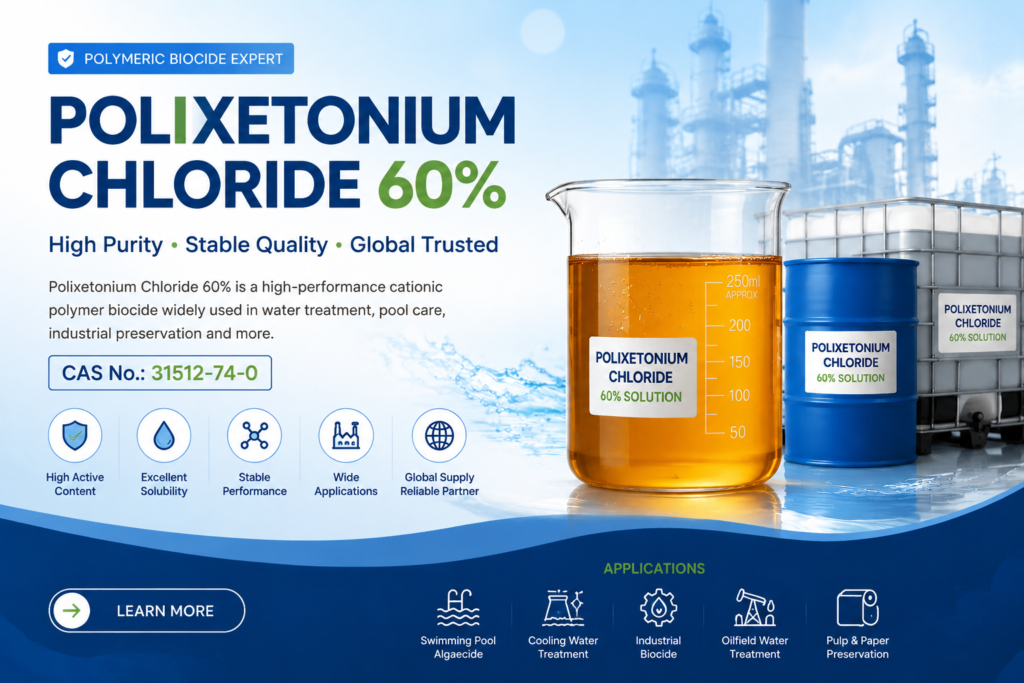
When buyers first search for Polixetonium Chloride, one question often comes up:
“Why is this product almost always supplied as a 60% solution? Why not make it 80%, 90%, or even 100%?”
It seems like a simple question, right? After all, higher concentration usually means more active ingredient, lower shipping volume, and potentially better cost efficiency. But chemistry does not always work that way.
Polixetonium Chloride is not like a simple salt that can be dried into a pure powder and easily redissolved whenever needed. It is a high molecular weight cationic polymer, and its commercial form depends heavily on physical properties such as viscosity, stability, handling, and application performance.
The short answer?
A 60% active solution represents a practical balance between chemical strength and real-world usability.
But there is more behind this number than many people realize.
What Exactly Does “60% Polixetonium Chloride” Mean?
Before discussing why the concentration is 60%, we need to clarify what this number actually represents.
Understanding active content is essential when comparing different Polixetonium Chloride products. A higher percentage does not always mean better performance, because factors such as molecular structure, viscosity, and application conditions also influence the final result.
For a deeper explanation of how to evaluate product specifications and quality indicators, you can read our guide on How to Evaluate Polixetonium Chloride Performance.
A typical commercial grade of Polixetonium Chloride is supplied as a 60% active aqueous solution.
This means:
- Approximately 60% of the product weight is active polymer
- The remaining portion is mainly water and minor formulation components
- The product is supplied as a ready-to-use liquid concentrate
For example, a 1,000 kg shipment of Polixetonium Chloride 60% solution contains roughly:
- 600 kg active Polixetonium Chloride polymer
- 400 kg water and associated liquid components
However, “60%” does not mean the polymer itself is only 60% pure. It describes the active content of the commercial solution.
This difference matters.
Many buyers compare products only by concentration, but for polymeric biocides, concentration is only one part of the picture. Molecular structure, charge density, molecular weight, viscosity, and application compatibility also influence performance.
Why Not Supply Polixetonium Chloride at 100% Concentration?
At first glance, a 100% product sounds attractive.
More active ingredient.
Less water.
Lower freight cost.
Sounds perfect, doesn’t it?
Not exactly.
The challenge is that Polixetonium Chloride is a polymer-based material, not a simple crystalline chemical.
As active concentration increases, several physical challenges appear.
1. Extremely High Viscosity Becomes a Handling Problem
One of the biggest reasons Polixetonium Chloride is supplied at around 60% concentration is viscosity control.
Polymeric materials naturally become thicker as concentration increases.
Think about honey.
A little honey flows easily from a spoon. But if you remove most of the water content, it becomes extremely thick and difficult to move.
Polixetonium Chloride behaves in a similar way.
At higher concentrations:
- Pumping becomes more difficult
- Transfer from drums or IBC containers becomes slower
- Accurate dosing becomes harder
- Mixing into formulations requires more energy
For industrial users, a product that cannot be easily pumped or blended creates operational problems.
A slightly lower concentration that flows smoothly often performs better in real production environments.
2. Water Plays an Important Role in Polymer Stability
Many people think water in a chemical product is simply a “diluent.”
That is not always true.
For Polixetonium Chloride, water helps maintain:
- Polymer mobility
- Solution uniformity
- Storage stability
- Easier dispersion during application
A polymer solution needs enough space for its molecular chains to move freely.
When concentration becomes too high, polymer chains interact more strongly with each other. This can increase viscosity and may affect handling characteristics.
So water is not just reducing concentration.
It helps keep the product practical.
The 60% Concentration Provides a Good Balance
Commercial chemical products are designed around real customer needs, not just laboratory numbers.
A 60% Polixetonium Chloride solution offers several advantages:
Strong Active Content
A 60% solution provides a high level of active polymer, allowing economical transportation and efficient dosing.
Manageable Viscosity
The product remains pumpable and suitable for:
- Drum filling
- IBC packaging
- Automatic dosing systems
- Industrial blending
Better Storage Performance
The solution remains stable under recommended storage conditions without becoming excessively difficult to handle.
Easier Customer Formulation
Manufacturers using Polixetonium Chloride in:
- Pool algaecides
- Cooling water treatment
- Industrial biocide formulations
- Metalworking fluid preservation
can adjust the final concentration more easily.
Why Do Industrial Buyers Prefer a 60% Grade?
Different industries have different reasons for choosing this concentration.
The preferred concentration often depends on the final application. For example, swimming pool formulators may focus on non-foaming algae control, while industrial users may prioritize long-term microbial management and compatibility with existing treatment programs.
To understand where this polymeric biocide is commonly used, explore our article about Industry-Specific Uses of Polixetonium Chloride.
Let’s take a closer look.
Swimming Pool Algaecide Applications
In the pool industry, Polixetonium Chloride is commonly known as:
- Polyquat 60
- Polyquat 60 Algaecide
- WSCP
- Polymer-based non-foaming algaecide
A 60% solution is popular because formulators can directly blend it into finished products.
For example:
A manufacturer producing a Polyquat 60 algaecide does not need an extremely concentrated raw material. They need a reliable ingredient that can be:
- accurately dosed
- mixed consistently
- packaged safely
The 60% grade fits this purpose well.
Cooling Water Treatment
Cooling systems require chemicals that can be accurately injected into large water volumes.
A product that is too concentrated and too viscous can create problems with:
- metering pumps
- storage tanks
- automatic feeding systems
The 60% solution provides enough active content while maintaining practical flow properties.
Industrial Formulations
Many industrial users purchase Polixetonium Chloride as a raw material rather than a finished product.
They may combine it with:
- other biocides
- corrosion inhibitors
- dispersants
- specialty additives
A predictable liquid concentrate simplifies production.
Manufacturers value consistency more than chasing the highest possible concentration.
Does Higher Concentration Always Mean Lower Cost?
This is another common misunderstanding.
A higher concentration product may reduce shipping costs because less water is transported.
But total cost depends on many factors:
- Raw material price
- Manufacturing difficulty
- Packaging requirements
- Pumping equipment
- Storage conditions
- Customer processing requirements
Sometimes a very concentrated product creates additional costs elsewhere.
For example:
A customer receiving a highly viscous product may need special heating equipment or stronger pumps.
That extra investment may eliminate the freight savings.
The cheapest chemical on paper is not always the cheapest solution in practice.
Is Polixetonium Chloride 60% Considered a Standard Grade?
Yes.
For global commercial applications, Polixetonium Chloride 60% solution is widely recognized as a standard industrial grade.
Typical specifications may include:
- Active content: around 58–61%
- Appearance: clear amber-colored viscous liquid
- pH: approximately neutral
- Density: around 1.15 g/cm³
- Viscosity: controlled for practical handling
Of course, exact specifications vary between manufacturers.
Buyers should always review:
- Certificate of Analysis (COA)
- Technical Data Sheet (TDS)
- Safety Data Sheet (SDS)
before approving a supplier.
How Should Buyers Evaluate a 60% Polixetonium Chloride Supplier?
The concentration alone should not be the only purchasing factor.
A reliable supplier should provide:
- Consistent active content
- Batch-to-batch stability
- Clear technical documentation
- Proper packaging
- Application support
A good supplier understands that customers are not simply buying a chemical.
Selecting the right supplier is just as important as selecting the right concentration. Reliable supply requires consistent quality control, technical documentation, and experience supporting different application fields.
If you are looking for guidance on choosing a reliable source, check our article Choosing the Best Polixetonium Chloride Supplier.
They are buying predictable performance.
Whether the final product is a pool algaecide, cooling water treatment chemical, or industrial biocide, consistency matters.
Final Thoughts: Why 60% Became the Industry Choice
So, why is Polixetonium Chloride usually supplied at 60%?
Because it works.
It provides:
- High active content
- Stable storage
- Practical viscosity
- Easy transportation
- Reliable industrial handling
A 100% concentration may sound better from a numbers perspective, but chemistry has its own rules.
The best commercial product is not always the strongest one.
Sometimes, the smartest formulation is the one that gives manufacturers and end users the easiest path from container to application.
And for Polixetonium Chloride, that balance has made the 60% solution the industry standard.
Frequently Asked Questions
1. What does Polixetonium Chloride 60% mean?
Polixetonium Chloride 60% means the commercial solution contains approximately 60% active polymer by weight, with the remaining portion mainly consisting of water and formulation components.
2. Why is Polixetonium Chloride not sold as a 100% pure product?
Polixetonium Chloride is a high molecular weight polymer. A 100% product would become extremely difficult to handle because of excessive viscosity and poor flow characteristics.
3. Is Polixetonium Chloride 60% suitable for pool algaecide production?
Yes. Polixetonium Chloride 60% is widely used as a raw material for non-foaming Polyquat 60 algaecide formulations due to its stability and easy blending properties.
4. Does higher Polixetonium Chloride concentration always improve performance?
No. Performance depends on factors such as active content, molecular characteristics, dosage, and application conditions. Higher concentration does not automatically mean better results.
5. How should Polixetonium Chloride 60% be stored?
Polixetonium Chloride 60% should generally be stored in sealed containers under recommended temperature conditions, avoiding extreme heat or freezing to maintain product quality and handling properties.