GET IN TOUCH
Ask For Sample?
Why Cationic Polymers Are Becoming Popular in Water Treatment?
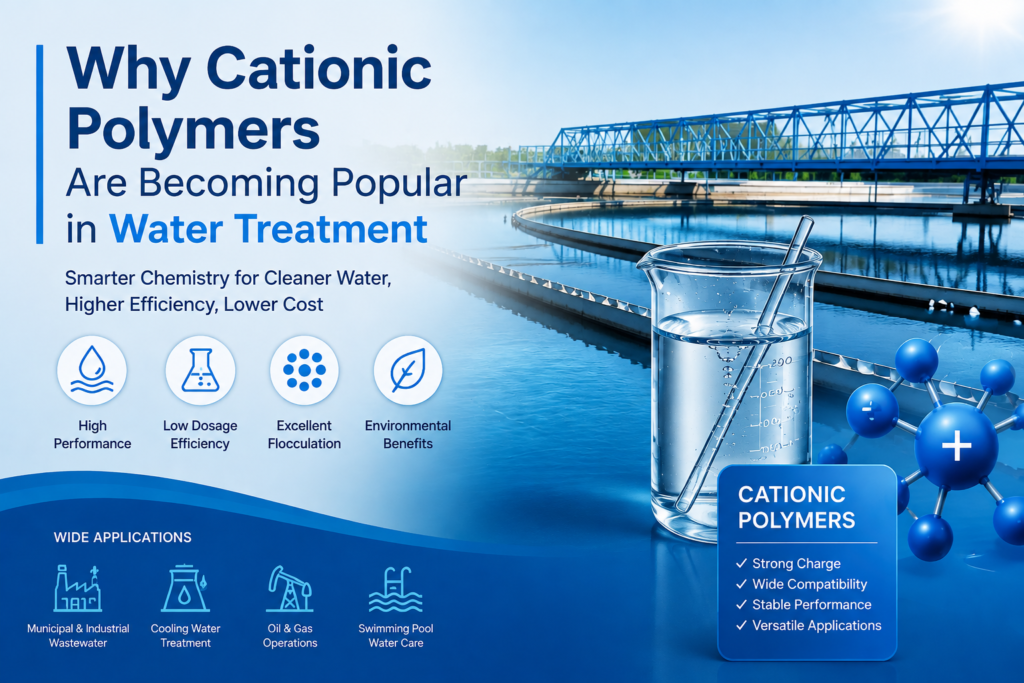
Water treatment has always been about solving a simple but difficult problem: how can we remove unwanted substances from water while keeping the process efficient, reliable, and cost-effective?
For decades, industries have relied on traditional chemicals such as inorganic coagulants, oxidizing agents, and conventional biocides. These materials still play an important role. However, as water systems become more complicated, many engineers and formulators are looking for solutions that offer better control, lower chemical consumption, and improved performance.
This is where cationic polymers are attracting increasing attention.
From municipal wastewater treatment plants to industrial cooling systems, oilfield operations, metalworking fluids, and commercial swimming pools, cationic polymers are becoming an important part of modern water management strategies.
But why?
What makes these polymers different from traditional chemicals? Why are more companies exploring cationic polymer-based solutions instead of relying only on conventional treatments?
The answer lies in their unique molecular structure, strong interaction with suspended particles, and ability to solve multiple water treatment challenges with relatively small dosages.
Simply put, cationic polymers are not just another chemical product. They represent a different way of thinking about water treatment.
What Are Cationic Polymers and How Do They Work?
Before discussing why they are becoming popular, it helps to understand what cationic polymers actually are.
A cationic polymer is a polymer containing positively charged functional groups. The word “cationic” means the molecule carries a positive charge.
Many unwanted substances in water — including suspended solids, organic particles, algae cells, and negatively charged colloidal materials — naturally carry negative charges.
Think about two magnets facing each other.
Opposite charges attract.
The positive charge of a cationic polymer allows it to interact with negatively charged particles in water. Once attached, the polymer chains can connect multiple small particles together, creating larger aggregates that are easier to remove.
This process is commonly called flocculation.
A simple example:
Imagine a glass of muddy water. Tiny clay particles remain suspended because they repel each other and do not easily settle. When a suitable cationic polymer is added, these tiny particles begin to gather together into larger groups. Eventually, they become heavy enough to separate from the water.
Of course, industrial water systems are far more complicated than a glass of muddy water. Factors such as pH, temperature, dissolved salts, organic content, and particle type can influence performance.
That is why selecting the correct polymer chemistry is important.
Different cationic polymers have different charge densities, molecular weights, and application characteristics.
Why Traditional Water Treatment Chemicals Are Not Always Enough
Traditional water treatment chemicals remain widely used for good reasons. They are proven, available, and familiar to operators.
However, modern water systems often face new challenges.
For example:
- Industrial wastewater contains more complex organic contaminants.
- Cooling systems operate under higher concentration cycles.
- Manufacturers require cleaner process water with fewer residues.
- Environmental regulations encourage reduced chemical discharge.
- Customers expect better performance with lower operating costs.
A chemical that worked well twenty years ago may not always provide the same results today.
This does not mean traditional chemicals are outdated. Instead, many companies are combining different technologies.
For example, a treatment program may include:
- A cationic polymer for particle control.
- A biocide for microbial management.
- A corrosion inhibitor for metal protection.
- A scale inhibitor for mineral deposits.
The key idea is balance.
Water treatment is rarely about finding one “magic chemical.” It is about designing a system where each component performs its specific role.
Cationic polymers fit well into this approach because they can provide targeted functions without unnecessarily increasing chemical loading.
The Key Reasons Behind the Growing Demand for Cationic Polymers
1. Strong Performance at Low Dosage
One of the biggest reasons cationic polymers are becoming popular is their efficiency.
Because polymers have long molecular chains, a single polymer molecule can interact with many particles at the same time.
This creates a bridging effect.
Instead of simply neutralizing particles individually, polymer chains connect multiple particles together.
The result?
Better separation performance with relatively low addition rates.
For industrial users, this can mean:
- Lower chemical consumption.
- Reduced sludge volume.
- Easier water clarification.
- Improved process stability.
Of course, the actual dosage depends on water quality and application conditions. A polymer that works well in one system may not perform the same way in another.
Water chemistry always matters.
2. Versatility Across Multiple Industries
Another reason behind the popularity of cationic polymers is their wide application range.
They are not limited to one specific industry.
Common applications include:
Municipal and Industrial Wastewater Treatment
Cationic polymers are widely used as flocculants or coagulant aids.
They help remove:
- Suspended solids.
- Organic particles.
- Turbidity-causing materials.
- Certain colloidal substances.
Many wastewater treatment facilities use polymers together with other treatment methods to improve clarification efficiency.
Cooling Water Treatment
Industrial cooling systems require careful microbial and deposit control.
Certain cationic polymers, including quaternary ammonium-based polymers, are used in non-oxidizing microbial control applications.
For example, Polixetonium Chloride (Polyquaternium-42) is a cationic polymer known for applications in industrial water systems and algae control.
Its polymeric structure provides different behavior compared with small-molecule biocides.
You can learn more about this material through:
What Is Polixetonium Chloride? A Complete Beginner’s Guide
Swimming Pool Water Care
Swimming pools require clear, attractive water.
Traditional chlorine treatment is essential, but pool operators often use polymer-based products to support water quality.
Cationic polymers can help with:
- Algae control.
- Water clarity improvement.
- Particle removal.
For example, Polyquat-based products are widely recognized in pool care because they provide non-oxidizing algae control characteristics.
You may find more information about these polyquat-based products at the series of Specialty Pool Chemicals.
Oil and Gas Applications
Oilfield operations often involve complex water systems containing oil droplets, solids, and organic materials.
Cationic polymers can assist with:
- Water clarification.
- Separation processes.
- Treatment of produced water.
Their ability to interact with negatively charged particles makes them useful in difficult separation environments.
Popular Types of Cationic Polymers Used in Water Treatment
Not all cationic polymers are the same.
Different chemical structures provide different performance characteristics.
PolyDADMAC
PolyDADMAC, or polydiallyldimethylammonium chloride, is one of the most common cationic polymers used in water treatment.
It is widely used as:
- A coagulant.
- A flocculation aid.
- A clarification agent.
Its advantages include:
- Strong charge density.
- Good water compatibility.
- Broad application range.
Many water treatment formulators use PolyDADMAC as a basic building block for clarification products.
Polyamine
Polyamines are another important category of cationic polymers.
They are commonly used in:
- Wastewater treatment.
- Paper industry applications.
- Industrial clarification.
Depending on molecular structure and charge characteristics, Polyamines can provide effective charge neutralization and particle aggregation.
Polixetonium Chloride
Polixetonium Chloride is a special cationic polymer with quaternary ammonium groups.
It is also known as Polyquaternium-42.
Its applications include:
- Industrial microbial control.
- Algae management.
- Pool chemical formulations.
Unlike traditional oxidizing treatments, it works through a different mechanism based on its cationic polymer structure.
For buyers interested in specifications and supply information:
Technical Properties of Polixetonium Chloride
provides additional details.
Environmental and Operational Advantages of Cationic Polymers
The increasing interest in cationic polymers is not only about performance.
Operational advantages also matter.
Reduced Chemical Consumption
When a polymer performs efficiently, users may achieve the desired treatment effect with less chemical input.
This can reduce:
- Storage requirements.
- Transportation costs.
- Chemical handling frequency.
Improved Process Control
Water treatment operators often prefer chemicals that provide predictable performance.
Because polymers interact directly with particles and contaminants, they can offer better control in many systems.
This is especially valuable for industries where unstable water quality can interrupt production.
Compatibility With Modern Treatment Programs
Modern water treatment is becoming more integrated.
Instead of using isolated chemicals, many companies build complete treatment programs.
Cationic polymers can work alongside:
- Filtration systems.
- Membrane processes.
- Disinfection programs.
- Other treatment chemicals.
The important point is compatibility.
A good chemical solution should fit into the entire water management system.
Challenges and Considerations When Using Cationic Polymers
While cationic polymers offer many benefits, they are not universal solutions.
Several factors should be considered.
Water Chemistry Matters
A polymer that works perfectly in one location may perform poorly elsewhere.
Important factors include:
- pH.
- Temperature.
- Salt concentration.
- Organic loading.
- Suspended solids characteristics.
Testing is usually recommended before large-scale application.
Charge Balance Is Important
Too much or too little polymer can reduce performance.
If the dosage is too low, particles may not fully aggregate.
If the dosage is too high, charge reversal may occur.
Finding the correct balance is essential.
Product Quality Should Be Verified
For industrial buyers, polymer quality is a major consideration.
Important quality indicators may include:
- Active content.
- Molecular weight range.
- Viscosity.
- Appearance.
- pH.
- Batch consistency.
Reliable suppliers should provide technical documents such as specifications, COA, and SDS.
How to Choose the Right Cationic Polymer for Your Water System
Choosing a cationic polymer is not simply about selecting the product with the highest charge.
The right choice depends on the application.
Consider these questions:
What is the treatment goal?
Are you trying to:
- Remove suspended solids?
- Control algae?
- Improve clarification?
- Separate oil and water?
- Reduce microbial growth?
Different goals require different polymer structures.
What type of water is being treated?
Industrial wastewater, cooling water, pool water, and oilfield water all have different requirements.
A polymer designed for clarification may not be the best option for microbial control.
What support does the supplier provide?
A good chemical supplier should do more than sell a product.
Technical communication, sample support, application advice, and consistent supply are all important parts of a successful partnership.
The Future of Cationic Polymers in Global Water Treatment
Water challenges are becoming more complex.
Industries need solutions that help them manage limited water resources, improve efficiency, and maintain reliable operations.
Cationic polymers are likely to continue gaining attention because they offer a combination of:
- Flexible applications.
- Strong performance.
- Efficient chemical usage.
- Compatibility with modern treatment systems.
The future of water treatment will probably not depend on one single chemical technology.
Instead, it will come from smarter combinations of chemistry, engineering, and operational knowledge.
Cationic polymers are an important piece of that future.
From wastewater clarification to industrial cooling systems and specialty pool applications, these materials are helping companies approach water treatment in a more controlled and efficient way.
And that is exactly why more professionals are starting to pay attention.
Frequently Asked Questions (FAQ)
1. What are cationic polymers used for in water treatment?
Cationic polymers are used for water clarification, flocculation, algae control, microbial management, and separation processes. They help remove negatively charged particles by creating larger aggregates that are easier to separate.
2. Why are cationic polymers becoming popular in industrial water treatment?
Cationic polymers are becoming popular because they provide efficient performance, work at relatively low dosages, and can be applied across wastewater, cooling water, oilfield, and pool water treatment systems.
3. Is Polixetonium Chloride a cationic polymer?
Yes. Polixetonium Chloride is a cationic polymer containing quaternary ammonium groups. It is also known as Polyquaternium-42 and is used in applications including algae control and industrial water treatment.
4. How do I select the right cationic polymer for my water treatment application?
The right polymer depends on water quality, treatment objectives, operating conditions, and compatibility with existing chemicals. Laboratory testing and technical discussion with a supplier are recommended before full-scale use.