
GET IN TOUCH
Ask For Sample?
Why Pool Water Turns Green Even with Chlorine?
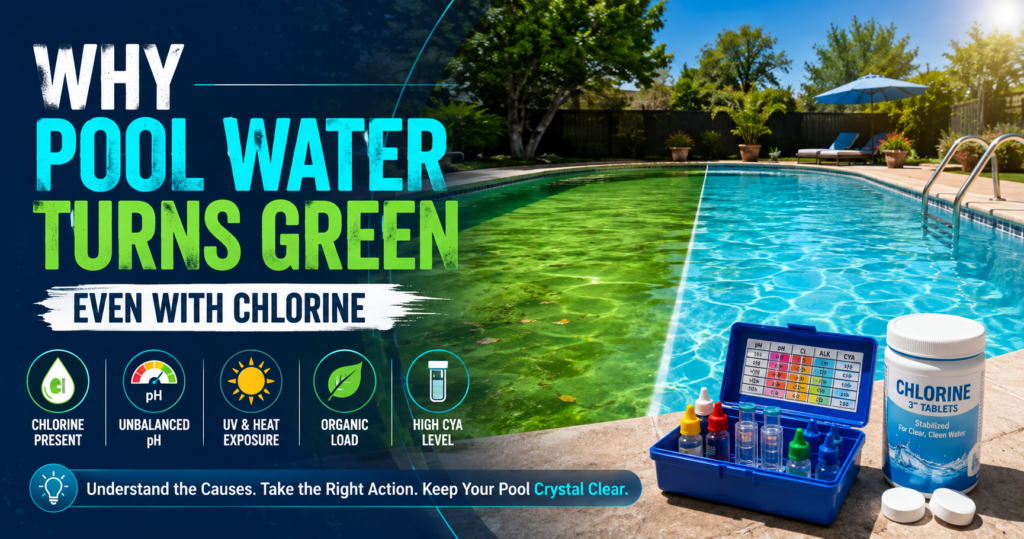
You test the pool. Chlorine is present. The pump is running. Everything seems more or less normal.
Yet the water is turning green.
It’s one of the most frustrating situations for pool owners because chlorine is supposed to keep algae under control. So if there’s chlorine in the water, shouldn’t the pool stay clear?
Not necessarily.
A green pool doesn’t always mean there is no chlorine. More often, it means the chlorine isn’t working effectively enough, isn’t staying active long enough, or is being overwhelmed by conditions inside the pool.
And there’s another wrinkle: not every green pool is actually an algae problem.
Let’s break down what’s happening.
Chlorine Is in the Pool—So Why Is Algae Still Growing?
Here’s the first thing to understand: detecting chlorine and having enough effective chlorine are not the same thing.
A test strip might show chlorine. A liquid test kit may also produce a reading. But those numbers need context.
Pool water chemistry works as a system. Chlorine effectiveness is influenced by pH, cyanuric acid, sunlight, temperature, organic contamination, circulation, filtration, and the amount of algae already present.
Think of chlorine like a security team.
Having guards in the building doesn’t guarantee security if there are too few guards, half of them can’t respond quickly, and trouble is entering faster than they can handle it.
That’s roughly what can happen in a swimming pool.
Algae cells enter through rainwater, windblown debris, swimmers, equipment, and the surrounding environment. Given warmth, sunlight, nutrients, and insufficient sanitation, they can reproduce surprisingly quickly.
Once algae growth gets ahead of the sanitizer, the familiar green tint appears.
For a closer look at how this process starts, see How Green Algae Develops in Swimming Pools.
Free Chlorine Matters More Than Simply “Having Chlorine”
One common misunderstanding comes from treating all chlorine readings as if they mean the same thing.
They don’t.
When testing pool water, three terms are especially useful:
- Free chlorine (FC): chlorine available to sanitize the water.
- Combined chlorine (CC): chlorine that has reacted with contaminants and formed chloramines.
- Total chlorine (TC): essentially free chlorine plus combined chlorine.
Suppose a pool shows measurable total chlorine. That sounds reassuring.
But if much of that reading represents combined chlorine rather than adequately available free chlorine, the pool may have much less sanitizing capacity than the owner assumes.
That’s why simply saying, “My pool has chlorine,” doesn’t tell the whole story.
The better question is:
Does the pool have enough effective free chlorine for its current water conditions?
That distinction becomes particularly important when algae has already started growing.
Your pH May Be Quietly Working Against You
Chlorine chemistry changes with pH.
In unstabilized water, free chlorine exists mainly as hypochlorous acid (HOCl) and hypochlorite ion (OCl⁻). Hypochlorous acid is the more powerful sanitizer of the two.
As pH rises, the balance shifts toward hypochlorite ion.
So a high-pH pool can contain chlorine while its sanitizing action is less favorable than expected.
This doesn’t mean you should chase an extremely low pH. Pool chemistry is about balance, not pushing one number as far as possible.
For typical swimming pools, pH is commonly maintained around 7.2–7.8, with the exact operating target depending on the overall treatment program and applicable guidance.
And there’s an important nuance here: in pools containing cyanuric acid, the relationship between pH and chlorine effectiveness becomes more complicated because CYA also strongly affects available chlorine chemistry.
That brings us to another major cause of mysteriously green pools.
Too Much Cyanuric Acid Can Change the Chlorine Picture
Cyanuric acid is useful.
Outdoor pools lose chlorine rapidly under ultraviolet light. CYA helps protect chlorine from sunlight, allowing it to remain in the pool longer.
Sounds great, right?
Up to a point.
As CYA concentration increases, more chlorine becomes associated with cyanurate species. That changes the concentration of the highly active chlorine species available at a given moment.
This is why free chlorine should not always be interpreted as a standalone number.
A chlorine concentration that may work under one CYA condition might be inadequate under another.
This often becomes a problem when stabilized chlorine products are used repeatedly and CYA gradually accumulates.
The pool owner keeps adding chlorine.
The test still shows chlorine.
Yet algae starts appearing along steps, walls, ladders, corners, or shaded surfaces.
It can feel as if the chlorine has simply stopped working. The chemistry is more subtle: the relationship between free chlorine and CYA has changed.
Sometimes the Chlorine Is Simply Being Overwhelmed
Picture a busy swimming pool on a hot Saturday afternoon.
Kids are jumping in and out. Sunscreen is everywhere. Leaves blow across the surface. Someone has probably introduced more organic material than anyone wants to think about.
All of this creates sanitizer demand.
Chlorine doesn’t spend its entire working life fighting algae. It also reacts with a broad range of contaminants entering the water.
These may include:
- Sweat and swimmer waste
- Skin oils and cosmetics
- Sunscreen
- Leaves and grass
- Pollen
- Insects
- Airborne debris
- Organic material after storms
The greater the contaminant load, the greater the chlorine demand can become.
During hot weather or periods of heavy pool use, sanitizer can therefore disappear much faster than expected.
This is one reason a pool can look fine one evening and noticeably green shortly afterward.
Algae didn’t magically arrive overnight. Conditions simply shifted far enough in its favor.
Warm Water and Sunshine Give Algae a Head Start
Summer is basically algae season.
Warm water supports faster biological activity, while strong sunlight can increase chlorine loss in outdoor pools. Heavy swimming adds another layer of contamination.
Then comes the summer thunderstorm.
Rain can introduce debris and affect water chemistry, while wind carries dust, spores, leaves, and other material into the pool.
Suddenly the sanitizer has quite a workload.
This explains why algae problems often appear during hot weather even in pools that normally receive regular chlorine treatment.
You may be following roughly the same maintenance routine as before—but the pool isn’t experiencing the same conditions.
That distinction matters.
Why Algae Is One of the Biggest Problems in Swimming Pool Maintenance explains why algae can become persistent once conditions begin favoring growth.
Poor Circulation Creates Little Algae Hideouts
Here’s something that gets overlooked all the time.
The water in a swimming pool isn’t chemically identical everywhere at every second.
Sanitizer must circulate.
If circulation is poor, certain areas can receive less effective treatment than the main body of water.
Typical trouble spots include:
- Behind ladders
- Around steps
- Inside corners
- Near poorly positioned returns
- Under floating equipment
- Along shaded walls
- Around fixtures and fittings
These areas can become miniature refuges for algae.
The main pool may test reasonably well because that’s where the sample was taken. Meanwhile, algae is quietly developing somewhere with weaker circulation.
A few green patches appear.
Then a wall develops a green film.
Soon the entire pool starts looking cloudy or green.
This is why brushing matters more than many pool owners realize. Brushing physically disrupts algae attached to surfaces and exposes it more effectively to the treatment present in the water.
Chemistry and physical maintenance work together.
Don’t Blame Chlorine Before Checking the Filter
Dead algae doesn’t politely disappear.
Once algae cells are damaged or killed, the suspended material still needs to be removed from the water. That job falls largely to the circulation and filtration system.
A struggling filter can therefore leave a pool looking cloudy, dull, or greenish even after the sanitation problem has improved.
Check the basics:
Is the filter operating correctly?
Is it dirty?
Has circulation time been adequate?
Are return jets positioned effectively?
Does the pressure reading suggest cleaning or maintenance is needed?
Sometimes pool owners respond to every clarity problem by pouring in more chemicals when the mechanical side of the system deserves attention first.
More chemistry isn’t always the answer.
Here’s the Twist: Green Water Isn’t Always Algae
This is important.
A pool can turn green because of dissolved metals, especially copper.
The appearance can be confusingly similar to an algae problem, but there are clues.
Algae-related green water often comes with cloudiness, slippery surfaces, visible growth, or increased chlorine demand.
Metal-related discoloration may leave the water relatively clear but tinted green.
Copper can enter pool water from several sources, including source water, corrosion of copper-containing equipment, and certain copper-based pool treatment products.
Changes in water chemistry or oxidation conditions can then make the discoloration much more visible.
Adding more chlorine without identifying the cause may not solve a metal-related green-water problem and can sometimes make discoloration more noticeable.
So before treating every green pool as an algae outbreak, ask:
Is the water cloudy and biologically dirty—or clear with an unusual green tint?
Testing the water for metals can help answer that question.
Why Recurring Green Algae Is Different from a One-Time Outbreak
Almost every pool can experience an occasional algae problem.
Recurring algae is another matter.
If the same green patches keep returning after treatment, something in the maintenance system probably needs attention.
Maybe free chlorine isn’t being maintained appropriately relative to CYA.
Perhaps circulation is poor in one section.
Maybe the filter isn’t removing suspended material efficiently.
There could also be a persistent source of contamination on brushes, pool cleaners, ladders, toys, covers, or other equipment.
This is where simply adding a large chlorine dose whenever the water turns green becomes frustrating.
The pool clears.
A week or two passes.
Green returns.
Repeat.
Instead, recurring algae calls for a maintenance strategy that considers sanitation, circulation, filtration, water balance, surface cleaning, and algae prevention together.
Where Does Polyquat 60 Fit In?
For pools prone to algae, a non-copper polymeric algaecide such as Polyquat 60 may be used as part of a preventive maintenance program.
Polyquat 60 is commonly associated with a cationic polymer known as Polixetonium Chloride or Polyquaternium-42 in relevant product contexts. Unlike copper-based algaecides, it does not rely on adding copper ions to the pool.
That distinction can be valuable where operators want to avoid metal-related staining or discoloration concerns.
Polyquat 60 is also known for its low-foaming to non-foaming behavior, making it suitable for circulating pool systems when formulated and applied appropriately.
Its role, however, needs to be understood correctly.
An algaecide should not be treated as a substitute for proper chlorine sanitation.
Chlorine remains central to controlling microorganisms and oxidizing contaminants in conventionally chlorinated pools. A polymeric algaecide can serve as an additional algae-control tool, particularly as part of preventive maintenance.
If you’re interested in the chemistry behind this behavior, How Does Polyquat 60 Algaecide Work in Swimming Pools? explains the mechanism in more detail.
Chlorine and Algaecide Aren’t Doing Exactly the Same Job
This distinction is easy to miss.
Chlorine is a sanitizer and oxidizer. It plays a much broader role in maintaining hygienic pool water.
An algaecide has a narrower purpose: helping prevent or control algae.
So the question shouldn’t really be:
“Should I use chlorine or an algaecide?”
For many treatment programs, a better question is:
“How should sanitation, algae prevention, filtration, circulation, and water balance work together?”
That’s a much more useful way to think about pool maintenance.
A pool isn’t a bucket of water where one chemical fixes everything. It’s a small water-treatment system—and every part affects the others.
So, What Should You Check When a Chlorinated Pool Turns Green?
Start with diagnosis rather than immediately adding another chemical.
Test free chlorine, combined chlorine, pH, and CYA using a reliable test method. If the water is clear but strongly tinted, consider checking metals as well.
Then inspect the physical system.
Look at circulation, filtration, return flow, walls, steps, corners, ladders, and other areas where algae can attach.
Brush affected surfaces thoroughly.
If algae is confirmed, follow an appropriate algae-removal procedure based on the pool’s sanitizer system and water chemistry. After the outbreak is controlled, establish a maintenance program that keeps sanitizer levels appropriate for the pool’s CYA concentration and operating conditions.
For pools with repeated algae pressure, a suitable preventive algaecide may provide an additional layer of control.
The key word is additional.
Preventing Green Water Is Easier Than Fixing It
Nobody enjoys standing beside a pea-green swimming pool wondering what went wrong.
Prevention is usually simpler.
Maintain appropriate sanitizer levels. Keep pH within the recommended operating range. Watch CYA rather than allowing it to climb unnoticed. Brush surfaces. Maintain the filter. Keep water circulating effectively.
And pay attention when the pool begins looking slightly dull.
That subtle loss of sparkle can be an early warning.
Clear pool water has a particular crispness to it—you know it when you see it. When that disappears, don’t wait until the deep end resembles a pond.
Check the water.
Small corrections made early are usually far easier than fighting a mature algae bloom.
The Bottom Line
A swimming pool can turn green even when chlorine is present because chlorine concentration alone doesn’t tell you how effectively the pool is being sanitized.
High CYA, unsuitable pH, heavy organic load, strong sunlight, warm water, poor circulation, inadequate filtration, or rapidly developing algae can all contribute.
And sometimes algae isn’t responsible at all. Metals such as copper can also produce green water.
That’s why successful algae control is less about pouring more product into the pool and more about understanding the whole system.
Chlorine matters enormously—but chlorine works best when the conditions around it are right.
Keep the chemistry balanced, keep the water moving, keep the filter working, and address algae before it gains momentum.
That’s how a green pool becomes a much less common surprise.
Frequently Asked Questions
1. Why is my pool green if the chlorine level is normal?
A measurable chlorine reading doesn’t necessarily mean the pool has enough effective free chlorine for its CYA level and current contamination load. High CYA, poor circulation, heavy organic demand, or an established algae bloom can still allow green water to develop.
2. Can too much chlorine make pool water green?
High chlorine itself isn’t the usual cause of an algae-green pool. However, oxidation can make dissolved metals such as copper more visible, sometimes producing clear green or blue-green water. Metal testing can help distinguish this from algae.
3. Why does my pool keep turning green after chlorine treatment?
Recurring green pool water often points to an underlying issue such as insufficient free chlorine relative to CYA, poor circulation, inadequate filtration, contaminated equipment, or algae surviving on pool surfaces.
4. Can Polyquat 60 prevent green algae in swimming pools?
Polyquat 60 can be used as a supplemental algaecide in suitable pool maintenance programs. It may help prevent algae growth, but it should not replace proper sanitizer levels, filtration, circulation, or routine cleaning.
5. How can I tell whether green pool water is algae or copper?
Algae often produces cloudy green water, slippery surfaces, visible deposits, or increased sanitizer demand. Metal-related discoloration can remain relatively clear. Testing for copper and other metals provides a more reliable diagnosis.