
GET IN TOUCH
Ask For Sample?
Why Global Buyers Choose Polixetonium Chloride ?
Finding the right water treatment chemical isn’t always as simple as comparing prices.
For many purchasing managers, formulators, and distributors, the real challenge is finding a product that performs consistently, arrives on time, and comes from a supplier who understands both chemistry and international business.
That’s one reason Polixetonium Chloride has become increasingly popular among buyers around the world.
Whether it’s used in industrial water treatment, metalworking fluids, or swimming pool formulations, this polymeric quaternary ammonium compound has earned a reputation for dependable performance, non-foaming characteristics, and long service life.
But performance alone isn’t the whole story.
Let’s look at why more global buyers continue to choose Polixetonium Chloride—and what separates a reliable supplier from everyone else.
What Makes Polixetonium Chloride Different?
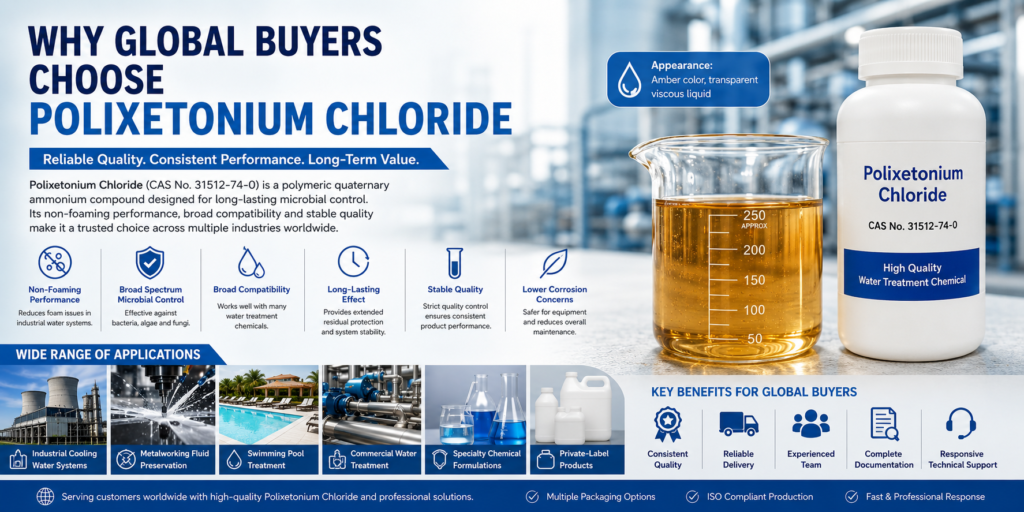
Polixetonium Chloride (CAS No. 31512-74-0) is a polymeric quaternary ammonium compound designed for long-lasting microbial control.
Unlike many conventional biocides that work through rapid oxidation, Polixetonium Chloride controls microorganisms through its cationic polymer structure. The positively charged polymer adsorbs onto negatively charged microbial cell surfaces, disrupting cell membrane integrity and ultimately inhibiting growth.
This different mode of action provides several practical advantages:
- Non-foaming during normal operation
- Effective across a broad pH range
- Good compatibility with many water treatment programs
- Long-lasting residual activity
- Lower corrosion concerns than many oxidizing biocides
For buyers looking for consistent results rather than aggressive short-term treatment, these characteristics are especially valuable.
Reliable Performance Across Multiple Industries
One reason global demand continues to grow is versatility.
Instead of serving only one market, Polixetonium Chloride supports several industries using the same proven chemistry.
Common applications include:
- Industrial cooling water systems
- Metalworking fluid preservation
- Swimming pool algaecide formulations
- Commercial water treatment products
- Specialty chemical formulations
- Private-label water treatment products
For distributors, this means one product can support multiple customer segments without maintaining excessive inventory.
That’s a practical advantage many purchasing teams appreciate.
Non-Foaming Performance That Buyers Appreciate
Foaming isn’t just annoying.
In many industrial systems, excessive foam can reduce circulation efficiency, interfere with filtration, affect pumps, and complicate routine operation.
Polixetonium Chloride is well known for its non-foaming performance under recommended operating conditions.
This characteristic makes it especially suitable for:
- Cooling towers
- Closed-loop water systems
- Industrial circulation equipment
- Metalworking fluid systems
- Swimming pool treatment products
For manufacturers producing premium algaecides, non-foaming performance is often one of the first selling points customers notice.
Broad Compatibility with Water Treatment Programs
Very few water treatment chemicals work alone.
Most industrial systems already contain corrosion inhibitors, scale inhibitors, dispersants, or oxidizing disinfectants.
A microbial control product needs to fit into that existing treatment program without creating unnecessary complications.
Polixetonium Chloride generally offers good compatibility with many commonly used treatment chemicals.
However, one important consideration remains.
Because it is a strongly cationic polymer, direct mixing with strong anionic chemicals should be avoided unless compatibility has been verified through laboratory or field testing.
Understanding this simple principle helps buyers avoid unnecessary formulation problems later.
Stable Quality Makes Procurement Easier
Experienced buyers rarely judge a supplier by a single shipment.
They evaluate consistency.
Important quality indicators typically include:
- Stable active content
- Consistent viscosity
- Uniform appearance
- Reliable density
- Controlled pH
- Batch-to-batch reproducibility
For polymeric products like Polixetonium Chloride, viscosity is more than a routine specification.
It often reflects the molecular weight range of the polymer, which can influence application performance and formulation consistency.
Reliable manufacturing control helps ensure customers receive predictable product quality over long-term supply.
Flexible Packaging for International Supply
Different customers require different packaging.
Some need laboratory samples.
Others purchase full container loads every month.
Reliable suppliers usually provide multiple packaging options such as:
- 1 L plastic bottles
- 5 L plastic jerrycans
- 25 L stackable plastic jerrycans
- 200 L plastic drums
- 1000 L IBC totes
This flexibility simplifies purchasing for distributors, contract manufacturers, and industrial end users alike.
Proper export packaging also reduces transportation risks during international shipping.
Technical Support Beyond the Product
Buying chemicals isn’t simply buying liquids in containers.
Buyers often need answers about:
- Product selection
- Compatibility
- Storage recommendations
- Application guidance
- Documentation
- Regulatory information
- Technical data interpretation
A knowledgeable supplier can shorten qualification time and reduce unnecessary trial-and-error.
Many experienced buyers value responsive technical support just as much as competitive pricing.
After all, solving a problem quickly often saves far more than a small difference in product cost.
If you’re comparing suppliers or evaluating specifications, you may also find our How to Evaluate Polixetonium Chloride Performance guide helpful before making a purchasing decision.
What Buyers Should Check Before Purchasing
Choosing a supplier shouldn’t be based only on the lowest quotation.
Before placing an order, consider asking:
- Is the active content reported clearly?
- Are routine quality tests performed on every batch?
- Is third-party testing available if required?
- Are COA, SDS, and technical documentation complete?
- Can the supplier provide consistent long-term production?
- Is technical support available after delivery?
- Does the supplier have experience serving international customers?
These questions help reduce purchasing risk before the first shipment ever leaves the factory.
Why Long-Term Partnerships Matter More Than Low Prices
Many companies discover an interesting pattern after several purchasing cycles.
The supplier with the lowest initial quotation isn’t always the most economical choice.
Shipment delays, inconsistent quality, poor communication, or unstable production can quickly outweigh small price differences.
Long-term suppliers create value by offering:
- Consistent product quality
- Reliable delivery schedules
- Faster technical responses
- Stable manufacturing
- Better production planning
- Lower overall procurement risk
That’s why many experienced importers evaluate total supply reliability instead of focusing only on unit price.
Final Thoughts
Global buyers choose Polixetonium Chloride for more than one reason.
Its non-foaming performance, broad application range, compatibility with many water treatment programs, and reliable microbial control make it a trusted option across multiple industries.
Equally important is choosing a supplier capable of delivering consistent quality, dependable documentation, flexible packaging, and responsive technical support.
When those elements come together, procurement becomes simpler, product performance becomes more predictable, and long-term business relationships become much easier to build.
New to this product? Start with our Everything You Need to Know About Polixetonium Chloride guide, then explore our Application Guide for Polixetonium Chloride for practical recommendations and selection tips.
Frequently Asked Questions
1. What industries commonly use Polixetonium Chloride?
It is widely used in industrial water treatment, cooling water systems, metalworking fluid preservation, swimming pool algaecide formulations, and specialty chemical manufacturing.
2. Why is Polixetonium Chloride preferred over many conventional biocides?
Its polymeric structure provides long-lasting microbial control while offering non-foaming performance, broad pH compatibility, and lower corrosion concerns than many oxidizing biocides.
3. Can Polixetonium Chloride be mixed with all chemicals?
Not always. Because it is a strongly cationic polymer, compatibility testing is recommended before combining it with strong anionic chemicals.
4. What quality indicators should buyers evaluate?
Key specifications include active content, viscosity, density, pH, appearance, and batch-to-batch consistency, along with complete technical documentation.
5. Why do experienced buyers often stay with the same supplier?
Reliable quality, consistent deliveries, responsive technical support, and stable long-term production usually create greater value than switching suppliers based only on a slightly lower price.