
GET IN TOUCH
Ask For Sample?
What Makes Non-Oxidizing Biocides Suitable for Sensitive Systems?
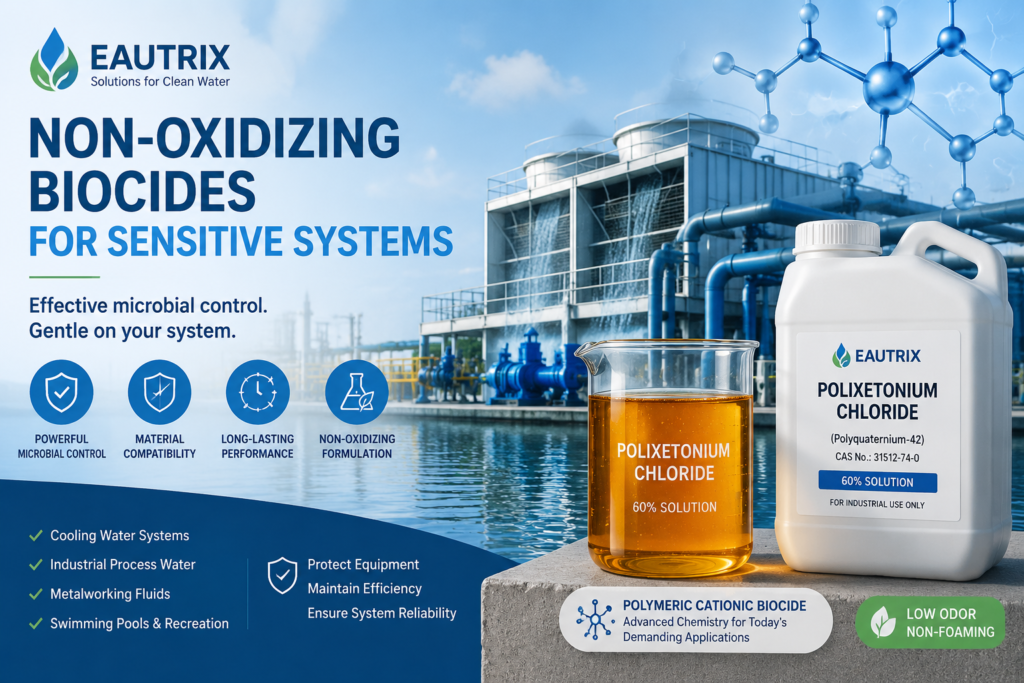
When people talk about microbial control in water treatment, the first thought is often simple: “Use something strong enough to kill microorganisms.”
Sounds reasonable, right?
But sensitive systems tell a different story.
In many industrial applications, the strongest chemical is not always the best choice. A water system may contain delicate materials, expensive equipment, strict quality requirements, or microorganisms that need controlled management rather than aggressive chemical attack.
This is where non-oxidizing biocides become increasingly important.
Unlike oxidizing biocides that control microorganisms through oxidation reactions, non-oxidizing biocides work through different mechanisms, such as disrupting cell membranes, interfering with microbial metabolism, or preventing microbial growth.
The result?
A more controlled approach to microbial management — one that can provide effective protection while reducing unwanted side effects.
For cooling water systems, metalworking fluids, industrial process water, and other sensitive applications, this balance matters. After all, nobody wants to solve a microbial problem by creating corrosion, material compatibility issues, or process instability.
So, what exactly makes non-oxidizing biocides suitable for sensitive systems?
Let’s take a closer look.
1. What Are Non-Oxidizing Biocides?
Before discussing why these biocides work well in sensitive environments, it helps to understand what they actually are.
A non-oxidizing biocide is a chemical agent that controls bacteria, algae, fungi, or other microorganisms without relying on oxidation reactions.
Instead of “burning away” microbial cells through oxidation, these compounds usually target specific biological structures or processes.
Common examples include:
- Quaternary ammonium compounds (quats)
- Polymeric quaternary ammonium compounds
- Isothiazolinones
- Glutaraldehyde
- DBNPA
- Bronopol
Among these, polymeric cationic biocides have attracted growing attention because of their unique molecular structure.
A traditional small-molecule quat may quickly interact with microorganisms and then become depleted. A polymeric quat, however, contains repeated charged units along a larger molecular chain. This structure can influence how the molecule interacts with surfaces, microorganisms, and the surrounding water environment.
Think about the difference between a single worker fixing a problem and a coordinated team working together.
One person can complete a task, but a well-organized team may provide longer-lasting support.
That is the basic idea behind polymeric biocides.
For example, Polixetonium Chloride (Polyquaternium-42, CAS No. 31512-74-0) is a cationic polymer widely studied for microbial control applications, especially where persistent performance and compatibility are important.
You can learn more about its chemical identity and naming system in our guide:
Polyquaternium-42 CAS Number, Chemical Name, and Synonyms Explained
2. Why Sensitive Systems Need More Than Strong Microbial Control
A common misunderstanding in water treatment is that stronger chemicals always deliver better results.
But sensitive systems are different.
Imagine maintaining a high-performance sports car. You would not simply pour in the strongest chemical cleaner available and hope for the best. The cleaner might remove dirt, but it could also damage sensitive components.
Water systems can behave in a similar way.
Many industrial environments include materials that require careful chemical selection:
- Stainless steel equipment
- Aluminum components
- Copper alloys
- Membrane systems
- Heat exchangers
- Precision manufacturing equipment
A microbial control program must consider more than just killing microorganisms.
It must also consider:
- Corrosion potential
- Material compatibility
- Residual chemical effects
- Process stability
- Environmental requirements
This is why non-oxidizing biocides are often preferred in sensitive applications.
They offer another route to microbial control.
Instead of creating a highly reactive chemical environment, they provide targeted activity against microorganisms while maintaining a more stable operating condition.
3. The Difference Between Oxidizing and Non-Oxidizing Biocides
The easiest way to understand the difference is to look at their working mechanisms.
Oxidizing Biocides
Oxidizing biocides, such as chlorine and bromine-based products, control microorganisms by creating oxidative stress.
They attack important biological components, including:
- Cell membranes
- Proteins
- Enzymes
- Cellular structures
Their advantages are clear:
- Fast microbial kill
- Broad-spectrum activity
- Cost-effective treatment
However, oxidation is not selective.
The same chemical reaction that affects microorganisms can also influence system materials.
Potential concerns may include:
- Corrosion acceleration
- Short contact time
- Reduced effectiveness with high organic loads
- Material compatibility challenges
Non-Oxidizing Biocides
Non-oxidizing biocides work through different pathways.
Depending on the chemistry, they may:
- Disrupt microbial cell membranes
- Interfere with enzyme systems
- Prevent reproduction
- Control biofilm formation
Their advantages include:
- Longer-lasting activity in some applications
- Better compatibility with certain materials
- Lower oxidation-related corrosion risk
- Suitability for specialized systems
Of course, no biocide is perfect.
The correct choice depends on the water chemistry, microorganisms present, operating conditions, and treatment goals.
The question is not:
“Which biocide is strongest?”
The better question is:
“Which biocide provides the right balance between microbial control and system protection?”
That is where non-oxidizing chemistry often shines.
4. Key Reasons Non-Oxidizing Biocides Work Well in Sensitive Applications
4.1 Reduced Oxidation Stress on Equipment
One major advantage of non-oxidizing biocides is that they avoid strong oxidation reactions.
For sensitive equipment, this can be extremely valuable.
Industrial systems often operate continuously for months or years. Even small chemical stresses can accumulate over time.
A cooling tower, for example, does not experience only one chemical treatment event. It experiences hundreds or thousands of treatment cycles.
A small difference in chemical aggressiveness may create a significant long-term impact.
Non-oxidizing biocides help operators maintain microbial control without adding unnecessary oxidative pressure.
4.2 Better Compatibility With Delicate Materials
Different industries use different construction materials.
A chemical that works perfectly in one system may not be suitable for another.
For example:
- Metalworking fluids may contain sensitive additives.
- Heat exchangers may use corrosion-sensitive alloys.
- Process water systems may require strict contamination control.
Non-oxidizing biocides are often selected because they can fit into these more demanding environments.
The goal is not simply killing microbes.
The goal is protecting the entire system.
4.3 Longer Residual Activity
Some non-oxidizing biocides can provide extended microbial control because they remain active in the system for longer periods.
This is particularly useful where continuous dosing is difficult or where microbial growth develops slowly.
Polymeric cationic biocides are interesting in this area because their larger molecular structures may influence adsorption behavior and interaction with microbial surfaces.
For systems dealing with recurring algae or biofilm challenges, this characteristic can be especially valuable.
A practical example is Polixetonium Chloride, which is commonly supplied as a 60% active solution and used in applications requiring persistent algae control.
More details about its long-lasting performance can be found here:
Why Does Polixetonium Chloride Provide Long-Lasting Algae Control?
5. How Cationic Polymer Biocides Protect Delicate Water Systems
Among non-oxidizing biocides, cationic polymer biocides represent an interesting category because their molecular structure gives them different behavior compared with traditional small-molecule antimicrobials.
The key feature is the presence of positively charged groups along the polymer chain.
Microbial cell surfaces are generally negatively charged. When a cationic polymer comes into contact with microorganisms, electrostatic attraction can occur.
It is a little like a magnet effect.
The positively charged polymer is attracted to the negatively charged microbial surface, allowing interaction with the cell membrane.
This interaction may lead to:
- Disruption of membrane integrity
- Leakage of cellular components
- Loss of normal cell function
- Reduced microbial growth
But the story does not stop there.
The polymer structure can also influence how the chemical behaves in water systems.
A larger polymer molecule may interact differently with surfaces, dissolved materials, and microbial communities compared with a small molecule.
This is one reason polymeric biocides have become attractive for applications where stable performance is important.
Of course, performance depends on many factors, including:
- Polymer structure
- Molecular weight
- Active concentration
- Water chemistry
- Microbial population
- Contact time
There is no “magic chemical” that works everywhere.
Good water treatment is always about matching the chemistry with the system.
6. Applications Where Non-Oxidizing Biocides Are Preferred
Non-oxidizing biocides are widely used across industries where chemical control must be balanced with equipment protection and process stability.
Let’s look at several important examples.
6.1 Cooling Water Systems
Cooling water systems are one of the most common applications for non-oxidizing biocides.
Cooling towers, heat exchangers, and recirculating water loops provide ideal conditions for microbial growth:
- Warm temperatures
- Continuous water circulation
- Exposure to air
- Nutrient availability
If microorganisms are not controlled, problems may appear quickly:
- Slime formation
- Biofilm development
- Heat transfer reduction
- Increased maintenance frequency
Oxidizing biocides are widely used, but some systems require a gentler approach.
For example, systems with corrosion-sensitive components or strict operational requirements may benefit from non-oxidizing alternatives.
Cationic polymer biocides, including Polixetonium Chloride, are often considered for algae and microbial control where long-lasting activity and compatibility are priorities.
6.2 Metalworking Fluids
Metalworking fluids are another sensitive environment.
These fluids contain carefully balanced formulations with:
- Lubricants
- Surfactants
- Emulsifiers
- Corrosion inhibitors
- Performance additives
Microbial contamination can cause:
- Bad odors
- Fluid degradation
- Reduced machining performance
- Increased maintenance costs
However, aggressive chemical treatment may damage the formulation balance.
That is why non-oxidizing biocides are frequently considered in metalworking applications.
They can help control microbial growth while maintaining the physical and chemical characteristics of the fluid.
6.3 Industrial Process Water
Many manufacturing processes require stable water quality.
Examples include:
- Paper production
- Textile processing
- Chemical manufacturing
- General industrial water systems
In these industries, microbial control is not only about killing microorganisms.
It is also about maintaining reliable production.
A sudden chemical imbalance can create unexpected problems.
A suitable non-oxidizing biocide program can help maintain stable operation without unnecessary chemical disturbance.
6.4 Swimming Pools and Recreational Water
Swimming pools may seem simple compared with industrial systems, but they are also sensitive environments.
Pool operators need effective algae control while maintaining:
- Water clarity
- Swimmer comfort
- Chlorine compatibility
- Equipment protection
Polymeric algaecides are commonly used because they can provide algae control without creating excessive foam or introducing metal-based staining concerns.
This is especially important for premium residential pools, commercial pools, and facilities where water appearance matters.
7. Why Polixetonium Chloride Is a Suitable Choice for Sensitive Systems
Among polymeric non-oxidizing biocides, Polixetonium Chloride has gained attention because of its combination of microbial control performance and application flexibility.
Also known as Polyquaternium-42, Polixetonium Chloride is a cationic polymer with CAS No. 31512-74-0.
It is typically supplied as a concentrated liquid solution, commonly around 60% active content.
Its main characteristics include:
- Non-oxidizing chemistry
- Low odor
- Non-foaming behavior
- Broad pH tolerance
- Compatibility with many water treatment programs
For sensitive systems, several features are especially valuable.
7.1 Non-Oxidizing Mechanism
Because Polixetonium Chloride does not rely on oxidation, it avoids many issues associated with strong oxidizers.
This makes it suitable for applications where corrosion control and material compatibility are important considerations.
7.2 Polymeric Structure
The polymeric structure gives Polixetonium Chloride different behavior compared with traditional quaternary ammonium compounds.
The long molecular chain allows multiple charged sites along the structure.
This contributes to its interaction with microorganisms and helps explain why polymeric quats are often selected for longer-lasting microbial management.
7.3 Suitable for Algae Control
Algae can be particularly difficult in open water systems.
Cooling towers, decorative water features, and swimming pools may experience repeated algae growth due to sunlight and nutrient exposure.
Polixetonium Chloride is widely recognized as a polymeric algaecide option for these situations.
For a complete introduction to this material, see:
What Is Polixetonium Chloride? A Complete Beginner’s Guide
8. How to Select the Right Non-Oxidizing Biocide?
Choosing a biocide is not simply about comparing active ingredients.
A successful treatment program requires understanding the complete operating environment.
Here are several important factors.
8.1 Identify the Main Microbial Challenge
Different systems may face different problems:
- Algae
- Bacteria
- Fungi
- Biofilm formation
The right biocide depends on the target organisms.
A product that works well for algae control may not always be the ideal choice for every bacterial challenge.
8.2 Understand System Conditions
Important factors include:
- Temperature
- pH
- Water hardness
- Organic contamination
- Flow conditions
- Material composition
A good supplier should understand these details before recommending a product.
8.3 Evaluate Compatibility
Sensitive systems require careful compatibility evaluation.
Consider:
- Existing treatment chemicals
- Equipment materials
- Process requirements
- Regulatory expectations
Laboratory testing and small-scale trials are often valuable before full implementation.
8.4 Consider Concentration and Handling
The active concentration of a biocide affects:
- Transportation
- Storage
- Dosage calculation
- Cost efficiency
For example, concentrated polymeric solutions can reduce storage volume compared with diluted products.
However, proper handling procedures remain essential.
9. Future Trends in Gentle but Effective Microbial Control
Industrial users are becoming more focused on balanced chemical solutions.
The future of microbial control is unlikely to be about simply finding stronger chemicals.
Instead, the industry is moving toward smarter approaches:
- More selective microbial control
- Lower environmental impact
- Better material compatibility
- Improved dosing accuracy
- Combination treatment strategies
Polymeric biocides are part of this trend.
Their ability to provide effective microbial management while supporting system stability makes them attractive for many specialized applications.
As industrial equipment becomes more advanced and process requirements become stricter, sensitive systems will need chemical solutions that are both effective and carefully controlled.
10. Conclusion
Sensitive water systems require a different way of thinking.
The question is not:
“Which chemical kills microorganisms the fastest?”
The better question is:
“Which chemical controls microorganisms while protecting the entire system?”
Non-oxidizing biocides provide an important answer.
Their controlled mechanisms, compatibility advantages, and flexible applications make them suitable for many demanding environments, from cooling water systems to metalworking fluids and recreational water treatment.
Among these solutions, cationic polymer biocides such as Polixetonium Chloride demonstrate how modern microbial control can balance performance with system protection.
Because sometimes the smartest solution is not the strongest one.
It is the one that works quietly, consistently, and safely over time.
Frequently Asked Questions (FAQ)
1. What is a non-oxidizing biocide?
A non-oxidizing biocide is a chemical agent that controls microorganisms without using oxidation reactions. It works through mechanisms such as membrane disruption, metabolic interference, or microbial growth inhibition.
2. Why are non-oxidizing biocides preferred for sensitive water systems?
Non-oxidizing biocides are often preferred because they can provide microbial control while reducing oxidation-related corrosion risks and improving compatibility with sensitive materials.
3. Are polymeric biocides less corrosive than oxidizing biocides?
In many applications, polymeric biocides may create fewer oxidation-related corrosion concerns because they do not rely on strong oxidative reactions. However, corrosion performance depends on the entire treatment program and operating conditions.
4. Can Polixetonium Chloride be used in cooling water systems?
Yes. Polixetonium Chloride (Polyquaternium-42, CAS No. 31512-74-0) is used in industrial microbial control applications, including cooling water systems where algae and microbial management are required.
5. How do I choose the right non-oxidizing biocide for my application?
The selection should consider microbial targets, water chemistry, operating conditions, equipment materials, regulatory requirements, and compatibility with existing treatment chemicals.