
GET IN TOUCH
Ask For Sample?
How Microbial Contamination Impacts Industrial Equipment Performance?
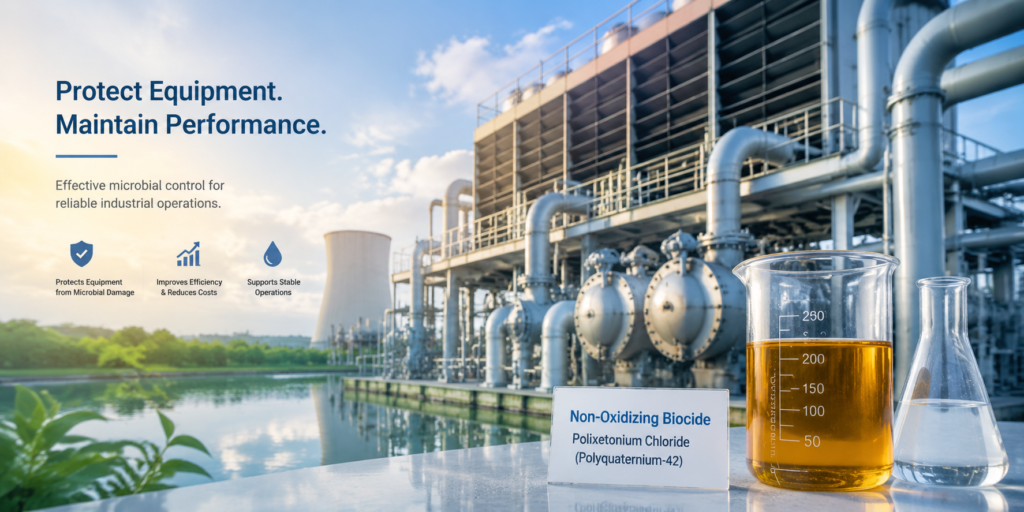
Have you ever wondered why industrial equipment slowly loses efficiency even when maintenance schedules are followed carefully?
A cooling tower starts consuming more energy. A heat exchanger transfers less heat than before. A metalworking fluid develops an unpleasant odor after only a few weeks. Pumps become noisy, filters clog faster, and unexpected downtime appears.
At first glance, these problems may seem unrelated.
But there is often a hidden connection behind them — microbial contamination.
Microorganisms are tiny, but their impact on industrial systems can be surprisingly large. Bacteria, algae, fungi, and other microorganisms can attach themselves to equipment surfaces, create protective biofilms, accelerate corrosion, and interfere with normal operations.
The interesting thing is that microbial contamination rarely causes immediate failure. Instead, it slowly changes the operating environment inside equipment. Day after day, the damage builds quietly until performance drops, maintenance costs increase, and production efficiency suffers.
So, how exactly do microorganisms affect industrial equipment? And why is microbial control such an important part of modern industrial water management?
Let’s take a closer look.
What Is Microbial Contamination in Industrial Systems?
Microbial contamination refers to the unwanted presence and growth of microorganisms in industrial environments.
These microorganisms may include:
- Bacteria
- Algae
- Fungi
- Yeasts
- Protozoa
In industrial systems, microorganisms can enter through several pathways:
- Raw water sources
- Airborne particles
- Process chemicals
- Human contact
- Inadequate cleaning procedures
Once inside a suitable environment, microorganisms can multiply rapidly.
And what makes industrial systems especially attractive to microbes?
The answer is simple: water, nutrients, and surfaces.
Many industrial processes provide exactly what microorganisms need:
- Warm temperatures
- Continuous water circulation
- Organic contaminants
- Metal surfaces for attachment
A cooling tower, for example, creates an ideal environment for microbial growth. It contains water, oxygen, sunlight exposure, and nutrients collected from the surrounding environment.
A metalworking fluid system can face similar challenges. Oils, additives, and organic residues may become food sources for bacteria and fungi if microbial control is insufficient.
You might think, “But the concentration of microorganisms is tiny. How much damage can they really cause?”
That is where the problem begins.
Microorganisms do not need to be visible to create serious operational issues.
Why Microorganisms Become a Hidden Threat Inside Equipment
One of the biggest challenges with microbial contamination is that it often develops silently.
Unlike mechanical failures, microbial problems usually do not create obvious warning signs at the beginning.
There is no dramatic noise. No sudden breakdown. No immediate alarm.
Instead, microorganisms gradually change the internal conditions of equipment.
For example:
A small number of bacteria attach to a heat exchanger surface.
↓
They produce extracellular polymeric substances (EPS), creating a sticky protective layer.
↓
More microorganisms attach and form a mature biofilm.
↓
The surface becomes covered with biological deposits.
↓
Heat transfer efficiency decreases, pressure drop increases, and cleaning frequency rises.
This process can continue unnoticed for weeks or months.
The problem becomes even more serious because microorganisms inside biofilms are much harder to remove compared with free-floating cells.
Biofilms act like a protective shield.
They help microorganisms survive:
- Water flow
- Temperature changes
- Cleaning chemicals
- Some biocides
This is why simply flushing a system with water often does not solve microbial contamination.
The visible problem may disappear temporarily, but the microbial community can quickly recover.
How Microbial Growth Reduces Equipment Performance
Industrial equipment performance depends on stable operating conditions.
When microorganisms interfere with those conditions, several problems can occur.
1. Reduced Heat Transfer Efficiency
Heat exchangers, cooling towers, and chillers rely on clean surfaces for effective heat exchange.
Even a thin layer of microbial deposits can act like insulation.
Think about wearing a thick jacket on a hot day. The jacket blocks heat movement.
A microbial layer does something similar inside industrial equipment.
When biofilm and biological deposits accumulate:
- Heat transfer decreases
- Energy consumption increases
- Cooling efficiency drops
- Operating temperatures may rise
For facilities running continuously, even a small efficiency loss can create significant operating costs.
This is especially important in industries such as:
- Power generation
- Chemical processing
- Food manufacturing
- Data center cooling
- Automotive production
A system that works harder to achieve the same result is not only inefficient — it also experiences additional stress.
2. Increased Fouling and Blockages
Microbial contamination often contributes to fouling problems.
Fouling occurs when unwanted materials accumulate on equipment surfaces.
These materials may include:
- Microbial cells
- Biofilm layers
- Organic deposits
- Suspended solids trapped by biological slime
As deposits build up, they can restrict flow paths.
Common consequences include:
- Reduced water circulation
- Increased pressure drop
- Blocked filters
- Lower pump efficiency
In cooling water systems, microbial slime can become particularly troublesome because it combines with minerals and suspended particles.
The result?
A sticky, stubborn deposit that is much harder to remove than ordinary dirt.
Biofilm Formation: The Invisible Layer That Causes Major Problems
If microbial contamination had a “secret weapon,” biofilm would probably be it.
A biofilm is a community of microorganisms attached to a surface and surrounded by a self-produced protective matrix.
This matrix contains substances such as:
- Polysaccharides
- Proteins
- Extracellular DNA
Together, these materials create a protective environment where microorganisms can survive.
You can imagine biofilm as a tiny underwater city.
The microorganisms are not simply floating around randomly. They build a structured community where they communicate, exchange nutrients, and protect each other.
Pretty clever for something invisible, right?
But from an industrial perspective, this clever behavior creates serious problems.
Biofilms can:
- Reduce heat transfer
- Increase corrosion risk
- Consume chemical treatments
- Create unpleasant odors
- Increase maintenance requirements
More importantly, once a mature biofilm forms, removing it becomes much more difficult.
This is why preventing microbial attachment is often more effective than trying to remove heavy contamination later.
Corrosion and Material Damage Caused by Microbial Activity
When people think about industrial corrosion, they usually imagine chemical reactions caused by oxygen, acids, or salts.
However, microorganisms can also play an important role in corrosion processes.
This type of damage is known as microbiologically influenced corrosion (MIC).
MIC occurs when microorganisms create conditions that accelerate metal deterioration.
Certain bacteria can produce corrosive by-products, change local chemical environments, or create concentration differences on metal surfaces.
The result?
Small corrosion points gradually develop into larger damage areas.
Common microorganisms associated with MIC include:
- Sulfate-reducing bacteria (SRB)
- Acid-producing bacteria
- Iron-oxidizing bacteria
These microorganisms may contribute to:
- Pitting corrosion
- Surface degradation
- Metal weakening
- Leakage risks
For industrial equipment, corrosion is more than a surface problem.
A corroded pipe, heat exchanger, or storage tank can lead to:
- Unexpected shutdowns
- Expensive repairs
- Product contamination
- Reduced equipment lifespan
This is why microbial control is not only about keeping water clean. It is also about protecting valuable industrial assets.
The Impact of Microbial Contamination on Cooling Water Systems
Cooling water systems are among the most vulnerable industrial environments for microbial growth.
Why?
Because they provide almost everything microorganisms need:
- Continuous water circulation
- Moderate temperatures
- Nutrients from the environment
- Large surface areas for attachment
Cooling towers are especially challenging because they are open systems.
Dust, airborne microorganisms, and organic materials can continuously enter the water.
Over time, microbial populations can increase if proper control measures are not maintained.
Common problems caused by microbial contamination in cooling systems include:
Biofilm accumulation
Microbial slime can attach to:
- Cooling tower fill materials
- Heat exchanger surfaces
- Pipes
- Pumps
This reduces system efficiency and increases cleaning requirements.
Algae growth
When sunlight reaches cooling tower basins or open water areas, algae may grow rapidly.
Algae can:
- Block water channels
- Increase suspended solids
- Provide nutrients for other microorganisms
Increased chemical consumption
A contaminated system often requires more treatment chemicals because microorganisms consume and reduce treatment effectiveness.
This creates a frustrating cycle:
More contamination → More chemicals required → Higher operating costs.
That is why many industrial operators focus on preventive microbial management instead of waiting until problems become visible.
How Microbial Problems Affect Metalworking Fluids and Industrial Processes
Cooling water is not the only industrial application affected by microbial contamination.
Metalworking fluids (MWFs) are another common area where microorganisms create challenges.
These fluids contain water, oils, emulsifiers, and organic additives.
Unfortunately, many of these components can also support microbial growth.
When bacteria and fungi multiply inside metalworking fluids, several problems may appear:
Unpleasant odors
A common sign of microbial contamination is a “rotten egg” smell caused by microbial metabolism.
Reduced fluid performance
Microbial activity can break down important additives, affecting:
- Lubrication performance
- Cooling ability
- Corrosion protection
Shorter fluid life
Instead of lasting months, contaminated fluids may require early replacement.
Worker concerns
Poorly controlled microbial growth may affect workplace conditions and create hygiene concerns.
For manufacturers using large quantities of metalworking fluids, replacing contaminated fluid frequently can become a significant operating expense.
Proper microbial control helps extend fluid service life and maintain stable production conditions.
Why Traditional Cleaning Alone Cannot Solve Microbial Issues
A common reaction to microbial contamination is:
“Why not simply clean the equipment more often?”
Regular cleaning is important, but cleaning alone may not solve the root problem.
The reason is biofilm.
A simple cleaning process may remove loose deposits, but microorganisms protected inside biofilms can survive.
After cleaning stops, surviving microorganisms may quickly rebuild the microbial population.
It is similar to cutting weeds without removing the roots.
The surface looks better temporarily, but the problem returns.
A complete microbial control program usually requires several approaches:
- Regular monitoring
- Proper system maintenance
- Water quality management
- Suitable antimicrobial treatments
For industrial water systems, chemical control is often an important part of this strategy.
Using Proper Microbial Control Strategies for Long-Term Equipment Protection
The goal of microbial control is not to completely eliminate every microorganism.
That is usually unrealistic in industrial environments.
Instead, the goal is to maintain microbial populations at acceptable levels and prevent harmful growth.
A good microbial control program usually considers:
1. Regular monitoring
Operators should track:
- Microbial counts
- Water quality parameters
- Deposit formation
- Equipment performance changes
Early detection makes problems much easier to manage.
2. Selecting suitable biocides
Different systems require different antimicrobial solutions.
Oxidizing biocides, such as chlorine-based treatments, are widely used because of their strong killing ability.
However, some applications require alternatives.
Non-oxidizing biocides are often considered when operators need:
- Longer-lasting microbial control
- Better material compatibility
- Lower corrosion concerns
- Stable performance under specific conditions
For example, cationic polymer-based biocides such as Polixetonium Chloride (Polyquaternium-42) are used in certain industrial and pool applications because of their persistent antimicrobial properties and compatibility advantages.
(Internal link suggestion: What Is Polixetonium Chloride? A Complete Beginner’s Guide)
Understanding the differences between microbial control products helps users select the right chemistry for their systems.
3. Preventing biofilm development
Since mature biofilms are difficult to remove, prevention is always valuable.
Effective strategies include:
- Maintaining proper chemical dosage
- Avoiding stagnant water areas
- Controlling nutrient sources
- Performing routine inspections
A clean system today is usually easier and cheaper to maintain than a heavily contaminated system tomorrow.
Microbial Control Is an Investment in Equipment Reliability
Industrial equipment represents a major investment.
Whether it is a cooling tower, heat exchanger, manufacturing line, or fluid management system, every hour of downtime has a cost.
Microbial contamination may seem like a small biological issue, but its impact reaches much further:
- Lower efficiency
- Higher maintenance costs
- Reduced equipment lifespan
- Increased operational risks
The challenge is that microbial problems often develop quietly.
They do not always announce themselves.
By the time visible slime, corrosion, or performance loss appears, microorganisms may already have been affecting the system for a long time.
That is why effective microbial management should be viewed as part of equipment protection — not simply chemical treatment.
After all, preventing a problem is usually much easier than repairing the damage it creates.
Frequently Asked Questions
1. How does microbial contamination affect industrial equipment performance?
Microbial contamination can reduce equipment performance by creating biofilms, increasing fouling, blocking flow paths, reducing heat transfer efficiency, and accelerating corrosion. These effects can increase energy consumption and maintenance costs.
2. What industries are most affected by microbial contamination?
Industries with water-based processes are especially vulnerable, including power plants, chemical manufacturing, cooling water operations, metalworking, oil and gas, and industrial wastewater treatment.
3. Why are biofilms difficult to remove from industrial systems?
Biofilms contain a protective matrix produced by microorganisms. This structure helps microbial communities survive chemical treatments, water flow, and environmental changes, making complete removal more challenging.
4. Are non-oxidizing biocides effective for industrial microbial control?
Yes. Non-oxidizing biocides can provide effective microbial control in many industrial applications, especially when longer-lasting activity, material compatibility, or reduced corrosion concerns are important.
5. How can companies prevent microbial contamination in cooling water systems?
Companies can reduce microbial contamination through regular monitoring, proper water treatment programs, equipment maintenance, and selecting suitable biocides based on system requirements.