
GET IN TOUCH
Ask For Sample?
The Difference Between Preventive and Reactive Algae Treatment
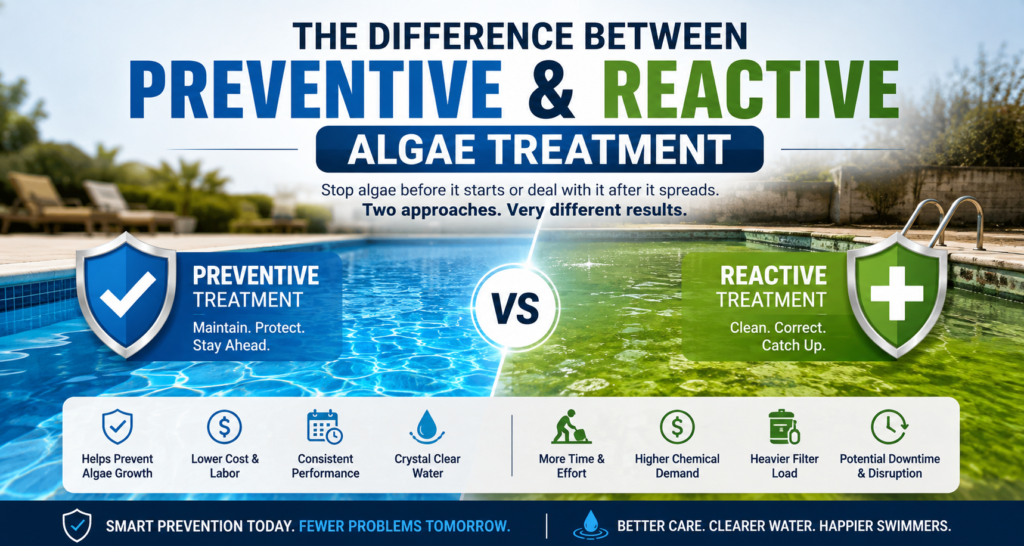
A swimming pool can look perfect on Monday and turn cloudy, dull, or even green by Friday. Sometimes the change seems to happen overnight.
It usually doesn’t.
Algae problems tend to build quietly. A few spores enter the water through wind, rain, swimmers, garden debris, or contaminated equipment. Under favorable conditions, they begin to grow. By the time the water changes color or the walls feel slippery, the problem may already be well established.
That simple fact explains why preventive algae treatment and reactive algae treatment are quite different approaches to pool care.
Preventive treatment aims to make algae growth less likely before visible trouble appears. Reactive treatment starts after algae has already gained a foothold and focuses on restoring the pool.
Both approaches have a place. But they involve different chemical demands, labor requirements, costs, and expectations.
Preventive Algae Treatment: Stopping Trouble Before You See It
Preventive algae treatment is exactly what it sounds like: maintaining conditions that make it difficult for algae to establish a meaningful population.
It isn’t simply a matter of pouring algaecide into otherwise neglected water.
A sound preventive program normally starts with the basics—proper sanitizer levels, balanced water chemistry, good circulation, effective filtration, routine brushing, and removal of organic debris.
An algaecide can then provide another layer of control.
Think of it like maintaining a clean kitchen. You don’t wait until mold appears on the walls before wiping surfaces and managing moisture. Pool maintenance works in much the same way. Small, regular actions help prevent a much larger cleanup later.
Preventive algae control becomes especially valuable when conditions are favorable for growth, such as:
- Hot weather and warm pool water
- Heavy swimmer loads
- Strong sunlight
- Rainstorms and wind-blown debris
- Reduced circulation in certain areas
- Seasonal pool opening or closing
- Temporary sanitizer fluctuations
- High organic contamination
The goal isn’t to replace chlorine or another primary sanitizer. Rather, preventive algae treatment supports the broader water-care program.
That’s an important distinction.
Reactive Algae Treatment Starts After the Problem Appears
Reactive treatment begins when algae is already visible or strongly suspected.
Perhaps the water has developed a green tint. Maybe steps and walls feel slippery. There may be patches in corners, around ladders, behind fittings, or in areas where circulation isn’t great.
Now the job has changed.
Instead of suppressing early algae development, the operator needs to deal with an existing population while also removing dead organisms and accumulated contamination from the water.
That commonly means more than adding one chemical.
Depending on the pool and the severity of the outbreak, corrective treatment may involve testing and adjusting water chemistry, brushing affected surfaces, cleaning the filter, improving circulation, applying an appropriate sanitizer treatment, vacuuming debris, and using a compatible algaecide where appropriate.
In other words, reactive treatment is usually a process, not a single dose.
And yes, it generally takes more effort.
So, What’s the Real Difference?
The easiest distinction is timing.
Preventive treatment acts before visible algae becomes established.
Reactive treatment acts after algae growth has become a problem.
But timing affects almost everything else.
| Factor | Preventive Treatment | Reactive Treatment |
|---|---|---|
| Main goal | Reduce the chance of algae growth | Control an existing algae problem |
| Timing | Routine or risk-based | After algae appears |
| Chemical demand | Usually lower and more consistent | Often higher and more variable |
| Brushing and cleaning | Routine maintenance | More intensive |
| Filter workload | Normal | Often significantly increased |
| Downtime | Usually minimal | May disrupt pool operation |
| Labor | Predictable | Potentially substantial |
| Cost | Easier to budget | Can become expensive |
| Water appearance | Maintains clear water | Restores affected water |
This difference matters even more for commercial pools.
A homeowner may tolerate a green pool for a few days while correcting the problem. A hotel, resort, health club, water park, or community facility may not have that luxury.
Cloudy or green water isn’t merely unattractive. It can interfere with operations and damage guest confidence.
Prevention therefore becomes an operational strategy as much as a chemical one.
But Isn’t Chlorine Supposed to Prevent Algae?
Yes—but there’s a catch.
Maintaining an appropriate sanitizer residual is one of the most important parts of algae prevention. Yet real pools don’t operate under perfectly controlled laboratory conditions.
Chlorine demand changes.
Swimmers introduce sweat, oils, cosmetics, and other organic material. Sunlight can reduce available chlorine. Heavy rain can change water conditions. Leaves and environmental debris add contaminants. Poor circulation can create areas where chemical distribution is less effective.
Then there’s maintenance itself.
A pool may be perfectly managed most of the time but experience a short period of inadequate sanitizer concentration. Under warm, sunny conditions, that window may be enough to give algae an opportunity.
This is one reason professional maintenance programs often rely on several control measures rather than asking one chemical to do everything.
For a closer look at that relationship, see Why Chlorine Alone Cannot Always Prevent Algae.
Preventive Treatment Is About Maintaining a Margin of Safety
There’s a useful way to think about preventive algae treatment.
It’s a margin of safety.
You still maintain sanitizer. You still balance the water. You still run the circulation and filtration systems correctly.
But you recognize that real operating conditions fluctuate.
A suitable preventive algaecide can help reduce the opportunity for algae to become established during those fluctuations.
Polymeric quaternary ammonium compounds are one example used for this purpose. Certain formulations are valued because they can provide algae-control activity without some of the drawbacks associated with older treatment approaches.
Polyquat 60, for example, is commonly associated with non-foaming algae-control formulations.
That matters because foam isn’t exactly the visual effect a hotel pool manager wants to explain to guests.
For buyers evaluating this chemistry as an ingredient for pool-care formulations, Polyquat 60 Algaecide provides a useful starting point for understanding its role and product characteristics.
Reactive Treatment Has a Different Job
Once a pool is visibly green, preventive thinking is no longer enough.
Imagine weeds in a garden.
Keeping weeds from becoming established might require modest, regular maintenance. Leave the garden untouched for weeks, however, and pulling one weed won’t solve much. You now have to remove mature growth, deal with roots, clear dead material, and restore the area.
An established algae outbreak creates a similar maintenance problem.
Treatment must address both the organisms and the conditions that allowed them to flourish.
That means asking several questions:
Is the sanitizer level adequate?
Is the pH within the correct operating range?
Is filtration working properly?
Are there circulation dead spots?
Has the filter become loaded with contamination?
Is organic debris consuming sanitizer?
What type and severity of algae growth is present?
Skipping these questions and simply adding more algaecide can waste chemicals without solving the underlying problem.
Why Reactive Treatment Can Consume So Much More Labor
Chemical cost gets plenty of attention. Labor often doesn’t.
Yet labor can be one of the largest hidden costs of an algae outbreak.
Someone has to test the water. Someone has to brush the surfaces. Filters may need cleaning or backwashing. The pool may require repeated inspection and treatment. Settled material may need vacuuming.
For a residential pool, that’s annoying.
For a pool service company managing dozens or hundreds of accounts, it’s expensive.
Suppose a technician normally spends 20 or 30 minutes performing routine service at a property. A significant algae outbreak may require repeat visits and much more physical cleaning.
Suddenly, one troublesome pool disrupts the route schedule.
That’s why professional algae control isn’t simply about finding the strongest treatment available. Consistency matters enormously.
Preventing ten outbreaks can be far more valuable than rapidly correcting one.
Preventive Algaecides Don’t Replace Good Pool Chemistry
This point deserves repeating because it’s one of the most common misconceptions in pool maintenance.
An algaecide should not be used as an excuse for poor sanitation.
Preventive algae treatment works best as part of a broader maintenance system.
That system includes appropriate sanitizer residuals, pH control, circulation, filtration, brushing, debris removal, and routine water testing.
The algaecide provides additional support.
This also explains why dosage recommendations should be based on the actual formulated product rather than assumptions about the raw active ingredient.
Two products may use related chemistry while containing different active concentrations or supporting ingredients. Their directions can therefore differ considerably.
Always follow the label and applicable local requirements for the finished pool treatment product.
Where Does Polyquat 60 Fit?
Polyquat 60 is widely used as an ingredient in non-foaming pool algaecide formulations.
The term generally refers to a concentrated polymeric quaternary ammonium chemistry used for algae control. Unlike some traditional quaternary ammonium compounds, polymeric quat formulations are particularly attractive where minimizing foam is important.
That characteristic makes sense for swimming pools.
Foam can become especially noticeable around return jets, water features, spas, and areas with strong agitation. Even when it doesn’t indicate a serious water-quality problem, it can make the pool look poorly maintained.
Polymeric chemistry can therefore be useful when formulators want algae-control performance while avoiding excessive foaming.
You can read more about the mechanism in How Does Polyquat 60 Algaecide Work in Swimming Pools?.
Still, Polyquat 60 shouldn’t be viewed as a magic bottle that fixes every green pool.
Its value depends on how it is incorporated into the overall maintenance program.
Preventive Treatment Is Particularly Useful During High-Risk Periods
Not every week presents the same algae risk.
Anyone who maintains outdoor pools knows this instinctively.
A mild spring week with low swimmer traffic is very different from a scorching July weekend when the pool is packed from morning until evening.
Warm water generally creates more favorable biological conditions. Heavy bathing increases contamination. Strong sunlight influences sanitizer stability. Summer storms can suddenly introduce dirt, nutrients, and organic material.
Those are exactly the moments when a preventive program earns its keep.
The same logic applies before a pool will be unattended for a period or when seasonal operating conditions are changing.
Rather than treating every day as identical, professional operators can think in terms of risk periods.
Routine prevention remains the foundation, while monitoring and maintenance intensity can increase when algae pressure rises.
Reactive Treatment Should Also Ask: Why Did the Algae Appear?
Clearing the water is only half the job.
If nobody identifies the cause, the same problem may return.
This is where troubleshooting becomes important.
Recurring algae may point toward poor circulation, inadequate sanitizer maintenance, filtration problems, neglected surfaces, excessive organic load, or weaknesses in the maintenance schedule.
Certain locations deserve special attention.
Steps. Corners. Behind ladders. Around lights. Beneath removable fittings. Areas with weak circulation.
Algae doesn’t care whether the middle of the pool looks gorgeous. It needs one favorable little neighborhood.
Once growth becomes established there, the pool may face repeated problems until the underlying condition is corrected.
Prevention and Reaction Aren’t Really Opposites
Here’s the slight contradiction.
A good pool program needs both.
Preventive treatment should be the normal operating strategy. Reactive treatment should remain available for situations where conditions escape routine control.
The mistake is relying almost entirely on reaction.
If every algae problem requires aggressive corrective treatment, something upstream probably needs attention.
A more resilient program follows a simple cycle:
Maintain → Monitor → Prevent → Correct when necessary → Identify the cause → Return to prevention.
That last step matters.
After an algae outbreak has been controlled, operators shouldn’t simply congratulate themselves and move on. The maintenance program should be reviewed so that the same problem becomes less likely next time.
Commercial Pools Have More to Lose From Reactive-Only Treatment
Consider a resort pool.
Guests arrive expecting sparkling blue water. Nobody wants to hear that the pool should look better after another chemical treatment and several filtration cycles.
Or consider a pool service company.
Its reputation depends partly on something remarkably simple: customers expect clear water when they look into their backyard.
For these businesses, algae prevention affects more than chemistry.
It affects labor planning, customer satisfaction, chemical inventory, maintenance schedules, complaint rates, and potentially facility availability.
A predictable preventive program is easier to manage than repeated emergency treatments.
That’s not glamorous. It is, however, good operations.
Choosing Between Preventive and Reactive Algae Products
The intended use should guide product selection.
A preventive product may emphasize compatibility with routine maintenance, low foaming, ease of dosing, and performance at maintenance concentrations.
A product intended for corrective use may be evaluated differently because the pool is already experiencing active growth.
Formulators and professional buyers should therefore consider several factors rather than focusing only on active concentration:
- Algaecide chemistry
- Active ingredient concentration
- Foaming tendency
- Compatibility with the intended pool-care program
- Product stability
- Packaging requirements
- Intended treatment stage
- Label directions and regulatory requirements in the destination market
For private-label brands, distributors, and pool chemical companies, these considerations become especially important because the raw material must fit the intended finished formulation—not merely look attractive on a specification sheet.
The Better Question Isn’t “Which Treatment Is Stronger?”
It’s tempting to compare algae treatments purely by strength.
But that’s often the wrong question.
A better question is:
What job does this treatment need to perform?
If the pool is already heavily affected, the operator needs a corrective strategy.
If the pool is clean and the objective is keeping it that way, prevention becomes the priority.
These are different jobs.
A fire extinguisher is valuable when something is burning. A properly maintained electrical system is valuable because it helps prevent the fire in the first place. You wouldn’t judge the electrical system because it can’t extinguish flames.
Pool algae management follows similar logic.
Preventive and reactive treatments should be evaluated according to their roles within the maintenance program.
A Balanced Algae-Control Program Usually Wins
There is no realistic way to promise that a maintained outdoor pool will never encounter algae.
Weather changes. Equipment fails. Swimmer loads spike. Maintenance gets interrupted. Nature has a habit of ignoring schedules.
Still, the frequency and severity of algae problems can often be reduced through consistent water management.
That’s the practical advantage of preventive treatment.
It changes algae control from an emergency response into routine maintenance.
Reactive treatment remains essential when problems occur, but it shouldn’t become the default operating method.
For pool service companies, hotels, resorts, distributors, and private-label chemical brands, this distinction is worth understanding. It influences formulation decisions, chemical consumption, labor requirements, and ultimately the experience of the people using the pool.
Clear water rarely happens by accident.
More often, it’s the quiet result of problems that were handled before anyone could see them.
Frequently Asked Questions
1. What is the difference between preventive and reactive algae treatment?
Preventive algae treatment is used before visible algae becomes established and supports routine pool maintenance. Reactive treatment is used after algae has appeared and usually requires additional sanitation, brushing, filtration, and cleaning.
2. Can Polyquat 60 be used for preventive pool algae control?
Polyquat 60 chemistry is commonly used in non-foaming pool algaecide formulations, including products intended for routine algae control. The actual dosage and use instructions should always follow the label of the finished product and applicable regulations.
3. Do I still need chlorine when using a preventive algaecide?
Yes. An algaecide generally complements rather than replaces the pool’s primary sanitation program. Proper sanitizer residual, water balance, circulation, filtration, and physical cleaning remain fundamental to pool maintenance.
4. Why is preventive algae treatment better for commercial swimming pools?
Preventive algae control can reduce unexpected cleanup, extra technician visits, chemical demand, operational disruption, and the risk of visibly poor water conditions. This makes maintenance more predictable for hotels, resorts, public pools, and pool service companies.
5. What should I do if preventive algae treatment fails and the pool turns green?
First determine why algae became established. Check sanitizer levels, pH, filtration, circulation, organic contamination, and affected surfaces. An existing outbreak usually requires a broader corrective treatment process rather than simply increasing the preventive algaecide dose.