
GET IN TOUCH
Ask For Sample?
How Algae Impacts Pool Appearance and Customer Experience?
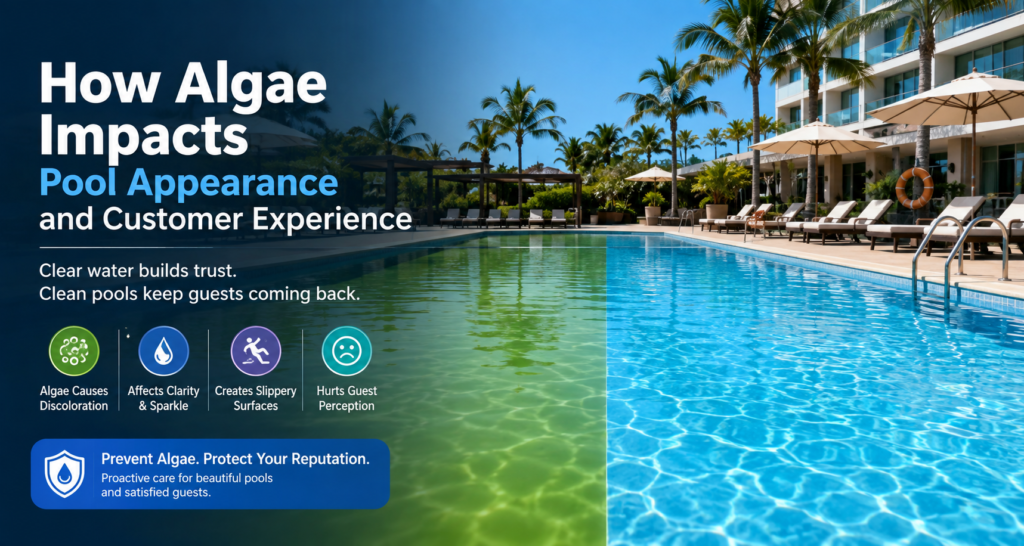
A swimming pool can be chemically balanced on paper and still look uninviting.
That may sound strange, but anyone who manages a hotel, resort, health club, water park, or community pool knows the problem. Guests rarely arrive carrying a water-test kit. They don’t check free chlorine, alkalinity, or calcium hardness before deciding whether a pool looks clean.
They look at the water.
Is it sparkling? Can they clearly see the bottom? Do the walls look clean? Does the water have that crisp blue appearance people associate with a well-maintained pool?
Algae can change all of those impressions remarkably quickly.
A faint green tint, slightly cloudy water, or a slippery patch near the steps may seem like a minor maintenance issue to an operator. To a guest, however, it can send a much simpler message:
This pool doesn’t look clean.
And once that thought appears, chemistry isn’t going to talk them out of it.
Pool Appearance Is Part of the Customer Experience
Think about the last time you walked past a beautiful resort pool.
Before touching the water, you probably noticed the color. Sunlight reflected from the surface. The floor was visible through clear water. The whole scene looked fresh and inviting.
That’s not an accident.
For commercial properties, a swimming pool is more than a body of treated water. It’s part of the visual environment. Hotels use pools in advertising photographs. Resorts build outdoor spaces around them. Fitness clubs present clean aquatic facilities as part of the membership experience.
Even residential communities may treat the pool as a centerpiece.
This makes water appearance surprisingly important.
A guest doesn’t need to understand microbiology to recognize that something looks wrong. Slight discoloration can create doubt, and visible algae can turn that doubt into a strong negative impression.
That’s where algae becomes more than a maintenance problem. It becomes a customer-experience problem.
What Does Algae Actually Do to Pool Appearance?
Pool algae can appear in different forms, and not every outbreak looks like the dramatic green pool people imagine.
Sometimes the signs are subtle.
Early algae development may show up as a light green haze on a wall, reduced water brilliance, slippery surfaces, or patches in areas with weaker circulation. In other cases, algae growth can become obvious enough to change the overall color and clarity of the pool.
Green algae is probably the most familiar example.
As growth increases, pool water may lose its bright blue appearance and develop a greenish cast. With heavier contamination, visibility through the water can decline significantly.
Other algae problems may appear as localized patches rather than turning the entire pool green.
That distinction matters.
A pool doesn’t need to resemble a pond before customers notice something is wrong.
Water Loses Its Visual “Sparkle”
Pool professionals sometimes talk about water having a certain sparkle.
It isn’t exactly a scientific measurement, but you know it when you see it.
Clear, properly maintained water reflects light differently from water carrying suspended material or biological growth. When algae begins developing, that crisp visual quality may gradually disappear.
The pool starts looking dull.
Then perhaps slightly cloudy.
Then noticeably green.
From the customer’s perspective, those stages aren’t necessarily separate technical conditions. They’re simply different versions of “the pool doesn’t look right.”
A Little Green Can Create a Big Perception Problem
Here’s the awkward part: customer perception isn’t proportional to the actual size of the algae problem.
A small patch can have a large psychological effect.
Imagine checking into a hotel after a long flight. You walk toward the pool, towel in hand, and notice green material around one corner of the steps.
Would you think:
“Interesting. This appears to be localized algae development caused by reduced circulation in a hydraulic dead zone.”
Probably not.
You’d be more likely to wonder whether the pool is being maintained properly.
That’s human nature.
Visible cleanliness works as a shortcut for perceived overall cleanliness. Guests can’t see chlorine residual or filtration performance, so they judge what they can see.
Algae therefore becomes a visual warning signal—even when the underlying water condition is more complicated than appearance alone suggests.
Slippery Surfaces Make the Problem Feel Even Worse
Algae doesn’t only affect color.
Growth on pool walls, floors, ladders, steps, and other wet surfaces can contribute to a slippery or slimy feel. That sensory experience can reinforce the customer’s impression that the pool is poorly maintained.
Visual perception says, “That looks dirty.”
Touch says, “Something feels wrong.”
Together, they’re much harder to ignore.
Slippery surfaces can also create maintenance and safety concerns, especially around frequently used entry areas. Pool operators should therefore treat unusual surface slickness as something worth investigating rather than merely a cosmetic annoyance.
Areas with limited circulation deserve particular attention. Steps, corners, ladders, recessed sections, and other places where water movement is weaker may show problems before the open pool does.
Cloudy or Green Water Can Reduce Customer Confidence
People associate clear water with cleanliness.
The association isn’t perfect from a technical standpoint. Crystal-clear water isn’t automatically microbiologically safe, and cloudy water can have causes unrelated to algae.
Still, customer perception matters.
When swimmers can’t clearly see through the water, uncertainty rises.
What’s in there?
Why can’t I see the bottom properly?
Has the pool been cleaned?
Those questions can appear within seconds.
For commercial facilities, that’s a problem because confidence is part of the service being provided. Guests aren’t simply buying access to water. They’re expecting a managed recreational environment that feels comfortable, clean, and cared for.
Algae undermines that feeling.
Hotels and Resorts Have More at Stake Than Water Chemistry
For a private backyard pool, an algae outbreak is frustrating.
For a commercial property, the consequences can spread further.
Imagine a resort during peak season. Temperatures are high, the pool is heavily used, and guests are constantly taking photographs.
Then algae appears.
Now the maintenance team isn’t the only group dealing with the consequences. Front-desk staff may receive complaints. Management may need to explain temporary pool restrictions. Guests may photograph discolored water. Reviews can mention poor pool maintenance.
One maintenance issue has suddenly touched several parts of the business.
That’s why commercial pool algae control should be considered part of facility management rather than treated purely as an emergency chemical task.
The objective isn’t simply to kill algae after somebody notices it.
It’s to keep the pool consistently presentable.
Heavy Bather Loads Can Make Algae Control More Challenging
Commercial pools live a harder life than many residential pools.
Think about what enters the water during a busy summer afternoon: sweat, sunscreen, cosmetics, dust, organic debris, and countless small contaminants carried by swimmers.
Then add sunlight, warm temperatures, changing weather, and varying circulation conditions.
The treatment system has plenty to deal with.
Disinfectant demand can increase as the pool receives more contaminants. Meanwhile, environmental conditions may favor algae growth, particularly if circulation, filtration, brushing, sanitizer levels, or maintenance routines become inadequate.
This helps explain why a pool can look perfect one week and begin showing trouble surprisingly soon afterward.
Algae doesn’t care that Saturday is your busiest day.
“But We Use Chlorine” Isn’t Always the End of the Story
Chlorine plays a central role in swimming pool sanitation and algae management. But maintaining a pool isn’t as simple as adding chlorine and forgetting everything else.
Sanitizer performance can be influenced by several factors, including:
- water chemistry
- sunlight exposure
- bather load
- circulation
- filtration
- organic contamination
- maintenance frequency
- localized areas with poor water movement
If conditions drift, algae may gain an opportunity to establish itself.
Once visible growth develops on surfaces, restoring the pool may require brushing, filtration, water balancing, appropriate sanitizer management, and an algae-control treatment suited to the situation.
This is why experienced operators look at the pool as a system.
Chemistry matters. Hydraulics matter. Filtration matters. Cleaning matters.
Skip one piece, and the others have to work harder.
Prevention Usually Looks Better Than Rescue
There’s an interesting contradiction in good pool maintenance: when it’s working properly, customers barely notice it.
Nobody posts a review saying:
“Fantastic preventive algae management. Five stars.”
They simply see a beautiful pool.
That’s the point.
Preventive maintenance aims to keep conditions unfavorable for algae before visible growth becomes a customer-facing issue. Reactive treatment begins after the problem has already appeared.
Both approaches have their place, but commercial operators have a strong reason to emphasize prevention.
Once the water has turned green, the problem is already visible.
The facility may then face chemical treatment, brushing, filtration work, downtime, labor costs, and possible customer complaints. Preventing an outbreak can often be far less disruptive than recovering from one.
For a closer look at this distinction, our guide to preventive and reactive algae treatment explains why treatment timing can make such a noticeable difference in commercial pool maintenance.
Where Does an Algaecide Fit Into Pool Maintenance?
An algaecide is not a substitute for proper sanitation, circulation, filtration, or water balance.
That’s worth saying clearly.
Instead, an appropriate algaecide can form one part of a broader algae-management program.
Certain commercial maintenance programs use polymeric quaternary ammonium compounds for algae control. One commonly recognized type is Polyquat 60, a polymer-based algaecide valued particularly where non-foaming performance is desirable.
Why does the non-foaming part matter?
Imagine a luxury hotel pool surrounded by carefully designed landscaping—and then picture a layer of unwanted foam floating across the surface.
Technically treated? Perhaps.
Visually attractive? Not exactly.
For commercial pools where appearance matters, the treatment itself shouldn’t create another appearance problem.
Facilities evaluating polymer-based algae control can read more about Polyquat 60 Algaecide and how this type of non-foaming formulation fits into pool maintenance programs.
Why Non-Foaming Performance Matters to the Customer Experience
Some traditional quaternary ammonium algaecides can create foam under certain conditions, particularly when water is heavily agitated.
Residential users may tolerate a small amount.
Commercial operators have stronger reasons not to.
Pools with water features, return jets, fountains, spas, or high circulation can make visible foam especially undesirable. Customers don’t know whether that foam is harmless. They simply see something unusual floating on the water.
Once again, perception wins.
Polymeric quaternary products such as Polyquat 60 are often selected partly because they are associated with low- or non-foaming algae-control applications.
This doesn’t eliminate the need for correct dosing and good pool management. It simply means operators can consider algae-control chemistry without intentionally introducing an obvious visual distraction.
Algae Can Affect the Entire Property Image
A poorly maintained pool rarely stays “just a pool problem.”
This is particularly true for hotels and resorts.
The pool may appear in booking photographs. Families may choose a property partly because of its aquatic facilities. Guests may spend several hours a day around the pool area.
Now imagine that same space with cloudy green water.
The chairs are beautiful. The landscaping is perfect. The weather is glorious.
But where is everyone looking?
At the green pool.
It’s a bit like wearing an expensive suit with a large coffee stain on the front. The rest of the presentation suddenly becomes much harder to appreciate.
That’s why pool appearance deserves attention at the management level, not only inside the maintenance room.
Customer Experience Begins Before Anyone Enters the Water
This point is easy to overlook.
The pool experience starts visually.
A guest approaches the water and makes a rapid assessment: clean or dirty, inviting or questionable, well maintained or neglected.
Clear blue water encourages confidence.
Visible algae creates hesitation.
That means operators should inspect pools from the customer’s perspective, not solely from the equipment-room perspective.
Walk around the deck.
Look across the water from several angles.
Check the steps.
Look at corners and shaded areas.
Observe whether the bottom remains clearly visible.
Pay attention to changes in color or surface texture.
Routine testing remains essential, of course. But combining technical monitoring with visual inspection can reveal developing problems before they become impossible to miss.
Keeping a Pool Attractive Requires a System, Not a Single Chemical
There’s no magic bottle that replaces good pool management.
A strong algae-control program typically combines consistent water chemistry, effective circulation, filtration, surface cleaning, monitoring, and appropriate chemical treatment.
The important word is consistent.
Algae problems often develop when several small weaknesses overlap: sanitizer levels drift, temperatures rise, circulation isn’t ideal in one corner, the pool becomes unusually busy, and brushing gets delayed.
Individually, each issue may seem minor.
Together? That’s where trouble starts.
For pool maintenance companies, hotels, resorts, and other commercial facilities, preventive algae control can provide another layer of support when incorporated into a properly managed treatment program.
And ultimately, the goal isn’t merely algae-free water.
It’s a pool customers actually want to enter.
Clear. Inviting. Comfortable.
The kind of pool someone sees from across the deck and thinks, Yep, that’s where I want to spend the afternoon.
FAQs
1. Can algae make pool water look cloudy before it turns green?
Yes. Developing algae problems may contribute to dull or cloudy-looking water before a strong green color becomes obvious. Cloudiness can have many other causes, however, so pool chemistry, filtration, and circulation should also be checked.
2. Why does algae often appear first on pool steps and corners?
Steps, corners, and recessed areas may have weaker circulation than the main body of the pool. These areas can therefore become early trouble spots when sanitation, cleaning, or circulation conditions are less than ideal.
3. Does green pool water always mean algae?
No. Algae is a common cause of green pool water, but dissolved metals and other water-chemistry issues can also cause discoloration. Correct diagnosis should come before treatment.
4. How can hotels prevent algae from affecting the guest experience?
Hotels can combine routine water testing, correct sanitizer levels, good circulation and filtration, regular brushing and cleaning, visual inspections, and an appropriate preventive algae-control program. The aim is to identify changing conditions before visible algae reaches the guest-facing stage.
5. Why is a non-foaming algaecide useful for commercial swimming pools?
A non-foaming pool algaecide can help operators manage algae without creating conspicuous foam that affects water appearance. This can be particularly useful for hotels, resorts, water parks, and other facilities where pool presentation is an important part of the customer experience.