
GET IN TOUCH
Ask For Sample?
Polyquat 60 Before and After Pool Shock Treatment
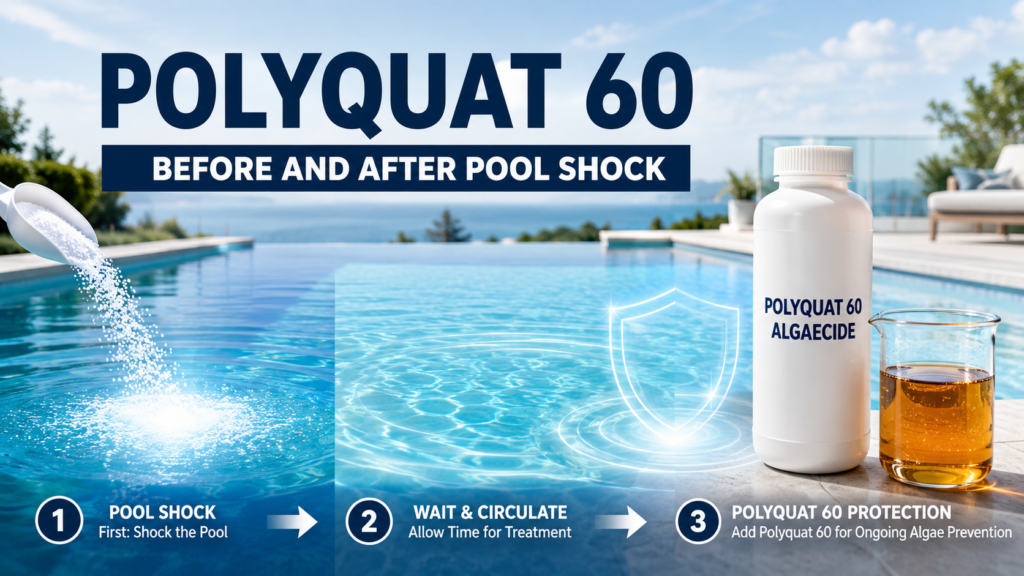
Pool shock and Polyquat 60 are often used in the same maintenance program, but timing matters.
Should you add Polyquat 60 before shocking the pool? Should it go in afterward? Or can you pour both products into the water during the same maintenance visit and let the circulation system sort things out?
Here is the practical answer:
For most corrective treatments, shock the pool first. Allow the chlorine to complete its work, test the water, and then add Polyquat 60 after the free chlorine has returned to the range permitted by the product label.
Polyquat 60 can be used before shock in certain preventive or seasonal programs. However, adding a large dose immediately before a strong chlorine shock may reduce efficiency. The high oxidizer level can increase chlorine demand and gradually degrade part of the polymer.
That doesn’t mean chlorine and Polyquat 60 are fundamentally incompatible. They are commonly used in the same pool. The issue is the concentration of chlorine and the time between treatments.
Routine chlorination is one thing. A powerful shock treatment is another.
Let’s clear up the difference.
Pool Shock and Polyquat 60 Don’t Do the Same Job
It is tempting to place every algae-control chemical in the same bucket. Pool shock kills algae, and Polyquat 60 controls algae, so they must be interchangeable, right?
Not quite.
Pool shock normally refers to a treatment that raises the concentration of an oxidizing sanitizer—usually chlorine—to a much higher level than the pool’s ordinary operating concentration.
Its job may include:
- Oxidizing organic contamination
- Destroying many living algae cells
- Restoring sanitizer performance
- Breaking down some combined chlorine compounds
- Responding to heavy swimmer use, storms, or contamination
- Helping recover cloudy or green water
Polyquat 60 has a different role.
It is a polymeric quaternary ammonium algaecide. The name generally refers to an algaecide concentrate containing about 60% active polymer, commonly based on polixetonium chloride chemistry.
Rather than working as a strong oxidizer, Polyquat 60 uses its positively charged polymer structure to interact with algae. It is most useful as a preventive treatment or as supplemental protection after the primary sanitizer has brought the pool under control.
A simple comparison helps.
Shock is the emergency cleaning crew. Polyquat 60 is the guard that stays behind to make it harder for algae to return.
You may need both, but you don’t necessarily want both arriving at the exact same moment.
For a closer look at the polymer’s function, see How Does Polyquat 60 Algaecide Work in Swimming Pools?.
So, Should Polyquat 60 Go Before or After Pool Shock?
In most situations involving visible algae, cloudy water, or a significant contamination event, the preferred sequence is:
- Test and balance the water.
- Brush and remove debris.
- Apply the appropriate shock treatment.
- Run the circulation and filtration system.
- Continue cleaning until the water is clear.
- Let free chlorine decline to the acceptable range stated on the Polyquat 60 product label.
- Add Polyquat 60 as a preventive follow-up treatment.
This order makes sense because shock handles the immediate oxidizer demand first.
A green pool may contain algae, leaves, pollen, body oils, microorganisms, and other contaminants. If Polyquat 60 is added before that load has been removed, the polymer is being asked to work in rather unfriendly water.
High chlorine may also attack some of the organic polymer. Meanwhile, suspended material can bind or remove part of it from the water. The result may be higher chemical consumption without better algae control.
Shock first. Clean thoroughly. Then protect the recovered pool.
That is usually the more efficient sequence.
There is an important qualification, though: directions differ among finished Polyquat 60 products. Some registered formulations state that they may be used with elevated sanitizer levels or direct users to superchlorinate as part of an algae-treatment procedure. Always follow the directions printed on the finished product label.
General advice should never overrule a legally approved label.
What Happens When High Chlorine Meets Polyquat 60?
Chlorine is a strong oxidizer. It does not politely inspect every molecule and attack only the unwanted ones.
At high concentrations, chlorine can react with many organic materials in pool water. Polyquat 60 is an organic cationic polymer, so strong oxidizing conditions can gradually alter or break down part of its polymer structure.
Several practical effects may follow.
First, the pool may show increased chlorine demand. Free chlorine can fall more quickly than expected because part of it is reacting with the algaecide or its degradation products.
Second, the effective residual of the Polyquat 60 treatment may be reduced. Even if some algae-control activity remains, part of the dose may no longer provide the persistence expected from a preventive application.
Third, water testing can become confusing. A pool owner may see chlorine dropping and assume that a hidden algae bloom is still consuming it. In reality, several demands may be present at once: algae, organic debris, sunlight, and the polymer treatment itself.
This is why separating a heavy shock dose from a full Polyquat 60 dose is often sensible.
Under ordinary chlorination, the interaction is generally slower and easier to manage. Polyquat 60 is widely used in chlorinated pools, so its use does not require chlorine-free water. The concern is mainly the unusually high oxidizer concentration created during shock treatment.
Think of sunlight and a curtain. Normal sunlight slowly fades the fabric over time. A powerful bleaching treatment acts much faster. Both involve exposure, but the intensity changes the outcome.
How Long Should You Wait After Shocking Before Adding Polyquat 60?
There is no reliable universal answer such as “always wait exactly 24 hours.”
For many pools, the waiting period may be around 24 to 48 hours. In other cases, especially after an aggressive algae treatment, it can take longer for free chlorine to fall.
The better rule is to test rather than guess.
Add Polyquat 60 only when:
- The shock treatment has completed its main corrective job
- Visible algae has been brushed and removed
- The water is clear or clearly improving
- Free chlorine has fallen to the range allowed by the algaecide label
- pH and other relevant water conditions are acceptable
- The filtration and circulation systems are operating properly
Some consumer guidance uses a free chlorine level below approximately 5 ppm as a convenient reference point. That figure can be useful for certain products, but it should not be treated as a universal chemical law.
The acceptable level depends on the Polyquat 60 formulation, the shock product, cyanuric acid concentration, local operating requirements, and the directions on both labels.
Cyanuric acid deserves special attention. It affects how chlorine behaves in outdoor pools, which means that a single free-chlorine number does not describe every pool in exactly the same way.
The safest instruction is refreshingly simple: measure the water and follow the applicable product labels.
Why Waiting by the Clock Can Be Misleading
Suppose two pools are shocked at sunset.
One is a clear residential pool with little organic contamination. The other is a warm commercial pool recovering from a heavy algae bloom.
After 24 hours, their chlorine levels may be entirely different.
The rate at which free chlorine declines depends on factors such as:
- The original shock dose
- Pool volume
- Type and severity of algae
- Organic contamination
- Sunlight exposure
- Cyanuric acid level
- Water temperature
- Circulation and filtration
- Whether the pool remains covered
- The chlorine product used
A hot, uncovered pool in bright summer sun may lose chlorine relatively quickly. A covered pool with significant stabilizer may hold an elevated level for much longer.
That is why “wait one day” is incomplete advice.
Wait, yes—but test too.
Can You Add Polyquat 60 Before Shocking the Pool?
You can, but whether you should depends on the reason for treating the pool.
If the pool has visible algae and requires a strong corrective shock, adding Polyquat 60 immediately beforehand usually offers little advantage. The shock treatment should be allowed to attack the active bloom first.
If Polyquat 60 has already been added, do not panic. It does not automatically create a dangerous pool-water reaction when used according to label directions. You may simply experience additional chlorine consumption or reduced Polyquat residual.
Avoid pouring concentrated shock and concentrated algaecide together in a bucket, skimmer, feeder, or small area of the pool. Pool chemicals should be added separately and according to their individual labels.
If the pool must be shocked after a recent Polyquat 60 dose:
- Keep the pump running to distribute the algaecide
- Allow the recommended circulation period on the label
- Test free chlorine and other relevant parameters
- Apply shock separately
- Monitor chlorine demand afterward
- Consider a maintenance dose of Polyquat 60 later, if the label and pool conditions support it
Do not automatically add another full dose. Repeated blind dosing can waste product and may affect filtration or water clarity.
What If You Added Shock and Polyquat 60 at the Same Time?
This is a common maintenance mistake. Fortunately, it usually calls for observation and testing—not frantic chemical correction.
Start by keeping the circulation system running. Do not pour more chemicals into the pool in an attempt to “balance out” the first two.
Then:
- Test free chlorine after the normal mixing period.
- Check it again later to see how quickly it is declining.
- Brush any visible algae.
- Clean or backwash the filter when needed.
- Allow the shock process to finish.
- Reassess the water before adding another algaecide dose.
The likely problem is reduced efficiency, not a need to drain the pool.
Some of the Polyquat 60 may remain useful, while some may be degraded or removed. The exact result depends on the concentrations, formulations, water chemistry, and contact time.
This is also why you should not promise customers that Polyquat 60 is completely “unaffected by chlorine” under every condition. It is compatible with chlorinated pool programs, but compatibility during normal maintenance does not mean unlimited resistance to strong oxidation.
That small distinction matters, especially for professional product instructions.
The Best Sequence for a Pool with Visible Green Algae
When algae is already visible, Polyquat 60 should not be expected to replace an adequate shock and cleaning procedure.
Use this general sequence, subject to product labels and local requirements.
First, test the pool water. Check free chlorine, combined chlorine where relevant, pH, and cyanuric acid. Correcting pH before a chlorine treatment may improve the predictability of the process, but never mix concentrated acid and chlorine.
Next, remove leaves and other debris. Organic debris consumes sanitizer. Leaving a pile of leaves at the bottom while adding more shock is a bit like mopping the kitchen while someone is still spilling soup.
Brush the walls, steps, corners, ladders, and floor. Algae often develops in areas with weak circulation or rough surfaces.
Apply the shock product according to its label and the condition of the pool. Keep the pump and filter operating as directed.
Continue brushing, filtering, vacuuming, and testing. A single dose may not complete the recovery of a heavily contaminated pool.
Once the water is clear, the algae has been removed, and free chlorine has returned to the permitted range, add Polyquat 60 Algaecide as a follow-up preventive treatment.
Finally, maintain an appropriate sanitizer residual. Polyquat 60 supports the treatment program; it does not replace disinfection.
The Best Sequence for Routine Weekly Maintenance
Routine maintenance is easier because there is no major bloom to correct.
A typical weekly program may look like this:
- Test sanitizer and pH
- Empty baskets and remove debris
- Brush areas with limited circulation
- Inspect filter pressure
- Adjust routine sanitizer
- Add the label-directed maintenance dose of Polyquat 60
- Circulate the water for the required period
If no shock is needed, Polyquat 60 can be added while the pool operates at its normal sanitizer level, provided the product label allows it.
If routine shock is scheduled for the same maintenance cycle, separate the treatments. Shock first, then add Polyquat 60 after the elevated free chlorine has declined to the permitted range.
For commercial service routes, this may require planning treatments across separate visits. That can feel inconvenient, but it often produces more predictable chemical use and a more useful algaecide residual.
Polyquat 60 After a Storm or Heavy Pool Use
A summer storm can carry pollen, dust, soil, leaves, and microorganisms into the water. Heavy bather use adds another kind of load—sweat, cosmetics, sunscreen, and other organic material.
In either case, start with water testing.
Do not assume the pool needs both shock and algaecide simply because the water has been busy. If sanitizer remains adequate and the water is clear, routine adjustment and filtration may be enough.
When a significant shock treatment is justified, complete it first. Add Polyquat 60 later as preventive support, especially when warm weather and high nutrient loading create continued algae pressure.
The key is to respond to the water, not to a fixed calendar.
What About Pool Opening?
Pool opening presents a slightly different situation.
After months under a cover, the water may contain debris, organic matter, and early algae growth. Even water that looks fairly clear can place a heavy demand on chlorine.
A sensible opening sequence is:
- Remove and clean the cover.
- Reassemble and start the circulation system.
- Remove debris and clean the pool.
- Test and adjust water chemistry.
- Shock if the water condition requires it.
- Filter and brush until the water is clear.
- Let free chlorine return to the label-approved range.
- Add Polyquat 60 for continued algae prevention.
Adding Polyquat 60 before evaluating the pool can waste product. If a major shock is about to follow, the polymer may face strong oxidizing conditions almost immediately.
There is no prize for adding every chemical on opening day.
What About Pool Closing and Winterization?
Winterization is one of the few cases where people often discuss adding Polyquat 60 before or near a shock treatment.
The goal is not to clear an active bloom. It is to close a clean pool and reduce the risk of algae growth while circulation is limited or stopped.
A common approach is to shock the clean pool several days before final closing. Then allow free chlorine to decline before adding the winter dose of Polyquat 60. Circulate the algaecide thoroughly before shutting down the system.
This sequence lets chlorine handle remaining oxidizer demand while preserving more of the Polyquat treatment for the closed period.
Water temperature matters too. Closing after the water has cooled reduces biological activity and can improve the chances of a clean spring opening.
For winter products designed around polymeric algae control, see Winter Algaecide for Pool Closing.
Again, check the winter algaecide label. Some finished products contain blended ingredients and may have directions that differ from a straight 60% Polyquat concentrate.
Should Polyquat 60 Be Used to Kill an Existing Algae Bloom?
Polyquat 60 can help control algae, and some registered product labels provide treatment directions for visible algae. Still, its strongest practical role is often prevention and follow-up protection.
A severe algae bloom creates several problems at once:
- A large living algae population
- High chlorine demand
- Suspended dead and living cells
- Dirty surfaces
- Increased filter loading
- Possible circulation problems
Simply adding more algaecide does not remove those problems.
Shock, brushing, vacuuming, and filtration do the heavy corrective work. Polyquat 60 can then help limit renewed growth after recovery.
This distinction is explored further in The Difference Between Preventive and Reactive Algae Treatment.
Does Polyquat 60 Reduce Chlorine?
It can contribute to chlorine demand, particularly when a substantial Polyquat dose meets a high chlorine concentration.
That does not mean Polyquat 60 acts as an instant chlorine neutralizer. Nor does it mean routine use always causes a dramatic sanitizer loss.
The size and speed of the effect depend on:
- Polyquat dose
- Chlorine concentration
- Contact time
- Temperature
- Sunlight
- Organic contamination
- Other chemicals in the formulation
- Pool filtration and circulation
A chlorine drop after adding Polyquat 60 may therefore be real, but it should be interpreted alongside the pool’s overall condition.
If free chlorine falls rapidly, test again. Check for organic contamination or surviving algae before blaming one product.
Can Polyquat 60 Make Water Cloudy After Shock?
It is possible, though cloudiness after algae treatment often has several causes.
Dead algae may remain suspended after shock. The filter then needs time to capture it. Polyquat 60 is a cationic polymer and may also interact with negatively charged particles in the water.
At an appropriate dose, this interaction can sometimes support particle removal and improve clarity. At an excessive dose—or when combined closely with another cationic or anionic treatment—the water may behave differently than expected.
Do not combine Polyquat 60 blindly with a clarifier, flocculant, phosphate remover, or other polymer treatment. Oppositely charged products may react with one another, while similar products may create excessive treatment.
If the pool becomes cloudy:
- Stop adding unnecessary chemicals
- Maintain circulation
- Check filter operation
- Test sanitizer and pH
- Vacuum settled material
- Allow time for filtration
- Follow the labels before adding anything else
Sometimes the pool needs patience more than another bottle.
Five Timing Mistakes Worth Avoiding
The first mistake is adding Polyquat 60 and shock together simply to save time. The products may still provide some benefit, but separating a strong oxidizer dose from the polymer generally makes chemical performance easier to predict.
The second is relying only on elapsed time. Twenty-four hours does not guarantee that free chlorine has returned to an acceptable level. Test the water.
The third is adding Polyquat 60 to a dirty green pool and expecting it to replace brushing, filtration, and adequate sanitizer.
The fourth is confusing compatibility with simultaneous concentrated mixing. Products that can coexist after dilution in pool water should still never be mixed as concentrates unless the labels specifically direct it.
The fifth is repeating a full algaecide dose because the first dose “must have disappeared.” Without measurements or label support, that assumption can cause overdosing and unnecessary cost.
A Practical Decision Guide
Use the following logic when deciding what to add first.
If the pool has visible algae, shock and clean first. Add Polyquat 60 after the corrective process and after chlorine returns to the permitted range.
If the water is clear and sanitizer is normal, use Polyquat 60 according to its preventive maintenance directions. Shock only if testing or pool conditions show a real need.
If Polyquat 60 has already been added and shock is now necessary, circulate the algaecide, apply the shock separately, and monitor chlorine demand. Reassess before redosing.
If you are opening the pool, inspect and clean it before choosing the treatment. Shock first when contamination or algae is present.
If you are closing a clean pool, shock early enough for chlorine to decline before adding the final Polyquat 60 treatment and circulating it thoroughly.
That is the central idea: use treatment order to protect the purpose of each chemical.
The Bottom Line: Let Shock Correct, Then Let Polyquat Protect
Polyquat 60 and pool shock can belong in the same maintenance program, but they perform different jobs.
Shock provides strong oxidation for correcting contamination and active algae problems. Polyquat 60 provides non-oxidizing, polymer-based algae control that is particularly valuable for prevention and follow-up protection.
For most algae-recovery treatments, use shock first. Continue brushing, filtering, and testing until the pool is under control. Then add Polyquat 60 after free chlorine has returned to the range permitted by the algaecide label.
Do not depend on a fixed waiting period alone. A 24-to-48-hour interval is common, but actual chlorine levels matter more than the clock.
And never mix concentrated pool chemicals together.
Good pool care is rarely about adding the greatest number of products. It is about giving each product the conditions it needs to do its job.
Frequently Asked Questions
1. Can I add Polyquat 60 immediately after shocking my pool?
It is usually better to wait until the shock treatment has finished and free chlorine has declined to the range allowed by the Polyquat 60 label. This may take 24 to 48 hours or longer, depending on the pool. Test the water rather than relying only on time.
2. What happens if I add Polyquat 60 before pool shock?
High chlorine may increase chlorine demand and degrade part of the Polyquat 60 polymer. The combination is not normally a reason to drain the pool, but the algaecide treatment may provide a shorter or less predictable residual.
3. Should I shock or add Polyquat 60 first when my pool is green?
Shock, brushing, filtration, and debris removal should normally come first when visible algae is present. Add Polyquat 60 afterward to help prevent algae from returning. Follow the labels of both finished products.
4. How long after adding Polyquat 60 can I shock the pool?
There is no single waiting period for every formulation. If shock is not urgent, allow the Polyquat 60 to circulate for the time stated on its label and separate the treatments as much as practical. If contamination requires immediate shock, treat the sanitation problem first and reassess the algaecide dose later.
5. Can Polyquat 60 replace chlorine shock treatment?
No. Polyquat 60 is an algaecide, not a primary pool sanitizer or a direct replacement for chlorine shock. It works best as supplemental algae control within a program that includes correct sanitizer levels, circulation, filtration, brushing, and balanced water chemistry.