
GET IN TOUCH
Ask For Sample?
When Should You Add Polyquat 60 During Pool Maintenance?
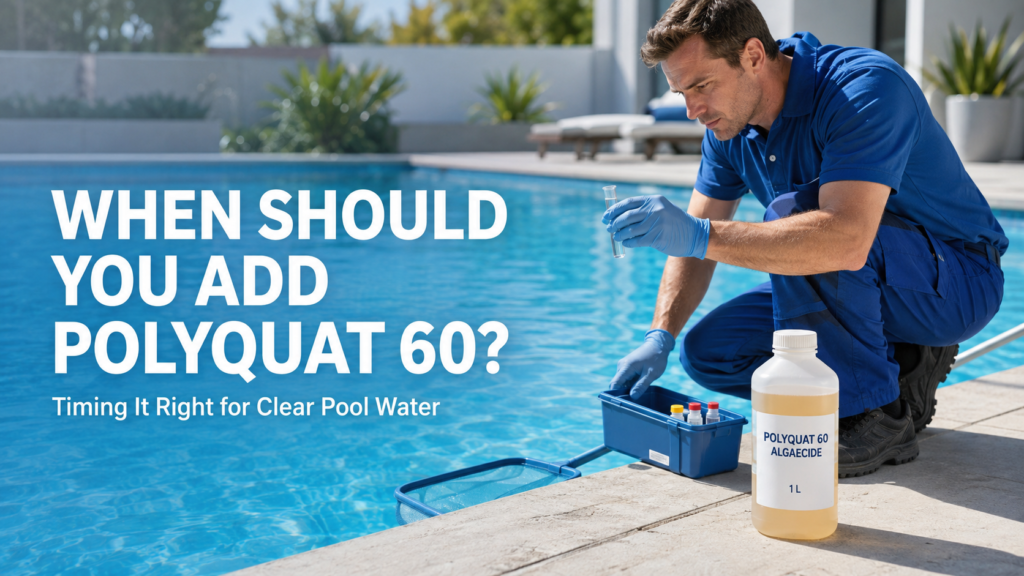
A swimming pool may look perfectly clear while algae are already preparing to make an appearance. That is what makes preventive algae control tricky. By the time a green tint appears on the steps or a slippery film develops along the wall, the easy maintenance window has often passed.
Polyquat 60 works best when it is added at the right stage of the pool maintenance cycle—not simply whenever someone remembers to pour it in.
So, when should you add it?
For routine preventive maintenance, add Polyquat 60 after the pool water has been tested and balanced, while the circulation system is running, and when the sanitizer level is within the product label’s normal operating range. If the pool has recently received a strong shock treatment, wait until the elevated chlorine level has fallen to the range specified on the Polyquat 60 label before adding the algaecide.
That is the short answer. The full answer depends on whether you are maintaining clear water, opening the pool, treating visible algae, responding to severe weather, or preparing the pool for winter.
Let’s sort out each situation.
First, What Does Polyquat 60 Actually Do?
Polyquat 60 is the common pool-industry name for a concentrated polymeric quaternary ammonium algaecide. Many formulations contain approximately 60% active poly[oxyethylene(dimethyliminio)ethylene(dimethyliminio)ethylene dichloride], also known as Polixetonium Chloride, CAS No. 31512-74-0.
Unlike chlorine, Polyquat 60 is not an oxidizing sanitizer. Its cationic polymer carries positive electrical charges that interact with negatively charged algae cells. This interferes with normal cellular activity and helps suppress or control algae growth.
That distinction matters.
Chlorine handles broad sanitizing and oxidation duties. Polyquat 60 provides supplemental algae control. It should not be treated as a substitute for maintaining an appropriate sanitizer residual.
Its polymeric structure also explains why a properly formulated Polyquat 60 product is generally:
- Non-foaming
- Metal-free
- Suitable for chlorine- and bromine-treated pools
- Less likely to cause surface staining than metal-based algaecides
- Useful for preventive and seasonal maintenance
- Effective across a relatively broad pool-water pH range
If you would like more background on the chemistry, read Polyquat 60 Explained: The Science Behind Polymer-Based Algaecides.
The Best Time for Routine Polyquat 60 Maintenance
For a pool that is already clean and free of visible algae, Polyquat 60 is usually added as part of a regular preventive maintenance visit.
The ideal sequence is:
- Test the water.
- Correct major water-balance problems.
- Confirm that the sanitizer is within the normal label-approved range.
- Remove leaves and other debris.
- Brush or vacuum the pool if needed.
- Clean or backwash the filter when necessary.
- Start or continue normal circulation.
- Add the label-directed maintenance dose of Polyquat 60.
- Keep the circulation system running for the label-directed period.
Why add it after testing and basic cleaning?
Because an algaecide cannot correct an unsuitable pH, poor circulation, a badly clogged filter, or a missing sanitizer residual. Adding more product before correcting those problems is a bit like spraying air freshener in a room with a leaking drain—the main cause is still there.
Polyquat 60 should enter water that is reasonably balanced and moving well. Circulation helps disperse the polymer throughout the pool rather than leaving a concentrated pocket near the application point.
Should You Add Polyquat 60 Before or After Chlorine?
Polyquat 60 can normally be used in a chlorine-maintained pool. “Compatible,” however, does not mean every chemical should be poured into the same bucket or added at exactly the same moment.
Never premix Polyquat 60 with chlorine, shock, acid, or another concentrated pool chemical. Add each product separately and follow its label.
For ordinary chlorination, the sequence may be quite simple:
- Test and balance the water.
- Adjust chlorine to its normal operating range.
- Allow it to disperse.
- Apply Polyquat 60 separately with the pump running.
If chlorine is already at an ordinary maintenance level permitted by both labels, a long delay may not be required. The manufacturer’s directions remain the deciding authority.
The situation changes after shock treatment.
When Should Polyquat 60 Be Added After Pool Shock?
High sanitizer concentrations can oxidize part of a polymeric algaecide. Adding Polyquat 60 immediately before or immediately after a large chlorine shock dose may therefore waste some of the product.
The safer general sequence is:
- Balance the water.
- Brush and vacuum where necessary.
- Shock the pool according to the shock-product label.
- Run the pump and allow the chlorine to work.
- Wait until chlorine has returned to the range allowed by the Polyquat 60 label.
- Add Polyquat 60 separately.
- Continue circulation.
Do not apply a universal waiting period such as “always wait exactly 24 hours.” Labels and shock strengths differ. Water temperature, sunlight, cyanuric acid concentration, contaminant load, and the amount of chlorine added all affect how quickly the sanitizer level falls.
A 24-hour interval may be sufficient in one pool and inadequate in another. A water test gives a more dependable answer than the clock.
Some product guidance warns that applying a strong oxidizer and an algaecide together may cause the chlorine to consume the algaecide before it has delivered the intended benefit. In other words, timing is not fussy chemistry for chemistry’s sake—it directly affects performance.
Does Polyquat 60 Need to Be Added in the Morning or Evening?
For routine treatment, time of day is less important than water condition and circulation. Still, late afternoon or evening can be a practical application window.
Here is why:
- Swimmer activity is usually lower.
- The pump can circulate the product for several uninterrupted hours.
- There is less chance that someone will add another chemical immediately afterward.
- Staff can test and inspect the pool again the following morning.
Evening application is not a universal label requirement, though. If the product label allows immediate swimming or gives a specific re-entry time, follow that instruction. Published labels differ: one historical EPA-approved label stated that treated water could be used immediately, while another registered algaecide label requires a period before swimming. That variation is exactly why the container label must take priority over general online advice.
For a commercial pool, local health codes and facility procedures may impose additional restrictions even when a product label permits rapid re-entry.
When Should You Add Polyquat 60 During Pool Opening?
Pool opening is a transition, not a single chemical event.
When the cover comes off, the water may contain leaves, fine sediment, pollen, dead microorganisms, and organic material accumulated during the closed season. Adding Polyquat 60 before removing that physical load may consume product unnecessarily or deliver uneven results.
A practical opening sequence is:
- Remove and clean the cover carefully.
- Reassemble and inspect the circulation equipment.
- Fill the pool to its normal operating level.
- Start the pump and check for leaks.
- Remove large debris.
- Test and balance the water.
- Brush the walls, steps, corners, and floor.
- Vacuum and clean the filter.
- Restore the sanitizer according to the sanitizer label.
- If shock treatment is needed, complete it first.
- Once chlorine returns to the range permitted by the algaecide label, add Polyquat 60.
- Maintain circulation for the required period.
If the opening water is clear and the sanitizer is already within its normal range, Polyquat 60 can be applied as an initial preventive treatment after water balancing.
If the water is green, cloudy, or covered with visible growth, treat it as an algae-removal job rather than a routine opening dose.
When Should You Use Polyquat 60 for Visible Algae?
Polyquat 60 can be labeled for both algae prevention and control, but heavy algae growth requires more than pouring algaecide into untouched water.
Physical cleaning matters. A lot.
Brush algae from walls, steps, ladders, light niches, corners, and other low-circulation areas. Vacuum settled material and make sure the filter can handle the debris. Dense algae layers and biofilms may shield the cells below from treatment.
One registered 60% polyquat label instructs users to clean pools with heavy algae before application. For visible growth, it specifies a larger treatment dose than the maintenance dose, followed by debris removal after 24 hours. It also calls for dilution and application around the pool perimeter while circulation remains on. The registered product label illustrates why treatment and maintenance rates must not be confused.
A sensible visible-algae sequence is therefore:
- Identify whether the discoloration is really algae.
- Brush and vacuum the affected surfaces.
- Check water balance and sanitizer performance.
- Clean or backwash the filter.
- Carry out any required shock treatment.
- Allow elevated chlorine to decline as directed.
- Add the Polyquat 60 treatment dose on the product label.
- Run the circulation system.
- Remove dead or loosened algae.
- Retest the water.
- Return to a preventive maintenance dose only after visible growth has been controlled.
Do not repeatedly add more algaecide while ignoring a circulation failure or an unsuitable chlorine-to-cyanuric-acid relationship. A pool can show a measurable chlorine reading and still develop algae when the sanitizer is not working effectively. Why Pool Water Turns Green Even with Chlorine explains several reasons this happens.
When Should Polyquat 60 Be Added After Heavy Rain?
Heavy rain can change pool chemistry surprisingly fast. It may dilute the sanitizer, shift pH, carry soil and organic debris into the water, and increase chlorine demand.
Do not automatically pour Polyquat 60 into the pool while a storm is still filling it with runoff. Wait until conditions are safe, then:
- Remove leaves and debris.
- Restore the proper water level.
- Test pH, alkalinity, sanitizer, and other relevant parameters.
- Correct the water balance.
- Clean the skimmer and filter.
- Restore the normal sanitizer residual.
- Add a supplemental Polyquat 60 dose only if the label recommends one after heavy rain.
Some product labels specifically include an additional post-rain dose. Others do not. Again, the formula concentration and registered directions decide the amount.
The same logic applies after flooding. Floodwater may introduce soil, sewage, fertilizers, microorganisms, and other contamination. That is no longer an ordinary algae-prevention event, and local public-health guidance may be needed.
What About Hot Weather and Heavy Swimmer Use?
Warm water, strong sunlight, sunscreen, sweat, and frequent swimming increase the stress on a pool maintenance program. Chlorine can be consumed faster, and algae reproduce more readily when sanitizer coverage becomes inconsistent.
During these periods, check the pool more often rather than blindly increasing every chemical.
A Polyquat 60 maintenance application may be appropriate:
- Before a forecast period of hot weather
- Before a holiday or weekend with expected heavy use
- After a major swimming event, once debris has been removed and chemistry restored
- When the normal maintenance interval is approaching
- When the product label calls for more frequent treatment under high-use conditions
Several approved polyquat labels explicitly allow more frequent maintenance dosing during high temperatures or unusually heavy pool use. The instruction does not mean “double the dose whenever it is hot.” It means shorten the interval only as the label permits.
Should Polyquat 60 Be Added Before a Pool Party?
Preventive treatment is most helpful before the pool comes under stress, but adding it five minutes before swimmers arrive is not the smartest approach.
A better plan is to service the pool one or two maintenance cycles before the event, or at least early enough to satisfy the label’s circulation and swimmer-re-entry instructions.
Before the event:
- Confirm water balance.
- Check sanitizer levels.
- Clean the pool and filter.
- Apply the label-approved preventive treatment early enough for full distribution.
After the event:
- Remove debris.
- Retest the sanitizer and pH.
- Restore normal chemistry.
- Add Polyquat 60 only if the regular schedule or product label calls for it.
A pool party raises sanitizer demand far more directly than it creates a need for unlimited algaecide. Polyquat 60 is support, not a chemical eraser for poor sanitation.
When Should You Add Polyquat 60 Before Closing the Pool?
Polyquat 60 is widely used in pool-closing programs because it is non-foaming and does not introduce copper. Timing is especially important here.
Do not close the pool too early while the water remains warm. Algae grow more readily in warmer water, even under a cover. Where climate permits, many professionals wait until the water temperature has fallen and is staying relatively cool before completing winterization.
A typical closing order is:
- Remove debris and clean the pool thoroughly.
- Test and balance the water.
- Clean the filter and circulation system.
- Apply any required closing shock.
- Keep the pool circulating.
- Allow elevated chlorine to fall to the range allowed by the winter algaecide label.
- Add the specified Polyquat 60 or winter-algaecide dose.
- Circulate it for the label-directed period.
- Lower the water level or drain equipment where required.
- Install winter accessories and secure the cover.
The critical point is simple: do not pour Polyquat 60 into stagnant water immediately before switching off the pump. It needs time to spread through the pool.
For a product designed specifically for extended off-season protection, see Winter Algaecide for Pool Closing and Winterization.
How Often Should Polyquat 60 Be Added?
There is no responsible single answer without reading the product label.
Examples from published labels show meaningful differences:
- One 60% polyquat product calls for weekly maintenance.
- Another registered formula specifies additions every five to seven days.
- An older EPA-approved product uses a two-week maintenance interval.
- Some labels permit additional dosing after heavy rain or more frequent dosing during high heat and heavy use.
Those differences may reflect active concentration, formulation, registration, intended market, and performance data.
Do not assume every bottle bearing “Polyquat 60” has identical directions. Confirm:
- Active ingredient
- Active concentration
- Initial-treatment dose
- Visible-algae treatment dose
- Maintenance dose
- Treatment interval
- Dilution instructions
- Required circulation time
- Swimmer re-entry requirements
- Special instructions for rain, heat, or winter closing
In the United States, products marketed to kill or control algae in swimming pools are regulated as pesticides and must carry the required registration and usage information. Buckman, a manufacturer of the polymeric active ingredient, also directs formulators and users to review the EPA label for approved applications.
How Should Polyquat 60 Be Added?
After measuring the correct quantity, apply the product according to its label. Depending on the formulation, the instructions may say to add it directly or dilute it first.
Typical application principles include:
- Wear the protective equipment specified on the label and SDS.
- Keep the pump and filtration system operating.
- Distribute the dose around the pool perimeter when directed.
- Concentrate attention on low-circulation areas without leaving undiluted product sitting on a surface.
- Use a clean measuring container reserved for pool chemicals.
- Never return unused measured chemical to the original container.
- Never mix concentrates together.
- Store the product in its original labeled container.
Some Polyquat 60 safety data sheets classify the concentrated product as harmful if swallowed and capable of causing eye irritation. “Non-foaming” and “metal-free” do not mean the concentrate should be handled casually.
Can Polyquat 60 Make Pool Water Cloudy?
Temporary cloudiness can sometimes appear after treatment, particularly when the polymer interacts with suspended algae, fine debris, or other particles. Polyquat 60 may show some flocculating behavior because it is a cationic polymer.
The response should not be an immediate second dose.
Instead:
- Keep the filter operating.
- Check the filter pressure.
- Backwash or clean the filter when needed.
- Vacuum settled debris.
- Verify the dose and pool volume.
- Retest the water before adding another chemical.
If cloudiness is the main problem and algae are not present, a dedicated Polymer Pool Clarifier may be more appropriate. Algaecides and clarifiers may both involve polymer chemistry, but they are not automatically interchangeable.
Common Polyquat 60 Timing Mistakes
Adding It at the Same Time as Shock
Strong oxidation may reduce the useful Polyquat 60 concentration. Separate the treatments and test the chlorine level before adding the algaecide.
Treating Before Correcting Water Balance
Extremely unsuitable water conditions can reduce the reliability of the entire maintenance program. Test first.
Pouring It into a Pool with No Circulation
The polymer needs water movement for even distribution. Repair circulation problems before expecting uniform control.
Waiting Until Algae Cover the Pool
Polyquat 60 is especially useful as a preventive treatment. A mature outbreak requires brushing, filtration, sanitizer management, and debris removal.
Using a Maintenance Dose for an Existing Outbreak
Maintenance rates are designed to suppress regrowth in clean water. Visible-algae treatment rates are often higher.
Guessing the Pool Volume
A dosage calculation based on the wrong volume can lead to poor control or needless overapplication. Measure the pool dimensions and calculate the volume carefully.
Treating Green Water Without Identifying the Cause
Green water may result from algae, but dissolved metals can also produce green or discolored water. Adding more algaecide will not remove oxidized copper.
A Simple Polyquat 60 Maintenance Schedule
| Maintenance situation | Recommended application point |
|---|---|
| Routine clear-water care | After testing, balancing, cleaning, and restoring normal sanitizer levels |
| After ordinary chlorination | Add separately while circulating, following both labels |
| After shock treatment | Wait until chlorine falls to the range permitted by the Polyquat 60 label |
| Pool opening with clear water | After circulation starts and water is balanced |
| Pool opening with algae | After cleaning and the main algae-treatment or shock stage, as the labels direct |
| After heavy rain | After debris removal, testing, balancing, and sanitizer correction |
| Before heavy use | Early enough to complete the required circulation and re-entry interval |
| After heavy use | After cleaning and restoring normal water chemistry, if the schedule calls for treatment |
| Visible algae | After brushing and cleaning; apply the label’s treatment dose, not the maintenance dose |
| Pool closing | After cleaning and any shock treatment, but before final shutdown and covering |
| Hot weather | Follow the label’s permitted shorter interval rather than improvising a larger dose |
The Bottom Line: Add It When the Pool Is Ready
The best time to add Polyquat 60 is not determined by a calendar alone.
Add it when:
- The pool is physically clean.
- The water has been tested and reasonably balanced.
- The sanitizer is within the range allowed by the product label.
- The circulation system is operating.
- No concentrated, incompatible chemical is being added at the same moment.
- There is enough circulation time remaining for uniform distribution.
For routine maintenance, that usually means adding Polyquat 60 after testing, cleaning, and balancing. After shock treatment, wait for chlorine to return to the permitted range. During closing, apply it early enough to circulate before the system is shut down.
Good timing helps the same measured dose do more useful work. And honestly, preventing that first slippery patch is far easier than rescuing a pool that has already turned green.
Frequently Asked Questions
1. Should I add Polyquat 60 before or after shocking my pool?
In most maintenance programs, complete the shock treatment first. Then test the water and wait until chlorine falls to the range permitted by the Polyquat 60 label before adding the algaecide. Never premix shock and Polyquat 60.
2. Can I add Polyquat 60 while the pool pump is running?
Yes. Polyquat 60 is normally applied with circulation operating so the product can spread evenly. Keep the pump running for the period stated on the product label.
3. How long after adding Polyquat 60 can I swim?
Swimmer re-entry instructions vary among registered products. Some labels permit rapid or immediate use, while others specify a waiting period. Follow the exact directions on your container and any local commercial-pool rules.
4. Should I add Polyquat 60 every week?
Some products specify weekly maintenance, while others use five-to-seven-day or two-week intervals. Follow the maintenance dose and frequency on the specific Polyquat 60 algaecide label rather than applying a generic schedule.
5. When should I add Polyquat 60 when closing a pool for winter?
Add it after the pool has been cleaned and balanced and after any closing shock has fallen to the permitted chlorine range. Circulate the Polyquat 60 thoroughly before shutting down the equipment and securing the winter cover.