
GET IN TOUCH
Ask For Sample?
Why High Bather Loads Reduce Swimming Pool Water Clarity?
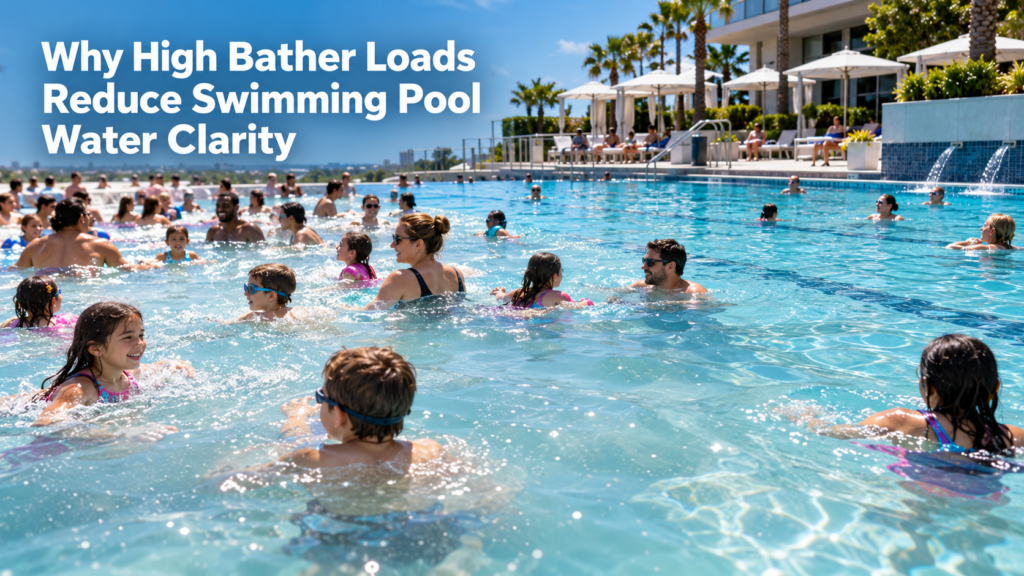
A swimming pool can look brilliant at 9:00 a.m. and noticeably dull by late afternoon.
The filtration system has not stopped. The chlorine feeder may still be running. The pH may even remain within its normal range. Yet the deep end no longer looks as sharp, underwater lights develop soft halos, and the main drain becomes harder to see.
What changed?
Usually, the answer is not one dramatic water-quality failure. It is the accumulated effect of people.
Every swimmer introduces small amounts of sweat, skin cells, body oils, hair products, cosmetics, dust, microorganisms, and other materials into the pool. One swimmer may make little visible difference. Fifty, one hundred, or several hundred swimmers can place an entirely different burden on the treatment system.
This is known as a high bather load.
High bather loads reduce pool water clarity because they add contaminants faster than the sanitizer, circulation system, and filter can process and remove them. The result is often a gradual build-up of suspended particles, organic matter, chloramines, and microorganisms.
The pool may not turn cloudy at once. More often, it loses its sparkle first.
That small visual change is worth noticing.
What Does “Bather Load” Actually Mean?
Bather load refers to the number of people using a swimming pool during a given period.
It is sometimes described as the number of swimmers in the water at one moment. That is only part of the picture. Pool operators also need to consider how many people enter the water over several hours.
For example, a hotel pool may never contain more than 25 guests at the same time. However, if different groups enter and leave throughout the day, the pool may receive contaminants from 150 or 200 people.
The true treatment burden is therefore cumulative.
Bather load is also affected by swimmer behavior. Ten adults quietly swimming laps do not create exactly the same water burden as ten children splashing, jumping, wearing sunscreen, and repeatedly entering from a dusty deck.
Several factors influence the real load placed on the pool:
- The total number of swimmers
- The length of each swimming session
- Swimmer age and activity level
- Water temperature
- Indoor or outdoor conditions
- Use of sunscreen, cosmetics, and body lotions
- Whether swimmers shower before entering
- The amount of water splashing and aeration
- The pool’s circulation and filtration capacity
This explains why a crowded pool does not always become cloudy—and why another pool may lose clarity after a relatively small party. Bather numbers matter, but system capacity and operating conditions matter too.
Every Swimmer Brings Something into the Water
People do not enter a pool as chemically neutral objects.
Even a clean swimmer carries natural oils, tiny flakes of skin, perspiration, hair, lint, and microorganisms. Sunscreen, moisturizer, makeup, deodorant, hair conditioner, and traces of detergent from swimwear may add further material.
Outdoor pools receive an extra mix. Wet feet carry dust and soil from the deck. Wind adds pollen and fine debris. Grass, sand, and airborne particles enter more easily when people frequently move between the pool and surrounding areas.
Much of this material is too small to see individually. Once dispersed, however, the particles scatter light.
That is when clear water begins to look hazy.
Imagine sunlight passing through a clean window. The light travels through with little interference. Now imagine the same window covered with a thin layer of dust. You can still see through it, but the view is softer and less defined.
Suspended particles create a similar effect in pool water.
They redirect light instead of allowing it to pass cleanly through the water. This optical scattering can make a pool look milky, flat, or slightly grey even when no large debris is visible.
For a closer explanation of this mechanism, see Why Does Swimming Pool Water Become Cloudy?.
High Bather Loads Increase the Organic Burden
A heavily used pool receives a continuous supply of organic material.
“Organic” does not necessarily mean dangerous. In water treatment, the term broadly covers carbon-containing substances such as sweat, body oils, skin particles, cosmetics, and natural debris.
The trouble is that chlorine reacts with many of these substances.
Instead of remaining fully available for disinfection, part of the chlorine is consumed while oxidizing swimmer waste. CDC guidance explains that when chlorine reacts with dirt, sweat, urine, and other contamination, less free chlorine remains available to control germs. cdc.gov
This process is often called chlorine demand.
When swimmer contamination enters faster than the disinfection system can handle it, the free chlorine residual can fall. The water may still contain chlorine, but the effective residual may be smaller than expected.
That distinction matters.
A test performed early in the day may show an acceptable result. Several hours of heavy use can change conditions quickly, especially in a warm, crowded pool. For this reason, CDC guidance for public pools recommends more frequent disinfectant and pH testing—up to hourly during heavy use. cdc.gov
Waiting until closing time to test the water is a bit like checking the fuel gauge after the journey. The reading may explain what happened, but it did not help during the busiest period.
Free Chlorine Falls While Combined Chlorine Can Rise
Free chlorine is the portion available to disinfect water and react with contaminants.
When chlorine combines with nitrogen-containing swimmer waste, including compounds associated with perspiration and urine, chloramines can form. Pool test results usually report these reaction products as part of the combined chlorine reading.
Combined chlorine is calculated as:
Combined Chlorine = Total Chlorine − Free Chlorine
Unlike free chlorine, combined chlorine is not an effective primary disinfectant at typical pool operating concentrations. CDC material describes it as chlorine that has combined with organic or inorganic compounds and is no longer an effective recreational-water disinfectant. CDC
Chloramines are often associated with:
- A strong “chlorine” smell
- Eye irritation
- Respiratory discomfort
- Reduced swimmer comfort
- Poor indoor air quality
- A tired or heavily used feeling around the pool
Interestingly, a strong chlorine smell does not necessarily mean that a pool contains too much useful chlorine. It can indicate that chlorine is being consumed by contaminants.
High combined chlorine does not directly explain every case of cloudy water. Still, it is a useful warning that the treatment system is under pressure from swimmer waste.
It may also appear alongside falling free chlorine, rising particle levels, and declining clarity.
Fine Particles Can Be Too Small for the Filter
Pool filters are essential, but they do not capture every particle with the same efficiency.
Hair, leaves, insects, and larger pieces of debris are relatively easy to trap. Very fine particles present a different challenge. Some remain below the practical capture range of the filter media, particularly during a single pass.
Body oils and cosmetics may also form very small droplets or coat other particles. Dead microorganisms, fragments of organic material, and mineral particles can remain suspended instead of settling.
The water keeps circulating, yet the haze stays.
This is not always evidence that the filter is broken. It may mean that the filter needs more time—or that the particles are simply too small to be captured efficiently in their present form.
A Polymer Pool Clarifier can support filtration when fine suspended particles are the main cause of poor clarity. A suitable cationic polymer interacts with negatively charged particles and helps them gather into larger, more filterable structures.
Think of it as turning loose flour-like dust into soft clusters that the filter has a better chance of holding.
The clarifier does not replace correct sanitation, circulation, or filter maintenance. It addresses a specific physical problem: fine particles that remain dispersed in the water.
That difference is important. If live algae, scale precipitation, incorrect pH, or damaged filter components are causing the cloudiness, adding more clarifier may not solve the real problem.
The Filter Receives More Work Than Usual
During high bather load periods, more water contaminants reach the filter.
This can create two apparently opposite problems.
First, the filter may not capture the incoming particles fast enough. The rate of contamination exceeds the rate of removal, so suspended material accumulates in the pool.
Second, the filter may capture a large amount of material and become increasingly restricted. Flow falls as the filter collects debris, reducing the volume of water treated during each hour.
A filter can therefore be working hard while the pool is still becoming cloudy.
Several operating issues can make the situation worse:
- An undersized filter
- A circulation pump running for too few hours
- Incorrect filtration speed
- Channels forming in sand media
- Dirty or damaged cartridges
- Inadequate backwashing
- Blocked baskets or strainers
- Poor circulation in corners and steps
- Closed or incorrectly positioned valves
- A turnover rate that is too slow for actual use
Professional guidance from the Pool Water Treatment Advisory Group notes that inadequate filtration, incorrect filtration rates, undersized filters, and excessive turnover periods can all contribute to cloudy water, particularly where high bather loads are involved. PWTAG Technical Notes
The lesson is simple: the treatment system must be judged against real operating conditions, not just the empty pool volume printed on a design sheet.
Circulation Becomes Part of the Clarity Problem
Clear pool water depends on treated water reaching the whole pool.
In a busy pool, swimmers create movement and help mix the upper water layer. That may sound helpful, but heavy use can also expose circulation weaknesses.
Contaminants tend to collect in poorly circulated locations such as:
- Steps and shallow ledges
- Corners
- Areas behind ladders
- Children’s play zones
- Around water features
- Near the bottom of deep sections
- Areas far from return inlets
A water sample taken near a return jet may show acceptable chlorine. The water in a remote corner may be quite different.
This is one reason a single test cannot always describe the condition of an entire commercial pool. Testing location, timing, and swimmer activity all influence the result.
Return jets should distribute treated water across the pool rather than creating one strong current that circles a small zone. Skimmers, gutters, drains, and balance tanks also need adequate flow.
If circulation is weak, the sanitizer takes longer to reach contaminants and suspended particles take longer to reach the filter.
Sunscreen and Body Oils Add a Stubborn Haze
Outdoor pools often face their greatest clarity problems on hot, sunny days.
That seems unfair, doesn’t it? Those are precisely the days when guests expect the water to look its best.
Sunscreen is one reason.
Modern sunscreens are designed to remain on skin during swimming. Their water resistance is useful for people but challenging for pool treatment. Some of the product still washes away and enters the water as fine oily droplets.
Body lotion, tanning products, hair conditioner, and natural skin oils add to the mixture.
These substances may:
- Create an oily surface film
- Attach to dust and skin particles
- Increase chlorine demand
- Coat filter media
- Produce a dull water appearance
- Leave deposits around the waterline
- Encourage foam in certain treatment programs
The effect is often strongest during holiday weekends, hotel peak seasons, school breaks, and hot afternoons.
The pool may have balanced pH and measurable sanitizer yet still look tired because the physical particle burden has risen sharply.
Heavy Swimming Keeps Settled Material in Motion
In a quiet pool, some particles gradually settle or move toward the circulation outlets.
In a busy pool, they may be stirred back into suspension.
Feet disturb material on steps and floors. Swimming strokes create turbulence. Jumping, water games, and fountains produce additional mixing. Fine debris that might otherwise be vacuumed from the floor returns to the water column.
This can make cloudiness seem to appear suddenly during use.
The problem was not necessarily created in one moment. Some material may already have been present near the floor or in low-flow zones. Swimmer movement simply redistributed it throughout the pool.
That is why water sometimes looks much clearer the following morning. Overnight circulation and filtration have had several quiet hours to remove particles without constant disturbance.
The improvement is encouraging, but it should not be mistaken for proof that the treatment program is adequate. If the same haze returns every busy afternoon, the system is repeatedly falling behind.
High Bather Loads Can Encourage Microbial Growth
Sanitizer consumption is not only a visual issue.
If free chlorine falls too far, microorganisms can survive longer. Algae may also gain an opportunity to grow, especially in warm, sunny water or in poorly circulated areas.
Early algae growth does not always appear as bright green water. It may first show up as:
- Slightly dull water
- Slippery steps or walls
- Dust-like material on the floor
- Increased chlorine demand
- Hazy patches in low-flow areas
- A filter that becomes dirty unusually quickly
An approved sanitizer must remain the foundation of microbial control. An algaecide can support an algae-prevention program, but it cannot replace the sanitizer residual.
For pools that need supplementary algae control, <strong><u><a href=”https://eautrix.com/products/polyquat-60-algaecide/”>Polyquat 60 Algaecide</a></u></strong> provides a non-foaming, polymer-based approach. It should be used according to the finished-product label and the applicable local regulations.
A clarifier and an algaecide may both involve cationic polymer chemistry, but they do not automatically perform the same job. One is mainly selected to improve the removal of suspended particles; the other is used to help prevent or control algae.
Trying to make one bottle fix every pool problem usually ends in frustration.
Why Balanced Test Results Do Not Guarantee Clear Water?
Pool operators sometimes face a confusing situation: pH is within range, free chlorine looks acceptable, and total alkalinity is stable—yet the water is still hazy.
How can that happen?
Routine chemical tests describe selected water parameters. They do not directly measure every suspended particle, oil droplet, filter problem, or circulation weakness.
A balanced pool can still contain:
- Fine suspended debris
- Dead algae
- Poorly dispersed body oils
- Excess clarifier
- Precipitated minerals
- Material released from a damaged filter
- Localized contamination in a dead zone
Water balance, sanitation, filtration, and clarity are connected, but they are not interchangeable.
Good chemistry supports clear water. It does not remove the need for effective physical treatment.
Why Water Clarity Is Also a Safety Issue?
Clear water is attractive, but appearance is not the only concern.
Lifeguards and pool staff need to see swimmers, submerged objects, lane markings, and the pool floor. When the bottom or main drain cannot be seen clearly, supervision becomes harder.
Cloudiness can also warn that filtration, sanitation, or circulation is not keeping pace with pool use.
World Health Organization guidance treats low turbidity as an important part of effective pool-water treatment because particles can interfere with disinfection and reduce visual clarity.
A cloudy pool should therefore not be treated as a minor cosmetic defect—especially in a commercial facility.
If visibility falls below the applicable local safety requirement, the responsible response may be to close the pool until clarity is restored. Local health codes and facility procedures should always take priority.
No guest enjoys seeing a “Pool Closed” sign. Still, protecting swimmers matters more than avoiding an awkward conversation at reception.
How Can Operators Prepare for Busy Periods?
The best time to prepare for a high bather load is before swimmers arrive.
Start with a clean, balanced pool and a properly operating filtration system. Empty skimmer and pump baskets. Check filter pressure and inspect the circulation pattern. Confirm that chemical feeders contain enough product for the expected operating period.
A practical high-use plan may include:
- Testing free chlorine and pH before opening
- Testing more frequently during busy hours
- Recording combined chlorine
- Confirming that automated readings match manual tests
- Extending filtration time when needed
- Cleaning or backwashing filters based on system requirements
- Checking flow meters and return inlets
- Vacuuming settled debris before opening
- Encouraging swimmers to shower
- Scheduling short rest periods where local rules permit
- Watching water clarity throughout the day
- Keeping chemicals, test reagents, and trained staff available
Commercial facilities should base operating decisions on the pool design, water volume, treatment system, local code, and chemical labels. A fixed routine created for quiet weekdays may not be enough for a holiday weekend.
Small Swimmer Habits Can Make a Big Difference
A short pre-swim shower removes a surprising amount of sweat, dirt, cosmetics, and loose skin material.
CDC guidance recommends showering for at least one minute before entering a pool. This reduces the material available to react with chlorine.
Facilities can encourage better swimmer hygiene by providing:
- Clean and convenient showers
- Simple signs near changing areas
- Easy access to toilets
- Regular breaks for young children
- Foot showers for outdoor pools
- Clean deck surfaces
- Clear rules about swimming during diarrheal illness
Signs alone rarely change every habit. Convenience helps. If the shower is hidden, cold, or poorly maintained, guests are less likely to use it.
Good pool management includes the human side of water treatment. Chemistry cannot carry the full burden by itself.
When Should a Polymer Pool Clarifier Be Considered?
A clarifier may be helpful when:
- Water chemistry is within its intended operating range
- The sanitizer residual has been restored
- Algae growth is not the active problem
- Circulation and filtration are working
- Fine suspended particles remain in the water
- The filter needs help capturing those particles
Correct dosage matters.
Too little product may provide limited particle conditioning. Too much can overcoat particles, interfere with aggregation, increase filter loading, or even make the water look worse.
More chemical does not always produce more clarity.
The clarifier should be evenly distributed according to the product label, followed by adequate circulation and filtration. Filter pressure should then be monitored because successful particle capture can increase the amount of material retained by the filter.
If pressure rises or flow falls, the filter may need cleaning or backwashing according to its operating instructions.
What Should You Do After a Very Busy Pool Day?
Once the pool closes, the system finally has time to catch up.
Operators should first test the water rather than adding chemicals based only on appearance. Check free chlorine, total chlorine, combined chlorine, pH, and any other parameters required by the facility’s treatment program.
Next:
- Remove visible debris.
- Brush surfaces and low-flow areas.
- Empty baskets and inspect strainers.
- Check filter pressure and flow.
- Confirm that feeders and controllers are working.
- Run circulation and filtration for an appropriate period.
- Apply any required corrective treatment according to the product label.
- Retest before reopening.
- Confirm that the pool floor and main drain are clearly visible.
Shock treatment may be required in some situations, but it should not be used as an automatic answer to every hazy pool. The treatment must reflect actual test results, local requirements, and the type of sanitizer system.
Similarly, a clarifier should not be poured into water merely because the pool looks cloudy. Diagnose first. Treat second.
Clear Water Is the Result of System Capacity
High bather loads reduce swimming pool clarity because every swimmer adds material that must be oxidized, disinfected, circulated, captured, and removed.
When contaminants enter faster than the treatment system can process them, water clarity declines.
The solution is rarely one miracle chemical. Clear water comes from the combined performance of swimmer hygiene, sanitizer control, water balance, circulation, filtration, routine cleaning, and—where appropriate—particle clarification.
A well-run pool does not simply respond to cloudiness after it appears. Its operating plan changes with demand.
Quiet Tuesday morning? One level of attention.
Holiday afternoon with a packed deck? That is a different pool, even if the water volume and equipment have not changed.
Recognizing that difference is how operators protect both water clarity and swimmer confidence.
Frequently Asked Questions
1. How quickly can a high bather load make pool water cloudy?
A busy pool can begin losing its sparkle within a few hours if swimmer contamination enters faster than the sanitizer and filter can process it. The timing depends on swimmer behavior, water temperature, circulation, filter capacity, and the starting water condition.
2. Why is my pool cloudy after a pool party even though the chlorine reading is normal?
The water may still contain fine suspended particles, sunscreen, body oils, or dead organic material. A single chlorine reading also may not reflect conditions during the party. Check combined chlorine, pH, filter operation, circulation, and water clarity before choosing a treatment.
3. Can a pool clarifier fix cloudy water caused by heavy swimming?
A polymer pool clarifier may help when fine suspended particles remain after sanitation, circulation, and water balance have been corrected. It will not repair damaged filtration equipment or replace chlorine, brushing, vacuuming, and proper pool operation.
4. How often should pool water be tested during high bather loads?
Commercial operators should follow local regulations and their facility procedures. CDC guidance recommends testing disinfectant and pH at least twice daily and as often as hourly during heavy use. More frequent testing helps detect rapid sanitizer demand before water quality declines.
5. How can hotels and commercial pools prevent cloudy water during peak season?
Prepare the system before busy periods, maintain a suitable sanitizer residual, test frequently, keep filters clean, extend circulation when necessary, encourage pre-swim showers, remove debris, and use a compatible clarifier only when fine suspended particles are the confirmed problem.