
GET IN TOUCH
Ask For Sample?
How Rain and Storms Can Make Swimming Pool Water Cloudy?
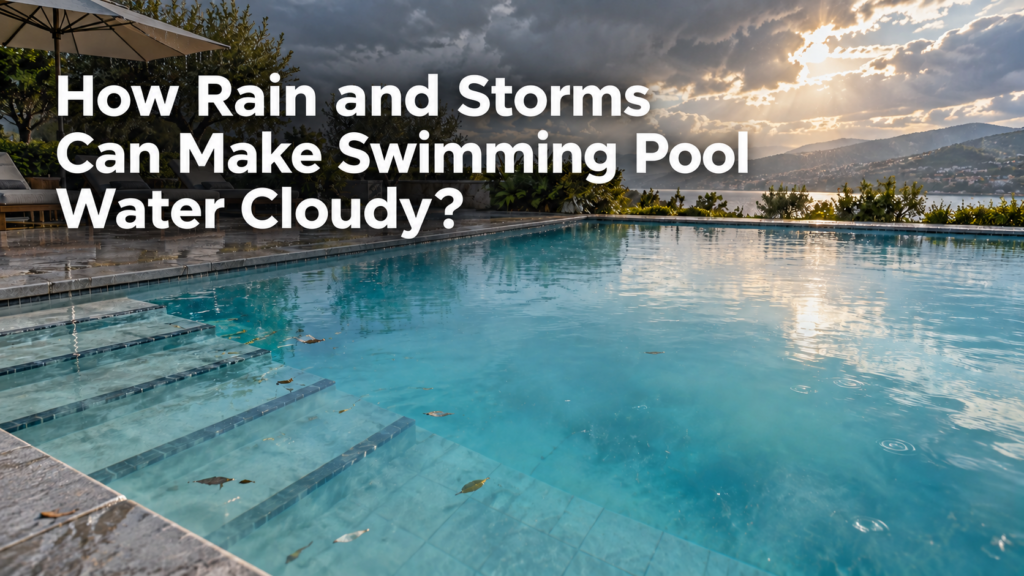
A swimming pool can look bright, blue, and perfectly inviting in the afternoon—then turn dull or cloudy after one night of heavy rain. It feels sudden, but the change is rarely mysterious. A storm does much more than add water. It carries dust, pollen, soil, leaves, organic matter, and airborne pollution into the pool. It can also dilute the pool’s carefully balanced chemistry, increase chlorine demand, disturb circulation, and create favorable conditions for algae.
In other words, the rain itself is only part of the story.
The real trouble comes from everything that arrives with it and everything the extra water changes. For a residential pool, that may mean a disappointing weekend and several hours of cleanup. For a hotel, resort, school, fitness club, or public aquatic center, cloudy water can affect guest confidence, daily operations, and swimmer safety.
So, why does a storm make clear water lose its sparkle? More importantly, how can pool operators restore clarity without throwing one chemical after another into the water? Let’s work through it in a practical order.
Rainwater Is Not Just “More Pool Water”
Fresh rain often looks clean. That makes it easy to assume that a few centimeters of rainfall simply dilute the pool a little. Yet rainwater travels through the atmosphere before reaching the surface, and storm runoff may travel across roofs, paving, soil, landscaping, or a pool deck before entering the basin.
Along the way, it may collect:
- Fine dust and soil particles
- Pollen and plant fragments
- Leaves, insects, and grass clippings
- Soot and airborne pollution
- Bird droppings and other organic contamination
- Fertilizer residues from nearby landscaping
- Oils and dirt washed from the pool deck
Some material is large enough for a skimmer basket or vacuum to remove. The harder fraction is microscopic. These fine particles can remain suspended in the water and scatter light, creating the familiar grey, white, or dull-blue haze.
You may be able to see the main drain before the storm and barely make it out the next morning. That visual change is the combined effect of thousands—or millions—of tiny particles, not necessarily one major chemical failure.
What Actually Happens to Pool Chemistry During a Storm?
Cloudiness after rain is usually a multi-cause problem. A single test result rarely tells the whole story. Heavy rain may change several water conditions at once, and those changes can reinforce one another.
Rain dilutes sanitizer and other dissolved chemicals
When a large volume of rain enters a pool, it dilutes the existing water. Free chlorine, salt, stabilizer, alkalinity, calcium hardness, and other dissolved components may all move away from their previous levels.
The effect depends on rainfall volume, pool depth, overflow, drainage, and whether contaminated runoff entered the water. A brief shower may have little measurable impact. A severe storm that raises the water level substantially can change the treatment balance in a meaningful way.
Dilution alone does not always cause visible cloudiness. The trouble begins when reduced sanitizer residual meets a sudden load of organic matter and microorganisms.
Contamination increases chlorine demand
Storms add leaves, pollen, soil, insects, and other contaminants. Chlorine begins reacting with oxidizable material rather than simply maintaining a protective residual.
That creates a double squeeze: rainfall may lower the sanitizer concentration while incoming contamination makes the sanitizer work harder. If the demand rises faster than the treatment system can respond, the free chlorine residual can fall.
Water may still look acceptable for a short time. Then it becomes dull, hazy, or slightly green as fine debris accumulates and microbial activity begins to increase.
pH and total alkalinity may shift
Rainwater often has relatively low alkalinity, although its exact chemistry varies by location and atmospheric conditions. A substantial amount can lower total alkalinity or contribute to pH movement. Runoff may introduce other substances that push the water in a different direction.
Why does that matter? Because pH affects swimmer comfort, surface protection, sanitizer behavior, and the tendency of minerals to remain dissolved or form deposits.
If pH rises too high, chlorine becomes less effective and calcium carbonate may begin to form a pale haze, especially when calcium hardness and water temperature are also elevated. If pH or alkalinity falls too low, the water can become corrosive. Either condition deserves correction, but the correct response starts with testing—not guessing.
Wind and rain disturb settled material
A storm churns the water. Strong wind drives debris toward the pool, return jets continue moving the water, and rainfall strikes the surface for hours. Material that had settled in corners, on steps, or along the floor may be lifted back into suspension.
Think of shaking a snow globe. The particles were already present, but movement makes them visible again.
This is one reason the pool may look worse during or immediately after the storm. Some of that haze can be removed through patient circulation and filtration, provided the filter is clean and functioning correctly.
The Four Main Types of Post-Storm Cloudiness
Not all cloudy water should be treated in the same way. Before adding a clarifier, algaecide, oxidizer, or pH adjuster, look at the color, timing, test results, pool surfaces, and filter behavior.
1. Suspended dirt, dust, and pollen
This is one of the most common causes after heavy wind or rain. The water may look grey, milky, or simply less brilliant than usual. Chemistry can be close to the target range, yet fine particles remain too small for the filter to capture efficiently.
The first response is physical: skim, brush, vacuum, clean baskets, and run the circulation system. If the remaining particles continue to pass through the filter, a purpose-designed Polymer Pool Clarifier may help gather fine suspended material into larger groups that the filter can retain more easily.
A clarifier supports filtration. It does not replace filtration, and adding extra product is not a shortcut. Too much polymer can restabilize particles or create additional haze, depending on the formulation and water conditions. Follow the finished-product label and use a measured dose.
2. Early algae growth
If sanitizer levels remain low after the storm, warm water and incoming nutrients can give algae an opening. The first sign is not always a vivid green pool. Water may look slightly dull, walls may feel slippery, or steps may develop a faint green tint.
Brush the surfaces and test the sanitizer. If the color becomes more obvious after brushing, biological growth is more likely. Correct the water balance and restore the sanitizer according to the pool’s operating procedure and local requirements.
An appropriate algaecide may support prevention or control as part of a complete treatment program. Eautrix Polyquat 60 Algaecide is a non-foaming, polymer-based option for pool and spa applications. Still, it should not be presented as a substitute for adequate sanitizer, brushing, circulation, or filtration.
Once algae die, they may remain as very fine suspended debris. Oddly enough, successful algae control can make the water look temporarily greyer. The biological problem may be improving while the removal stage is still unfinished.
3. Mineral haze
Storm-related dilution and later chemical correction can change the water’s saturation balance. If pH is high and calcium hardness is already elevated, calcium carbonate may come out of solution and produce a white or pale cloud.
This kind of haze may appear after someone adds an alkaline product, calcium hypochlorite, or another treatment without checking the full water balance. The rain gets blamed because the timing matches, but the visible cloudiness may be linked to the correction that followed.
Test pH, total alkalinity, calcium hardness, and water temperature. A calculated saturation index can provide a clearer picture than any one value alone. Avoid repeatedly adding clarifier when the root cause is mineral precipitation.
4. Filter overload or poor circulation
A pool filter has a finite holding capacity. After a storm, it may receive several days’ worth of dirt in a few hours. Skimmer baskets fill, pump strainers become blocked, filter pressure rises, and flow through the return lines falls.
Even good water chemistry cannot compensate for weak circulation. If the system cannot move contaminated water through the filter, suspended particles stay in the pool.
Check:
- Skimmer and pump baskets
- Water level at the skimmer opening
- Pump operation and priming
- Filter pressure compared with its clean starting pressure
- Return flow at the pool inlets
- Valves, suction lines, and visible air leaks
- Filter cleaning or backwashing needs
For a sand filter, backwash according to the equipment instructions and pressure readings. Clean cartridge elements carefully rather than relying only on a quick spray across the surface. For diatomaceous earth systems, follow the manufacturer’s cleaning and recharge procedure.
Why Storm Runoff Is More Serious Than Direct Rainfall?
Direct rainfall is usually less troublesome than dirty water flowing into the pool from surrounding surfaces. Runoff can carry a concentrated mix of soil, fertilizer, mulch, microbes, oils, and decaying organic matter.
If muddy water crosses the deck and enters the pool, the problem is no longer simple dilution. The incoming solid load may overwhelm the filter, and fertilizer residues may supply nitrogen or phosphorus that supports algae growth.
This is where site design matters. Deck slope, drainage channels, landscaping borders, roof discharge, and the pool’s overflow system should direct stormwater away from the basin. Chemical treatment can clean up an incident, but it cannot permanently fix poor drainage.
For commercial properties, documenting the source of runoff is especially useful. If the same corner of the pool turns cloudy after every storm, walk the site while it is raining—when conditions are safe. The water’s path often reveals the real cause in minutes.
A Practical Recovery Plan After Heavy Rain
The safest recovery sequence moves from inspection to measurement, then from physical removal to chemical correction. Random chemical additions can waste product and make diagnosis harder.
Step 1: Make the pool area safe
Do not approach the pool during lightning, high winds, flooding, or electrical hazards. After the storm has passed, inspect the deck, equipment room, covers, drains, and electrical systems. If equipment has been flooded or damaged, have it checked by a qualified professional before operation.
Cloudy water also reduces visibility below the surface. In a commercial pool, poor visibility of the bottom may require closure under local operating rules. Safety comes before the urge to reopen quickly.
Step 2: Remove large debris first
Use a leaf rake or skimmer to remove leaves, twigs, and other large material. Empty the skimmer baskets and pump strainer basket. Heavy debris should not be sent needlessly through the filter.
Brush steps, walls, ladders, benches, corners, and other low-circulation areas. Vacuum settled dirt using the method appropriate for the filter and contamination level. If there is a large amount of sediment, vacuuming to waste may be appropriate where the system design and local water-discharge rules allow it.
Step 3: Correct the water level
An overfilled pool may not skim the surface effectively. If the water sits above the normal operating level, floating debris can bypass the skimmer opening.
Lower the water only through an approved discharge route. Never drain a pool carelessly after intense rain, especially where groundwater may be high. Excess groundwater pressure can damage or even lift certain pool structures.
Step 4: Test before treating
Measure at least:
- Free chlorine or the relevant sanitizer residual
- Combined chlorine, where applicable
- pH
- Total alkalinity
- Cyanuric acid in stabilized chlorine pools
- Calcium hardness when mineral haze is suspected
- Salt level in saltwater pools, if dilution was substantial
Commercial operators should also follow local testing, recording, and reopening requirements. Use a dependable test method and fresh reagents. A strip can provide a quick screen, but accurate corrective work may call for a suitable drop test or photometer.
Step 5: Restore water balance and sanitizer
Make measured corrections based on the pool volume and test results. Do not pour multiple concentrated chemicals together, and do not add them simultaneously at the same point. Follow product labels for application method, circulation requirements, separation time, and swimmer re-entry.
If the pool has visible algae or unusually high sanitizer demand, use the corrective procedure permitted for that pool and sanitizer system. The required treatment depends on the actual sanitizer, stabilizer level, water condition, and local rules; a universal “add this many scoops” formula is not reliable.
Step 6: Run circulation and monitor the filter
Extended circulation may be needed after a storm. Watch the filter pressure and flow because a dirty filter can load rapidly. Clean or backwash when indicated by the equipment manufacturer or the established pressure rise—not merely because the water looks cloudy.
Then give the system time to work. A filter cannot remove all fine debris in ten minutes. Several turnovers or cleaning cycles may be required, particularly in a large commercial pool.
Step 7: Use a clarifier only when the diagnosis supports it
If chemistry is under control, algae are not actively growing, circulation is sound, and fine suspended particles remain, a compatible clarifier may support removal.
Cationic polymer clarifiers carry positive charges that can interact with many negatively charged particles. This reduces the forces keeping those particles apart and helps them form larger, filterable clusters. It is a little like gathering loose flour into small crumbs: the material becomes easier to catch.
But dosage matters. More is not automatically better. Review the label, confirm compatibility with other recently added products, and avoid stacking several polymer treatments without technical guidance.
Step 8: Re-test before reopening
Clear-looking water is not proof that the water is properly sanitized, and correct chemistry is not proof that visibility is adequate. Confirm both.
Before swimmers return, check that sanitizer and pH meet the applicable operating range, the circulation system works normally, drain covers and fittings are secure, and the pool bottom is clearly visible. Commercial facilities should follow their written operating procedure and local health regulations.
Common Post-Storm Mistakes—And Why They Backfire
The pressure to clear a pool quickly can lead to hurried decisions. These are among the most common.
Adding every available chemical
An operator sees cloudy water and adds shock, algaecide, clarifier, phosphate remover, and pH adjuster within a short period. Each product may have a valid use, but together they can react, interfere, or overload the water with treatment chemicals.
Test first. Identify the strongest evidence. Treat the cause in a logical order.
Assuming cloudy water always means algae
Algae are one possibility, not the only one. Fine soil, pollen, mineral precipitation, air entering the circulation system, poor filtration, and dead algae can all create cloudy water.
Color, surface feel, sanitizer demand, filter behavior, and microscopic examination—where available—can help distinguish causes.
Overdosing clarifier
A correctly dosed polymer clarifier can improve filtration. An excessive dose may coat filter media, create sticky deposits, or leave particles suspended. When the first dose does not produce instant results, adding more too soon can make the situation harder to correct.
Backwashing too often
A slightly loaded sand filter may capture fine particles better than a freshly backwashed one. Backwashing on a fixed, overly frequent schedule can waste water and reduce filtration efficiency. Use the filter’s pressure change and manufacturer guidance.
Ignoring the source of runoff
If soil and landscape water enter the pool after every storm, chemical cleanup becomes an expensive routine. Improving drainage, adding barriers, adjusting deck grading, or redirecting roof water may prevent more cloudiness than any treatment product.
Can a Pool Clarifier Fix Storm-Clouded Water?
Sometimes, yes—but only when fine suspended particles are the main remaining problem.
A pool clarifier is especially relevant when:
- Water chemistry has been tested and corrected
- The sanitizer residual is appropriate
- Active algae growth is not the main issue
- The pump and filter are operating correctly
- Fine haze persists after physical cleaning and circulation
It is less likely to solve the problem when the pool has an active algae bloom, severe mineral imbalance, poor circulation, a damaged filter, or continuing runoff contamination.
This distinction matters for both pool owners and chemical brands. A well-designed clarifier can do its job beautifully, but no clarifier can repair a broken pump or stop mud from flowing across the deck.
How to Reduce Cloudiness Before the Next Storm?
Weather cannot be controlled. Preparation can.
Before a forecast storm, pool operators can:
- Remove loose leaves and debris from the deck and nearby drains
- Empty skimmer and pump baskets
- Confirm normal circulation and filter pressure
- Test and adjust water within the approved operating range
- Secure lightweight furniture, covers, and chemical containers
- Check that roof drains and landscape runoff lead away from the pool
- Maintain a suitable sanitizer residual without exceeding label or regulatory limits
Do not drain a pool simply because heavy rain is forecast. Do not add a large “insurance dose” of chemicals without testing and label support. Preparation should keep the system stable, not create a second problem before the storm arrives.
For seasonal closures, an off-season treatment plan may also reduce algae and spring cleanup. A formulated Winter Algaecide can be considered as one part of that program, alongside correct closing chemistry, physical cleaning, circulation procedures, and a suitable cover.
Commercial Pools Need a Written Storm Response
Hotels, resorts, water parks, schools, and community pools have more at stake than appearance alone. A storm may affect several systems at once: water chemistry, deck drainage, electrical equipment, outdoor furniture, circulation, and public access.
A short written response plan helps staff act consistently. It can include:
- Conditions that require immediate pool closure
- Post-storm inspection responsibilities
- Required water tests and acceptable operating ranges
- Filter and pump inspection steps
- Rules for chemical approval and dosing records
- Visibility criteria for reopening
- Escalation contacts for electrical, structural, or water-quality concerns
The plan does not need to be complicated. In fact, simple and specific is better. Who tests the water? Who decides whether to close? Who records the corrective dose? Who confirms that the main drain is visible? Clear ownership prevents rushed assumptions.
Clear Water Returns Faster When the Cause Is Clear
Rain and storms make swimming pool water cloudy through a chain of events. They add fine particles and organic contamination, dilute treatment chemicals, increase sanitizer demand, disturb settled debris, and place extra strain on the circulation and filtration system. If conditions remain favorable, algae or mineral haze may add another layer to the problem.
The fastest route back to clear water is not usually the largest chemical dose. It is a calm sequence: inspect, remove debris, test, correct, circulate, filter, and then apply a compatible clarifier or algaecide only when the evidence supports it.
That approach saves chemicals, protects equipment, and produces a more reliable result. Better still, it turns the next storm from a pool emergency into a manageable maintenance event.
Frequently Asked Questions
1. Why is my pool cloudy after heavy rain even though the chlorine level is normal?
Rain and wind can add fine dust, pollen, soil, and organic debris that remain suspended even when the chlorine residual tests within range. Check filtration, circulation, pH, total alkalinity, and signs of mineral haze or early algae before selecting a treatment.
2. How long should I run my pool pump after a storm?
Run the circulation system long enough to filter the added contamination, while monitoring filter pressure and flow. The exact time depends on pool volume, pump flow, filter condition, and debris load. Severe cloudiness may require extended circulation and one or more filter-cleaning cycles.
3. Should I add pool clarifier immediately after rain?
Not automatically. First remove debris, test the water, correct sanitizer and balance, and confirm that the filter works properly. Add a compatible pool clarifier only when fine suspended particles remain and the product label supports its use under those conditions.
4. Can heavy rain cause algae in a swimming pool?
Heavy rain can create conditions that favor algae by diluting sanitizer, adding nutrients and organic matter, and increasing chlorine demand. Rain does not guarantee an algae bloom, but delayed testing, weak circulation, warm water, and low sanitizer residual make growth more likely.
5. Is it safe to swim in a cloudy pool after a thunderstorm?
Do not swim during lightning or while electrical hazards remain. After the storm, wait until water chemistry meets the required range, equipment is safe, and the pool bottom and drains are clearly visible. Cloudiness can hide a swimmer in distress, so visual clarity is a safety requirement, not merely a cosmetic preference.