
GET IN TOUCH
Ask For Sample?
Why Does Swimming Pool Water Become Cloudy?
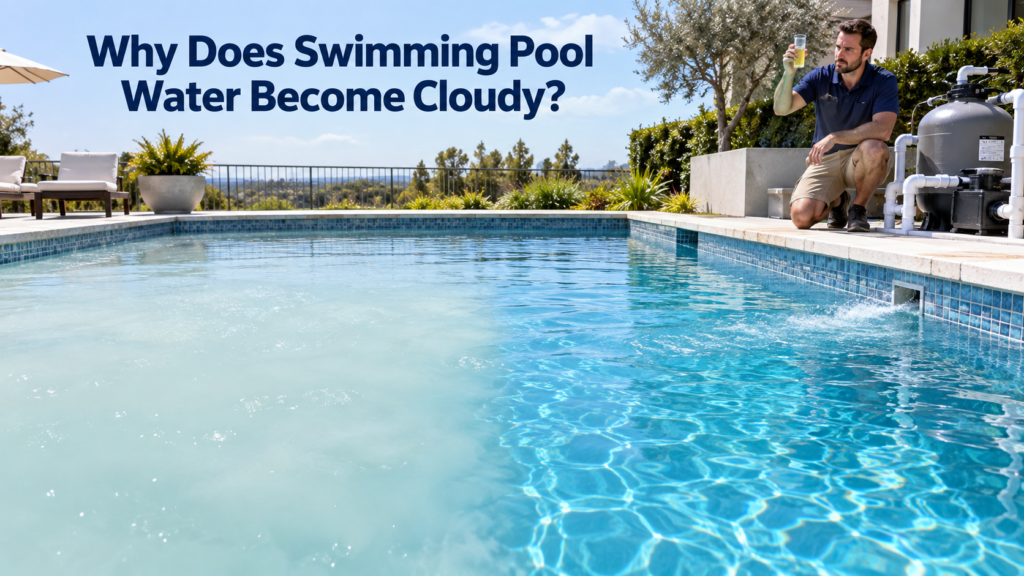
A clear swimming pool can turn dull surprisingly fast. One evening, the water looks bright enough to reveal every line on the floor. The next morning, it has a pale haze, the deep end looks distant, and the underwater light seems to glow inside a glass of diluted milk.
What happened?
Cloudy pool water is rarely caused by one mysterious event. It is usually the visible result of tiny particles staying suspended in the water. Those particles may be dust, body oils, dead algae, mineral deposits, pollen, microorganisms, or fragments of organic matter. In a healthy pool, good sanitation, circulation, and filtration keep these materials under control. When one part of that system falls behind, the water loses its shine.
The useful question, then, is not simply, “What chemical should I add?” It is, “Why are these particles still in the pool?” Once you answer that, the right treatment becomes much easier to choose.
What Does “Cloudy Pool Water” Actually Mean?
Cloudiness is a loss of water transparency. Light enters the pool, strikes suspended material, and scatters instead of travelling cleanly through the water. Your eyes see the scattered light as haze.
Some particles are large enough for a filter to capture easily. Others are so small that they pass through the filter media or remain suspended for a long time. A pool can therefore look cloudy even when the particles are invisible one by one. Think of a beam of sunlight crossing a dusty room. You do not notice each speck until the light reveals the whole floating crowd.
Cloudiness can appear in several forms:
- White or grey haze often points to fine debris, mineral precipitation, unbalanced water, or filtration trouble.
- Cloudy green water often suggests algae, although dissolved metals or other issues can also affect colour.
- Dull blue water may be chemically close to normal but still contain fine suspended material that the filter has not removed.
- Cloudiness after treatment may come from dead algae, precipitated minerals, incompatible additions, or chemicals added too quickly.
Colour offers a clue, not a diagnosis. Testing the water and inspecting the equipment still matter.
Low Free Chlorine Lets Contaminants Gain Ground
Free chlorine is the portion of chlorine available to disinfect the water and oxidize many contaminants. When its level drops too low for the pool’s conditions, organic matter and microorganisms can accumulate faster than the treatment system removes them.
The demand on chlorine rises when swimmers bring sweat, cosmetics, skin cells, dirt, and other material into the pool. Rain, leaves, pollen, warm weather, and intense sunlight can add more pressure. A pool party that looked perfectly ordinary on Saturday may leave the water dull by Sunday morning.
Low free chlorine can also give algae a chance to grow. Early algae growth is not always a bright green carpet. It may begin as a faint loss of sparkle, slightly slippery walls, or a persistent haze. By the time the water is obviously green, the problem has usually moved beyond its earliest stage.
Still, cloudy water does not automatically mean that the pool merely “needs more chlorine.” A test result must be interpreted in context. Stabilized outdoor pools, indoor pools, spas, and public facilities may follow different operating ranges and local regulations. Cyanuric acid also changes how outdoor chlorine behaves. Follow the chemical label and the rules that apply where the pool is operated.
Combined Chlorine Can Signal a Growing Contaminant Load
When chlorine reacts with nitrogen-containing contaminants, it can form chloramines. Pool operators often estimate this condition by subtracting free chlorine from total chlorine; the difference is called combined chlorine.
Chloramines are associated with that sharp “chlorine” smell many people recognize around a poorly managed pool. Oddly enough, a strong smell does not necessarily mean there is plenty of effective chlorine. It may indicate that chlorine has been reacting with a heavy contaminant load. The CDC explains that chlorine can combine with sweat, dirt, skin cells, cosmetics, and other swimmer-introduced matter to form chloramines. (CDC)
Cloudiness, odour, and eye irritation can appear together, but they do not always share one cause. The key is to measure free chlorine, total chlorine, and pH rather than judging the pool by smell alone. Your nose is useful, but it is not a photometer.
Poor Filtration Is One of the Most Common Culprits
Pool water can be chemically balanced and still look cloudy if the filtration system cannot remove suspended material.
A filter may underperform because it is dirty, damaged, undersized, channelled, or operated for too few hours. Flow can also fall when baskets are packed with debris, the impeller is obstructed, valves are incorrectly positioned, or the water level is too low for reliable skimming. Even a sound filter needs enough circulation time to process the water.
Check the entire path, not just the filter tank:
- Is water moving strongly from the return inlets?
- Are the skimmer and pump baskets clean?
- Is the filter pressure unusually high or unexpectedly low?
- Does the pressure gauge return to its normal clean reading after service?
- Is filter media in good condition?
- Are return jets positioned to reduce dead spots?
- Is the pump operating long enough for the pool’s size, temperature, and bathing load?
Different filter types fail in different ways. A sand filter may develop channels or need maintenance. A cartridge may be coated with oils or clogged deep within its pleats. A diatomaceous earth filter may have damaged grids or an incorrect media charge. Follow the equipment manufacturer’s instructions; random backwashing or aggressive cleaning is not always helpful.
Here is the practical truth: chemicals can condition particles, but the particles still have to leave the water. Most of that work belongs to circulation, filtration, brushing, and vacuuming.
Fine Suspended Particles May Be Too Small to Catch Easily
Wind-blown dust, clay, sunscreen residue, pollen, and fragments of dead algae can remain in suspension. Individually, these particles are tiny. Together, they scatter enough light to make the pool look flat or milky.
This is where a pool clarifier may help—after the main cause has been identified and basic water balance and filtration have been checked. A clarifier conditions small particles so they form larger groups that a working filter can capture more easily.
Eautrix Polymer Pool Clarifier is designed for this supporting role in swimming pool water treatment. It should not be treated as a replacement for sanitizer, algae control, or equipment maintenance.
More is not necessarily better. Overdosing some clarifiers can make filtration harder or leave the water looking no better than before. Product strength also differs, so dosage must come from the label or the supplier’s technical guidance—not from a generic capful copied from an unrelated product.
Algae Can Make Water Cloudy Before It Looks Green
Algae thrive when several favourable conditions meet: nutrients, warm water, sunlight, weak sanitizer control, and areas with poor circulation. A wall step, ladder recess, light niche, or quiet corner can become the first hiding place.
During an active bloom, algae cells cloud the water. After treatment, dead cells may continue to produce a grey-blue or pale green haze until the filter removes them. That is why a pool may change from green to blue but remain cloudy for a while. The algae may have been controlled, yet the cleanup is not finished.
Brush the walls and floor, maintain suitable circulation, clean the filter as required, and vacuum settled material. If a maintenance program calls for a non-foaming polymeric algaecide, Eautrix Polyquat 60 Algaecide may be considered according to its label and formulation purpose.
An algaecide is not automatically a primary sanitizer, and a clarifier is not automatically an algaecide. Related pool products may support the same goal—cleaner water—while doing very different jobs. That small distinction prevents a lot of expensive trial and error.
High pH Can Turn Clear Water Hazy
Pool pH affects swimmer comfort, sanitizer performance, equipment, and the tendency of minerals to precipitate. When pH becomes too high, calcium carbonate is more likely to leave solution and form fine particles. These particles can make the water look white or cloudy and may eventually form scale on surfaces and equipment.
High pH can result from source water, aeration, certain treatment chemicals, plaster curing, or repeated additions intended to raise alkalinity or pH. It should be corrected gradually with an appropriate product, reliable testing, and close attention to the label.
The opposite condition is not desirable either. Very low pH can make water aggressive toward plaster, grout, heaters, and metal components. Clear-looking water is not proof of healthy water balance.
For many pools, commonly referenced pH guidance falls around 7.2 to 7.8, though the exact operating target should follow applicable codes, sanitizer system requirements, surface type, and professional guidance. The CDC recommends maintaining home pool or hot-tub pH between 7.0 and 7.8. (CDC) Measure first. Adjust second.
Total Alkalinity Influences pH Stability
Total alkalinity describes the water’s ability to resist sudden pH changes. If it is too low, pH may swing easily. If it is too high, pH can become difficult to lower and may drift upward under aeration.
High alkalinity does not always create cloudiness on its own, yet it can help produce conditions in which calcium carbonate precipitates. This is why repeatedly treating only the pH reading may feel like pushing a beach ball underwater: it pops back up because the underlying balance has not been corrected.
Adjust alkalinity and pH as connected variables. Make measured changes, allow the water to circulate, and retest before adding more product.
Calcium Hardness Can Be Too High—or Too Low
Calcium hardness is the amount of dissolved calcium in pool water. Excess calcium, especially when combined with high pH, high alkalinity, and warm water, increases the risk of scale and cloudy water. Fresh chemical additions can sometimes trigger a visible white cloud as calcium carbonate precipitates.
Low calcium presents a different concern, particularly in plaster or concrete pools. Water with insufficient calcium may become aggressive toward calcium-containing surfaces. Vinyl-lined and fiberglass pools have different needs, so one universal target does not fit every construction type.
Pool professionals often assess the broader saturation balance rather than looking at calcium alone. Temperature, pH, alkalinity, calcium hardness, and dissolved solids interact. A calcium result that seems acceptable on its own may behave differently when the water is hot and the pH is high.
If fill water contains high calcium, repeated draining and refilling may not solve the root problem. Partial water replacement with a more suitable source, specialized treatment, or professional advice may be needed.
Swimmers Bring More Than Towels
Busy pools can turn cloudy even when the equipment is working. Every swimmer adds a small organic load: sweat, body oils, hair products, sunscreen, cosmetics, fabric fibres, and traces of dirt. Add a hot afternoon, twenty energetic children, and a modest residential filter, and the system may struggle.
This is why commercial pools and heavily used residential pools need maintenance routines matched to actual bathing load. A schedule built for two quiet swimmers may not cope with a holiday gathering.
Simple habits help:
- Encourage swimmers to shower before entering.
- Keep soil, grass, and food away from the pool edge.
- Maintain sanitizer throughout the day, not only after closing.
- Empty baskets and inspect circulation after heavy use.
- Test more frequently during hot weather and busy periods.
It sounds almost too ordinary, but cleaner swimmers really do mean less work for the water-treatment system.
Rain, Wind, and Source Water Can Change the Picture Overnight
A storm can deliver dust, pollen, leaves, soil, and microorganisms. Heavy rain may dilute treatment levels or alter water balance. Runoff is even more troublesome because it can carry fine earth and organic matter directly into the pool.
Source water can also introduce hardness, metals, suspended sediment, or unusual alkalinity. If cloudiness appears immediately after topping up or filling the pool, test both the pool and the source. That comparison may reveal more than another round of pool-side guessing.
After severe weather, remove debris, restore the normal water level, verify circulation, test the key parameters, and follow the pool’s treatment plan. Do not mix chemicals in a bucket or pour different products together. Add each product separately according to its label.
Incorrect Chemical Addition Can Create a Cloud of Its Own
Sometimes the treatment causes the visible haze—not because the product is defective, but because it was selected, dosed, or added incorrectly.
Common mistakes include:
- Adding too much clarifier or algaecide
- Adding products without allowing enough circulation time between them
- Pouring incompatible chemicals into the same location
- Raising pH, alkalinity, or calcium too quickly
- Adding calcium-containing material to water already prone to scaling
- Testing too soon after treatment, before the water has mixed
- Using a consumer-ready dosage for a concentrated industrial raw material
Concentration matters. Two liquids with similar names may contain very different amounts of active ingredient. A 60% raw-material concentrate cannot be dosed as if it were a diluted retail product.
Never combine pool chemicals outside the pool unless a validated formulation and controlled manufacturing process specifically require it. Keep products in their original containers, use clean measuring tools, and follow the safety data and label instructions.
A New or Recently Resurfaced Pool May Look Cloudy
Fresh plaster and cementitious surfaces can affect water chemistry as they cure. Dust from construction or resurfacing may also remain in the system. These pools often need a carefully managed start-up process involving brushing, filtration, and frequent testing.
This is not a good moment for improvisation. Surface manufacturers and experienced start-up professionals may specify a particular sequence to protect the finish. The wrong chemistry can leave scale, staining, roughness, or permanent appearance problems.
Why Is the Pool Still Cloudy After Shocking?
Shock treatment may oxidize contaminants or help control an algae problem, but it does not physically remove every resulting particle. After algae die, their remains can stay suspended. A filter with poor flow, dirty media, or insufficient operating time may take much longer to clear them.
High-dose treatment can also temporarily disturb water balance or create precipitates under certain conditions. If the pool remains cloudy after treatment, do not keep adding more shock blindly. Recheck sanitizer, pH, filter pressure, circulation, and the appearance of pool surfaces. Brush, vacuum, and service the filter where required.
Also remember that some test methods can produce misleading readings outside their intended range. If the result makes no sense, confirm it with a suitable test method or a qualified pool professional.
Is Cloudy Pool Water Safe for Swimming?
Do not assume that cloudy water is safe simply because it does not smell bad or look green. Cloudiness can accompany inadequate disinfection, and poor visibility creates a separate safety hazard. If a swimmer in trouble cannot be seen clearly at the bottom, rescue can be delayed.
As a sensible rule, avoid swimming when the water is unusually cloudy, when the pool floor or main drain cannot be seen clearly, or when sanitizer and pH have not been verified. The CDC also advises swimmers to avoid unusually cloudy water. (CDC) Public and commercial operators must follow their local closure and visibility requirements.
This is not about making the water Instagram-perfect. It is about seeing people, seeing hazards, and knowing that the treatment system is under control.
How to Diagnose Cloudy Pool Water Step by Step
When the water turns cloudy, resist the temptation to add three products at once. Multiple additions can hide the original cause and create a second problem.
Use a simple sequence:
- Stop swimming if visibility is poor. Confirm that the deepest point and required safety markers are clearly visible.
- Inspect the pool. Note the colour, wall texture, debris, recent weather, bather load, and any treatments already added.
- Test the water. At minimum, check free chlorine, total chlorine, and pH. Depending on the situation, also check alkalinity, calcium hardness, cyanuric acid, temperature, and other system-specific parameters.
- Verify circulation. Inspect the water level, skimmers, pump basket, return flow, valves, and obvious air leaks.
- Check the filter. Compare pressure with the clean operating pressure and inspect or service the media according to the manufacturer’s directions.
- Brush and vacuum. Move settled material toward removal and pay attention to corners and steps.
- Correct the cause. Balance the water, restore sanitizer, control algae, or repair filtration as the evidence indicates.
- Use a clarifier only when appropriate. If fine suspended particles remain and the filter is working, a correctly dosed clarifier may help.
- Allow time to circulate and filter. Then retest. Clear water is a process, not always a five-minute reaction.
Record what you measured and what you added. Even a short maintenance log can reveal patterns: cloudiness after every storm, pressure rising too quickly, sanitizer falling after busy weekends, or pH climbing whenever aeration increases.
How Long Does It Take to Clear a Cloudy Pool?
There is no honest universal answer. Slight haze caused by fine particles may improve after proper filtration and corrective treatment within a day. A significant algae bloom, severe water imbalance, high calcium condition, or equipment problem may take several days and more than one maintenance cycle.
The deciding factors include:
- The cause and severity of the cloudiness
- Pool volume and turnover conditions
- Filter type, condition, and size
- Water temperature
- Amount of suspended material
- Whether algae are still active
- Accuracy of diagnosis and treatment
If the water is not steadily improving, pause and reassess. Repeating the same addition without evidence is not persistence; it is just expensive guessing.
How Can You Prevent Cloudy Water?
Prevention is less dramatic than rescuing a milky pool, but it costs less and causes fewer headaches.
Maintain a testing schedule based on pool use and local requirements. Keep sanitizer and pH in their intended ranges. Clean baskets, watch filter pressure, brush low-circulation areas, and remove leaves before they break down. Increase monitoring after storms, heat waves, and heavy swimmer use.
Algae prevention may form part of a broader maintenance program, particularly in warm conditions or pools with recurring algae pressure. During seasonal closure, a purpose-designed Winter Algaecide can support off-season algae control when used as part of a complete winterization procedure.
The phrase “complete procedure” matters. No single bottle can compensate for poor balance, dirty water, unsuitable sanitizer conditions, or a cover full of debris. Good pool care works like a team: chemistry, circulation, filtration, cleaning, and consistent observation each do their part.
Clear Water Begins with the Right Diagnosis
Swimming pool water becomes cloudy when fine material accumulates faster than the pool can destroy, capture, or remove it. Low sanitizer, early algae growth, overloaded water, unbalanced pH, high calcium, weak circulation, filter trouble, weather, and incorrect chemical additions can all lead to the same visible symptom.
That shared symptom is why diagnosis matters so much. A clarifier can help a sound filter capture fine particles, but it cannot repair a broken pump. An algaecide can support algae control, but it cannot replace an approved sanitizer. Extra chlorine may address certain contaminants, but it will not correct high calcium or damaged filter media.
Test. Inspect. Correct the cause. Then give the system time to do its work.
When those steps are followed in the right order, cloudy water becomes much less mysterious—and clear water becomes far easier to maintain.
Frequently Asked Questions
Why is my pool cloudy even when chlorine and pH look normal?
The water may contain fine dust, pollen, dead algae, oils, or mineral particles that a poorly performing filter has not removed. Check circulation, filter pressure, media condition, alkalinity, calcium hardness, and the accuracy of the test results before adding more chemicals.
Can I use a polymer pool clarifier to clear cloudy water?
Yes, a compatible polymer pool clarifier may help a working filter capture very fine suspended particles. First correct active algae, sanitizer problems, water imbalance, and equipment faults. Follow the product dosage because overdosing may reduce performance.
Why did my pool become cloudy after adding shock treatment?
Shock treatment can leave dead algae and oxidized organic material suspended in the water. It may also contribute to temporary mineral precipitation when the water is already prone to scale. Maintain filtration, brush and vacuum the pool, check pH and calcium balance, and avoid repeated blind dosing.
Can too much algaecide make a swimming pool cloudy?
Yes. Excess product, formulation incompatibility, or incorrect use of a concentrated raw material may cause haze, residue, or foam depending on the chemistry. Use the exact label dose and never assume all algaecides have the same active concentration.
How do I clear cloudy pool water without making the problem worse?
Stop swimming if visibility is poor, test the water, inspect circulation and filtration, remove debris, and correct the identified cause one step at a time. Allow each treatment to circulate before retesting. Add a clarifier only when fine suspended particles remain and the filter is functioning properly.