
GET IN TOUCH
Ask For Sample?
How Dust, Pollen, and Fine Debris Affect Pool Water Clarity?
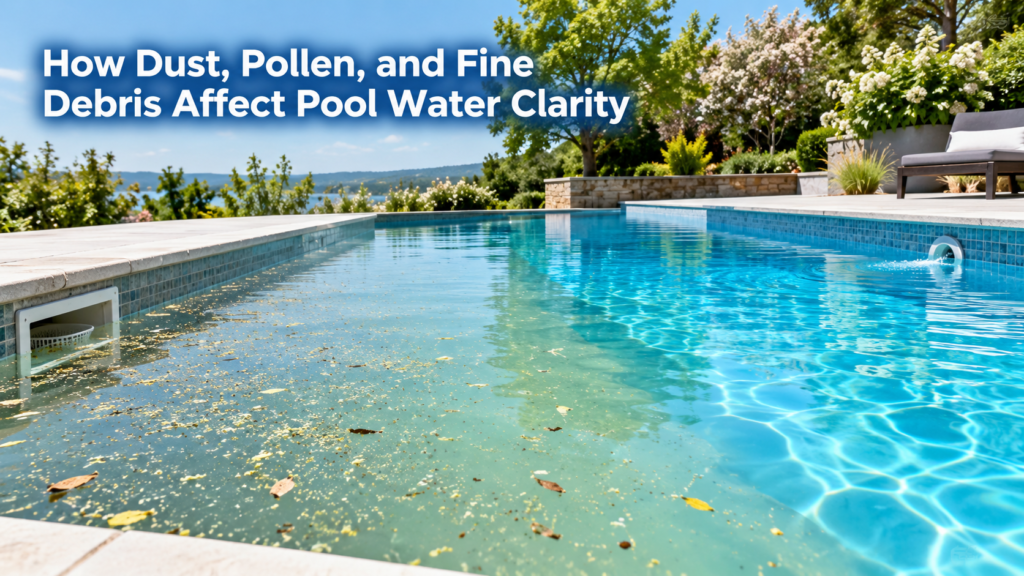
A swimming pool can look perfect in the morning and slightly hazy by late afternoon. The sanitizer level may be correct. The pH may be within range. The filtration system may be running normally. Still, something seems off.
The water has lost its sparkle.
In many cases, the cause is not a major chemical failure. It is a quiet buildup of dust, pollen, soil, plant fragments, and other fine debris. These particles enter the pool every day, often without anyone noticing. Some float on the surface, some sink, and the smallest ones remain suspended in the water.
That last group creates the real clarity problem.
Fine particles scatter light as it passes through the pool. Instead of seeing crisp tile lines and a sharply defined main drain, swimmers see a soft, milky, or dull appearance. The water may still look blue, but it no longer looks truly clear.
So, where do all these particles come from—and why can they be so difficult to remove?
Outdoor Pools Are Natural Particle Collectors
An outdoor pool is essentially a large, open container of moving water. Wind carries material into it from gardens, roads, construction sites, trees, roofs, and nearby fields.
Even a pool surrounded by a clean deck receives airborne contamination.
Common sources include:
- Windblown soil and road dust
- Tree and grass pollen
- Smoke and other airborne particles
- Small leaf fragments
- Insect remains
- Sand carried on swimmers’ feet
- Fibers from towels and clothing
- Skin cells, hair, and cosmetic residues
- Soil washed from the deck during rain
- Material released from landscaping work
Large leaves and insects are easy to notice. A skimmer basket or leaf net can usually remove them.
Fine debris behaves differently. It may be too small to see as an individual particle, yet thousands or millions of these particles can remain in the water at the same time. Together, they change how light travels through the pool.
The result is familiar: the water looks dusty, smoky, or faintly cloudy, especially when viewed across the length of the pool.
Why Tiny Particles Have Such a Big Visual Effect?
Water clarity is largely about light.
When pool water contains very little suspended matter, light travels through it with limited interference. Pool surfaces appear sharp, reflections look bright, and the deep end remains clearly visible.
When fine particles enter the water, they absorb and scatter some of that light. The more suspended material the pool contains, the more noticeable the haze becomes. This optical effect is commonly described as turbidity.
The U.S. Environmental Protection Agency explains that clear water contains low concentrations of suspended particles, while turbid water contains enough particles to absorb and scatter light.
That is why a surprisingly small quantity of dust can affect a large pool. The particles do not need to turn the water brown. They only need to remain suspended long enough to interfere with light.
You may notice the effect most clearly:
- At night when underwater lights are switched on
- When sunlight enters the water at a low angle
- When looking from the shallow end toward the deep end
- After swimmers disturb settled material
- After brushing the walls or floor
- During periods of heavy pollen
- Following dry, windy weather
Underwater lights are especially revealing. Their beams make suspended particles visible, rather like dust floating through a sunbeam inside a room.
Dust: Small, Persistent, and Easy to Overlook
Dust is not one single substance. It can contain mineral particles, dry soil, organic matter, tire residue, fibers, soot, and fragments from nearby construction or landscaping.
A windy day can deliver a considerable amount of this material to an uncovered pool.
Some dust settles quickly. A pool vacuum can remove it from the floor. However, the finest fraction may remain suspended for hours or even days. Normal swimming activity, return jets, automatic cleaners, and brushing can keep lifting it back into the water.
Dust can also enter after rainfall. Rain washes material from the air and surrounding surfaces. Water flowing from a dirty deck, roof, or planting area may carry an even heavier particle load.
This explains why a pool can become cloudy after a storm even when the rain itself looked clean.
The problem is not always the rainwater. It is everything the rain brings with it.
Pollen Can Look Like Algae—But It Behaves Differently
Pollen causes a different kind of confusion.
During spring and early summer, trees, flowers, weeds, and grasses can release enormous amounts of pollen. Depending on the plant species, it may appear yellow, greenish, cream, or light brown.
Some pollen floats and collects along the waterline. Some gathers in corners where circulation is weak. Smaller grains may become dispersed throughout the pool.
From a distance, a layer of yellow-green pollen can resemble early algae growth. Yet the two problems are not the same.
Pollen usually:
- Accumulates quickly during a local pollen event
- Collects at the surface or along the waterline
- Moves when the water is disturbed
- Feels dusty or powdery rather than slimy
- Does not cling firmly to walls in the same way established algae may
- Returns rapidly when nearby trees continue releasing pollen
Algae, by contrast, grows in the pool. It may attach to surfaces, spread into low-circulation areas, consume sanitizer, and return if the biological cause is not controlled.
There is a catch, though. Pollen is organic material. If it remains in the pool, it can increase the workload on the sanitation and filtration systems. So, while pollen is not algae, ignoring it may help create conditions in which water quality becomes harder to maintain.
Fine Debris Does More Than Make Water Look Dull
Cloudiness is the most obvious effect, but it is not the only one.
Debris can consume part of the pool’s disinfectant capacity. The CDC notes that dirt and material carried into pool water can reduce chlorine concentration, while filtration helps remove debris that would otherwise use up disinfectant needed for controlling germs.
This creates a chain reaction:
- Dust, pollen, and organic matter enter the pool.
- The filter must handle a greater solids load.
- Organic material raises sanitizer demand.
- Fine particles remain suspended if the filter cannot capture them efficiently.
- Water loses clarity.
- Poor clarity makes inspection and supervision more difficult.
In a residential pool, dull water is frustrating. In a hotel, resort, school, health club, or public facility, it can become an operational concern.
Guests judge a pool in seconds. If they cannot see the floor clearly, they rarely think, “The water probably contains harmless pollen.” They think the pool is dirty.
More importantly, bottom visibility supports swimmer safety. Pool staff must be able to see drains, steps, objects, and people below the surface. Clear water is not merely decorative.
Why the Filter May Struggle with Fine Particles?
Pool filtration systems continuously circulate water and trap suspended material. The U.S. Geological Survey describes filtration as one of the main physical processes used to remove particles from swimming pools.
However, no filter captures every particle in a single pass.
The result depends on several factors:
- Filter type
- Filter condition
- Media quality
- Flow rate
- Circulation pattern
- Pump run time
- Particle size
- Particle charge
- Overall debris load
Large particles are usually captured without much trouble. Very small particles may pass through the filter media and return to the pool.
Some fine particles also carry similar electrical surface charges. Because like charges repel, these particles resist coming together. They remain separate, stable, and small—exactly the form that can be difficult for a filter to capture.
Think of a crowd of people who all insist on maintaining personal space. They never form a group large enough for the filter to stop them.
Meanwhile, the pool continues circulating. The particles pass through the plumbing again and again, and the water keeps its faint haze.
“Balanced Chemistry” Does Not Always Mean Clear Water
This point causes plenty of confusion.
A pool operator checks the water and finds that pH and sanitizer levels are acceptable. Yet the water remains cloudy. The immediate reaction is often to add more chlorine.
Sometimes extra oxidation is necessary, particularly when there is algae or a high organic load. But chlorine is not a mechanical particle remover. It cannot make mineral dust disappear, and it does not automatically make every tiny particle large enough for the filter to capture.
Balanced chemistry and clear water are connected, but they are not identical.
Good pool maintenance needs both:
- Chemical control, which manages pH, sanitizer residual, alkalinity, and related water conditions
- Physical removal, which takes suspended and settled material out of the water
If the problem is primarily dust or pollen, repeatedly increasing sanitizer may not solve the visible haze. The operator must improve debris removal as well.
Start with the Simple Physical Steps
Before adding a clarifying product, reduce the particle load by mechanical means.
First, empty the skimmer and pump baskets. A basket packed with leaves, flowers, or insects restricts water movement and reduces surface-cleaning performance.
Next, skim floating pollen and debris. A fine-mesh net often catches smaller material more effectively than a standard leaf net.
Brush the walls, steps, benches, and floor. This loosens settled material and moves it toward the circulation system. If the pool contains heavy deposits, brush gently. Aggressive brushing can create a sudden cloud that overwhelms an already loaded filter.
Vacuum settled debris. When the system and local water restrictions permit, very heavy contamination may need to be vacuumed to waste rather than sent through the filter.
Then inspect the filter pressure and flow. A dirty filter can restrict circulation, but backwashing too frequently can also be unhelpful in some systems. Follow the equipment manufacturer’s instructions and clean the filter when the pressure change or operating condition indicates that service is needed.
Finally, give the system enough time. One turnover does not mean every drop of water has passed through the filter once. Filtered water mixes continuously with unfiltered water, so clarity improves gradually rather than all at once.
When a Pool Clarifier Can Help?
If the chemistry is suitable, circulation is working, and fine particles still pass through the filter, a polymer pool clarifier may help.
A cationic polymer carries positive charge sites. Many suspended particles in pool water have negatively charged surfaces. When the polymer is correctly dispersed, it can interact with these particles, reduce their electrical repulsion, and help them form larger clusters.
These clusters are often called microflocs.
The particles do not magically vanish. They become easier for the filtration system to capture. That distinction matters.
The sequence looks like this:
- Tiny particles remain dispersed in the pool.
- A suitable polymer is added at the recommended dose.
- The polymer interacts with particle surfaces.
- Small particles gather into larger filterable groups.
- Circulation carries those groups to the filter.
- The filter removes them from the water.
- Pool clarity gradually improves.
This is the same broad principle behind coagulation and flocculation in water treatment: small particles are brought together so later separation becomes easier. The CDC describes coagulation as the addition of treatment chemicals that help bind small particles together, followed by the formation of larger flocs that can be removed.
For routine pool polishing and mild haze, a clarifier is generally designed to work with normal filtration. It is different from a heavy flocculant treatment that aims to create material large enough to settle for vacuum removal.
To learn more about this mechanism, see What Is a Polymer Pool Clarifier and How Does It Work?.
More Clarifier Is Not Necessarily Better
Cloudy water makes people impatient. That is understandable. A weekend event is approaching, guests are arriving, or the pool simply looked better yesterday.
So another dose goes in. Then another.
Unfortunately, polymer overdosing may reduce performance. Too much product can interfere with particle aggregation, leave the water difficult to filter, or increase filter loading. Exact effects depend on the formulation, water conditions, and filtration system, but the central lesson is simple: dose by pool volume and product directions, not by frustration.
Before applying a clarifier:
- Confirm the pool volume.
- Test pH and sanitizer.
- Remove large debris.
- Make sure circulation is functioning.
- Check whether another clarifier or flocculant was recently used.
- Read the product label.
- Measure the dose carefully.
- Allow time for circulation and filtration.
For buyers developing their own finished product, the active polymer concentration, viscosity, dilution behavior, packaging, and label directions should be considered together. A formula that performs well in one concentration cannot simply be copied into another package with unchanged directions.
Eautrix supplies Polymer Pool Clarifier based on PolyDADMAC technology for bulk, customized, and private-label requirements.
Dust and Pollen Problems Need Seasonal Planning
Particle contamination is rarely constant throughout the year.
Spring may bring tree pollen. Early summer can bring grass pollen and seed material. Hot, dry weather increases dust. Storms wash soil and organic matter into the water. Autumn adds leaves and decaying plant fragments.
A good maintenance plan should respond to these seasonal changes.
During high-pollen or dusty periods:
- Run the filtration system long enough to handle the added load.
- Empty skimmer baskets more frequently.
- Inspect waterline areas and low-circulation corners.
- Use a pool cover when practical.
- Rinse dirty decks away from the pool.
- Keep surrounding landscaping trimmed.
- Clean or service filters according to pressure and flow conditions.
- Monitor chlorine demand rather than assuming the usual dose will always be enough.
- Use a compatible clarifier only when there is a clear need.
Commercial operators should also record unusual events. A note such as “heavy pollen overnight” or “construction dust from adjacent site” helps explain sudden changes in clarity and supports a more accurate response.
Without those records, every cloudy-water event can look like a mysterious chemical failure.
Prevention Begins Outside the Water
Pool care is not limited to what gets poured into the pool.
If dust repeatedly blows from bare soil, stabilizing or covering that area may have more value than increasing chemical use. If pollen collects beneath overhanging trees, pruning and improved surface skimming may reduce the daily burden. If deck runoff enters the pool after every storm, drainage deserves attention.
Useful preventive measures include:
- Keeping the surrounding deck clean
- Directing landscaping runoff away from the pool
- Using entrance mats or foot-rinse areas
- Covering the pool during severe dust events
- Maintaining adequate water level for effective skimming
- Positioning return jets to support surface movement
- Removing decaying vegetation near the pool
- Checking that skimmer weirs move freely
- Addressing dead circulation zones
This is the less glamorous side of crystal-clear water. Still, it works.
A bottle can support the filtration system, but it cannot correct poor drainage, blocked baskets, weak circulation, or a filter that has not been maintained.
Diagnose the Haze Before Treating It
Not every cloudy pool is suffering from the same problem.
Fine debris is likely when:
- Cloudiness appears after wind, dust, landscaping, or heavy pollen.
- Chemistry remains reasonably stable.
- Material can be seen in underwater light beams.
- Dust returns after brushing or swimming.
- The filter pressure changes as particles are captured.
- There is no obvious slimy growth on pool surfaces.
Other causes should be considered when:
- The water has a green tint or walls feel slippery.
- Sanitizer has fallen below the required level.
- pH or calcium conditions suggest precipitation.
- The pool recently received incompatible or excessive chemicals.
- Circulation is weak.
- Filter media is damaged or channelled.
- Cloudiness persists despite adequate physical removal.
Good diagnosis prevents unnecessary treatment. It also protects equipment, saves chemicals, and shortens recovery time.
If fine particles are the main issue, the aim is straightforward: stop more debris from entering, remove what can be removed physically, and help the filter capture what remains.
Clear Water Is the Result of a Working System
Dust, pollen, and fine debris may seem harmless because each particle is so small. Collectively, however, they can change a bright pool into one that looks tired, hazy, and poorly maintained.
They scatter light. They add pressure to the filtration system. Organic debris can increase sanitizer demand. And when particles are smaller than the filter can efficiently capture, the haze may remain even while the test results look acceptable.
The answer is not one dramatic chemical treatment. It is a coordinated process:
- Limit particle entry.
- Maintain circulation.
- Remove floating and settled debris.
- Keep the filter operating correctly.
- Test the water.
- Identify the real cause.
- Use an appropriate polymer clarifier when fine suspended particles need help forming filterable clusters.
That is how clarity returns—not through guesswork, but through sensible particle control.
For pool chemical distributors, service companies, and private-label brands, Eautrix provides customized polymer clarifier solutions with flexible concentration, color, packaging, and labeling options. Contact Eautrix to discuss a formulation for your target market.
Frequently Asked Questions
1. Can pollen make swimming pool water cloudy?
Yes. Fine pollen grains can remain suspended in pool water and scatter light, creating a yellowish, greenish, or dull haze. Surface skimming, filtration, vacuuming, and a suitable pool clarifier can help remove the particles.
2. How can I tell the difference between pollen and algae in a pool?
Pollen often floats, collects along the waterline, and moves easily when disturbed. Algae is more likely to cling to walls, grow in shaded areas, or make surfaces feel slippery. Always check sanitizer levels and inspect the pool carefully before choosing a treatment.
3. Why does dust pass through my pool filter?
Some dust particles are smaller than the filter can efficiently capture. They may also remain electrically stable and resist forming larger groups. A correctly dosed polymer pool clarifier can help gather fine suspended particles into clusters that the filter can remove more easily.
4. Should I add more chlorine when dust makes my pool cloudy?
Not automatically. Chlorine controls microorganisms and oxidizable contaminants, but it does not directly filter out mineral dust. Test the water first, maintain the required sanitizer residual, and improve physical particle removal through skimming, vacuuming, filtration, and clarification where appropriate.
5. How long does a polymer pool clarifier take to clear fine debris?
The time varies with particle load, water circulation, filter type, product dosage, and pool condition. Mild haze may improve after several hours of continuous filtration, while heavier contamination may take longer. Follow the product label and avoid repeated overdosing.