
GET IN TOUCH
Ask For Sample?
Why Polyquat 60 Does Not Cause Pool Surface Staining?
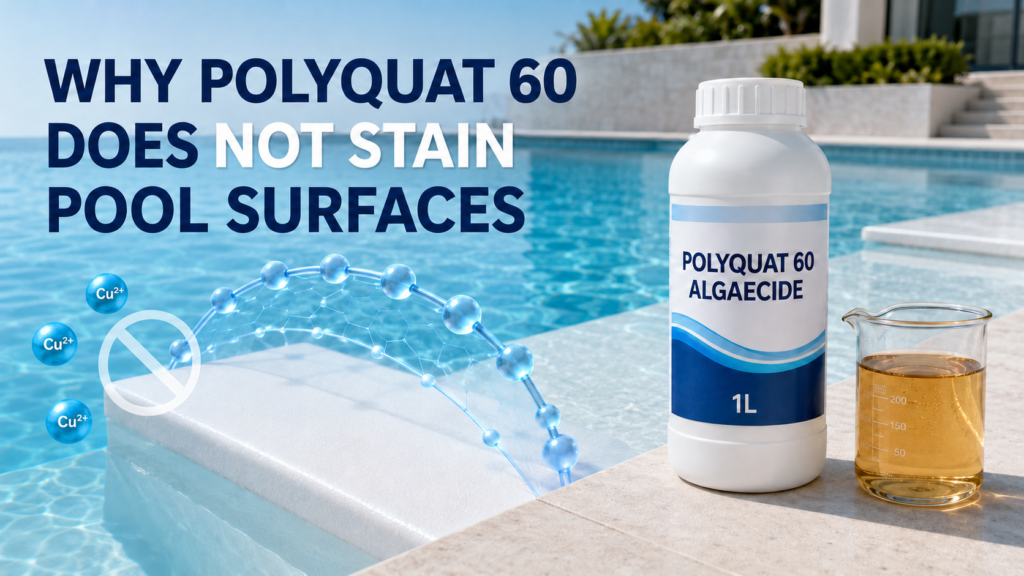
A clean swimming pool should look inviting—clear blue water, bright steps, and an even surface from one end to the other. So, when an algaecide leaves green, brown, gray, or black marks behind, it creates a rather frustrating question: did the chemical solve one problem only to create another?
This concern is especially common when pool owners have previously used metal-based algae treatments.
Polyquat 60 is different. It is a non-metallic, polymer-based algaecide. Because it does not introduce copper, iron, manganese, or colored mineral particles into the water, it does not create the main chemical pathway associated with metallic pool stains.
That’s the short answer. The full explanation is more useful, though, because “non-staining” does not mean that a pool treated with Polyquat 60 can never develop discoloration from another source.
Let’s sort out the chemistry—and a few common misunderstandings.
First, What Causes a Pool Surface Stain?
A pool stain is a colored deposit or chemical alteration that remains attached to the pool finish. It may appear on plaster, tile grout, fiberglass, vinyl, steps, fittings, or areas where circulation is poor.
Not every dark mark is a true stain. What looks like staining might be:
- Living algae
- Dead algae or organic debris
- Calcium scale holding dirt
- Rust from a metal fitting
- Copper or iron deposits
- Leaf tannins
- Discoloration beneath an old pool finish
- A localized repair that has aged differently
True staining often involves a material that has deposited on, reacted with, or become trapped inside the surface.
Metals are frequent contributors. Iron may produce reddish-brown or rust-colored marks. Manganese can create dark brown or black deposits, while copper is often associated with blue-green, turquoise, gray, or dark staining. Government water-quality guidance also identifies iron, copper, and manganese as common causes of stained plumbing fixtures and other water-contact surfaces.
Pool conditions make this issue more complicated. A metal may remain dissolved and nearly invisible for some time. Then the pH changes, chlorine rises, or another oxidizer is added. The metal changes chemical form and becomes less soluble. Once that happens, it may deposit on the pool surface.
A clear pool can develop stains surprisingly fast. That’s why the chemistry matters.
Why Some Algaecides Are Linked to Staining?
Certain algaecides use copper as an active algae-control component. Copper can be effective because dissolved copper ions interfere with processes that algae need for survival and growth.
However, copper does not simply disappear after it has done its job.
The metal remains part of the pool-water system unless it is physically removed, diluted, or kept dissolved with suitable treatment chemistry. Repeated dosing can therefore raise the total copper concentration over time.
Whether that copper produces visible stains depends on several factors:
- The amount of copper already present
- The amount introduced by the algaecide
- Pool-water pH
- Chlorine or other oxidizer concentration
- Carbonate alkalinity
- Water hardness
- The presence of sequestrants
- Surface porosity
- Circulation and mixing
- Local chemical concentrations during dosing
High-pH areas can be particularly troublesome. When a concentrated chemical is poured into one location, the water immediately around that location may have very different conditions from the rest of the pool. Copper compounds can then become less soluble and settle onto plaster, grout, ladders, or other surfaces.
The visible result may be a colored patch that does not brush away.
This does not mean every copper algaecide will stain every pool. Formulation quality, water balance, dosing, and metal management all matter. Still, when a product adds copper, it adds a substance that can participate in metal-staining reactions.
Readers comparing these two chemical approaches can see the differences in Copper Algaecide vs Polyquat 60: Understanding the Difference.
So, What Makes Polyquat 60 Different?
Polyquat 60 is a polymeric quaternary ammonium algaecide. In many pool and water-treatment formulations, the active ingredient is Polixetonium Chloride, also known as Polyquaternium-42, with CAS No. 31512-74-0.
The name gives us two useful clues:
- “Poly” refers to a polymer containing repeating units.
- “Quat” refers to quaternary ammonium groups carrying positive electrical charges.
The number “60” usually indicates that the commercial raw material contains approximately 60% active ingredient. The product is commonly supplied as a water-soluble liquid concentrate.
Most importantly for surface care, Polyquat 60 is not based on copper or another algae-controlling metal.
Its action comes from the positively charged polymer chain rather than dissolved metal ions. The polymer is attracted to negatively charged biological surfaces, including algae cells. This interaction can damage normal membrane function, restrict growth, and help bring fine suspended material together so the filtration system can capture it.
For a wider introduction to the chemistry and common pool applications, see What Is Polyquat 60 Algaecide? A Complete Beginner’s Guide.
No Metal In, No New Metal Deposit
Here lies the central reason Polyquat 60 does not cause the type of pool staining commonly associated with copper algaecides:
It does not add staining metals to the water.
Polyquat 60 cannot introduce copper staining when there is no copper active ingredient in the formulation. It also does not supply iron or manganese as part of its normal functional chemistry.
That distinction matters because metallic staining requires a metal source. The source might be fill water, corroding equipment, a heater, an old copper-containing treatment, fertilizer carried into the pool, or a metal-based algaecide. Whatever the source, some metal must first be present.
Polyquat 60 removes one possible source from that list.
Think of it this way. If muddy boots are never brought into the house, those particular boots cannot leave mud on the floor. Dirt may still enter through another door, of course, but not from the boots you left outside.
The same logic applies here. A non-metallic algaecide cannot guarantee that pool water is metal-free. It simply does not add a new dose of algae-controlling metal each time it is used.
Polyquat 60 Does Not Rely on Colored Mineral Pigments
Metal compounds can display strong colors because their ions absorb and reflect light in distinctive ways. Copper compounds, for example, are often blue or green. Iron deposits frequently appear yellow, orange, brown, or red.
Polyquat 60 does not work through this type of colored mineral chemistry.
Commercial Polyquat 60 raw material may range from pale yellow to amber, depending on the grade, concentration, manufacturing process, and product specification. Yet the product is diluted dramatically when added to thousands of gallons of pool water.
Its slight liquid color should not be confused with a pigment.
A pigment is made to remain visible. Polyquat 60 is a water-soluble treatment chemical intended to disperse through the pool. When an accurately measured dose is added with the circulation system operating, it should not paint, dye, or permanently color a compatible pool finish.
Naturally, this assumes that the formulation meets its specification and does not contain unwanted contaminants. Product quality still counts. A poorly controlled raw material containing excessive impurities is not equivalent to a properly manufactured pool-grade product.
Water Solubility Helps Prevent Localized Residue
Polyquat 60 is soluble in water. Once added correctly, it disperses through the circulating pool rather than remaining as gritty mineral particles.
That water solubility supports non-staining performance in several ways:
- It allows the product to spread through the pool.
- It reduces the chance of solid particles sitting on the floor.
- It avoids introducing copper salts that may later become insoluble.
- It supports interaction with algae suspended in the water and attached to surfaces.
- It allows the treatment to work within the existing circulation and filtration program.
This does not mean you should pour an entire concentrated dose into one quiet corner and walk away. Even water-soluble chemicals need adequate mixing.
Good application practice is simple: follow the registered product label, calculate the pool volume accurately, and keep the circulation system running as directed. Distribute the dose according to the label rather than creating one highly concentrated treatment zone.
Its Cationic Charge Is Not the Same as Metal Reactivity
The words “positively charged” sometimes cause confusion. Copper ions are positively charged, and Polyquat 60 is also cationic, so are they likely to behave in the same way?
No.
Electrical charge alone does not determine whether a substance will form a colored mineral stain.
A copper ion is a metal species. Depending on pH, carbonate concentration, oxidation conditions, and other dissolved substances, it may form compounds with limited solubility. Those compounds can settle on surfaces.
Polyquat 60 is a large organic polymer with positively charged quaternary ammonium groups distributed along its chain. It interacts strongly with negatively charged biological cells and suspended particles, but it does not turn into copper carbonate, copper oxide, iron oxide, or another colored metal deposit.
In other words, both materials may carry positive charge, yet their chemical identities and behavior are very different. A shopping cart and a car both have wheels, but no one expects them to perform the same job.
Does Polyquat 60 Stick to Pool Surfaces?
Cationic polymers can adsorb onto negatively charged particles and interfaces. That is part of what makes them useful in water treatment.
However, adsorption is not automatically the same as visible staining.
At label-directed pool concentrations, Polyquat 60 is intended to disperse in water and interact with algae and fine particles without leaving a colored metal deposit. Any microscopic interaction with a pool surface does not usually create visible discoloration because the polymer is not a strongly colored, insoluble mineral.
Surface condition still matters, though.
A rough, damaged, heavily scaled, or highly porous finish can trap all sorts of materials—dead algae, dust, iron particles, organic debris, or precipitated calcium. If discoloration develops on such a surface, the correct question is not merely, “What chemical did I add last?”
A better investigation asks:
- What is the color and texture of the mark?
- Does it brush away?
- Was algae already present?
- Does the fill water contain iron or manganese?
- Has a copper product been used previously?
- Is there scale on the surface?
- Did the discoloration appear after shock treatment?
- Is the water balanced?
- Are metal fittings corroding?
That broader view prevents Polyquat 60 from being blamed for a stain caused by a metal that entered the pool months earlier.
Why a Stain May Appear After Polyquat 60 Is Added?
Here’s the tricky part: timing does not always prove cause.
Suppose Polyquat 60 is added on Saturday. On Sunday, several brown patches become visible on the steps. It is natural to connect the two events. Yet several other processes may have occurred at the same time.
Previously Hidden Algae May Have Died
Dark or green growth can cling to plaster pores, grout lines, steps, shaded walls, and areas behind ladders. After treatment, dead algae may remain attached temporarily.
The affected area may look gray, brown, or faded rather than bright green. It can resemble staining until brushing and filtration remove the residue.
Polyquat 60 controls algae; it does not make every dead cell vanish instantly. Physical cleaning still matters.
Fine Particles May Have Gathered Together
Because Polyquat 60 is a cationic polymer, it may also help agglomerate some fine suspended particles. In simple language, tiny particles can gather into larger groups that are easier for a filter to capture.
If circulation is weak or the filter is not operating properly, these particles may settle in low-flow areas. The deposit can look like a stain, but it may brush away or be removed by vacuuming.
This is residue, not necessarily chemical alteration of the finish.
Existing Metals May Have Been Oxidized by Another Treatment
Pool owners often add an algaecide near the same time as chlorine shock. If the water already contains iron, copper, or manganese, a major change in oxidizer level or pH can make those metals more visible.
The surface staining may appear after Polyquat 60 was added, but the more direct trigger could be:
- A high chlorine dose
- A pH increase
- Metal-rich fill water
- Copper remaining from earlier treatments
- Corrosion inside the circulation system
- Loss of sequestrant protection
Polyquat 60 does not remove those metals. It also cannot prevent every reaction involving metals that are already present.
Scale May Trap Colored Material
Calcium scale is usually white or pale, but its rough surface can capture dirt, metals, algae residue, and organic matter. The final deposit may look tan, gray, green, or brown.
A smooth vinyl liner and a rough scaled plaster wall will not retain material in the same way. Surface history matters as much as the most recent chemical addition.
Could Polyquat 60 React with Other Pool Chemicals?
Polyquat 60 is cationic. Products with strong anionic character carry the opposite charge. When concentrated cationic and anionic products meet, they may interact and form haze, clumps, or precipitated material.
This is a compatibility issue—not a metallic staining mechanism.
Avoid mixing concentrated pool chemicals together in a bucket unless the product instructions specifically permit it. Add each chemical separately, allow circulation, and follow the label’s application sequence.
More is not better, either. Excessive dosing can raise treatment costs, burden the filtration system, and increase the chance of unwanted interactions. Accurate dosing is part of protecting both water quality and pool appearance.
The Polyquat 60 Dosage Guide for Swimming Pool Applications explains why pool volume, treatment purpose, and product concentration must be considered before dosing.
Is Polyquat 60 Suitable for Different Pool Surfaces?
A properly formulated Polyquat 60 algaecide is generally used in pools with common finishes such as:
- Plaster
- Concrete
- Fiberglass
- Vinyl liners
- Ceramic tile
- Aggregate finishes
Its non-metallic chemistry is particularly helpful where surface appearance is a major concern. Light plaster, white steps, decorative tile, and pale liners can make even slight metal discoloration easy to notice.
Still, “suitable” never means “ignore the label.”
Commercial products may contain different concentrations, formulation aids, and use directions. The finished algaecide label—not a general blog article—determines the correct dose, application method, safety requirements, and approved pool uses.
When testing an unfamiliar formulation or treating a delicate specialty finish, a small-area compatibility check may also be sensible.
How to Reduce the Overall Risk of Pool Staining?
Choosing a non-metallic algaecide removes one important staining source, but complete stain control requires attention to the whole pool.
Test the Source Water
Well water may contain iron or manganese even when it looks clear coming from the hose. Municipal water can also contain low metal levels or collect metals from plumbing.
If staining returns after every refill, the incoming water deserves attention.
Maintain Balanced Water
Keep pH, total alkalinity, calcium hardness, and sanitizer within the ranges recommended for the pool system and finish.
Extreme water conditions may promote corrosion, scale, or metal precipitation. Balanced water protects the pool surface as well as the equipment.
Avoid Repeated Metal Addition
Check the active ingredients of algaecides, mineral systems, and multi-purpose products. Copper may appear in more than one part of the maintenance program.
A single dose may seem small, but repeated additions can build a larger metal load.
Do Not Mix Concentrates
Pool chemicals should normally be added separately. Never combine concentrated products merely to save time. Chemical incompatibility can create heat, gas, precipitates, or loss of performance.
Follow each product label carefully.
Keep Water Moving
Circulation distributes the algaecide and prevents concentrated treatment pockets. It also carries dead algae and suspended material toward the filter.
Brush steps, corners, behind ladders, and other areas that receive weak circulation.
Clean the Filter
When algae and fine particles are removed from the water, they end up in the filter. A dirty or overloaded filter may return particles to the pool or reduce circulation.
Backwash or clean the filter according to the equipment instructions.
Use the Correct Dose
Estimate the pool volume as accurately as possible. Then distinguish between:
- Initial treatment
- Routine maintenance
- Treatment of visible algae
- Pool opening
- Winter closing
These applications may require different label rates. Guessing by eye is rarely a good idea.
The Key Point: Non-Staining Does Not Mean Stain-Removing
Polyquat 60 helps avoid adding new algae-controlling metals to pool water. That is why it is commonly described as a non-metallic or non-staining algaecide.
But it is not a metal remover.
It will not automatically extract copper from plaster, dissolve iron stains, eliminate calcium scale, or repair damaged pool finishes. If the pool already contains metals, a separate diagnosis and treatment plan may be needed.
This distinction keeps product expectations realistic:
- Polyquat 60 does not supply copper as its active algae-control mechanism.
- It does not normally form colored metallic precipitates.
- Its water-soluble polymer structure does not behave like a mineral pigment.
- It can be used to control algae without adding another common source of pool-surface staining.
- Existing metals, organic matter, scale, poor circulation, and incorrect chemical use can still cause discoloration.
For pool owners, service professionals, and private-label brands, that is the practical advantage. Polyquat 60 controls algae without asking the pool surface to pay the price.
Frequently Asked Questions
1. Can Polyquat 60 stain a white plaster pool?
A properly formulated Polyquat 60 product should not create copper-type stains because it does not use copper as its active ingredient. However, white plaster may still show stains caused by metals already in the water, organic debris, scale, rust, or dead algae. Always follow the product label and maintain balanced water.
2. Why did brown stains appear after adding Polyquat 60 algaecide?
Brown marks may come from existing iron, dead algae, leaf tannins, scale holding dirt, or material that settled after treatment. If chlorine shock or a pH adjustment was made at the same time, dissolved iron may also have become more visible. The timing alone does not prove that Polyquat 60 caused the stain.
3. Does Polyquat 60 remove copper stains from swimming pools?
No. Polyquat 60 is an algaecide, not a copper-stain remover or metal sequestrant. It avoids adding copper, but existing copper stains require separate identification and treatment suited to the pool finish.
4. Is Polyquat 60 safe for vinyl liner and fiberglass pools?
Polyquat 60 is commonly used in pools with vinyl liners and fiberglass surfaces when the finished product is correctly formulated and applied at its labeled rate. Do not pour excessive concentrate directly onto a surface, and always use the circulation method stated on the label.
5. Is a non-metal pool algaecide better for preventing surface discoloration?
A non-metal algaecide can reduce staining risk because it does not repeatedly add copper or another algae-controlling metal. It cannot prevent discoloration from every source, though. Water balance, source-water metals, circulation, filtration, surface condition, and dosing practices still need attention.