
GET IN TOUCH
Ask For Sample?
How Polyquat 60 Helps Prevent Algae Regrowth
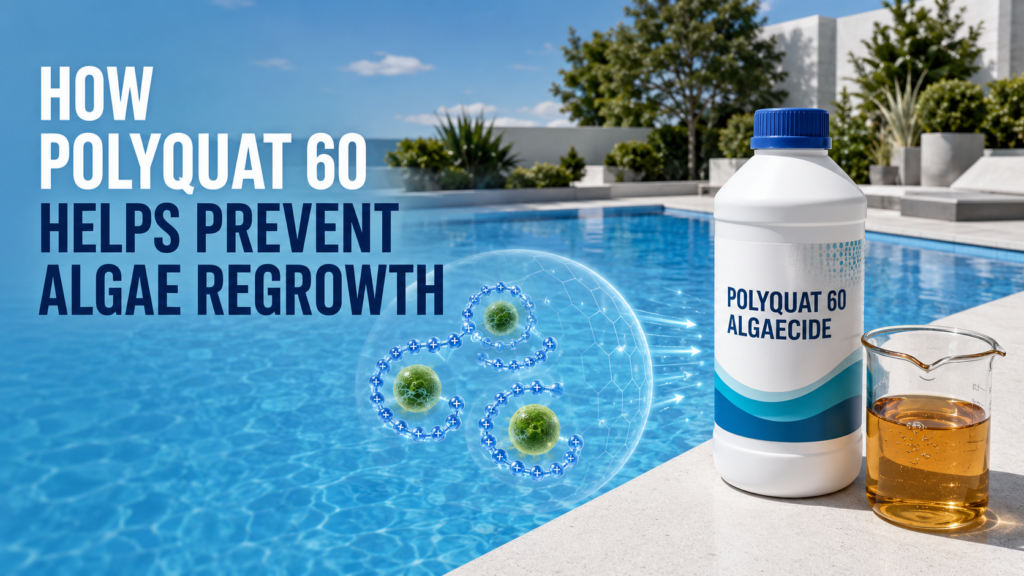
Algae can disappear after treatment and still return a few days later. That is one of the most frustrating problems in swimming pool maintenance.
The water looks clear. The pool walls have been brushed. The filter has been cleaned. Chlorine levels appear normal. Then a faint green haze develops near the steps, along a shaded wall, or behind a ladder.
Why does this happen?
Removing visible algae does not always eliminate every living cell or change the conditions that allowed the algae to grow. Small colonies may remain in surface pores, plumbing lines, filters, and low-circulation areas. New algae cells can also enter the pool through wind, rain, leaves, swimsuits, and cleaning equipment.
Polyquat 60 helps address this vulnerable period after algae treatment. As a non-oxidizing polymeric algaecide, it interferes with surviving algae cells and helps stop new colonies from becoming established.
It is not a replacement for chlorine, brushing, filtration, or balanced water. Its real strength lies elsewhere: providing an additional layer of preventive algae control between routine maintenance treatments.
Why Does Pool Algae Grow Back So Quickly?
An algae treatment may remove the obvious problem without removing every cause behind it.
Imagine cutting weeds without removing the roots. The garden looks tidy for a while, but the underlying conditions have not changed. Pool algae can behave in a similar way.
A visible bloom is only part of the algae population. Microscopic cells may survive in places that receive less brushing, less sanitizer, or weaker circulation. Common trouble spots include:
- Steps and ladders
- Light niches
- Skimmer throats
- Return fittings
- Grout lines
- Rough plaster
- Pool covers
- Cleaner hoses
- Filter media
- Corners with slow water movement
Some algae also form protective layers on surfaces. Black algae, for example, can become firmly attached and may resist a quick, single treatment. Mustard algae can cling to shaded areas and may contaminate pool tools, floats, and swimwear.
Then there is the water itself. Warm temperatures, sunlight, organic debris, nutrients, poor circulation, and insufficient sanitizer create an inviting environment for another bloom.
So, yes, the water may look clear after treatment—but clear water does not always mean that the risk has passed.
What Is Polyquat 60?
Polyquat 60 is the common pool-industry name for a concentrated polymeric quaternary ammonium algaecide.
Many Polyquat 60 formulations are based on Polixetonium Chloride, also known as Polyquaternium-42, with CAS No. 31512-74-0. The “60” normally refers to an active concentration of approximately 60%.
Its important characteristics include:
- Polymeric cationic structure
- Non-oxidizing action
- Non-metallic chemistry
- Low-foaming or non-foaming performance
- Compatibility with chlorine and bromine treatment programs
- Suitability for preventive and maintenance applications
Unlike chlorine, Polyquat 60 does not work primarily by oxidizing contaminants. It interacts directly with biological cell surfaces through its positively charged polymer structure.
That distinction matters. Chlorine and Polyquat 60 are not two versions of the same treatment. They perform different jobs within the pool maintenance program.
For pool chemical distributors, service companies, and private-label brands, a concentrated Polyquat 60 Algaecide provides a practical base for developing non-foaming, metal-free algae-control products.
The Chemistry Is Charged—Literally
The word “cationic” means positively charged.
Many components on an algae cell surface carry negative charges. When Polyquat 60 enters the water, its positively charged polymer chains are attracted to these negatively charged biological surfaces.
It is a little like static attraction, although the actual chemical interaction in pool water is more complex.
Once the polymer reaches an algae cell, it can attach to the cell surface and interfere with membrane function. The cell membrane is essential because it controls movement between the cell and the surrounding water.
When that membrane is disturbed, several problems may develop for the algae:
- The cell may struggle to maintain its internal balance.
- Normal nutrient exchange may be interrupted.
- Essential cellular materials may leak.
- Energy-related processes may become less efficient.
- Reproduction and colony development may be inhibited.
This is one reason Polyquat 60 is well suited to prevention. It does not have to wait for algae to form a thick, visible layer before interacting with the cells.
When a small number of cells enter or remain in treated water, Polyquat 60 can make it harder for them to survive, reproduce, and build a new population.
Preventing Regrowth Starts with the Algae You Cannot See
A severe algae bloom may contain an enormous number of cells. Shock treatment, brushing, vacuuming, and filtration can remove most of them, yet even a small surviving population may start another growth cycle.
The first stage of regrowth is usually invisible.
The remaining cells begin to recover. They absorb nutrients. They divide. Their population slowly increases. By the time a pool owner notices green water or slippery walls, the new colony may already be well established.
Polyquat 60 helps interrupt this early recovery stage.
Its cationic polymer chains can interact with dispersed algae cells and small colonies before they become obvious. This reduces the chance that surviving organisms will rebuild their population after the main cleanup.
Timing is important here.
Applying preventive algaecide only after the pool has turned green misses much of its value. Polyquat 60 performs particularly well during the quiet period after corrective treatment—when the water looks better but remains vulnerable.
Think of it as guarding the pool after the main battle has ended. The visible bloom may be gone, but someone still needs to watch the gate.
It Also Helps Control New Algae Entering the Pool
A treated swimming pool is not a sealed laboratory system.
Airborne dust, rainwater, plants, animals, swimmers, and pool equipment can continually introduce new biological material. A brush used in an affected pool may carry algae cells. So can a wet swimsuit worn in a lake or another swimming pool.
Polyquat 60 cannot stop these cells from physically entering the water. What it can do is make the pool a less favorable place for them to establish themselves.
When an effective preventive concentration is present, newly introduced cells encounter the cationic polymer before they have time to form a mature colony.
That is the key difference between contamination and infestation.
A few algae cells entering a pool do not automatically create a visible bloom. They must survive, reproduce, and find suitable surfaces or water conditions. Polyquat 60 interferes with that progression.
Of course, performance depends on several factors:
- Product concentration
- Applied dose
- Time since the last treatment
- Pool volume
- Water temperature
- Organic contamination
- Sanitizer level
- Circulation
- Filtration
- Algae type and severity
This is why preventive treatment should be part of a routine—not a random addition made whenever someone remembers.
Why the Polymeric Structure Matters?
Traditional quaternary ammonium compounds and polymeric quats belong to the broader quat family, but they do not behave identically.
Many conventional, small-molecule quats have strong surfactant properties. Under agitation, they may produce visible foam. That becomes a real nuisance in spas, water-feature pools, hotel pools, and systems with strong return jets.
Polyquat 60 contains repeated cationic groups along a polymer chain. Its polymeric structure gives it different water-treatment behavior and greatly reduces the familiar foaming problem associated with many conventional quats.
This matters for regrowth prevention because a maintenance algaecide may be added regularly. A treatment that creates foam every week would quickly become unpopular, even if it controlled algae.
Polyquat 60 is therefore better suited to ongoing treatment in applications where water appearance matters.
It also does not introduce copper. That removes the possibility of copper accumulating through repeated algaecide additions and contributing to surface staining or hair discoloration under certain water conditions.
For long-term preventive programs, avoiding those unwanted side effects is no small advantage.
Does Polyquat 60 Leave Long-Lasting Protection?
Polyquat 60 is often described as providing residual or long-lasting algae control. This does not mean one dose protects the pool indefinitely.
The active polymer concentration gradually decreases.
Polyquat 60 may interact with algae, microorganisms, suspended particles, and other negatively charged material in the water. Some of the polymer-bound material may then be captured by the filter. Water loss from backwashing, splash-out, leaks, or partial draining can reduce the remaining concentration as well.
Exposure to oxidizing sanitizers may also gradually reduce the amount of active polymer available in the pool.
In practical terms, the preventive barrier becomes weaker with time. If no maintenance dose is added, algae may eventually find another opportunity—especially during hot weather or periods of heavy pool use.
Regular treatment restores that protective level.
Many finished Polyquat 60 products use weekly or periodic maintenance schedules, but there is no universal dose for every formulation. Active concentration, label directions, pool volume, water conditions, and local regulations must all be considered.
Always follow the directions supplied with the finished algaecide. More is not automatically better.
Polyquat 60 and Chlorine: Different Jobs, Better Together
Can Polyquat 60 replace chlorine?
No.
Chlorine remains the primary sanitizer and oxidizer in most swimming pools. It controls pathogenic microorganisms and oxidizes a wide range of swimmer waste and organic contaminants. Polyquat 60 has a narrower supporting role centered on algae control.
A sound treatment program may use:
- Chlorine or bromine for primary sanitation
- Polyquat 60 for supplemental algae prevention
- Filtration for particle removal
- Brushing and vacuuming for physical cleaning
- Balanced pH and alkalinity for stable water conditions
This combined approach reduces the chance that one weakness will turn into an algae bloom.
For example, a short drop in free chlorine may occur after heavy rain, an unusually busy swimming day, or unexpected organic contamination. Polyquat 60 may provide additional algae suppression during that vulnerable period.
But there is an important limit: it should not be treated as permission to neglect sanitizer.
If chlorine remains too low for too long, water safety may be compromised even when no algae are visible. Polyquat 60 is an algaecide, not a complete disinfectant program for recreational water.
Likewise, when a pool already contains a heavy algae bloom, a maintenance dose of Polyquat 60 should not be expected to perform the entire cleanup. Corrective sanitation, brushing, filtration, and removal of dead material are usually needed.
Clean Up First, Then Guard Against the Comeback
Polyquat 60 performs best when the initial algae load has already been reduced.
If the pool contains thick green water or well-established surface growth, the treatment sequence generally needs to address the existing contamination first. The exact procedure should follow the sanitizer and algaecide labels, but the maintenance logic is straightforward:
- Test and correct the water balance.
- Remove leaves and other large debris.
- Brush algae-affected surfaces thoroughly.
- Apply the required corrective sanitizer treatment.
- Keep the circulation and filtration system operating as directed.
- Vacuum or filter out loosened and dead algae.
- Clean or backwash the filter when needed.
- Add the preventive algaecide at the appropriate stage and label dose.
- Continue routine testing and maintenance additions.
Why not simply pour Polyquat 60 into a neglected green pool and walk away?
Because thick algae, debris, and heavy organic contamination create an enormous chemical demand. The polymer may bind to abundant suspended material rather than remain available for longer-term prevention.
Cleaning reduces that burden. Once the pool is physically cleaner and the main bloom has been controlled, the maintenance algaecide has a more manageable job.
Circulation Still Decides Where the Product Goes
Even an effective algaecide cannot help much if it never reaches the problem area.
Poor circulation creates local zones where sanitizer and algaecide concentrations may be lower than in the rest of the pool. These are often the same areas where dust, nutrients, and organic matter collect.
Typical dead spots include:
- Behind ladders
- Under steps
- Around built-in seats
- Near poorly aimed return fittings
- Inside decorative features
- Along deep corners
- Beneath floating covers
After Polyquat 60 is added, adequate circulation helps distribute it throughout the water. Brushing also exposes attached cells and moves treated water across surfaces that circulation alone may not reach.
Pool operators should pay attention to return-jet direction, pump run time, filter condition, and skimmer performance. A chemical cannot compensate for a hydraulic system that barely moves the water.
Sometimes the most important algae treatment is not another bottle. It is adjusting a return fitting or cleaning a clogged filter.
Filtration Completes the Job
An algaecide can affect algae cells, but the pool still needs a way to remove suspended residues.
After algae cells are damaged or killed, fine biological particles may remain in the water. If they are not captured or vacuumed away, the pool can stay cloudy. This remaining material can also contribute to sanitizer demand.
Polyquat 60 may encourage interactions between charged particles, but it should not automatically be treated as a replacement for a dedicated clarifier. Product formulations and treatment objectives differ.
When fine suspended material is the main reason the water looks dull, a properly selected Polymer Pool Clarifier can support particle aggregation and filtration. The clarifier and algaecide should still be applied according to their individual labels, with attention to dosage and chemical compatibility.
Overdosing polymer-based products can sometimes reduce treatment efficiency rather than improve it. Careful dosing wins here. A heavy hand does not.
Balanced Water Makes Regrowth Less Likely
Polyquat 60 works within the broader pool environment. It cannot correct every condition that encourages algae.
Pool water should be tested regularly for parameters such as:
- Free and combined chlorine
- pH
- Total alkalinity
- Calcium hardness
- Cyanuric acid, where applicable
- Salt level in saltwater systems
- Water temperature
Sanitizer effectiveness is closely connected to water chemistry. An unsuitable pH or an inappropriate relationship between chlorine and cyanuric acid can weaken the overall control program.
Nutrients also matter, though they should be kept in perspective. Phosphates and nitrogen compounds can support algae growth, but nutrient control is not a substitute for adequate sanitizer, good filtration, and physical cleaning.
Algae need an opportunity as well as food.
A balanced pool denies them that opportunity through several overlapping controls. Polyquat 60 adds another barrier, which is precisely why it can be useful when conditions become unpredictable.
When Is the Risk of Regrowth Highest?
Certain conditions deserve extra attention because they accelerate algae growth or weaken routine treatment.
After a Severe Algae Cleanup
Surviving cells, contaminated equipment, and residual debris can start another bloom. This is a logical time to establish a preventive treatment program after the corrective process has been completed.
During Hot, Sunny Weather
Warm water can support faster biological growth, while sunlight can increase chlorine loss in pools without suitable stabilization. More swimmers also bring additional contaminants.
After Heavy Rain or Storms
Rain may dilute treatment chemicals, affect water balance, and wash dust or organic material into an outdoor pool. Storm debris can also place extra demand on chlorine and filtration.
When the Pool Has Heavy Bather Use
Swimmers introduce sweat, oils, cosmetics, and other organic matter. Chlorine demand rises, particularly in hotels, resorts, schools, and public aquatic facilities.
During Periods of Reduced Circulation
Pump problems, shortened run times, blocked baskets, and dirty filter media can leave parts of the pool under-treated.
Before Seasonal Pool Closing
A covered pool may receive little circulation, brushing, or chemical adjustment for months. Adding a suitable algaecide as part of a complete closing procedure can reduce the chance of opening to green water.
Pool-closing formulations may need to account for long storage periods and changing water temperatures. A dedicated Winter Algaecide can be developed for this seasonal maintenance need.
Common Mistakes That Let Algae Return
Polyquat 60 is effective, but it cannot rescue a poorly managed treatment program from every mistake.
Using Only a One-Time Dose
A single treatment does not create permanent protection. Product concentration falls over time, so maintenance additions may be necessary.
Ignoring the Filter
Algae and debris can remain in dirty filter media. Cleaning or backwashing the filter helps remove captured material and restore proper water flow.
Skipping Brushing
Attached algae may be protected by surface layers or hidden in rough areas. Brushing exposes the colony and improves contact with treated water.
Adding an Unmeasured Amount
Guessing the pool volume or pouring directly from the bottle can lead to underdosing or overdosing. Calculate the water volume and use proper measuring equipment.
Expecting Polyquat 60 to Replace Sanitizer
A clear pool is not necessarily a properly sanitized pool. Maintain the required sanitizer residual and follow applicable public-health guidance.
Returning Contaminated Equipment to the Pool
Brushes, cleaner bags, hoses, toys, floats, covers, and swimwear may carry algae. Clean affected items as appropriate so they do not immediately reintroduce contamination.
Ignoring Dead Circulation Areas
If algae always appears in the same corner, the recurring problem may be water movement rather than product performance.
Why Polyquat 60 Works Well in Preventive Maintenance
The real value of Polyquat 60 is not a dramatic overnight change. It is consistency.
Its polymeric cationic chemistry targets algae through a non-oxidizing mechanism. Its low-foaming behavior makes repeat use more practical. Its metal-free composition avoids adding copper to the water. Its compatibility with standard sanitizer programs also allows it to serve as a supporting barrier rather than compete for the role of primary sanitizer.
For residential pools, this may mean fewer surprise blooms after storms or busy weekends.
For commercial operators, it may mean a more stable pool appearance between service visits and fewer embarrassing patches of algae around steps or walls.
For pool chemical brands, it provides a concentrated active ingredient that can be formulated for weekly maintenance, seasonal closing, or professional algae-control programs.
Still, the central principle should remain clear:
Polyquat 60 helps prevent algae regrowth by making it harder for surviving and newly introduced algae cells to recover, reproduce, and form established colonies. It works best when the pool is already clean, properly sanitized, well circulated, and regularly maintained.
No magic—just smart chemistry supporting good pool care.
Frequently Asked Questions
1. Does Polyquat 60 prevent algae from coming back permanently?
No. Polyquat 60 can suppress surviving cells and help prevent new colonies from becoming established, but its concentration decreases over time. Routine maintenance dosing, sanitation, filtration, brushing, and balanced water are still required.
2. When should Polyquat 60 be added after an algae treatment?
The correct timing depends on the finished-product label and the other chemicals used during treatment. In general, the main algae bloom should be controlled and physical debris removed before Polyquat 60 is relied upon for ongoing prevention. Always follow the product instructions.
3. Can Polyquat 60 prevent algae regrowth if chlorine is low?
It may provide supplemental algae suppression during a brief sanitizer fluctuation, but it cannot replace an adequate chlorine or bromine residual. Persistently low sanitizer can create both algae and water-safety problems.
4. How often should Polyquat 60 be used for weekly pool algae prevention?
Many finished products are designed for weekly or periodic maintenance, but frequency varies with active concentration, formulation, pool conditions, climate, and label approval. Use the dosage and schedule stated on the finished-product label.
5. Is Polyquat 60 suitable for preventing algae regrowth in saltwater pools?
Yes, properly formulated Polyquat 60 products are generally compatible with saltwater chlorination systems. The saltwater generator must still operate correctly, and the pool’s sanitizer level, pH, circulation, and filtration should remain within their recommended ranges.