
GET IN TOUCH
Ask For Sample?
What Is the Chemical Structure of Polixetonium Chloride?
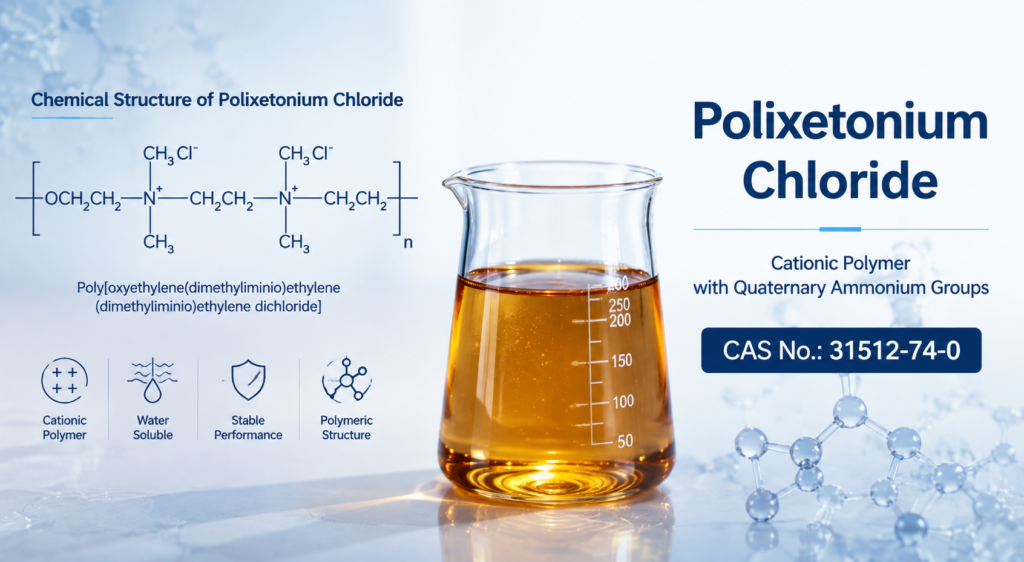
When buyers first encounter Polixetonium Chloride, the name itself can look intimidating. A long chemical name, a CAS number, multiple synonyms, and a polymer structure that is not represented by a simple small molecule formula — it can feel like a lot to understand.
But the basic idea is actually quite straightforward.
Polixetonium Chloride is a cationic polymer based on quaternary ammonium groups. Its chemical identity is closely associated with the polymer name:
Poly[oxyethylene(dimethyliminio)ethylene(dimethyliminio)ethylene dichloride]
It is also widely known as Polyquaternium-42, with the CAS number:
CAS No.: 31512-74-0
Unlike simple chemical compounds such as sodium chloride or ethanol, Polixetonium Chloride does not exist as one small molecule with one exact molecular weight. Instead, it is a polymeric material made from many repeating structural units connected together into longer chains.
Think of it like a long necklace. Each bead represents a repeating chemical unit, while the complete necklace represents the polymer chain. Different necklaces may contain slightly different numbers of beads, but they belong to the same family.
This polymer structure is the reason Polixetonium Chloride shows characteristics such as:
- Strong cationic charge
- Good water compatibility
- Non-foaming behavior
- Long-lasting activity
- Compatibility with many water treatment systems
Before discussing the structure in detail, it is helpful to first understand the basic identity and applications of this material. You can read our introduction here:
What Is Polixetonium Chloride? A Complete Beginner’s Guide
Breaking Down the Chemical Name of Polixetonium Chloride
The chemical name of Polixetonium Chloride looks complex:
Poly[oxyethylene(dimethyliminio)ethylene(dimethyliminio)ethylene dichloride]
Let’s break it into smaller parts.
“Poly” — A Long Chain Structure
The word “poly” tells us that this material is a polymer.
A polymer is a large molecule created by connecting many smaller repeating units, often called monomers.
Common examples include:
- Polyethylene used in plastic products
- Polyacrylamide used in water treatment
- PolyDADMAC used as a flocculant
- Polixetonium Chloride used as a cationic biocide
The important point is that polymers usually have a range of chain lengths rather than one single molecular size.
That means properties such as:
- Viscosity
- Charge density
- Solution behavior
can vary depending on polymer characteristics and manufacturing control.
“Oxyethylene” — The Oxygen-Containing Linkage
The term “oxyethylene” refers to an oxygen-containing segment within the polymer chain.
These oxygen atoms contribute to the polymer’s ability to interact with water.
This is one reason Polixetonium Chloride can be supplied as an aqueous solution instead of requiring organic solvents.
Water compatibility is especially important for products used in:
- Cooling water treatment
- Swimming pool chemicals
- Industrial water systems
- Process water applications
A material may have excellent biological activity, but if it cannot disperse properly in water, practical performance becomes limited.
The polymer structure helps solve this challenge.
Understanding the Polymer Backbone of Polixetonium Chloride
At the center of Polixetonium Chloride’s structure is a polymer backbone containing repeating units connected through chemical bonds.
The backbone provides the framework that holds the entire polymer together.
However, the backbone itself is not the only important feature.
The most important functional groups are the quaternary ammonium groups attached along the polymer chain.
These groups give Polixetonium Chloride its characteristic positive charge.
A useful analogy is a row of magnets attached to a flexible chain.
The chain allows movement and distribution, while the magnets create interaction with surrounding surfaces.
In Polixetonium Chloride:
- The polymer chain provides stability and persistence.
- The quaternary ammonium groups provide cationic activity.
Both parts work together.
A small molecule quaternary ammonium compound may have only one active charged center, while a polymeric quaternary ammonium compound contains multiple charged sites distributed along the chain.
This difference is one reason polymeric quats often behave differently from traditional quaternary ammonium compounds.
Why Polixetonium Chloride Is Classified as a Cationic Polymer
The word cationic simply means positively charged.
In water, Polixetonium Chloride carries positive charges because of its quaternary ammonium groups.
Many unwanted microorganisms and algae have negatively charged components on their cell surfaces.
The interaction between positive polymer charges and negatively charged biological surfaces contributes to the material’s biological control properties.
However, it is important to understand this carefully.
The performance of Polixetonium Chloride does not come from one single chemical feature alone.
It depends on a combination of factors:
- Polymer structure
- Charge density
- Molecular distribution
- Concentration
- Contact time
- Water conditions
This is why professional users evaluate not only the chemical name but also product specifications such as active content, viscosity, and consistency between batches.
How Chemical Structure Influences the Performance of Polixetonium Chloride
Understanding the chemical structure of Polixetonium Chloride is not just an academic exercise. For buyers, formulators, and water treatment professionals, the real question is:
How does the structure affect what the product can actually do?
The answer lies in the relationship between polymer architecture and practical performance.
A polymer is not simply a larger version of a small molecule. When many repeating units are connected together, new characteristics appear.
For Polixetonium Chloride, the polymer structure contributes to several important properties.
1. Multiple Positive Charge Sites Along the Polymer Chain
One of the most important structural characteristics of Polixetonium Chloride is the presence of multiple quaternary ammonium groups.
Instead of having only one positively charged site, the polymer chain carries many charged positions.
This creates a broader interaction area.
Imagine comparing a single person holding one magnet with a long rope covered with many small magnets. The second one can interact with a much larger surface area.
In a water treatment environment, this polymeric charge distribution helps Polixetonium Chloride interact effectively with suspended biological materials and negatively charged surfaces.
This characteristic is also why Polixetonium Chloride belongs to the family of polymeric quaternary ammonium compounds.
Why Polixetonium Chloride Is Different from Traditional Quaternary Ammonium Compounds
Many people are familiar with quaternary ammonium compounds, often called “quats.”
Traditional quats usually contain a smaller molecular structure with one main quaternary ammonium center.
Polixetonium Chloride is different because it is a polymer.
The difference can be compared like this:
| Feature | Traditional Quaternary Ammonium Compound | Polixetonium Chloride |
|---|---|---|
| Molecular structure | Smaller molecule | Long polymer chain |
| Charge sites | Usually limited | Multiple charge sites |
| Molecular size | Relatively small | Polymeric distribution |
| Foam tendency | Depends on chemistry | Generally non-foaming |
| Application behavior | Often fast interaction | Polymer-based sustained interaction |
This does not mean polymeric materials are automatically better in every situation.
The correct choice depends on the application.
For example, some systems require rapid microbial control, while others need long-lasting biological management with minimal impact on water characteristics.
That is why understanding structure matters.
The Relationship Between Polymer Chain Length and Physical Properties
Because Polixetonium Chloride is a polymer, its properties are influenced by the characteristics of its polymer chains.
One important factor is molecular weight distribution.
Unlike a simple molecule that has one exact molecular weight, a polymer contains chains of different lengths.
Some chains may be shorter.
Some may be longer.
The overall performance comes from the combined behavior of these polymer chains.
This affects physical properties such as:
Viscosity
Polymer solutions generally become thicker as polymer chain length increases.
This is why viscosity is often used as an important quality indicator during production and quality control.
However, viscosity alone does not tell the complete story.
A higher viscosity product is not automatically a better product.
Other factors also matter:
- Active content
- Polymer consistency
- Application requirements
- Storage stability
Solution Appearance
Commercial Polixetonium Chloride is normally supplied as a liquid solution.
The typical appearance is:
- Clear
- Transparent
- Amber-colored
- Viscous liquid
The appearance reflects the concentrated polymer solution characteristics.
Minor differences in color or viscosity can occur depending on manufacturing conditions, concentration, and raw materials.
For international buyers, consistent appearance and specification control are often more meaningful than appearance alone.
How Chemical Structure Supports Long-Lasting Biological Control
One common question from buyers is:
Why can Polixetonium Chloride provide longer-lasting algae control compared with some simple chemicals?
The answer is related partly to its polymer structure.
Because the molecule contains multiple functional groups distributed along a polymer chain, its interaction with biological surfaces is different from small molecules.
The polymeric nature allows it to remain active within a treatment environment for an extended period.
However, performance always depends on real operating conditions.
Factors such as:
- Water temperature
- Organic loading
- pH
- Exposure time
- Dosage level
can influence results.
A chemical structure creates potential performance advantages, but proper application determines actual results.
This is an important point for professional buyers.
A high-quality material and a suitable treatment program always work together.
Why Polixetonium Chloride Is Usually Supplied as a 60% Solution
Many buyers notice that Polixetonium Chloride is commonly available as a 60% solution rather than a pure 100% material.
Why?
Because polymeric quaternary ammonium compounds are usually manufactured and supplied in liquid form.
A concentrated aqueous solution provides several practical advantages:
Easier Handling
A 60% solution offers a balance between concentration and usability.
If the material were supplied at an extremely high concentration, handling could become more difficult because of increased viscosity.
Imagine trying to pour honey compared with water. The thicker the liquid becomes, the more challenging transportation and dosing can be.
Better Industrial Processing
Water treatment manufacturers and formulators normally need products that can be:
- Pumped
- Mixed
- Metered
- Blended into formulations
A controlled concentration helps maintain practical processing conditions.
For more information about why this specification is widely used, you can read:
Why Is Polixetonium Chloride Usually Supplied at 60%?
Why Chemical Structure Matters When Selecting a Polixetonium Chloride Supplier
For buyers, understanding the structure of Polixetonium Chloride helps with more than technical knowledge.
It also helps evaluate suppliers.
A reliable supplier should understand that this material is not simply a “chemical liquid.”
It is a functional polymer product where consistency matters.
Important quality considerations include:
Active Content
Active content indicates the concentration of polymeric active ingredients in the solution.
For commercial grades, buyers commonly compare active content specifications before evaluating price.
A lower-priced product may not always represent better value if the active concentration differs.
Viscosity Control
Because viscosity reflects polymer characteristics, suppliers should maintain consistent production control.
Large variations may indicate differences in polymer distribution or processing conditions.
Batch-to-Batch Stability
For industrial applications, consistent performance matters.
Professional buyers usually expect documentation such as:
- Certificate of Analysis (COA)
- Safety Data Sheet (SDS)
- Technical Data Sheet (TDS)
These documents help confirm that the supplied product matches the required specification.
The Connection Between Polixetonium Chloride and Polyquaternium-42
One reason Polixetonium Chloride can be confusing is that different industries may use different naming systems.
Chemical names, regulatory names, industry names, and commercial names do not always look identical.
Polixetonium Chloride is also commonly known as Polyquaternium-42.
These names refer to the same polymer material.
For buyers researching suppliers, understanding this naming relationship prevents unnecessary confusion when comparing technical documents.
If you want to learn more about this naming difference, you can read:
Is Polyquaternium-42 the Same as Polixetonium Chloride?
Final Thoughts: Why Understanding the Structure Helps Buyers Make Better Decisions
Chemical names can sometimes feel like a wall of technical language.
But behind the complicated terminology, the concept is simple:
Polixetonium Chloride is a polymer built with repeating structures and quaternary ammonium groups that give it its unique cationic properties.
Its structure influences:
- Charge behavior
- Water compatibility
- Physical properties
- Application performance
- Product handling characteristics
For buyers, this knowledge creates a clearer picture when comparing suppliers, reviewing specifications, and selecting the right grade.
After all, purchasing a specialty chemical is not only about buying a formula on paper.
It is about understanding how the material works in the real world.
Frequently Asked Questions
1. What is the chemical structure of Polixetonium Chloride?
Polixetonium Chloride is a cationic polymer with repeating quaternary ammonium groups. Its chemical name is Poly[oxyethylene(dimethyliminio)ethylene(dimethyliminio)ethylene dichloride], and it is identified by CAS No. 31512-74-0.
2. Is Polixetonium Chloride the same as Polyquaternium-42?
Yes. Polyquaternium-42 is another name used for Polixetonium Chloride. Both names describe the same polymer material used in applications such as algae control and industrial water treatment.
3. Why does Polixetonium Chloride have a positive charge?
Polixetonium Chloride contains quaternary ammonium groups that carry positive charges in aqueous solutions. These cationic sites contribute to its interaction with negatively charged biological surfaces.
4. Does Polixetonium Chloride have one exact molecular weight?
No. Because it is a polymer, Polixetonium Chloride consists of polymer chains with different lengths. It is usually described by polymer characteristics rather than one single molecular weight value.
5. Why is Polixetonium Chloride supplied as a 60% solution?
Polixetonium Chloride is commonly supplied as a 60% aqueous solution because this concentration provides a practical balance between active content, viscosity, transportation, and ease of handling for industrial users.