
GET IN TOUCH
Ask For Sample?
The Role of Polyquaternary Ammonium Compounds in Biological Control
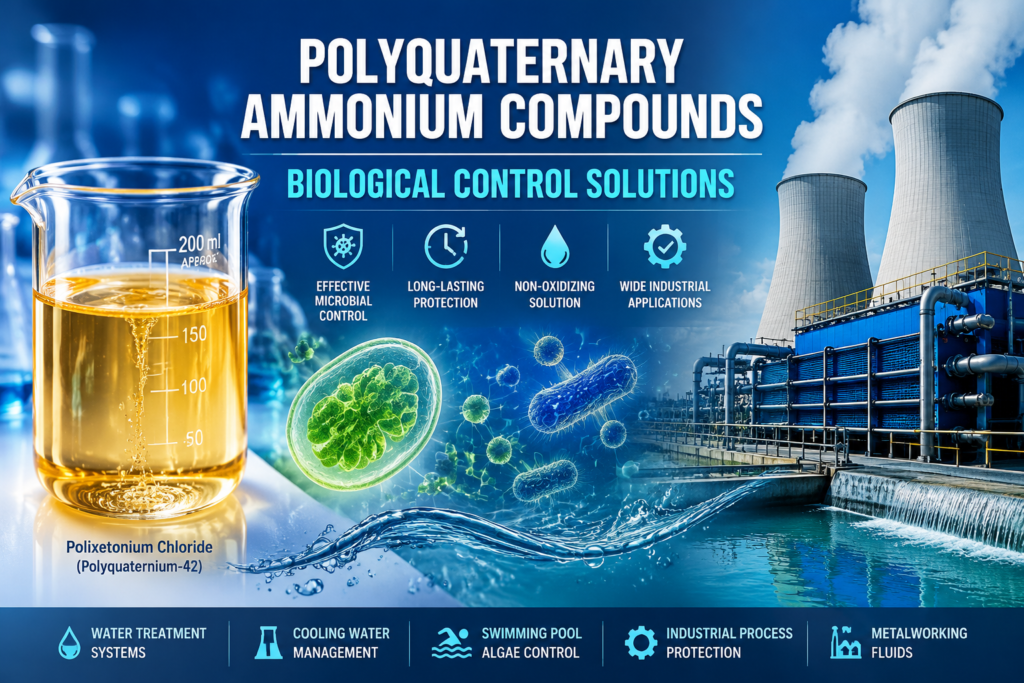
When people talk about controlling microorganisms, the first chemicals that often come to mind are chlorine, bromine, oxidizing agents, or traditional preservatives. These materials have played an important role for decades. However, as industrial systems become more demanding, many industries are looking for biological control solutions that offer longer-lasting effects, better material compatibility, and more stable performance.
This is where polyquaternary ammonium compounds are gaining increasing attention.
You may have seen these materials used under different names: cationic polymers, polymeric quaternary ammonium compounds, polyquats, or non-oxidizing polymer biocides. Although the terminology can seem confusing at first, the basic idea is quite simple — these are positively charged polymer structures designed to interact with microorganisms and help control unwanted biological growth.
So, why are these compounds becoming more popular? What makes a polymer-based biocide different from conventional chemicals? And where do products like Polixetonium Chloride fit into modern biological control strategies?
Let’s take a closer look.
1. Understanding Polyquaternary Ammonium Compounds and Their Growing Importance
Polyquaternary ammonium compounds belong to a special category of cationic polymers containing multiple quaternary ammonium groups along their polymer chains.
The word “cationic” simply means that these molecules carry a positive electrical charge. Many microorganisms, including bacteria and algae, have negatively charged surfaces because of components within their cell membranes. This creates a natural attraction between the polymer and the microbial surface.
Think of it like a magnet. The positive polymer chain is attracted to the negatively charged microbial cell surface, allowing interaction to occur more effectively.
Unlike simple quaternary ammonium compounds with small molecular structures, polyquaternary ammonium compounds have long polymer chains. This structural difference gives them unique characteristics:
- Strong interaction with microbial surfaces
- Long-lasting biological control capability
- Lower volatility compared with many small-molecule biocides
- Good compatibility with various water treatment environments
- Reduced foaming compared with some traditional surfactant-based products
Of course, no chemical works perfectly in every situation. Performance depends on many factors, including water chemistry, organic loading, temperature, microbial population, and application method.
Still, the polymer structure gives these materials an interesting advantage: they can remain active in a treated system for longer periods instead of disappearing quickly.
Why Are Industries Paying More Attention to Polyquaternary Ammonium Compounds?
The answer comes down to a common challenge: biological growth is persistent.
A cooling tower may look clean from the outside, but inside the system, microorganisms can quickly form biofilms. A swimming pool may have clear water today, yet algae can appear after a few days of poor maintenance. A metalworking fluid tank may develop unpleasant odors and microbial contamination if conditions are not properly managed.
Microorganisms are surprisingly adaptable. They do not simply disappear because a treatment chemical was added once.
This is why many industries prefer biological control programs rather than one-time chemical treatments.
Polyquaternary ammonium compounds are often considered valuable tools because they can provide continuous protection when properly formulated and applied.
2. Why Polyquaternary Ammonium Compounds Work in Biological Control
The effectiveness of polyquaternary ammonium compounds comes from the relationship between their chemical structure and microbial surfaces.
Most microbial cells have membranes containing negatively charged components such as phospholipids and other cellular materials. When a positively charged polymer approaches these surfaces, electrostatic attraction occurs.
The polymer can then interact with the cell membrane, affecting its normal function.
A simple way to imagine this process is to think about a protective wall around a building. If that wall is damaged, the building can no longer operate normally. In a similar way, when microbial cell structures are disturbed, their ability to survive and reproduce may be reduced.
However, biological control is rarely about one single mechanism.
Several effects may contribute:
1. Electrostatic Interaction
The positive charges along the polymer chain allow strong attraction to microbial surfaces.
This is one of the key reasons why cationic polymers are effective against many unwanted microorganisms.
2. Cell Surface Disruption
After contacting microbial cells, certain polyquaternary structures may interfere with membrane integrity.
This can reduce microbial activity and limit further growth.
3. Biofilm Control
Biofilms are communities of microorganisms attached to surfaces. They are one of the biggest challenges in industrial water systems.
A clean pipe today does not always mean a clean pipe tomorrow.
Once biofilms develop, microorganisms become harder to remove because the biofilm matrix protects them from external stress.
Polyquaternary ammonium compounds are often studied and applied as part of strategies aimed at reducing microbial attachment and maintaining cleaner systems.
3. The Antimicrobial Mechanism Behind Cationic Polymers
The mechanism of cationic polymer biocides is closely related to their molecular architecture.
Unlike traditional oxidizing chemicals, which attack microorganisms through oxidation reactions, polyquaternary ammonium compounds generally work through surface interaction.
This difference creates several practical benefits.
For example, oxidizing biocides such as chlorine can react quickly with microorganisms, but they may also react with organic matter, corrosion products, or other components in the system.
Polymer-based biocides usually behave differently.
They are designed to maintain biological activity while offering a more stable presence in treated systems.
This makes them attractive for applications where long contact time is important.
A Different Approach Compared with Traditional Biocides
Imagine two cleaning methods.
One method uses a strong spray that removes dirt immediately but disappears quickly.
Another method creates a protective layer that continues working after application.
Neither method is automatically better. The right choice depends on the situation.
The same principle applies to biological control chemicals.
Traditional oxidizing agents can provide rapid microbial reduction, while polyquaternary ammonium compounds are often selected when longer-lasting, non-oxidizing control is needed.
This is why many formulators combine different technologies depending on the application.
For example:
- Cooling water systems may require long-term microbial management.
- Swimming pool products may need algae prevention without excessive foaming.
- Metalworking fluids require protection while maintaining fluid performance.
- Industrial process water may require compatibility with sensitive equipment.
4. Major Applications of Polyquaternary Ammonium Compounds
The versatility of polyquaternary ammonium compounds is one of the main reasons they are attracting attention across different industries.
Although many people first associate quaternary ammonium compounds with disinfectants or household products, polymeric quaternary ammonium materials have developed a much broader range of industrial applications.
From cooling towers to swimming pools, from manufacturing facilities to specialty chemical formulations, these cationic polymers are becoming an important part of modern biological control programs.
Let’s look at some common application areas.
4.1 Water Treatment Systems
Water is one of the most challenging environments for biological control.
Why?
Because water provides almost everything microorganisms need: moisture, nutrients, minerals, and a suitable environment for growth.
In industrial water systems, uncontrolled microbial growth can lead to:
- Biofilm formation
- Slime accumulation
- Reduced heat transfer efficiency
- Equipment fouling
- Increased maintenance costs
Polyquaternary ammonium compounds are widely considered as non-oxidizing biological control agents because they can help manage microbial populations without relying on oxidation reactions.
This makes them suitable for systems where corrosion control and material compatibility are important considerations.
For example, in cooling water applications, operators often need a balance between microbial control and equipment protection. A chemical that works quickly but creates additional corrosion problems may not be the ideal solution.
The goal is not simply “killing microorganisms.”
The goal is maintaining a stable, clean, and efficient system.
4.2 Cooling Tower and Industrial Water Management
Cooling towers are a perfect example of why biological control requires continuous attention.
A cooling tower is exposed to air, sunlight, dust, and organic materials. These conditions create opportunities for algae, bacteria, and other microorganisms to grow.
Over time, microbial deposits can form a layer on surfaces.
This layer acts like insulation, reducing heat exchange efficiency.
In severe cases, biofilm accumulation may contribute to:
- Increased energy consumption
- Blocked water channels
- Unpleasant odors
- Higher cleaning frequency
Polyquaternary ammonium compounds can be used as part of cooling water treatment programs because of their persistent biological activity.
Compared with some conventional treatments, polymeric quaternary compounds may provide a longer-lasting effect, especially when the treatment program is properly designed.
4.3 Swimming Pool Algae Control
Swimming pool care is another important area where polyquaternary ammonium compounds have become popular.
Pool owners often face a frustrating problem:
The water looks perfect today, but a few days later, green algae appear.
Why does this happen?
Because algae spores are constantly introduced into pool environments through wind, rain, swimmers, and surrounding conditions.
Traditional chlorine treatment is essential for pool sanitation, but chlorine alone does not always provide the best algae prevention strategy.
This is where polymeric algaecides can play a supporting role.
Certain polyquaternary ammonium compounds are valued in pool applications because they can provide:
- Non-oxidizing algae control
- Low or non-foaming characteristics
- Compatibility with chlorine-based systems
- Long-lasting preventive effects
One well-known example is Polixetonium Chloride, also known as Polyquaternium-42.
You can learn more about its chemistry and naming relationship here:
Is Polyquaternium-42 the Same as Polixetonium Chloride?
Understanding the connection between these names helps buyers avoid confusion when searching for suppliers or comparing technical documents.
4.4 Metalworking Fluids
Metalworking fluids are another environment where biological control is critical.
These fluids often contain water, oils, additives, and nutrients that microorganisms can use for growth.
Without proper control, problems may appear:
- Bad odors
- Fluid degradation
- Reduced machining performance
- Worker complaints
The challenge is that metalworking fluids are not simple water systems.
A biological control agent must maintain effectiveness while remaining compatible with other formulation components.
For this reason, specialty cationic polymers are sometimes considered in industrial formulations where stable microbial management is required.
5. Polyquaternary Ammonium Compounds vs Traditional Biocides
When selecting a biological control agent, buyers often ask:
“Are polymeric quaternary compounds better than traditional biocides?”
The answer is: it depends.
There is no single chemical solution that works perfectly for every application.
Different technologies have different strengths.
| Technology | Main Characteristics |
|---|---|
| Oxidizing biocides | Fast microbial reduction, commonly used in water systems |
| Traditional quaternary ammonium compounds | Strong surface activity and broad applications |
| Polyquaternary ammonium compounds | Polymer structure, persistent activity, non-oxidizing characteristics |
| Isothiazolinones and other preservatives | Commonly used in industrial preservation applications |
Polyquaternary ammonium compounds are not designed to replace every existing biocide.
Instead, they provide another tool for formulators and treatment specialists.
Their advantages often include:
- Better persistence in some systems
- Reduced oxidation-related reactions
- Compatibility with sensitive equipment
- Lower volatility
- Useful algae control properties
However, performance depends heavily on formulation design and operating conditions.
A professional treatment program considers:
- Water quality
- Microbial species
- Temperature
- pH
- Organic contamination
- Contact time
6. The Role of Polixetonium Chloride in Modern Biological Control
Among various polyquaternary ammonium compounds, Polixetonium Chloride has gained attention as a specialty cationic polymer used in biological control applications.
It is also known as:
- Polyquaternium-42
- WSCP
- Poly[oxyethylene(dimethyliminio)ethylene(dimethyliminio)ethylene dichloride]
CAS Number:
31512-74-0
This polymer is commonly supplied as a concentrated liquid solution, often around 60% active content.
Its characteristics make it interesting for several applications:
- Industrial water treatment
- Cooling water systems
- Swimming pool algae control
- Specialty antimicrobial formulations
Unlike simple quaternary ammonium compounds, Polixetonium Chloride has a polymeric structure, which contributes to its unique performance profile.
For buyers researching this material, understanding specifications is extremely important.
Important quality parameters may include:
- Active content
- Appearance
- pH value
- Viscosity
- Density
- Storage stability
A reliable supplier should provide consistent technical documentation and support application evaluation.
For more information about its biological control performance, you may also read:
Why Does Polixetonium Chloride Provide Long-Lasting Algae Control?
7. Factors Affecting the Performance of Polyquaternary Ammonium Compounds
Even a high-quality cationic polymer cannot perform well without proper application.
Several factors influence biological control results.
Water Chemistry
Water hardness, dissolved minerals, and organic substances may affect chemical performance.
A product that works well in one location may require adjustment in another.
Polymer Concentration
Too little active material may not provide sufficient control.
Too much may increase cost without improving performance.
The correct dosage depends on system conditions.
Microbial Population
Different microorganisms respond differently.
Algae, bacteria, and fungi have different biological structures.
Therefore, treatment programs should consider the target organisms.
Contact Time
Biological control is not always an instant process.
Some applications require maintaining an effective concentration over time rather than achieving immediate reduction.
8. Future Trends of Cationic Polymer-Based Biological Control
The demand for more efficient and sustainable biological control solutions continues to grow.
Several trends are shaping the future of this field.
More Specialized Polymer Structures
Chemical manufacturers are developing polymers with improved performance characteristics, including better compatibility and controlled biological activity.
Combination Treatment Programs
Many industries are moving toward integrated approaches.
Instead of relying on one chemical, treatment specialists combine technologies to achieve better overall performance.
For example:
- Oxidizing agents for rapid control
- Polymeric biocides for longer protection
- Dispersants for deposit management
Growing Demand for Water Efficiency
As industries focus more on water reuse and conservation, maintaining clean water systems becomes increasingly important.
Poor biological control can reduce system efficiency and increase operating costs.
This creates new opportunities for advanced cationic polymer technologies.
9. Final Thoughts
Biological control is becoming more challenging as industries demand cleaner systems, better efficiency, and more reliable performance.
Polyquaternary ammonium compounds offer a unique approach by combining polymer chemistry with biological control functionality.
They are not a replacement for every existing treatment technology, but they provide an important option for industries looking for non-oxidizing, persistent, and versatile solutions.
From cooling towers to swimming pools, from industrial fluids to specialty formulations, cationic polymers continue to demonstrate why polymer-based biological control deserves closer attention.
For companies sourcing advanced water treatment chemicals, understanding these materials is the first step toward choosing the right solution.
10. Frequently Asked Questions
1. What are polyquaternary ammonium compounds used for?
Polyquaternary ammonium compounds are mainly used for biological control applications, including cooling water treatment, algae control, industrial process protection, and specialty antimicrobial formulations.
2. How do polyquaternary ammonium compounds control microorganisms?
These cationic polymers interact with negatively charged microbial cell surfaces. This interaction can disturb microbial structures and help reduce unwanted biological growth.
3. Is Polixetonium Chloride a polyquaternary ammonium compound?
Yes. Polixetonium Chloride is a polymeric quaternary ammonium compound and is also known as Polyquaternium-42. It is commonly used in applications requiring non-oxidizing biological control.
4. What is the difference between polyquaternary ammonium compounds and traditional quaternary ammonium compounds?
The main difference is molecular structure. Polyquaternary ammonium compounds contain polymer chains with multiple charged groups, which may provide different persistence and performance characteristics compared with smaller quaternary ammonium molecules.
5. Are polyquaternary ammonium compounds suitable for industrial water treatment?
Yes. Certain polyquaternary ammonium compounds are used in industrial water treatment programs, especially where long-lasting biological control and compatibility with system materials are important.