
GET IN TOUCH
Ask For Sample?
Why Water Clarity Is an Important Part of Professional Pool Maintenance?
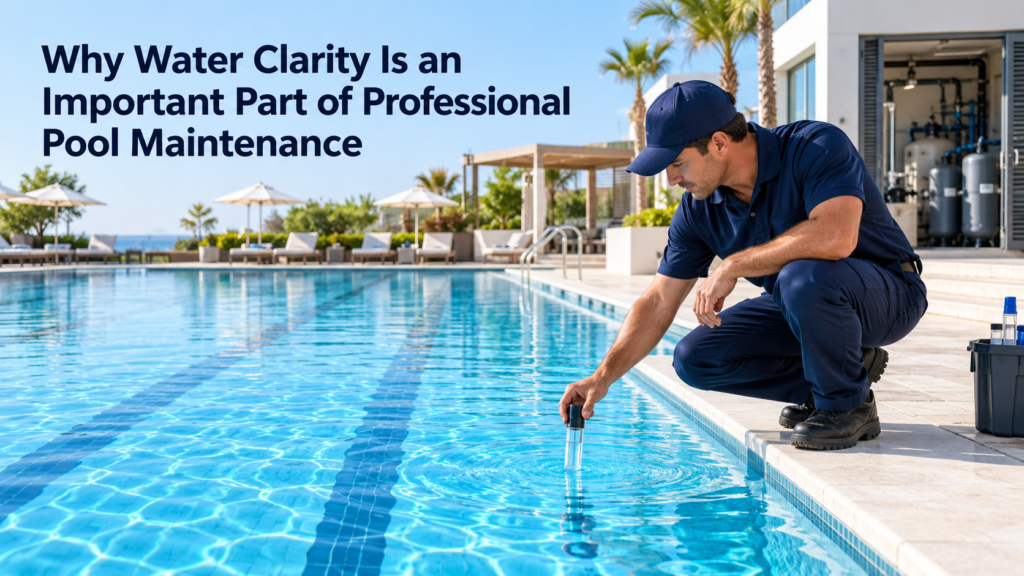
A professionally maintained swimming pool should look inviting before anyone touches the water. Guests expect to see a clean blue surface, sharp tile lines, and a clearly visible pool floor. When the water looks dull or cloudy, confidence disappears almost at once.
Yet water clarity is not merely about appearance.
Clear water supports swimmer safety, reflects the performance of the circulation and filtration system, and helps maintenance teams notice problems before they become expensive. For hotels, resorts, aquatic centers, health clubs, schools, and residential communities, it also affects customer satisfaction and the reputation of the entire facility.
A pool may have an acceptable chlorine reading and still look cloudy. It may also appear reasonably clear while hiding early filtration or water-balance problems. That is why professional pool maintenance treats clarity as an operating condition—not a decorative finishing touch.
Let’s look at what clear water really tells us, what causes clarity to decline, and how pool professionals can manage it more consistently.
Clear Water Creates Immediate Confidence
People judge a swimming pool in seconds.
They rarely ask about turnover rates, filter pressure, or sanitizer residual before forming an opinion. Instead, they look at the water. Can they see the drains? Are the floor markings sharp? Does the water sparkle, or does it have a pale, milky haze?
That first visual impression matters.
In a hotel or resort, the pool is often part of the property’s public image. Guests may see it from the lobby, restaurant, balcony, or booking photographs. A bright, clear pool suggests that the facility is cared for. Cloudy water suggests the opposite—even when the rest of the property is spotless.
The same principle applies to commercial aquatic centers and community pools. Swimmers associate clarity with cleanliness, order, and professional attention. That perception may not tell the whole technical story, but it strongly affects whether people feel comfortable entering the water.
For pool operators, water clarity is therefore both a maintenance goal and a form of silent communication. It tells swimmers, “This facility is being watched.”
Water Clarity Is Also a Safety Issue
The most important reason to maintain clear pool water is visibility.
Lifeguards and pool staff must be able to see swimmers beneath the surface. They also need a clear view of the pool floor, drains, steps, and other underwater features. Even a moderate haze can make observation more difficult, especially in deeper pools or under changing light conditions.
Imagine looking through a slightly fogged window. You can still see shapes, but fine details disappear. Pool haze creates a similar effect. Reflections, moving water, artificial lighting, and a crowded swimming area can make the problem worse.
Poor underwater visibility may delay recognition of:
- A swimmer in distress
- An object on the pool floor
- A damaged fitting or drain cover
- Algae developing on a submerged surface
- Debris that could create a slipping or hygiene concern
Professional maintenance teams should never assume that “almost clear” is good enough. If the deepest point of the pool cannot be seen distinctly from the deck under normal operating conditions, the pool deserves immediate attention.
Local health codes and operating requirements vary, so each facility must follow the rules in its jurisdiction. Still, the underlying principle remains simple: if staff cannot clearly observe what is happening underwater, safe supervision becomes harder.
Clarity Gives You a Window into Pool Performance
Clear water does not prove that every chemical parameter is correct. Likewise, cloudy water does not always mean sanitizer is absent. However, changes in clarity often provide an early warning that part of the treatment system is struggling.
A professionally operated pool depends on several connected processes:
- Water circulation
- Mechanical filtration
- Sanitization
- Oxidation of organic contaminants
- pH and alkalinity control
- Calcium balance
- Regular cleaning
- Appropriate use of supplementary treatment products
When one part underperforms, clarity may begin to decline.
For example, fine particles may remain suspended because the filter cannot capture them efficiently. Organic material may build up after a period of heavy use. A change in pH may reduce treatment efficiency or encourage mineral precipitation. Weak circulation may leave areas of the pool poorly treated.
The water often gives a visual signal before the situation develops into a major complaint. A slight loss of sparkle, a faint haze in the deep end, or slower recovery after busy periods can all tell an experienced operator that something needs attention.
That is the value of routine observation. Test results provide numbers; the water itself provides context.
Why Can a Pool Turn Cloudy Even When Chlorine Is Normal?
This question causes plenty of frustration. The chlorine level looks acceptable, the pH appears to be within the desired range, and yet the pool still looks hazy. What went wrong?
The answer is that sanitizer and clarity perform different jobs.
Chlorine helps control microorganisms and oxidize certain contaminants. It does not automatically remove every fine particle from the water. Dust, pollen, body oils, cosmetic residues, dead algae, mineral particles, and fragments of organic matter may continue circulating even when a sanitizer residual is present.
Some of these particles are extremely small. They remain dispersed throughout the water and pass through the filter repeatedly. Individually, they are hard to see. Together, they scatter light and create the familiar dull or milky appearance associated with cloudy pool water.
A chlorine test also represents conditions at a specific time and sampling point. It does not, by itself, confirm that circulation is even throughout the pool or that the filter is working correctly.
So yes, a pool can have a normal chlorine reading and poor clarity. That is not a contradiction. It simply means that water quality depends on more than one number.
Fine Suspended Particles Are Often the Hidden Problem
Many clarity problems begin with particles that are too small to settle quickly or become trapped by the filter.
These particles enter pool water from many sources:
- Dust carried by wind or nearby construction
- Pollen, soil, and plant material
- Skin cells, sweat, hair products, and cosmetics
- Sunscreen and body lotion
- Textile fibers from towels or swimwear
- Dead algae and other organic residues
- Mineral precipitation caused by imbalanced water
- Small debris introduced during storms
- Contaminants carried in by high swimmer traffic
Particle size matters. Larger debris can be removed by baskets, vacuuming, or filtration. Very fine material behaves differently. It may remain suspended because natural water movement keeps it from settling.
Many suspended particles also carry an electrical surface charge. Particles with similar charges tend to repel one another, which helps keep them separated. They remain tiny, mobile, and difficult for the filter to catch.
This is one reason a pool can run for hours without becoming clear. The water is circulating, but the smallest contaminants keep making another trip around the system.
Filtration Does the Heavy Work—but It Has Limits
A pool filter is the main physical barrier against suspended contamination. Its condition has a direct effect on water clarity.
Sand, cartridge, and diatomaceous earth filters work differently, yet all require correct sizing, adequate flow, proper maintenance, and enough operating time. If any of these factors is missing, clarity may suffer.
Common filtration problems include:
- Insufficient daily circulation time
- A dirty or damaged filter medium
- Incorrect backwashing procedures
- Channeling inside a sand filter
- Torn cartridges or filter elements
- A pump that is too small or performing poorly
- Excessive flow that pushes particles through the system
- Blocked baskets or restricted plumbing
- Air entering the circulation line
- Poor hydraulic balance within the pool
More filtration time is not always the answer. If water bypasses the filter or the medium cannot retain the particles, running the pump longer may only circulate the haze.
Filter pressure can provide useful clues, but it should be interpreted against the system’s clean starting pressure. A high reading may indicate a dirty or restricted filter. An unusually low reading may point to weak flow, a blockage before the pump, or another circulation problem.
The key is to assess the whole system. Professional maintenance is rarely about changing one setting and hoping for the best.
High Bather Loads Can Change Water Quickly
A quiet pool and a crowded pool are almost two different treatment environments.
Each swimmer introduces contaminants into the water. Some are visible, but most are not. Sweat, skin oils, cosmetics, sunscreen, hair products, and microscopic organic material all add to the treatment demand.
During busy periods, several things happen at once:
- Sanitizer demand increases
- More fine particles enter the water
- Filters collect contaminants faster
- Water movement may become uneven
- Surface debris can overwhelm skimmers
- Combined chlorine and odor complaints may develop
- Clarity can decline before the scheduled maintenance visit
This is especially important for water parks, hotel pools, swim schools, fitness centers, and public facilities. Their treatment plans should reflect actual use rather than a fixed calendar alone.
A pool that remains clear with 20 swimmers may struggle with 100. Professional operators anticipate that difference. They may extend circulation, inspect filters more often, adjust treatment schedules, encourage pre-swim showering, and prepare for rapid recovery after peak use.
Waiting until the water turns visibly cloudy is a little like waiting for smoke before checking whether the kitchen is overheating. The warning has arrived rather late.
Weather Can Disrupt Clarity Overnight
Outdoor pools face another variable: the weather.
Heavy rain can carry dust, soil, pollen, leaves, and organic debris into the pool. It can also dilute treatment chemicals and disturb water balance. Strong winds add airborne particles, while hot weather may increase swimmer use and sanitizer demand at the same time.
After a storm, the pool may contain contaminants from the air, deck, landscaping, and surrounding structures. Even if large debris is removed quickly, fine material can remain suspended.
Professional post-storm care usually includes:
- Removing leaves and visible debris
- Emptying skimmer and pump baskets
- Testing sanitizer, pH, alkalinity, and other relevant parameters
- Inspecting water level and circulation
- Checking filter pressure and condition
- Vacuuming settled material where necessary
- Providing sufficient filtration time
- Considering a suitable clarifier if fine suspended particles remain
The order matters. Adding more products before inspecting the pool can complicate the problem. First identify what changed; then apply the treatment that addresses it.
Balanced Chemistry Supports Clear Water
Pool water balance affects comfort, equipment protection, sanitizer performance, and clarity.
When pH moves outside the desired operating range, treatment efficiency can change. High pH may contribute to scale formation and mineral haze, particularly where calcium hardness and water temperature are also high. Very low pH can cause corrosion and damage pool surfaces or equipment.
Total alkalinity helps stabilize pH. Calcium hardness also requires attention, especially in plaster pools and regions with hard source water. Depending on the pool and sanitizer system, operators may also monitor cyanuric acid, total dissolved solids, salt level, temperature, and other parameters.
Still, balanced test results should not become a false finish line.
A pool can have acceptable chemical readings and remain cloudy because physical contaminants have not been removed. Chemistry can control the environment, but filtration must still carry particles out of the water.
This is why professional pool care combines chemical management with hydraulic and mechanical maintenance. One cannot reliably replace the other.
What Role Does a Polymer Pool Clarifier Play?
When fine suspended particles are the main cause of haze, a polymer pool clarifier can help the filtration system remove them.
Many liquid pool clarifiers contain water-soluble polymers. Cationic polymers carry positive charges along their molecular chains. Since many suspended particles have negatively charged surfaces, the polymer can attract and connect them.
You can think of the polymer as a bridge. It links tiny, separate particles into larger clusters that are easier for the filter to capture. The particles do not simply disappear; they become more filterable.
A well-formulated polymer clarifier may help:
- Improve the removal of fine suspended matter
- Restore visual brightness after heavy use
- Support recovery following dust, pollen, or storms
- Reduce persistent haze that passes through the filter
- Improve filter capture under suitable operating conditions
PolyDADMAC-based clarifiers, including products formulated with CAS 26062-79-3, are commonly used for particle-control applications. Commercial formulations may vary in polymer concentration, viscosity, appearance, recommended dosage, and compatibility with treatment systems.
The product must be dosed according to its formulation and label directions. More is not necessarily better.
Clarifier Is Helpful, but It Is Not a Cure-All
A clarifier should support a functioning pool system. It cannot compensate for every maintenance failure.
If the pump is not circulating water, the filter is damaged, algae is actively growing, or the water balance is seriously disturbed, adding clarifier alone will not solve the underlying problem.
Before using a clarifier, professionals should consider a few questions:
- Is the sanitizer level appropriate?
- Is the pH within the required operating range?
- Is there visible or suspected algae?
- Is circulation reaching the whole pool?
- Is the filter clean and working correctly?
- Are the particles suspended, or has material settled?
- Was another clarifier or flocculant recently added?
- Does the product suit the filter and treatment system?
Clarifiers work best when the cause has been identified and the filter is ready to collect the larger particle groups created by the polymer.
Overdosing can sometimes worsen haze, load the filter, or create handling difficulties. The exact effect depends on the formulation and pool conditions, but the lesson is straightforward: controlled dosing beats guesswork.
Clarifier and Flocculant Are Not the Same Thing
The two terms are sometimes used loosely, but pool clarifiers and pool flocculants usually support different maintenance approaches.
A clarifier generally forms particles large enough for the filter to capture while the circulation system continues operating. It is suited to gradual clarification and routine support when the pool remains in normal service.
A flocculant usually creates heavier particle masses intended to settle on the pool floor. The settled material is then vacuumed to waste. This treatment may be useful for severe cloudiness, but it can require pool closure, careful handling, and significant water replacement.
A simple distinction looks like this:
- Clarifier: gathers fine particles for filtration.
- Flocculant: gathers particles for settling and removal by vacuuming.
Neither product is automatically better. The correct choice depends on the severity of the problem, the filter configuration, available downtime, water restrictions, and the facility’s operating plan.
For a hotel that needs to keep the pool available, gradual filtration may be more practical. For a badly clouded pool that can be closed overnight, settling and vacuuming may offer faster recovery. Context decides.
Clear Water Can Reduce Operational Stress
Persistent cloudiness consumes time.
Staff repeat water tests, backwash filters, answer guest complaints, add treatment products, and explain why the pool does not look right. In commercial facilities, a serious clarity problem may also force temporary closure.
Good clarity management helps reduce this cycle.
When pool operators monitor trends and respond early, they can schedule work more efficiently. They may notice that clarity declines after weekend crowds, seasonal pollen, dust storms, or a particular cleaning procedure. Once a pattern becomes visible, the maintenance plan can be adjusted.
This is where recordkeeping becomes valuable.
A useful pool log may include:
- Free and combined sanitizer readings
- pH and alkalinity
- Water temperature
- Filter pressure
- Pump operating hours
- Estimated swimmer load
- Weather conditions
- Products and dosage amounts
- Visual clarity observations
- Cleaning and backwashing records
Over time, these notes tell a story. Perhaps haze always appears after a high-attendance event. Perhaps filter pressure rises faster after landscaping work nearby. Perhaps a new source of fill water is increasing mineral precipitation.
Without records, each cloudy-water event feels separate. With records, causes become easier to recognize.
Water Clarity Protects the Facility’s Reputation
For commercial pools, appearance has financial consequences.
A cloudy pool can generate complaints, poor reviews, refund requests, or uncomfortable conversations at the front desk. Guests may question hygiene across the property, even when the clarity issue is caused by harmless fine particles.
Photographs amplify the effect. A single image of dull pool water can circulate through social media or travel-review platforms long after the problem has been corrected.
Conversely, clear water photographs beautifully. It strengthens the appearance of the surrounding deck, landscaping, and architecture. For resorts and hotels, the pool becomes an asset in marketing materials rather than an operational liability.
Professional water clarity therefore supports more than maintenance. It protects brand trust.
People may not understand polymer chemistry or filtration rates, but they understand what clear water looks like.
A Practical Routine for Maintaining Consistent Clarity
Consistent water clarity comes from repeated, disciplined work. It is rarely the result of one “magic” chemical.
A professional routine should include the following steps:
- Inspect the pool visually. View it from several angles and check the deepest area. Look for haze, color changes, surface films, debris, algae, and uneven circulation.
- Test the water. Measure the parameters required for the facility and treatment system. Use reliable equipment, fresh reagents, and correct sampling methods.
- Check circulation. Confirm that the pump, skimmers, drains, return inlets, valves, and water level support proper movement.
- Inspect the filter. Compare pressure with the clean baseline. Follow the manufacturer’s maintenance procedure and examine the filter medium when performance is uncertain.
- Remove physical contamination. Empty baskets, brush surfaces, vacuum debris, and clean the waterline.
- Review recent events. Consider swimmer load, storms, dust, chemical additions, equipment changes, and source-water conditions.
- Correct the cause. Adjust chemistry, repair equipment, clean the filter, or increase appropriate circulation time as needed.
- Use a clarifier when suitable. Apply a compatible product at the recommended dosage when fine suspended particles remain.
- Recheck the result. Do not assume that treatment worked. Observe clarity, monitor filter pressure, and test the water again.
This process may sound methodical—and it is. That is precisely why it works.
Choosing a Clarifier for Professional or Private-Label Use
Pool service companies, distributors, and private-label brands should evaluate more than product color or price when selecting a polymer clarifier.
Important factors include:
- Polymer type and active concentration
- Recommended application dosage
- Appearance and viscosity
- Stability during storage
- Compatibility with common pool-treatment programs
- Filtration-system suitability
- Packaging quality
- Batch-to-batch consistency
- Availability of COA and SDS documentation
- Label and regulatory requirements in the target market
- Custom packaging and private-label support
A blue clarifier may look familiar to retail customers, but color does not determine performance. Clear or lightly colored formulations can work equally well when the active chemistry and dosage are appropriate.
Packaging should also match the buyer’s market. A 1-liter bottle may suit pool owners and retail shelves, while 5-liter and 25-liter containers can be more practical for service companies, commercial facilities, and distributors.
For private-label projects, the formula, packaging, label language, carton design, and documentation should be reviewed as one complete product system. A good chemical inside a leaking or poorly labeled package is still a bad customer experience.
Clarity Is the Result Everyone Can See
Professional pool maintenance involves pumps, filters, test kits, calculations, cleaning schedules, and careful chemical handling. Most swimmers never see that work.
They see the result.
Clear water shows that the physical and chemical parts of the pool system are working together. It improves underwater visibility, supports safer supervision, strengthens guest confidence, and helps facilities present a well-managed image.
Of course, clarity alone does not confirm that water is microbiologically safe. A pool can look beautiful and still require chemical correction. That distinction matters. Professional operators evaluate appearance, sanitizer conditions, water balance, circulation, and filtration together.
Still, clarity remains one of the most immediate and useful indicators available. It is the visible outcome of many hidden processes.
When the water loses its sparkle, do not simply add more product and cross your fingers. Check the system, identify the cause, and apply the right correction. That calm, evidence-based approach is what separates routine chemical addition from professional pool care.
For pool chemical distributors and private-label brands, Eautrix supplies customizable polymer pool clarifier solutions based on cationic polymer technology. Formulation concentration, liquid color, packaging, and private labels can be adapted to specific market requirements, with 1 L, 5 L, and 25 L packaging options available.
Frequently Asked Questions
1. Why is water clarity important in professional pool maintenance?
Water clarity supports underwater visibility, swimmer supervision, customer confidence, and early detection of filtration or water-balance problems. It is both a safety consideration and an indicator of overall pool-system performance.
2. Can pool water be cloudy even when chlorine levels are correct?
Yes. Fine particles, weak filtration, poor circulation, mineral precipitation, heavy swimmer use, or weather-related contamination can cause cloudy pool water even when the chlorine reading appears normal.
3. How does a cationic polymer pool clarifier work?
A cationic polymer attracts many negatively charged suspended particles and connects them into larger groups. These larger particles are easier for a functioning pool filter to capture.
4. How often should a professional pool use clarifier?
There is no universal schedule. Frequency depends on swimmer load, weather, filtration performance, source water, and the clarifier formulation. Follow the product directions and use it when conditions justify treatment rather than adding it automatically.
5. Can polymer pool clarifier replace filtration or chlorine?
No. A polymer clarifier helps remove suspended particles, but it does not replace sanitization, circulation, filtration, cleaning, or balanced water chemistry. It should be used as one part of a complete professional maintenance program.