
GET IN TOUCH
Ask For Sample?
What Pool Professionals Should Know About Cationic Pool Clarifiers?
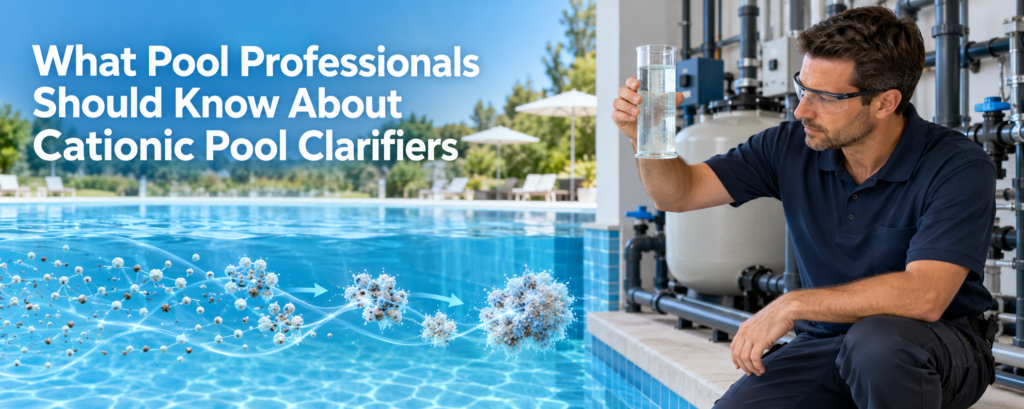
A swimming pool can have acceptable chlorine, a stable pH, and a working circulation system—yet the water still looks slightly dull.
You may notice a faint haze under the underwater lights. The main drain may appear less distinct than usual. From the deck, the pool seems clean, but it has lost that crisp, polished look guests expect.
This is where a cationic pool clarifier can help.
These polymer-based products are designed to gather very fine suspended particles into larger clusters that the filter can capture more easily. They do not replace chlorine, correct poor circulation, or repair a damaged filter. Used correctly, however, they can make an effective filtration system work much better.
For pool professionals, the key is understanding what the polymer does, when to use it, and when it is simply the wrong tool for the problem.
What Is a Cationic Pool Clarifier?
A cationic pool clarifier is a water-soluble treatment product containing positively charged polymer chains.
The word “cationic” refers to that positive electrical charge. This matters because many of the tiny contaminants suspended in pool water carry a negative surface charge.
These contaminants may include:
- Dust and soil particles
- Pollen
- Fine organic debris
- Dead algae fragments
- Body-care product residues
- Small particles left after heavy swimmer use
- Contaminants introduced by rain or wind
- Material too fine for the filter to capture efficiently
Although each particle may be microscopic, thousands or millions of them can scatter light. That light scattering gives water a cloudy, grey, or slightly milky appearance.
The particles often remain suspended because similar surface charges repel one another. Think of them as tiny magnets facing the wrong way. They stay separate, move through the water, and may pass through the filter repeatedly.
A cationic clarifier changes that behavior.
Its positively charged polymer chains interact with negatively charged particles, reducing the electrical forces that keep them apart. The polymer may also connect several particles through a process known as polymer bridging.
The result is the formation of larger particle clusters.
Those clusters can then be retained more easily by a sand, cartridge, or diatomaceous earth filter. In other words, the clarifier does not make the contamination disappear. It helps the filtration system remove it.
Why Can’t the Filter Remove Those Particles on Its Own?
Pool filters have practical limits.
A filter can capture hair, insects, leaves, lint, and other visible debris without much trouble. Very fine colloidal particles are different. Some are so small that they pass through the spaces within the filter media.
Even particles that are technically large enough to be captured may remain stable in the water because of their surface charge. They do not naturally combine into heavier, more filterable groups.
This is why cloudy water may persist even when the circulation pump is operating normally.
The filter may be running, but it is being asked to catch particles that behave more like smoke than sand. A cationic polymer helps turn that “smoke” into something the filter can hold.
This is also why filtration time after treatment matters. Adding a clarifier and then switching off the circulation system too soon interrupts the removal process. The polymer can prepare the particles for capture, but water still needs to carry those particles to the filter.
Charge Neutralization and Polymer Bridging
Cationic clarifiers commonly work through two related mechanisms: charge neutralization and bridging.
During charge neutralization, the positive sites on the polymer reduce the negative surface charge of suspended matter. Once the repulsive forces become weaker, the particles can approach one another and form small aggregates.
During polymer bridging, part of a long polymer chain attaches to one particle while another section attaches to a different particle. One chain may therefore connect several particles.
Picture a loose fishing net moving through the water. It does not dissolve the debris. It gathers individual specks into groups.
The balance must be right, though.
Too little polymer may not provide enough charge or bridging activity. Too much can coat the particles completely and make them stable again. This effect is sometimes called charge reversal or restabilization.
That is one reason “a little extra for good measure” is not a sound dosing method. More clarifier does not always produce clearer water.
Sometimes it produces exactly the opposite.
A Clarifier Is Not a Sanitizer
This distinction is essential.
A cationic clarifier is mainly a physical water-clarity aid. It helps remove suspended matter through filtration. Unless a specific finished product is registered and labeled for an additional function, it should not be treated as a sanitizer or algaecide.
A clarifier does not replace:
- A proper chlorine or approved sanitizer residual
- Routine pH control
- Alkalinity and hardness management
- Adequate circulation
- Filter cleaning
- Algae treatment
- Response procedures for fecal or bodily-fluid contamination
- Compliance with local commercial-pool regulations
Clear water is not automatically safe water.
A pool may look beautiful while still having inadequate disinfection. Likewise, a properly sanitized pool can appear hazy because of fine suspended particles. Water appearance and microbiological control are connected operationally, but they are not the same measurement.
Pool professionals should therefore diagnose the complete system before reaching for a clarifier.
When Does a Cationic Clarifier Make Sense?
Cationic clarifiers are most useful when fine suspended particles are the main reason for poor water clarity.
Typical situations include water that becomes hazy after a busy weekend, a storm, nearby landscaping work, or an event with unusually high swimmer use.
They may also help during routine maintenance when the pool has acceptable chemistry but struggles to achieve a polished appearance.
Common applications include:
- Hotels and resorts
- Apartment and residential-community pools
- Health clubs
- Schools and universities
- Water parks
- Public leisure facilities
- Competition and training pools
- Private pools with recurring fine-particle problems
Commercial facilities often place special value on rapid clarity recovery. A slightly cloudy residential pool may be inconvenient; the same appearance at a hotel can lead to complaints, poor photographs, and questions about maintenance quality.
Still, clarifier use should follow diagnosis rather than habit.
If the actual problem is algae growth, inadequate disinfectant, poor circulation, a dirty filter, or severely unbalanced water, adding more polymer may only complicate the situation.
Start with a Proper Water Diagnosis
Before dosing a cationic clarifier, check the basic operating conditions.
Begin with sanitizer level and pH. Then inspect circulation, flow, filter pressure, skimmer performance, return flow, and pump operation. Look for signs of algae on steps, walls, fittings, and low-circulation areas.
It is also worth asking a few simple questions:
- Did the haze appear after heavy swimmer use?
- Was there recent rain, wind, or construction dust?
- Has the filter been cleaned or backwashed recently?
- Has another chemical been added?
- Is the water evenly cloudy, or only cloudy in certain areas?
- Is the cloudiness white, green, brown, or grey?
- Has the circulation system been operating long enough?
- Is the pool losing clarity at the same time every day?
The colour and timing of the haze can offer clues.
Green water usually suggests algae, although metals can sometimes create unusual colours. Brown or reddish water may point toward iron or other metals. White cloudiness can result from calcium precipitation, poor chemical addition, aeration, or fine suspended solids.
A clarifier may assist with some particulate matter, but it will not correct every source of turbidity.
Clarifier or Flocculant: They Are Not Always the Same
The terms “clarifier” and “flocculant” are sometimes used loosely, but pool professionals should treat them as different operating approaches.
A clarifier normally forms relatively small aggregates that remain suspended long enough to travel through the circulation system and enter the filter. The pool often continues operating during treatment, subject to the product instructions and facility procedures.
A flocculant is generally intended to form larger, heavier material that settles on the pool floor. That settled matter is then removed by vacuuming to waste.
Clarification is therefore closely connected with normal filtration. Flocculation may require shutting down circulation, allowing settling time, and removing the sediment without sending it back through the filter.
The right choice depends on the contamination level, pool design, filter arrangement, available downtime, and discharge restrictions.
For mild or moderate haze, a cationic clarifier may be the more practical tool. For a serious suspended-solids event, a settling treatment may be considered—but only if the system and local rules allow it.
Why Dosage Is More Important Than It Looks?
Polymer dose affects performance at every stage.
An insufficient dose may produce little visible improvement. A severe overdose may leave the water hazier, increase filter loading, create surface residue, or make the filter media feel sticky.
There is no reliable universal dose for every cationic clarifier.
Products can differ in:
- Polymer chemistry
- Molecular weight
- Charge density
- Active concentration
- Viscosity
- Recommended dilution
- Finished-product formulation
- Intended pool volume
- Method and frequency of application
Pool conditions also change the result. A dose that works well in one pool may perform differently in another because the particle concentration, water temperature, dissolved solids, pH, filter type, and circulation pattern are different.
The safest rule is simple: follow the product label and technical instructions.
Measure pool volume carefully. Use calibrated dosing equipment when possible. Record the amount applied, the time of treatment, the water conditions, and the observed result.
For a large commercial facility, a controlled trial can be more useful than guessing. Treating a smaller volume or testing representative water samples may help identify a suitable working dose before full-scale application.
How to Add a Cationic Clarifier Correctly?
Application procedures depend on the individual product, so the supplier’s instructions should always come first. Still, several operating principles apply broadly.
Make sure the circulation system is working properly before treatment. Clean or backwash the filter if it is already heavily loaded, unless the treatment procedure says otherwise.
Measure the required amount accurately. If dilution is recommended, prepare it with clean water using compatible equipment. Do not mix concentrated clarifier directly with other pool chemicals.
Distribute the product in a way that supports even dispersion. Some products are added around the pool perimeter, while others may be introduced at a designated point in the circulation system.
Allow enough filtration time after dosing. Watch filter pressure because the newly formed aggregates may cause the filter to load faster than usual.
Once clarity improves, clean or backwash the filter according to the system manufacturer’s guidance. The filter has collected the material; it now needs to be removed from the system.
And, yes, document the treatment. Good records make future troubleshooting much easier.
Filter Type Can Change the Result
A clarifier should be matched with the filtration system rather than treated as a completely independent product.
Sand filters often benefit from polymer clarification because very fine particles may otherwise pass through the media. As aggregates form, capture can improve. Filter pressure may rise as more material is retained.
Cartridge filters can also capture polymer-bound particles effectively, but the cartridges may require earlier cleaning. Excess polymer can create difficult-to-remove deposits, especially if the product is repeatedly overdosed.
Diatomaceous earth filters already provide very fine filtration. A compatible clarifier may still help in certain situations, but careful dosing is particularly important. The product supplier and equipment manufacturer should confirm suitability.
Regenerative media filters, membrane-based systems, and specialist commercial filtration units may have their own chemical restrictions. Never assume compatibility based only on the word “clarifier.”
Professional treatment starts with the whole system—not just the bottle.
Watch for Chemical Compatibility
Cationic polymers can interact with other treatment chemicals.
This is particularly important when anionic products are present. An anionic polymer and a cationic polymer may react with each other, producing unwanted precipitation or reducing the performance of both.
Clarifiers may also behave differently in water containing high levels of dissolved solids, unusual metal concentrations, or residues from previous treatments.
Avoid mixing concentrated chemicals together. Keep separate feed equipment where required, and provide adequate time and distance between injection points.
If a facility uses enzymes, phosphate-removal products, metal-control agents, algaecides, or specialist filter aids, ask the chemical supplier for written compatibility guidance.
A clear compatibility statement is worth far more than an experiment conducted in a crowded plant room on a Friday afternoon.
Common Mistakes That Reduce Clarifier Performance
The most common mistake is adding clarifier before finding the cause of the cloudy water.
Other frequent errors include:
- Estimating pool volume instead of calculating it
- Dosing by eye
- Applying repeated doses without waiting for filtration
- Treating algae-related cloudiness with clarifier alone
- Adding the product while circulation is poor
- Ignoring an overloaded or damaged filter
- Mixing concentrated products
- Using a clarifier and flocculant as though they were identical
- Failing to clean the filter after particle capture
- Applying a maintenance dose when corrective treatment is needed
- Assuming all cationic polymers have the same active content
- Forgetting to record treatment results
Repeated overdosing deserves special attention. When the water does not clear immediately, operators may add another dose, then another.
Polymer treatment needs mixing, contact, circulation, and filtration time. Give the first treatment a fair chance to work before deciding that more is required.
What Should Professionals Monitor After Treatment?
Do not judge performance from the pool edge alone.
Visual clarity is important, but it should be supported by operational observations and, where required, measured turbidity data.
After treatment, monitor:
- Visibility across the pool and toward the main drain
- Turbidity, when measurement equipment is available
- Filter differential pressure
- Circulation flow
- Surface residue or foaming
- Return-water clarity
- Time needed to reach the expected result
- Frequency of filter cleaning or backwashing
- Sanitizer and pH readings
- Any change in swimmer comfort
Underwater lighting can reveal haze that is difficult to see in daylight. A consistent viewing point is useful for routine comparisons.
Commercial facilities should also record weather, swimmer load, treatment dose, filter condition, and recovery time. Over several weeks, those records can reveal whether the problem is occasional or structural.
Perhaps the filter is undersized. Perhaps circulation is poor in one section. Perhaps heavy-use periods require a different maintenance schedule.
A clarifier can solve a particle problem. It should not hide an equipment problem.
Choosing a Cationic Pool Clarifier Supplier
A professional buyer needs more than an attractive label and a low price.
The supplier should clearly identify the product’s intended application and provide consistent technical documentation. Depending on the market and product status, this may include a specification sheet, Safety Data Sheet, Certificate of Analysis, directions for use, storage guidance, packaging information, and applicable regulatory documentation.
Important purchasing questions include:
- What is the polymer chemistry?
- What is the active concentration?
- What are the normal pH, density, and viscosity ranges?
- Is the product designed for direct pool use or further formulation?
- Which filter systems are compatible?
- What dosage range is recommended?
- Has the product been tested in representative pool water?
- How stable is it during storage and transportation?
- Are batch-specific Certificates of Analysis available?
- Can the colour and packaging be customised?
- Are 1 L, 5 L, or 25 L packages available?
- Can private labels be supplied?
- What is the expected shelf life under recommended conditions?
For distributors developing a private-label pool clarifier, consistency is particularly important. A formula that changes from one shipment to the next can cause dosing complaints, packaging problems, and uneven field performance.
The finished product should also suit the target market. A concentrated bulk material for professional formulators is not automatically the same as a ready-to-use retail clarifier.
Storage and Handling Still Matter
Liquid polymer products should be stored according to the supplier’s recommended temperature range. Protect the containers from contamination, extreme heat, freezing, and prolonged direct sunlight.
Keep packages tightly closed when they are not in use. Use clean, compatible pumps and measuring tools. Introducing dirt, water, or residues from another chemical can affect product quality.
Viscous products may flow more slowly at low temperatures. This does not always mean the product is defective, but it can affect pumping and measurement. If a product has been exposed to freezing conditions, consult the supplier before use rather than simply shaking the container and hoping for the best.
Operators should follow the Safety Data Sheet and wear the recommended personal protective equipment during handling.
From Corrective Treatment to Routine Clarity Management
Cationic clarifiers can be used in two broad ways: as corrective treatments and as part of a planned maintenance program.
Corrective treatment addresses an existing haze. The pool may have experienced heavy use, windblown dust, rain, or a temporary filtration challenge.
Maintenance treatment aims to prevent very fine particles from accumulating to a visible level. Small, controlled doses may help a busy commercial pool maintain a polished appearance between routine filter-service intervals.
The second approach requires discipline. Maintenance dosing should be based on operating history, product guidance, swimmer load, and filtration performance. It should not become an automatic chemical addition that nobody reviews.
If a pool needs increasingly frequent clarifier treatments, investigate why.
The cause may be higher swimmer numbers, declining filter performance, poor hydraulic balance, shortened circulation time, or changes in source-water quality. The polymer may still help, but the treatment log is telling you something.
Listen to it.
Clear Water Is a System Result
A cationic pool clarifier can be remarkably effective, but it works as one part of a larger water-treatment system.
Sanitation controls microorganisms. Balanced water protects surfaces, equipment, and swimmer comfort. Circulation carries contaminants toward removal points. Filtration captures particles. Clarification helps the filter catch material that might otherwise remain suspended.
When all these elements work together, the water gains that sharp, inviting appearance pool users notice immediately—even if they cannot explain why it looks so good.
For pool professionals, the practical lesson is straightforward: diagnose first, dose carefully, maintain circulation, monitor the filter, and record the result.
A clarifier is not magic in a bottle. Used with technical judgment, though, it is a valuable tool for turning persistent haze into professionally managed water clarity.
Frequently Asked Questions
1. Can a cationic pool clarifier replace chlorine?
No. A cationic pool clarifier helps remove fine suspended particles through filtration. It does not replace chlorine or another approved pool sanitizer.
2. How long does a cationic pool clarifier take to work?
The response time depends on the product, particle load, dosage, circulation rate, and filter condition. Some improvement may appear within several hours, while more difficult cases can require a longer filtration period.
3. Can too much polymer pool clarifier make water cloudy?
Yes. Excess polymer can restabilise particles, increase filter loading, or leave residue in the system. Always calculate the pool volume and follow the recommended dose.
4. Can cationic clarifiers be used with sand and cartridge filters?
Many formulations can be used with both, but dosage and cleaning requirements may differ. Confirm compatibility with the clarifier supplier and the filter-equipment manufacturer.
5. What information should a private-label pool clarifier supplier provide?
A reliable supplier should provide product specifications, an SDS, batch-specific quality documents, usage guidance, packaging details, storage conditions, and information about formulation and filter compatibility.