
GET IN TOUCH
Ask For Sample?
Common Causes of Recurring Cloudy Pool Water
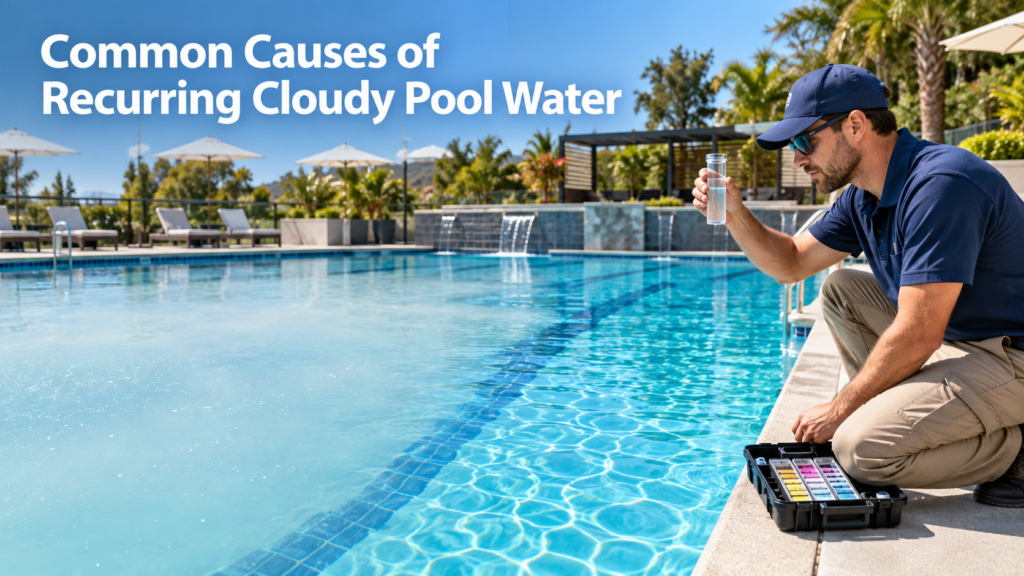
A swimming pool can look perfectly clear on Monday and turn hazy again by Wednesday. The water may still have a normal chlorine reading. The pH may appear acceptable. The filter may be running. Yet the main drain slowly disappears beneath a pale blue veil.
That is what makes recurring cloudy pool water so frustrating. You treat the visible problem, the pool clears for a while, and then the cloudiness returns.
When this happens, the first treatment probably addressed the suspended particles but not the condition producing them. The real cause may be weak circulation, an overloaded filter, poor sanitizer performance, high calcium levels, heavy swimmer use, environmental debris, or several smaller issues working together.
Clear water depends on three systems supporting one another:
- Balanced water chemistry
- Effective circulation and filtration
- Proper control of fine suspended particles
If one of these systems falls behind, cloudiness can keep returning. Let’s look at the most common causes and how pool professionals can identify them.
The Pool Was Cleared, but the Root Cause Wasn’t
A clarifier can help a filter capture particles that would otherwise remain suspended. A shock treatment can oxidize organic contamination. A filter cleaning can restore water flow.
Each action may improve clarity, but none can permanently correct a separate underlying problem.
Imagine repeatedly wiping condensation from a window without asking why the room is so humid. The glass becomes clear, but only for a little while. Recurring pool cloudiness follows the same pattern.
The first question should therefore be:
What keeps placing new particles into the water—or prevents the treatment system from removing them?
That shift in thinking matters. Instead of adding another chemical as soon as the water looks dull, the operator starts investigating the whole pool system.
Inadequate Filtration Time
One of the simplest causes is also one of the most frequently overlooked: the filter is not running long enough.
Pool water must pass through the filtration system repeatedly before fine contaminants can be removed. A short filtration cycle may handle a lightly used residential pool, but it may not be enough after a busy weekend, a storm, a dust event, or a sudden rise in temperature.
Commercial pools face an even greater challenge. Swimmers continuously introduce body oils, cosmetics, hair products, sweat, fabric fibers, and microscopic debris. If the filtration schedule does not reflect the actual bather load, suspended material begins accumulating faster than the filter can remove it.
A pool may still look acceptable in bright sunlight. Underwater lights, however, often reveal a different story. Their beams scatter through the fine particles, making the water appear smoky or milky.
When cloudiness repeatedly develops late in the day, inadequate filtration time deserves close attention.
Check:
- Whether the pump schedule matches current pool use
- Whether filtration continues long enough after peak bathing periods
- Whether timers or automatic controllers are working correctly
- Whether overnight filtration has been reduced to save electricity
- Whether the turnover rate meets the pool’s operational requirements
Energy efficiency matters, of course. But reducing pump operation too aggressively can create higher chemical use, more cleaning work, and recurring complaints about water quality. That is hardly a saving.
Poor Circulation Creates Hidden Trouble
The pump may be running, yet some areas of the pool may receive little effective circulation.
Steps, corners, benches, shallow shelves, spa spillways, and areas behind ladders can become low-flow zones. Fine debris remains suspended or settles temporarily in these places. It may then re-enter the main pool when swimmers disturb the water.
Poor return-jet direction can make the problem worse. If several jets push water across the same surface path, deeper sections may receive limited movement. Sanitizer distribution becomes uneven, and particles may not travel efficiently toward the skimmers or main drains.
This can explain why test results taken near a return fitting look good while other areas of the pool continue to develop haze.
Signs of uneven circulation include:
- Cloudiness that begins in one area
- Repeated debris accumulation on certain steps or corners
- Different sanitizer readings at different sampling points
- Weak movement near the bottom of the pool
- Persistent dullness despite long pump operation
Adjusting return fittings, clearing blocked lines, checking valves, and confirming pump output may provide more lasting improvement than another corrective dose of chemicals.
The Filter Is Dirty, Overloaded, or Poorly Maintained
A filter removes contamination only when water can pass through it correctly.
As dirt builds up, the pressure across the filter normally rises. Eventually, water flow declines and filtration performance suffers. A filter that is neglected may still appear to be operating—the pump makes its familiar sound and water returns to the pool—but actual circulation may be far below the required level.
The correct response depends on the filter type.
Sand filters may require backwashing when the pressure rises above the clean starting level. Cartridge filters need careful rinsing and periodic deep cleaning. Diatomaceous earth filters require correct cleaning and recharging procedures.
Overcleaning can also cause trouble. Backwashing a sand filter too frequently may reduce its ability to capture finer particles because a slightly established filter bed often filters more effectively than a freshly disturbed one.
Operators should record the clean operating pressure after proper maintenance. That number becomes a practical reference for future decisions. Without it, filter care can become guesswork.
Recurring cloudy water may indicate:
- A dirty cartridge
- Channeling inside a sand filter
- Damaged filter elements
- Incorrect filter media
- Insufficient diatomaceous earth
- A clogged skimmer or pump basket
- Air entering the circulation system
- A filter that is too small for the pool’s demands
If the filter cannot retain what reaches it, the same haze will keep coming back.
Fine Particles Are Passing Through the Filter
Not every suspended particle is large enough for a standard pool filter to capture efficiently.
Very fine dust, pollen fragments, cosmetic residues, organic colloids, and tiny mineral particles can remain dispersed in water. Many carry similar electrical surface charges. Because like charges repel, the particles resist coming together and stay suspended.
They may be almost invisible individually. Collectively, however, they scatter light and make the pool look dull or cloudy.
This is where a well-formulated cationic polymer clarifier can help. The positively charged polymer interacts with negatively charged particles, reducing their tendency to repel one another. Small particles begin forming larger clusters that the filter can capture more readily.
A clarifier does not replace filtration. It makes filtration more effective.
This distinction is important. Adding clarifier while the filter is dirty, damaged, or barely running is a bit like gathering dust into piles without having a vacuum ready. The particles have been prepared for removal, but the removal system still needs to do its job.
For recurring fine-particle haze, review both the clarifier dose and the filter condition.
Too Much Clarifier Can Also Cause Cloudiness
More product does not always produce clearer water.
An excessive clarifier dose can leave too much polymer in the water. Instead of forming stable, filterable particle clusters, the treatment may produce a persistent haze, interfere with particle capture, or leave surfaces feeling slightly sticky.
This often happens when operators add repeated “small” doses without calculating how much product is already present. The pool does not clear immediately, so another dose goes in. Then another. Before long, the treatment itself becomes part of the problem.
Always base the dose on:
- The actual pool volume
- The product concentration
- The severity and type of cloudiness
- The manufacturer’s directions
- The time allowed for circulation and filtration
Clarifiers need time to disperse and work. The filter also needs time to collect the enlarged particles. Adding more product after only a few hours may interrupt that process rather than speed it up.
Chlorine Is Present, but It Is Not Working Efficiently
A pool can show a chlorine reading and still have weak sanitation performance.
Free chlorine effectiveness depends heavily on pH. As pH rises, a smaller portion of the chlorine remains in its more effective sanitizing form. The test result may look normal, but organic contamination and early biological growth can still develop.
Stabilizer levels matter too. Cyanuric acid protects chlorine from rapid sunlight degradation in outdoor pools, but excessive levels can reduce the practical effectiveness of the available chlorine. The relationship between free chlorine and cyanuric acid therefore deserves more attention than either number viewed alone.
Combined chlorine is another clue. Chloramines form when chlorine reacts with nitrogen-containing contamination from swimmers and the surrounding environment. They can contribute to unpleasant odor, eye irritation, and dull-looking water.
If cloudiness returns even though “the chlorine is fine,” check the wider picture:
- Free chlorine
- Combined chlorine
- pH
- Cyanuric acid
- Water temperature
- Recent bather load
- Sunlight exposure
- Contamination events
A single chlorine reading is a snapshot, not a full diagnosis.
Early Algae Growth Is Easy to Miss
Algae does not always begin as an obvious green layer across the pool.
In its early stages, growth may appear as a slight loss of sparkle, a faint haze near the walls, or a slippery feeling on steps. The water may look almost normal in the morning and noticeably dull after a warm afternoon.
If sanitizer levels fall in low-circulation zones, microscopic algae can multiply. Dead algae cells may then remain suspended after treatment, producing white, gray, or pale green cloudiness.
This creates a two-part problem. The algae must first be controlled, and the remaining cellular debris must then be removed through filtration. Treating the organism without removing the dead material may leave the pool cloudy for days.
Look for:
- Slippery walls or steps
- Unusually high chlorine demand
- Haze that worsens in sunlight
- Green, yellow, or gray discoloration
- Cloudiness concentrated in poorly circulated areas
An appropriate non-foaming algaecide may support an algae-control program, but sanitizer management, brushing, circulation, and filtration remain essential. One product cannot carry the whole pool on its shoulders.
High Bather Loads Overwhelm the System
A crowded pool can change quickly.
Every swimmer introduces a small amount of organic material. Multiply that by dozens or hundreds of people, and the filtration and sanitation systems suddenly face a much larger burden.
Sunscreen is a common contributor. It forms tiny droplets and emulsions that may remain suspended. Cosmetics, lotions, perspiration, hair products, and fibers add to the load. Children’s pools and water-play areas often face even greater contamination because of their shallow depth, warm water, and intense activity.
After a high-use period, water may become hazy even when the pool was perfectly clear that morning.
Commercial operators should plan for demand rather than wait for visible deterioration. That may mean:
- Extending filtration hours
- Monitoring sanitizer more frequently
- Cleaning strainers and filters sooner
- Applying an appropriate maintenance clarifier
- Encouraging pre-swim showering
- Adjusting treatment before and after scheduled events
Recurring Monday-morning cloudiness at a hotel pool is rarely a mystery. It often reflects the weekend bather load.
Rain and Storm Runoff Add More Than Water
Rain does not simply dilute the pool.
A storm can carry dust, pollen, soil, leaves, spores, and airborne pollution into the water. Wind may contribute even more debris than the rain itself. If surrounding decks or landscaping drain toward the pool, runoff can introduce fine mineral particles and organic matter.
Heavy rain can also change pH, alkalinity, sanitizer concentration, and water level. Overflow may disturb normal skimming, while power interruptions can shorten filtration time.
The result is a perfect recipe for temporary haze.
If water clears after post-storm treatment but becomes cloudy after every rainfall, inspect the surrounding site. The real answer may involve deck drainage, landscape design, pool covers, or maintenance timing—not simply a larger chemical dose.
After a storm:
- Remove large debris.
- Check and empty baskets.
- Restore the correct water level.
- Test the full water balance.
- Brush affected surfaces.
- Run the circulation system.
- Clean or backwash the filter when needed.
- Use a suitable clarifier if fine particles remain suspended.
Treat the event as a system disturbance, not just a cosmetic problem.
High Calcium Hardness Can Produce a White Haze
Cloudiness does not always come from organic contamination. Sometimes it is mineral precipitation.
When calcium hardness, pH, and total alkalinity are high—especially in warm water—the water may become scale-forming. Calcium carbonate can begin precipitating as tiny white particles, creating a milky or chalky appearance.
This may occur after adding a high-pH chemical too quickly or in one concentrated area. It can also happen when water balance drifts gradually toward scale-forming conditions.
The pool may show other clues:
- Rough surfaces
- White deposits at the waterline
- Scale on heaters or fittings
- Cloudiness following a pH increase
- Haze that appears after adding calcium-containing products
Evaluate the whole balance rather than lowering one parameter blindly. The calcium saturation index, often assessed through the Langelier Saturation Index or a pool-specific saturation calculation, can help operators understand whether the water tends to form scale or corrode surfaces.
Balanced water is not defined by isolated “acceptable” readings. Temperature, pH, alkalinity, calcium hardness, and dissolved solids interact.
Low or Unstable Total Alkalinity Causes Repeated Imbalance
Total alkalinity acts as a buffer against sudden pH movement.
When alkalinity is too low, pH can change rapidly after chemical addition, rainfall, aeration, or heavy swimmer use. This instability may weaken sanitizer performance or encourage other reactions that affect clarity.
When alkalinity is too high, pH can become difficult to control and calcium precipitation may become more likely under certain conditions.
Operators sometimes correct pH without addressing alkalinity. The pH looks good for a day, then moves again. Cloudiness returns, and the treatment cycle begins all over.
If the pool repeatedly drifts out of range, investigate:
- Source-water alkalinity
- Chemical feed settings
- Aeration from fountains or spillways
- Acid addition procedures
- Fill-water replacement
- Testing accuracy
Stable water chemistry is usually quieter and less dramatic. That is exactly what a professional pool needs.
Unbalanced Chemical Addition Can Create Temporary Clouds
How chemicals are added matters almost as much as which chemicals are used.
Concentrated additions can create local zones with extreme pH or high mineral concentration. Two incompatible products introduced too closely together may react before either has dispersed properly. The result can be precipitation, small particles, or short-lived cloudiness.
Common mistakes include:
- Adding several chemicals at the same time
- Pouring products through the same skimmer
- Failing to allow circulation between treatments
- Using the wrong addition sequence
- Applying undissolved material directly to the pool
- Ignoring label instructions
- Mixing concentrated chemicals outside the pool
Never mix pool chemicals together. Follow each product’s safety and application directions, use clean equipment, and allow adequate circulation.
A rushed treatment schedule can turn a manageable water-quality issue into a more confusing one.
The Filter May Be Too Small for the Pool
Sometimes the equipment is working exactly as designed—it is simply being asked to do more than it can handle.
A filter selected for a lightly used pool may struggle after the property changes use. A private pool may become part of a holiday rental. A hotel may experience higher occupancy. A club may add swimming lessons or public events.
The pool volume has not changed, but the contamination load has.
Repeated cloudiness, frequent pressure increases, short filter cycles, and constant backwashing can indicate inadequate filter capacity. Pump and filter compatibility should also be reviewed. A high flow rate through an undersized filter may reduce particle capture and push debris through the media.
Equipment selection should consider:
- Pool volume
- Required turnover
- Peak bather load
- Filter type
- Effective filter area
- Pump flow
- Plumbing resistance
- Operating schedule
Chemical treatment cannot permanently compensate for undersized equipment.
Old Filter Media May No Longer Perform Well
Filter media does not last forever.
Sand can develop channels or become coated with oils and minerals. Cartridge fabric may become damaged, stretched, or permanently clogged. Internal components can crack, allowing unfiltered water to bypass the intended path.
A filter can therefore show normal pressure while delivering poor clarity.
If recurring haze continues after routine maintenance, inspect the media and internal fittings. Look for broken laterals, damaged cartridges, worn seals, or incorrect reassembly.
Pool professionals often spend days adjusting chemistry before opening the filter. Sometimes the missing answer is sitting inside that tank.
Source Water Can Reintroduce the Same Problem
Pools lose water through evaporation, splash-out, backwashing, and maintenance. Replacement water brings its own chemical profile.
Hard fill water may steadily raise calcium hardness. Water containing iron or manganese can discolor the pool or produce particles after oxidation. High alkalinity can push pH upward. Fine sediment from wells or aging supply lines may enter during refilling.
If cloudiness repeatedly appears after topping up the pool, test the source water separately.
Ask:
- Does the fill water contain visible sediment?
- Is its calcium hardness unusually high?
- Does it contain metals?
- Is its alkalinity affecting the pool balance?
- Does cloudiness develop immediately after refilling or several hours later?
Knowing the source-water profile allows operators to plan adjustments before the pool’s appearance suffers.
Testing Errors Can Keep the Cycle Going
A treatment plan is only as reliable as the test results behind it.
Old reagents, poorly stored test strips, dirty sample cells, incorrect sample volume, and inconsistent lighting can all produce misleading readings. Sampling water directly beside a return fitting or chemical feeder may also give results that do not represent the whole pool.
Automatic probes need cleaning and calibration. Manual kits need fresh reagents and careful technique.
When the water remains cloudy despite apparently ideal readings, verify the results with a second test method or a properly calibrated professional instrument.
Good sampling habits include:
- Collecting water away from returns and skimmers
- Taking the sample from an appropriate depth
- Testing promptly
- Using clean equipment
- Checking reagent expiration dates
- Following the specified test sequence
- Recording results over time
Trends often reveal more than isolated numbers. A log may show that pH rises every afternoon, chlorine demand spikes after lessons, or filter pressure climbs unusually fast.
How to Diagnose Recurring Cloudy Pool Water?
Random chemical additions make diagnosis harder. A structured check is faster and usually less expensive.
Start with these questions:
- When does the cloudiness appear?
After swimming, rain, refilling, chemical addition, or overnight? - Is it uniform?
Haze in one area may point to a circulation problem. - What color is it?
White or gray haze may suggest fine particles or minerals. Greenish haze may indicate algae. Brown or colored water may involve metals or outside contamination. - What is the filter pressure?
Compare it with the recorded clean pressure. - Is the flow visibly weaker?
Check baskets, valves, pump performance, and return fittings. - Are the test results trustworthy?
Confirm them with fresh reagents or another method. - What changed recently?
Weather, bather load, chemical supplier, operating schedule, source water, or equipment settings? - Was a clarifier already used?
Record the product concentration, dose, application time, and filtration period.
This process turns cloudiness from an annoying surprise into a traceable operational signal.
A Better Long-Term Approach to Clear Pool Water
Recurring cloudy water is rarely solved by one dramatic treatment. Long-term clarity comes from consistent control.
A sound maintenance program should include:
- Regular testing and written records
- Filtration schedules based on actual demand
- Routine inspection of pumps, baskets, and filter media
- Proper water balance
- Sanitizer management that accounts for pH and stabilizer
- Brushing and physical cleaning
- Fast response after storms or high-use events
- Accurate dosing of a compatible polymer clarifier when needed
For many pool operators, a maintenance dose of a well-designed cationic clarifier can help control the fine particles that normal filtration struggles to capture. The formula should be compatible with the pool’s treatment system, easy to dose, and suitable for the intended market.
Eautrix supplies polymer-based pool clarifier solutions for professional pool-care brands, chemical distributors, and private-label programs. Product concentration, liquid color, packaging, and label presentation can be adjusted for different commercial requirements, including 1 L, 5 L, and 25 L packages.
Still, the central lesson remains simple: a clarifier works best as part of a healthy pool system. Clear water comes from chemistry, circulation, filtration, and sensible maintenance working together.
When cloudiness keeps returning, do not just treat what you can see. Find the condition that keeps bringing it back.
Frequently Asked Questions
Why does my pool become cloudy again after using a clarifier?
The clarifier may have removed the existing suspended particles while an underlying issue—such as poor filtration, heavy swimmer use, unbalanced chemistry, or inadequate circulation—continued producing new ones. Check the filter, water balance, flow, and recent contamination events before repeating the dose.
Can too much pool clarifier make the water cloudy?
Yes. Overdosing a polymer pool clarifier may create haze or interfere with effective particle capture. Calculate the pool volume carefully, follow the product directions, and allow enough filtration time before considering another treatment.
Why is my pool cloudy when chlorine and pH are normal?
Normal chlorine and pH readings do not rule out fine suspended debris, early algae growth, high calcium hardness, poor circulation, filter damage, or excessive cyanuric acid. A full water test and equipment inspection are needed.
How long should a pool filter run after adding clarifier?
The required time depends on the pool size, filter type, flow rate, level of cloudiness, and clarifier formula. Many pools require continuous or extended filtration during treatment. Follow the product instructions and monitor filter pressure as captured particles accumulate.
What is the best way to prevent recurring cloudy pool water?
Maintain stable water chemistry, provide sufficient circulation and filtration, clean the filter when needed, manage heavy bather loads, and use a correctly dosed maintenance clarifier for persistent fine particles. Keeping accurate operating records makes recurring patterns much easier to identify.