
GET IN TOUCH
Ask For Sample?
Why Swimming Pools Need More Than Chlorine for Algae Prevention?
Chlorine is the backbone of swimming pool sanitation. It kills harmful microorganisms, helps break down organic waste, and keeps pool water safe for swimmers. But here’s a question many pool owners ask: If chlorine is so effective, why do swimming pools still develop algae?
The answer is simple. Chlorine is essential, but keeping algae away takes more than adding sanitizer and hoping for the best.
Algae can take hold when chlorine levels fall, circulation slows, or neglected areas create favorable conditions for growth. Even a pool that looks clean may have small algae colonies forming along steps, behind ladders, or in poorly circulated corners.
That’s why a complete algae prevention program combines chlorine with proper filtration, water balance, brushing, circulation, and, when appropriate, a compatible pool algaecide.
For pool professionals, commercial facility managers, and chemical distributors, understanding how these treatments work together is the key to clearer water, fewer maintenance problems, and more reliable pool care.
Chlorine Is Powerful, but It Has Its Limits
Chlorine works primarily through oxidation and disinfection. When chlorine-based sanitizers enter pool water, they form active chlorine species, including hypochlorous acid (HOCl).
Hypochlorous acid is especially effective at damaging microbial cells. It can also control many types of algae when an adequate free chlorine residual is maintained.
So why isn’t chlorine always enough?
Because real swimming pools face constantly changing conditions.
Sunlight, rain, swimmer activity, organic debris, and water chemistry all affect how well chlorine performs. Even when the pool operator maintains a suitable chlorine level, poor circulation and neglected surfaces can make algae control more difficult.
Consider an outdoor swimming pool during a busy summer weekend. Dozens of swimmers enter the water, sunscreen washes off their skin, leaves blow into the pool, and strong sunlight increases chlorine loss.
The chlorine system must handle all these challenges while maintaining a suitable disinfectant residual.
If chlorine drops too low, algae may gain a foothold.
The issue isn’t that chlorine doesn’t work. It’s that chlorine performance depends on the conditions in which it operates.
Why Algae Can Grow in a Chlorinated Swimming Pool
Several factors can make algae prevention harder, even in pools that receive regular chlorine treatment.
1. Sunlight Can Reduce Available Chlorine
Outdoor swimming pools face a constant challenge: ultraviolet radiation.
Sunlight breaks down unprotected free chlorine, which can cause sanitizer levels to fall faster than expected.
Cyanuric acid (CYA), commonly called chlorine stabilizer, helps protect chlorine from sunlight. However, excessive CYA can reduce the active chlorine available at a given free chlorine concentration.
This creates an important balance.
Pool operators need enough stabilizer to limit sunlight-related chlorine loss without allowing CYA levels to rise so high that algae control becomes harder.
A properly managed chlorine-to-CYA relationship is especially important in outdoor pools.
2. Poor Circulation Creates Trouble Spots
A swimming pool may contain thousands of gallons of water, but not every area receives the same water movement.
Corners, steps, ladders, recessed areas, and certain pool features may experience weaker circulation.
These areas can become favorable locations for algae growth, particularly when sanitizer levels are inadequate or surfaces are not brushed regularly.
Have you ever noticed algae appearing first on pool steps or along the waterline?
That’s often a sign that circulation, cleaning, or local water conditions need attention.
Even a strong chlorine program can struggle when water movement is poor.
3. Organic Debris Increases Chlorine Demand
Leaves, insects, pollen, sweat, and other contaminants enter swimming pools every day.
Chlorine reacts with many of these substances, increasing the amount of sanitizer needed to maintain an adequate residual.
A pool surrounded by trees may experience higher chlorine demand after windy weather. A heavily used hotel pool may face similar challenges during peak swimming hours.
When chlorine demand rises faster than sanitizer is supplied, free chlorine can fall.
That creates an opportunity for algae to grow.
4. Water Chemistry Affects Chlorine Performance
Pool water chemistry is more than a single chlorine reading.
pH, total alkalinity, calcium hardness, and cyanuric acid all influence pool maintenance.
In unstabilized water, increasing pH reduces the proportion of free chlorine present as hypochlorous acid. In stabilized pools, the relationship between pH, CYA, and active chlorine is more complex.
Maintaining recommended water chemistry helps support effective sanitation and reduces problems such as scale formation, corrosion, and cloudy water.
Algaecides cannot compensate for poorly managed pool chemistry.
5. Established Algae Can Be Harder to Remove
Algae growing on pool surfaces may become embedded in slime, dirt, or biofilm-like deposits.
These layers can make chemical treatment less effective.
That’s why brushing is such an important part of algae removal.
Physical cleaning helps expose algae to sanitizers and removes deposits from surfaces.
Some persistent algae problems may require repeated brushing, thorough filtration, and a properly managed chlorine treatment.
A preventive algaecide can support routine maintenance, but it shouldn’t replace the cleaning needed to remove established contamination.
Chlorine vs. Algaecide: What’s the Difference?
Chlorine and algaecide aren’t interchangeable products. They perform different, sometimes complementary, functions in swimming pool maintenance.
| Feature | Chlorine | Pool Algaecide |
|---|---|---|
| Primary role | Sanitization and oxidation | Algae control or prevention |
| Bacteria control | Essential when properly maintained | Not a substitute for an approved sanitizer |
| Algae control | Effective with adequate residual | Supports prevention or treatment according to label |
| Organic waste oxidation | Yes | Generally limited or absent |
| Routine use | Required for chlorine-sanitized pools | Optional, depending on pool conditions |
| Main limitation | Residual can fall with demand and exposure | Cannot replace chlorine or correct poor maintenance |
Think of chlorine as the pool’s main defense system.
An algaecide, when needed, provides an additional layer of algae-focused protection.
But there’s an important distinction: a well-maintained chlorine pool does not automatically need a separate algaecide. Many pools remain algae-free through proper sanitation, circulation, filtration, and cleaning alone.
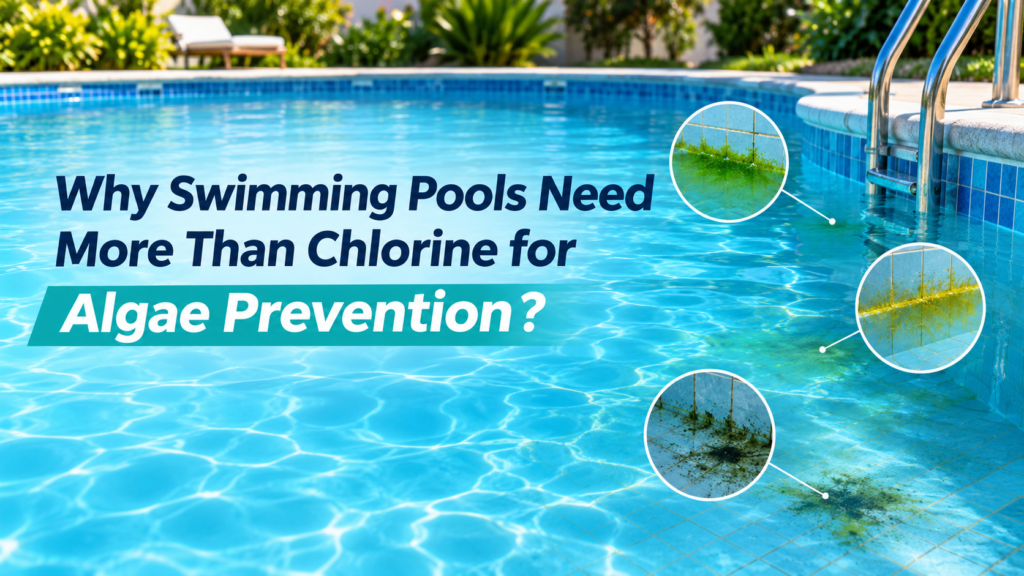
Supplemental algaecides are most useful when the pool’s operating conditions justify their use.Hero image alt text: Clear blue swimming pool illustrating why chlorine alone may not prevent algae, with close-up views of green, yellow, and dark algae growth along pool tiles.
How Polyquat 60 Algaecide Supports Swimming Pool Algae Prevention
Among the different types of pool algaecides, polymer-based formulations are often considered for routine algae prevention.
One example is Polyquat 60 Algaecide, a non-oxidizing polymer-based product commonly associated with Polixetonium Chloride, CAS No. 31512-74-0.
Unlike chlorine, Polyquat 60 does not depend on oxidation as its main algae-control mechanism.
Instead, its positively charged polymer structure interacts with negatively charged sites on susceptible algal cells.
These interactions can disturb cell membranes and interfere with normal cellular functions, helping control algae growth.
Because Polyquat 60 works through a different mechanism from chlorine, it can serve as a supplemental algae-control treatment in suitable swimming pool maintenance programs.
What Makes Polyquat 60 Different?
Several properties make Polyquat 60 attractive for professional pool chemical formulations.
- Non-oxidizing action: It provides an algae-control mechanism different from chlorine oxidation.
- Low-foaming performance: Properly formulated Polyquat products are generally low-foaming compared with some quaternary ammonium algaecides.
- Metal-free formulation: Polyquat 60 does not rely on copper salts, helping avoid copper-related staining concerns.
- Compatibility with chlorinated pools: It can be used in chlorine-maintained pools when the product label permits.
- Preventive applications: It is commonly used in maintenance and seasonal algae-control programs.
- Formulation flexibility: Different concentrations and packaging formats can support professional and retail markets.
These features explain why polymer-based algaecides remain relevant to pool chemical distributors and private label brands.
Still, product performance depends on the specific formulation, dosage, water conditions, and intended application.
A 60% active formulation is not interchangeable with a 10% product on a volume-for-volume basis.
Users must follow the directions for the exact product being applied.
Why a Preventive Algaecide Can Be Useful Even When Chlorine Is Present
Imagine two swimming pools located at neighboring resorts.
Both pools use chlorine sanitizers. Both have filtration systems. Both receive regular maintenance.
The first pool has stable water chemistry, strong circulation, and a consistent cleaning schedule.
The second pool experiences heavy swimmer traffic, frequent rainfall, occasional chlorine fluctuations, and several low-circulation areas.
Would both pools need the same algae prevention program?
Probably not.
The first pool may remain algae-free without any supplemental algaecide.
The second pool might benefit from an approved preventive algaecide alongside improvements to chlorine management, circulation, and cleaning.
This is where the idea of layered pool maintenance becomes useful.
A preventive algaecide can provide an additional algae-focused treatment, but it should never be treated as insurance against inadequate sanitation.
Reducing the Risk of Algae During Chlorine Fluctuations
Chlorine residuals can change between testing periods.
In a busy commercial pool, sanitizer demand may rise rapidly during peak use.
A suitable preventive algaecide may help suppress susceptible algae under these conditions.
However, it cannot guarantee algae prevention when chlorine levels are inadequate, and it does not maintain the required disinfectant residual.
The correct response to low chlorine is to restore proper sanitizer levels promptly.
Supporting Maintenance in Difficult Pool Areas
Steps, ladders, corners, and decorative water features can be challenging to maintain.
An algaecide circulating through the water may provide supplemental treatment in these areas.
But chemical treatment cannot replace brushing or adequate water movement.
If algae repeatedly appears in the same location, operators should investigate circulation patterns, surface deposits, and cleaning methods.
Helping Manage Seasonal Algae Risks
Outdoor swimming pools face changing conditions throughout the year.
During summer, warmer water, greater swimmer activity, and strong sunlight can increase maintenance demands.
During autumn, falling leaves and organic debris may increase chlorine consumption.
Before winter, outdoor pools in colder climates require careful preparation for periods of reduced circulation and maintenance.
A properly labeled winter algaecide may form part of a pool closing program.
Polyquat-based formulations are often considered for this application because of their non-oxidizing, low-foaming, and metal-free characteristics.
Yet winter algae prevention also depends on closing the pool with clean, balanced, adequately sanitized water.
Why Filtration and Circulation Matter Just as Much
A pool can contain the correct chemical products and still develop water quality problems.
Why?
Because chemicals need proper circulation to reach the areas where they’re needed.
Filtration also removes suspended particles and debris that would otherwise remain in the water.
These processes work alongside chlorine and supplemental algae treatments.
Circulation Helps Distribute Pool Chemicals
When water circulates effectively, chlorine and other compatible treatment chemicals can disperse throughout the pool.
Poor circulation can create zones where sanitizer delivery is less effective.
Pool operators should pay attention to return jet positioning, pump operation, water features, and areas that repeatedly show algae growth.
Running a pump for a fixed number of hours isn’t always enough. The goal is effective circulation and filtration for the pool’s actual conditions.
Filtration Removes Suspended Contaminants
Sand, cartridge, and diatomaceous earth (DE) filters remove particles from pool water through different filtration mechanisms.
Effective filtration helps maintain water clarity and reduces the amount of suspended material remaining in the pool.
However, filtration alone doesn’t reliably kill algae or disinfect pool water.
That’s the job of the sanitizer and, where appropriate, supplemental treatment chemicals.
Brushing Breaks Up Surface Deposits
Some pool maintenance tasks remain surprisingly simple.
Brushing is one of them.
Regular brushing removes dirt, disrupts algae deposits, and exposes surfaces to circulating sanitizer.
Pay special attention to pool steps, corners, ladders, and areas with visible discoloration.
A few minutes of targeted brushing can prevent small maintenance problems from becoming much larger ones.
Can Pool Clarifiers Help With Algae Prevention?
Pool clarifiers are sometimes confused with algaecides because both products can contribute to a cleaner-looking swimming pool.
But their main functions are different.
A polymer pool clarifier typically works by helping small suspended particles come together into larger aggregates that the filtration system can capture more easily.
For example, PolyDADMAC-based clarifiers use positively charged polymers to help destabilize certain negatively charged particles in water.
This process is known as coagulation or charge neutralization.
A clarifier may improve water clarity when fine suspended particles are responsible for cloudiness.
However, a conventional clarifier is not a substitute for an algaecide or sanitizer.
Where Clarifiers Fit Into a Complete Pool Care Program
Consider a pool that recently experienced an algae bloom.
After proper treatment has controlled the algae, the water may still appear cloudy because fine particles remain suspended.
A compatible pool clarifier may help the filtration system remove those particles.
The sequence matters.
First, identify and correct the cause of the algae problem. Then restore water quality through sanitation, filtration, cleaning, and any suitable supplemental treatments.
A clarifier can help improve appearance, but clear water is not proof that the water is microbiologically safe.
For distributors developing a complete pool chemical range, clarifiers and algaecides can serve distinct but complementary purposes.
A Practical Algae Prevention Program for Swimming Pools
A reliable prevention program doesn’t need to be complicated. It does, however, need to be consistent.
Step 1: Maintain an Adequate Chlorine Residual
Test free chlorine regularly and maintain the level required by the applicable pool code and sanitizer instructions. For many U.S. pools, CDC guidance identifies at least 1 ppm free chlorine without CYA and at least 2 ppm when CYA is used; local requirements may be stricter.
Step 2: Monitor Water Balance
Check pH, total alkalinity, calcium hardness, and cyanuric acid as appropriate. Follow local regulations and equipment recommendations rather than relying on a single universal target.
Step 3: Keep Water Moving and Filtering
Maintain adequate pump operation, inspect the filter, and clean or backwash according to equipment instructions.
Step 4: Brush and Remove Debris
Brush pool surfaces, vacuum when needed, and remove leaves and other debris before they increase chlorine demand.
Step 5: Consider a Preventive Algaecide
For pools with recurring algae challenges, consider a registered or otherwise legally authorized product, such as an appropriate Polyquat 60 formulation, following its label directions.
Step 6: Record and Review Water Conditions
Track sanitizer levels, pH, chemical additions, filter maintenance, and algae observations. These records can reveal recurring problems before they become serious.
What Pool Professionals Should Know About Algaecide Selection
Not all algaecides are the same.
Products may differ in active ingredients, concentrations, foaming characteristics, metal content, compatibility, and regulatory status.
For professional buyers, these differences matter.
A product that performs well in one market may not be appropriate for another without changes to its formulation, labeling, or regulatory documentation.
Compare Active Ingredients, Not Just Product Names
Terms such as pool algaecide, polymer algaecide, and winter algaecide describe product functions or market positioning.
They don’t always identify the chemical composition.
For example, Polyquat 60 Algaecide is commonly associated with Polixetonium Chloride (CAS 31512-74-0), while other polymer-based products may use different active ingredients.
Buyers should request the technical data sheet, safety data sheet, and relevant product specifications.
These documents help clarify what is actually being purchased.
Check the Active Concentration
A concentrated formulation may reduce shipping volume and packaging requirements for a given quantity of active ingredient.
But concentration alone doesn’t determine overall product value.
Buyers should also consider viscosity, appearance, formulation stability, labeling requirements, and recommended application rates.
The lowest price per liter isn’t necessarily the lowest cost per treatment.
Consider Foaming and Metal Content
Foaming can be undesirable in swimming pools with fountains, jets, or decorative water features.
Low-foaming polymer formulations may offer an advantage in such applications.
Metal content is another consideration.
Copper-based products may be effective for certain algae-control applications, but improper use or unsuitable water chemistry can contribute to staining or discoloration.
Metal-free Polyquat formulations avoid adding copper through the algaecide itself.
Confirm Local Regulatory Requirements
Algaecides marketed with claims to kill, control, or prevent algae may be regulated as pesticides or biocidal products, depending on the destination market.
In the United States, pool algaecides generally require EPA registration unless a specific exemption applies.
In the European Union, applicable biocidal product rules must be considered.
Importers and private label brands should verify registration, permitted claims, labeling, and other market requirements before selling a product.
A chemical’s technical performance does not, by itself, establish legal authorization for sale.
Why Polyquat 60 Appeals to Pool Chemical Distributors
For pool chemical distributors, the value of an algaecide extends beyond its chemistry.
Customers want products that fit their maintenance routines, are easy to understand, and perform consistently when used correctly.
A low-foaming, metal-free polymer algaecide can provide a useful addition to a broader pool care portfolio.
For example, a distributor might offer chlorine sanitizers, pH adjustment products, pool clarifiers, and a supplemental algaecide.
Each product addresses a different part of pool maintenance.
The distributor can then explain when each product is appropriate rather than suggesting that every pool needs every chemical.
Private Label Opportunities
Private label algaecide programs may support different customer groups through packaging and formulation choices.
Common packaging formats include 1L bottles for retail distribution, 5L containers for professional pool service companies, and 25L containers for larger commercial or distributor requirements.
For bulk supply, 200L drums and 1000L IBCs may also be considered.
Eautrix focuses on cationic polymer products and specialty pool chemical formulations, including Polyquat 60 Algaecide and related polymer-based water treatment products.
For buyers evaluating private label supply, important discussion points include product concentration, packaging, labeling, technical documentation, and destination-market compliance.
Any final product should be tested and reviewed against the buyer’s intended application and regulatory requirements.
Common Mistakes That Can Undermine Algae Prevention
Even experienced pool operators can run into problems when several small maintenance issues occur together.
One common mistake is relying on a single chlorine measurement without considering cyanuric acid, pH, swimmer activity, or recent weather.
Another is assuming that a clean-looking pool is automatically safe.
Water clarity is important, but proper sanitation must be confirmed through testing.
Overusing algaecide can also create problems. More product doesn’t always mean better algae control, and excessive treatment may cause unwanted water quality effects or violate label directions.
Mixing pool chemicals is another serious concern.
Concentrated pool chemicals should never be mixed together unless the manufacturer specifically directs it. Even products that can be used in the same pool may be incompatible when mixed in concentrated form.
Finally, some pool owners turn to algaecide when the real problem is poor circulation or inadequate chlorine.
That approach may temporarily change the appearance of the water without addressing the underlying cause.
The more reliable solution is to diagnose the problem first.
Is More Chemical Treatment Always Better?
Not necessarily.
In fact, a well-maintained swimming pool often needs fewer corrective chemical treatments than a neglected one.
Stable chlorine levels, balanced water chemistry, regular cleaning, and effective filtration can prevent many common algae problems.
Supplemental algaecides are tools, not shortcuts.
Their value comes from using the right product under the right conditions.
This distinction is particularly important for commercial pool operators, who must balance water quality, swimmer safety, operating costs, and regulatory compliance.
A carefully managed prevention program may reduce the frequency of severe algae outbreaks and the maintenance disruption associated with them.
However, any claims about reduced chemical consumption or lower operating costs should be supported by actual operating data.
Conclusion: Chlorine Is the Foundation, Not the Entire Pool Care Program
So, why do swimming pools need more than chlorine for algae prevention?
Because reliable algae prevention depends on more than one chemical.
Chlorine provides essential disinfection and oxidation, but its effectiveness can be affected by sunlight, organic contamination, water chemistry, and maintenance conditions.
Circulation distributes sanitizer. Filtration removes particles. Brushing helps control surface deposits. Regular testing keeps the entire system working as intended.
And when a pool faces recurring algae challenges, a suitable supplemental algaecide may provide additional support.
Polyquat 60 Algaecide is one option worth considering for appropriate applications, particularly where low foaming and metal-free formulation characteristics are valued.
The goal isn’t to add more chemicals to every pool.
It’s to create a dependable maintenance program that keeps water clear, surfaces clean, and swimmers protected.
For pool chemical distributors and professional buyers interested in polymer-based algaecides, Eautrix offers opportunities to discuss product specifications, concentration options, and private label packaging.
Learn more about Eautrix at Eautrix or contact info@eautrix.com for product and technical inquiries.
Frequently Asked Questions (FAQ)
1. Can algae grow in a swimming pool with normal chlorine levels?
Yes. Algae can persist or develop when chlorine levels fluctuate, circulation is poor, or surface deposits protect established growth. A single normal chlorine reading does not confirm that sanitizer levels have remained adequate over time. Consistent testing, brushing, and water balance are important.
2. Is Polyquat 60 Algaecide better than chlorine for algae prevention?
Polyquat 60 and chlorine serve different roles. Chlorine is an essential sanitizer that can also control algae, while Polyquat 60 is a supplemental, non-oxidizing algae-control product. Polyquat 60 cannot replace the required chlorine residual. Its usefulness depends on the pool’s conditions and the product’s approved directions.
3. How often should Polyquat 60 Algaecide be added to a swimming pool?
Application frequency depends on the specific formulation, active concentration, product label, and intended use. Some products are labeled for routine maintenance, while others may include seasonal treatment directions. Always follow the registered product label rather than applying a generic dosing schedule.
4. Can Polyquat 60 Algaecide be used with chlorine and pool clarifier?
Polyquat 60 may be compatible with chlorine-maintained pools and certain clarifier programs, but compatibility depends on the exact formulations. Follow each product’s label, avoid mixing concentrated chemicals, and confirm any proposed treatment combination with the suppliers.
5. What is the best way to prevent green algae in an outdoor swimming pool?
The most reliable approach is to maintain an adequate free chlorine residual relative to the pool’s stabilizer level, keep water chemistry within recommended limits, ensure effective circulation and filtration, and brush surfaces regularly. A suitable preventive algaecide can be considered for pools with recurring algae problems, but it should supplement—not replace—proper sanitation.